
Metal Forging Market Trends, Share & Demand by 2034
Coverage: by Raw Material (Carbon Steel, Aluminum Steel, Aluminum, Magnesium, Stainless Steel, Titanium, Others); Application (Automotive, Aerospace, Oil and Gas, Construction, Agriculture, Others) , and Geography (North America, Europe, Asia Pacific, and South and Central America)
- Status : Data Released
- Report Code : TIPRE00011881
- Category : Chemicals and Materials
- No. of Pages : 150
- Available Report Formats :


- Last update date : July 28, 2026


2025 Market Size
US$ 103.97 Bn
Base year value
2034 Forecast
US$ 149.1 Bn
Projected by 2034
CAGR 2026-2034
4.09 %
Growth rate
Addressable Market
US$ 1,149.53 Bn
(2026-2034)
The global Metal Forging market was valued at US$ 103.97 billion in 2025 and is expected to reach US$ 149.1 billion by 2034; it is estimated to record a CAGR of 4.09% during 2026-2034.
Metal Forging Market Assessment and Insights
- North America: Continued investments in aerospace production, automotive manufacturing, and defense programs supported a 2025 share of 22–26%, while the regional market is projected to expand at a CAGR of 4.0–4.5% during 2026–2034.
- US: The country remains the regional leader owing to its diversified industrial base, accounting for 72–76% of North America's market in 2025, with demand anticipated to grow at a CAGR of 4.1–4.6%.
- Europe: Germany, Italy, France, and the UK continue to lead regional manufacturing, supported by automotive exports and industrial engineering. Europe represented 24–28% of the market in 2025 and is expected to register a CAGR of 3.8–4.3%.
- Asia Pacific: China, India, Japan, and South Korea remain major production hubs benefiting from expanding manufacturing capacity and infrastructure investment. The region accounted for 40–45% share in 2025 and is forecast to grow at a CAGR of 5.0–5.5%.
- Largest Segment: Automotive remained the leading application, accounting for 42–46% market share in 2025, supported by demand for drivetrain, suspension, axle, and engine components, while recording a CAGR of 4.4–4.9%.
- High Growth Segment: Titanium emerged as the fastest-growing raw material segment owing to expanding aerospace and defense applications. It represented 6–9% market share in 2025 and is anticipated to expand at a CAGR of 6.2–6.8%.
- Key companies analyzed in detail: Aichi Steel Corporation, All Metals & Forge Group, ATI Inc., American Axle & Manufacturing Holdings, Inc., Arconic Corporation, Bharat Forge Limited, Larsen & Toubro Special Steels and Heavy Forgings Private Limited, M. Brashem, Nippon Steel Corporation, Scot Forge Company.
Source: The Insight Partners' analysis based on proprietary research, government publications, company annual reports, investor presentations, industry databases, and expert interviews.
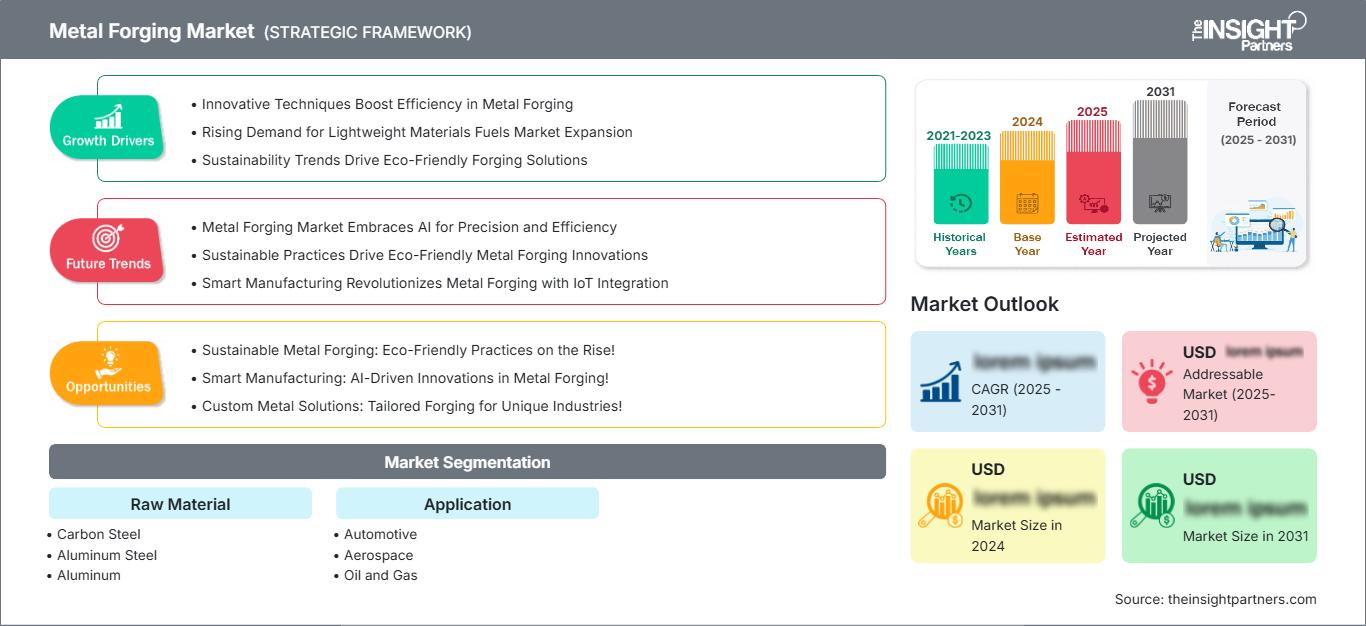
Advances in manufacturing technology will keep redefining the processes of forging in terms of automation, digital monitoring, robotics and computerized forging presses. Companies have started adopting software simulation to optimize their die design and minimize wastage of material during forging process. Simultaneously, increased demand for lighter weight alloys, higher strength parts and near net shape manufacturing is prompting manufacturers to invest more in precision forging processes which reduce the need for machining and also increase efficiency and quality of products manufactured.
Going forward, manufacturing investments made in Southeast Asia, India, Mexico and Middle East will present opportunities for forging companies. Initiatives by governments in the form of supporting domestic manufacturing, modernization of infrastructure, defense and renewable energy manufacturing equipment will be driving demand. Localization of the supply chain and advanced alloy usage will make manufacturers competitive and motivate them towards technological innovations.
Metal Forging Market Report Scope
| Report Attribute | Details |
|---|---|
| Market size in 2025 | US$ 103.97 Billion |
| Market Size by 2034 | US$ 149.1 Billion |
| Global CAGR (2026 - 2034) | 4.09% |
| Historical Data | 2021-2024 |
| Forecast period | 2026-2034 |
Metal Forging Market Analysis
The rise in the demand for vehicle parts, aircraft, industrial machinery, and energy equipment is the driving force behind the growth in the global forging of metal market since the components must be strong enough to withstand heavy mechanical load. The forged metal parts have better grain structure and higher tensile strength than casted pieces, therefore, the use of them is necessary. Constant building of infrastructure, installation of renewable energy sources, and industrialization are additional factors contributing to future demand.
The suppliers of raw materials, metal forging facilities, heat treatment firms, machining services, and OEMs represent the interconnected manufacturing environment focused on the quality of goods and their continuous delivery. Carbon steel remains the most used product due to its low price and high flexibility, however, aluminum, titanium, and magnesium forging gains popularity since the manufacturers strive for producing light parts. Innovations in closed-die forging and isothermal forging techniques and automated quality control methods become important as well.
The metal forging market report reveals that competition among forging companies is now being determined by factors such as technology, production flexibility, product quality, and customer relationship instead of price alone. Forging companies like Bharat Forge Limited, ATI Inc., Arconic Corporation, American Axle & Manufacturing Holdings, Inc., and Aichi Steel Corporation have continued to build advanced forging facilities for serving their aerospace, automotive, defense, and industrial customers with increasingly intricate high-performance parts.
Forging companies are also investing aggressively in automation, predictive maintenance, energy-efficient heating equipment, and production management systems to enhance their performance. Regional investments aimed at growing their operations in India, Southeast Asia, Mexico, and Eastern Europe will bring them closer to their automotive and industrial manufacturing customers while minimizing logistics risk. Investment in sustainable manufacturing through scrap recycling, energy efficiency, and emission reduction technologies is becoming an increasingly critical investment area due to the increasing concern for sustainability among the customers and regulators.
● REPORT CUSTOMIZATION
Tailor This Report To Align With Your Specific Business Requirements
This report can be customized to align precisely with your business objectives, scope, and target markets. Customization options include tailored segmentation, geography, competitive analysis, and strategic insights to support informed decision-making.
Customize This Report →WHAT YOU CAN ADJUST
- ● Segmentations
- ● Geography
- ● Competitive Analysis
- ● Language Preferences
Metal Forging Market: Strategic Insights
Regional Insights
North America Metal Forging Market
North America captured 22-26% of the metal forging market share in 2025 and is expected to grow at a CAGR of 4.0-4.5% between 2026 and 2034. This region has been able to leverage its well-established manufacturing landscape that has been backed by strong growth prospects in the aerospace & defense, automotive, construction machinery, and oil & gas industries. The government's policies aimed at manufacturing and building resilient supply chains have resulted in investments being made into advanced forging facilities and automation systems.
The US and Canada have continued with their efforts to modernize their industry base and leverage advanced manufacturing technology to increase production and reduce dependence on critical components being imported from other countries. Robotic technology, advanced digital inspection tools, simulation-based die design technology, and energy-efficient manufacturing processes are among some of the technologies being deployed by the forging companies. Demand for forged products is also being driven by replacement of outdated infrastructure, increased renewable energy installations, and manufacture of heavy industrial equipment.
U.S. Metal Forging Market
The US had a presence of 72–76% in the North American market in 2025 and is expected to exhibit a CAGR of 4.1–4.6% between 2025 and 2034. The US is home to some of the world's largest manufacturers of aerospace and defense equipment, ensuring that there remains high demand for titanium, aluminum, stainless steel, and special alloy precision-forged components. Furthermore, the automotive sector continues to demand forgings for crankshafts, connecting rods, steering parts, gears, axles, and other parts that offer improved mechanical performance and longevity.
Automation, process monitoring using artificial intelligence, and heat treatment technologies remain some of the most common investments made by domestic manufacturers. ATI Inc., American Axle & Manufacturing Holdings, Inc., All Metals & Forge Group, and Scot Forge Company are just some of the companies with extensive operations in aerospace, defense, industrial machinery, and energy.
Europe Metal Forging Market
Europe held a market share of 24-28% in 2025 and will grow at a CAGR of 3.8-4.3% over the forecast period. Germany retains its leading position in terms of regional demand thanks to the highly competitive automotive, machinery, and engineering sectors. The United Kingdom keeps its strong capability for the manufacture of aerospace engines. Meanwhile, France, Italy, and Spain foster the development of the sector with investments into industrial equipment, defense manufacturing, and transport infrastructure.
Germany retains the title of Europe's biggest manufacturer of forgings because of the presence of leading car manufacturers and industrial machinery companies, which need high-quality forging. The United Kingdom enjoys strong investments into manufacturing of aerospace engines and defense equipment. Meanwhile, France, Italy, and Spain continue the growth in demand for railway infrastructure, renewable energy equipment, agricultural machinery, and trucks. Recycling of steel, digital manufacturing, and low carbon manufacturing processes add to the competitiveness of the region and help to achieve manufacturing sustainability goals.
APAC Metal Forging Market
The Asia Pacific region constitutes 40–45% of the worldwide market in 2025, with the region anticipated to have a CAGR of 5.0–5.5% from 2024 to 2034. China dominates both production and consumption in the forging industry, followed by India, Japan, and South Korea. The factors such as rapid industrialization, increased automobile production, and infrastructure development keep driving the demand in the region.
Governments have various measures aimed at fostering advanced manufacturing, manufacture of electric vehicles, rail expansion, and development of military defense in order to improve the forging capacity within the region. India still remains active in manufacturing investment initiatives through its industrial development program. Japan and South Korea remain dominant in high-precision forging technologies.
Middle East & Africa Metal Forging Market
MEA is forecasted to experience growth at a CAGR of 4.4–4.9% during the period 2026 to 2034. Demand for forging in the Middle East & Africa region will be driven by industrial diversification, energy infrastructure, and construction projects in Saudi Arabia. The UAE will continue to invest in aerospace maintenance, infrastructure, and advanced manufacturing capabilities.
South Africa will remain significant in terms of manufacturing operations catering to mining, heavy equipment, and industrial machinery applications, and the rest of MEA will be boosted by investments in infrastructure and energy. Localization of manufacturing along with efforts to industrialize and develop downstream metal processing operations is anticipated to boost forging operations in the region.
Segmentation Analysis
Raw Material
The Raw Material segment is projected to register a CAGR of 4.5–5.0% during 2026–2034. Material selection remains closely linked to application requirements involving strength, corrosion resistance, weight reduction, operating temperature, and manufacturing economics. While carbon steel continues dominating high-volume production because of its cost-effectiveness, increasing demand for lightweight transportation and aerospace components is accelerating adoption of aluminum, titanium, and magnesium forgings. The metal forging market scope continues expanding as manufacturers diversify alloy portfolios to address evolving performance requirements across multiple industries.
- Carbon Steel – Continues to dominate production volumes owing to its high strength, affordability, and suitability for automotive, industrial machinery, agricultural equipment, and construction applications requiring reliable mechanical performance.
- Aluminum Steel – Supports specialized industrial applications requiring improved corrosion resistance and mechanical properties while providing manufacturers with greater flexibility for engineered forged component production.
- Aluminum – Demand continues increasing due to lightweight vehicle platforms, aerospace structures, and electric mobility applications where lower component weight contributes to improved energy efficiency and reduced emissions.
- Magnesium – Utilized in lightweight engineering applications requiring substantial weight reduction, particularly in automotive and aerospace sectors seeking enhanced fuel efficiency without compromising structural integrity.
- Stainless Steel – Preferred for corrosive operating environments including chemical processing, food processing equipment, marine systems, and energy infrastructure because of superior corrosion resistance and durability.
- Titanium – Experiences strong demand across aerospace, defense, and medical industries owing to exceptional strength-to-weight ratio, corrosion resistance, and high-temperature performance for mission-critical components.
Application
The Application segment is anticipated to grow at a CAGR of 4.7–5.2% throughout the forecast period. End-use demand remains diversified across transportation, industrial equipment, construction, and energy sectors. Automotive applications continue accounting for the highest consumption because forged components deliver superior durability, safety, and fatigue resistance under demanding operating conditions. Aerospace and renewable energy industries are also increasing adoption of precision-forged advanced alloy components for high-performance systems.
- Automotive – Represents the largest application owing to extensive use of forged crankshafts, gears, connecting rods, steering systems, axle components, and transmission parts that require exceptional mechanical strength.
- Aerospace – Continues expanding as aircraft manufacturers increasingly utilize titanium and aluminum forgings for structural components, landing gear assemblies, engine systems, and critical safety applications.
- Oil and Gas – Requires high-strength forged valves, flanges, pressure vessels, drilling equipment, and pipeline components capable of operating under extreme temperatures and high-pressure environments.
- Construction – Demand is supported by heavy machinery, cranes, earthmoving equipment, structural hardware, and infrastructure development requiring durable forged mechanical components with long service life.
- Agriculture – Agricultural equipment manufacturers increasingly utilize forged shafts, gears, couplings, and drivetrain components to improve equipment durability, operational efficiency, and resistance to harsh field conditions.
Opportunity Snapshot
| Application | Revenue Contribution | Trend Tag | Adoption Stage |
|---|---|---|---|
| Automotive | High | EV Platforms | Mature |
| Aerospace | High | Lightweight Airframes | Scaling |
| Oil and Gas | Medium | Deep Drilling | Mature |
| Construction | Medium | Smart Infrastructure | Scaling |
| Agriculture | Low | Precision Farming | Emerging |
Metal Forging Market Growth Drivers and Impact Analysis
Expansion of Global Automotive and Commercial Vehicle Manufacturing
Rising production of passenger vehicles, commercial trucks, electric vehicles, and off-highway equipment continues to support demand for forged components. Critical parts such as crankshafts, connecting rods, gears, steering knuckles, axle shafts, and transmission components require the superior strength and fatigue resistance achieved through forging. Although EVs contain fewer engine components, they continue to utilize forged suspension, chassis, and drivetrain parts. Growing investments in vehicle localization across India, Southeast Asia, Mexico, and Eastern Europe are further strengthening demand for regional forging capacity. Manufacturers are consequently expanding automation, precision forging, and lightweight alloy capabilities to meet evolving OEM specifications while maintaining cost competitiveness and production efficiency.
Increasing Aerospace and Defense Procurement Worldwide
Aircraft manufacturers and defense contractors increasingly specify forged titanium, aluminum, and specialty steel components because of their superior structural integrity and reliability under extreme operating conditions. Commercial aviation recovery, defense modernization programs, and rising aircraft backlogs continue to create sustained demand for landing gear systems, engine discs, turbine shafts, structural brackets, and fasteners. Governments across North America, Europe, and Asia Pacific are also increasing domestic defense manufacturing investments, encouraging localized production of forged components. This trend supports higher capital expenditure in advanced presses, isothermal forging technologies, and digital quality assurance systems capable of meeting stringent aerospace certification requirements.
Infrastructure Development and Industrial Equipment Investments
Large-scale investments in transportation infrastructure, renewable energy projects, mining, and industrial manufacturing continue to stimulate demand for heavy-duty forged products. Wind turbines, railways, construction machinery, agricultural equipment, and industrial processing systems all require durable forged components capable of operating under demanding conditions. Developing economies are investing significantly in manufacturing expansion and industrial modernization, while developed markets focus on replacing aging infrastructure with more efficient systems. These combined investments encourage forging companies to expand production capacity, improve energy efficiency, and adopt advanced manufacturing technologies that enhance productivity and product consistency across diverse industrial applications.
Metal Forging Market Future Trends
Digital Manufacturing and Smart Forging Facilities
Manufacturers are increasingly integrating artificial intelligence, industrial Internet of Things platforms, digital twins, and predictive maintenance into forging operations. These technologies improve die life, optimize material utilization, reduce production downtime, and enhance product quality through real-time process monitoring. The metal forging market trends indicate that smart manufacturing will become a key competitive differentiator as companies pursue higher productivity, lower operational costs, and greater manufacturing flexibility. Wider adoption of robotics and automated inspection systems is expected to improve consistency while supporting increasingly complex component production.
Growing Adoption of Lightweight High-Performance Alloys
Demand for aluminum, titanium, and magnesium forgings is expected to accelerate as transportation industries prioritize weight reduction and improved energy efficiency. Aircraft manufacturers, electric vehicle producers, and defense contractors increasingly require advanced forged alloys capable of delivering high strength with lower mass. Continuous alloy development, improved forging techniques, and expanded recycling capabilities are expected to reduce production costs while enabling broader adoption across industrial sectors that previously relied primarily on conventional carbon steel forgings.
Metal Forging Market Opportunities
Expansion into Emerging Manufacturing Economies
Rapid industrialization across India, Vietnam, Indonesia, Mexico, and selected Middle Eastern countries presents significant investment opportunities for forging manufacturers. The metal forging market Forecasts indicate that expanding automotive production, infrastructure development, and industrial equipment manufacturing will create sustained demand for locally produced forged components. Companies establishing regional production facilities, technical partnerships, and localized supply chains can reduce logistics costs while improving responsiveness to OEM customers. Investments in automated manufacturing and skilled workforce development are expected to further strengthen long-term competitiveness.
Development of Sustainable and Low-Carbon Forging Operations
Manufacturers have an opportunity to differentiate themselves through energy-efficient furnaces, recycled feedstock utilization, renewable electricity integration, and lower-emission production technologies. Industrial customers increasingly evaluate suppliers based on environmental performance alongside product quality and cost. Companies investing in decarbonization initiatives, digital energy management, and circular manufacturing practices are expected to improve operational resilience while meeting evolving customer procurement requirements. These sustainability-focused investments also position producers to comply with emerging environmental regulations and support long-term profitability.
Recent Developments
- June 2026: Forged Solutions Group Inc. (FSG), a provider of high specification forgings for the aerospace, defense, and space end markets and a portfolio company of an affiliate of J.F. Lehman & Co. LLC (JFLCO), acquired Custom Alloy Corp. (CAC), a manufacturer of forged components headquartered in High Bridge, New Jersey.
- June 2026: Chennai-based automotive component manufacturer MM Forgings Ltd invested in capacity addition and installed a new forging press, targeting revenue of nearly ₹2,000 crore in FY27.
Frequently Asked Questions

- Comprehensive Market Sizing and Forecast Analysis
- Detailed Segmentation Analysis
- In-Depth Market Dynamics Assessment
- Regional and Country-Level Insights
- Competitive Landscape and Company Benchmarking
- Strategic Business Intelligence
Recent Reports
Testimonials

The Insight Partners provided valuable market intelligence that supported our global go-to-market strategy. Their team was professional, responsive, and attentive to our feedback, providing thoughtful analysis and helpful methodological clarifications throughout the project.
Junmo Kim Chief Financial Officer (CFO), Enertech Co., Ltd.
The Insight Partners' SCADA System Market report is comprehensive, with valuable insights on current trends and future forecasts. The team was highly professional, responsive, and supportive throughout. We are very satisfied and highly recommend their services.
RAN KEDEM Partner, Reali Technologies LTDs
I requested a report on a very specific software market and the team produced the report in a few days. The information was very relevant and well presented. I then requested some changes and additions to the report. The team was again very responsive and I got the final report in less than a week.
JEAN-HERVE JENN Chairman, Future Analytica
We worked with The Insight Partners for an important market study and forecast. They gave us clear insights into opportunities and risks, which helped shape our plans. Their research was easy to use and based on solid data. It helped us make smart, confident decisions. We highly recommend them.
PIYUSH NAGPAL Sr. Vice President, High Beam Global
The Insight Partners delivered insightful, well-structured market research with strong domain expertise. Their team was professional and responsive throughout. The user-friendly website made accessing industry reports seamless. We highly recommend them for reliable, high-quality research services
YUKIHIKO ADACHI CEO, Deep Blue, LLC.
This is the first time I have purchased a market report from The Insight Partners.While I was unsure at first, I visited their web site and felt more comfortable to take the risk and purchase a market report.I am completely satisfied with the quality of the report and customer service. I had several questions and comments with the initial report, but after a couple of dialogs over email with their analyst I believe I have a report that I can use as input to our strategic planning process.Thank you so much for taking the extra time and making this a positive experience.I will definitely recommend your service to others and you will be my first call when we need further market data.
JOHN SUZUKI President and Chief Executive Officer, Board Director, BK Technologies
I wish to appreciate your support and the professionalism you displayed in the course of attending to my request for information regarding to infectious disease IVD market in Nigeria. I appreciate your patience, your guidance, and the fact that you were willing to offer a discount, which eventually made it possible for us to close a deal. I look forward to engaging The Insight Partners in the future, all thanks to the impression you have created in me as a result of this first encounter.
DR CHIJIOKE ONYIA MANAGING DIRECTOR, PineCrest Healthcare Ltd.Reason to Buy
- Informed Decision-Making
- Understanding Market Dynamics
- Competitive Analysis
- Identifying Emerging Markets
- Customer Insights
- Market Forecasts
- Risk Mitigation
- Boosting Operational Efficiency
- Strategic Planning
- Investment Justification
- Tracking Industry Innovations
- Aligning with Regulatory Trends





 Get Free Sample for