
Metal Powder for Additive Manufacturing Market Share, Size & Demand by 2034
Coverage: By Type (Powder Bed, Blown Powder, Others); Material (Alloy, Stainless Steel, Others); Application (3D Printing, Rapid Prototyping, Direct Digital Manufacturing (DDM)) , and Geography (North America, Europe, Asia Pacific, and South and Central America)
- Status : Data Released
- Report Code : TIPRE00021797
- Category : Chemicals and Materials
- No. of Pages : 150
- Available Report Formats :


- Last update date : July 30, 2026


2025 Market Size
US$ 41.1 Bn
Base year value
2034 Forecast
US$ 139.39 Bn
Projected by 2034
CAGR 2026-2034
14.53 %
Growth rate
Addressable Market
US$ 774.46 Bn
(2026-2034)
The metal powder for additive manufacturing market value stood at US$ 41.1 Billion in 2025 and is forecast to expand to US$ 139.39 Billion by 2034, growing at a CAGR of 14.53% during the forecast period from 2026 to 2034. The growth is mainly attributed to increasing usage of additive manufacturing in industries such as aerospace, healthcare, automotive, defense, and energy, owing to rising need for high quality metal powders with uniform particle structure and purity.
In North America, steady investments in advanced manufacturing facilities, aerospace manufacturing, and military modernization are set to boost demand in the region. In North America, the metal powder for additive manufacturing market size is driven by increasing qualification of titanium, nickel, stainless steel, and specialty alloys. Favorable policies promoting domestic manufacturing in conjunction with swift industrial digitalization and collaboration between universities, laboratories, and manufacturers are expected to aid a regional CAGR of around 13.5%–15.0% until 2034.
Metal Powder for Additive Manufacturing Market Assessment and Insights
- North America: North America accounted for 31%–34% share in 2025 owing to established aerospace, defense, and healthcare industries, coupled with significant investments in additive manufacturing technologies. The regional market is projected to expand at a CAGR of 13.5%–15.0% during 2026–2034.
- US: The US represented 78%–82% of the North American market in 2025, supported by strong aerospace production, defense spending, and industrial innovation. The country is anticipated to register a CAGR of 13.8%–15.2% during 2026–2034.
- Europe: Europe captured 27%–30% share in 2025, led by Germany, the UK, France, and Italy. Strong automotive engineering, industrial manufacturing, and research investments are expected to support a CAGR of 13.0%–14.5% during 2026–2034.
- Asia Pacific: Asia Pacific held 28%–31% of the metal powder for additive manufacturing market share in 2025, driven by China, Japan, South Korea, and India through expanding industrial automation and manufacturing capabilities. The regional market is forecast to grow at a CAGR of 15.5%–17.0% during 2026–2034.
- Largest Segment: Application – 3D Printing represented 62%–66% market share in 2025 as industrial manufacturers increasingly adopted additive manufacturing for serial production. The segment is expected to record a CAGR of 14.5%–15.5% during 2026–2034.
- High Growth Segment: Material – Alloy accounted for 56%–60% market share in 2025 and is projected to witness a CAGR of 15.5%–17.0% during 2026–2034, supported by demand for lightweight, high-strength engineered materials.
- Key companies analyzed in detail: Sandvik AB, Melrose Industries PLC, ATI Powder Metals, Praxair Surface Technologies, Inc., Höganäs AB, AMG Advanced Metallurgical Group N.V., Rio Tinto plc, voestalpine AG, Carpenter Technology Corporation, GKN Powder Metallurgy.
Source: The Insight Partners' analysis based on proprietary research, government publications, company annual reports, investor presentations, industry databases, and expert interviews.
There is continued growth in transition from prototyping production to the qualification of serial production due to advancement in the powder atomization technology, narrow particle size distribution control and process consistency. The aerospace and medical sectors require certified powder that can satisfy both the regulatory and mechanical requirements of the sector. In addition, there are advancements in gas atomization, plasma atomization and recycling technologies, which have been enhancing production efficiency and minimizing material wastage.
In future, the new centers for manufacturing within Asia Pacific, Middle East and some European nations will be receiving significant investments towards additive manufacturing ecosystem. The national strategy of digital manufacturing, localized supply chains and advanced materials research are inspiring powder manufacturers to open up their production facilities within the region. It will result in accelerated qualification and adoption of the technology across different industrial sectors.
Metal Powder for Additive Manufacturing Market Report Scope
| Report Attribute | Details |
|---|---|
| Market size in 2025 | US$ 41.1 Billion |
| Market Size by 2034 | US$ 139.39 Billion |
| Global CAGR (2026 - 2034) | 14.53% |
| Historical Data | 2021-2024 |
| Forecast period | 2026-2034 |
Metal Powder for Additive Manufacturing Market Analysis
Increasing uptake of additive manufacturing applications in aerospace, healthcare, automotive, and industrial machinery manufacturing segments is leading to the steady growth of metal powder for additive manufacturing market. Companies have started relying on additive manufacturing technology for the production of light and geometrically complex parts which are impossible to manufacture through the traditional methods of machining. Growing importance of minimizing material wastage, accelerating product development cycles, and providing flexible manufacturing capabilities is also helping in boosting the demand for top-quality metal powders. Moreover, rising number of certifications of additive manufactured parts by aviation regulatory bodies and health organizations will help in improving business prospects in the coming years.
Supply chain integration is becoming crucial as metal powder manufacturers, printer manufacturers, software manufacturers, and parts manufacturers are forming business ties to ensure consistent material flow and manufacturing. Recycling of leftover powders, increase in efficiency of atomization process, and strict quality controls are helping in reducing manufacturing costs while meeting stringent performance criteria.
The competitive landscape in the metal powder for additive manufacturing market report is one of consistent investments in growth, technological innovations, and mergers and acquisitions. The list of companies, such as Sandvik AB, Höganäs AB, ATI Powder Metals, Praxair Surface Technologies, Inc., Carpenter Technology Corporation, and voestalpine AG, are increasing their specialty alloys and at the same time improving their capabilities in manufacturing worldwide. In turn, Rio Tinto plc and AMG Advanced Metallurgical Group N.V. are relying on upstream raw materials and using them to improve their supply chains and create high-quality feedstock.
There is a trend of cooperation between suppliers of materials and manufacturers of equipment for additive manufacturing that determines the future competition landscape. Melrose Industries PLC, through its subsidiary GKN Powder Metallurgy, continues developing its capabilities in powder production for the needs of industry. Sustainable powder production, digital quality control, and recycling of metals will increase operational efficiency and at the same time contribute to environmental objectives.
● REPORT CUSTOMIZATION
Tailor This Report To Align With Your Specific Business Requirements
This report can be customized to align precisely with your business objectives, scope, and target markets. Customization options include tailored segmentation, geography, competitive analysis, and strategic insights to support informed decision-making.
Customize This Report →WHAT YOU CAN ADJUST
- ● Segmentations
- ● Geography
- ● Competitive Analysis
- ● Language Preferences
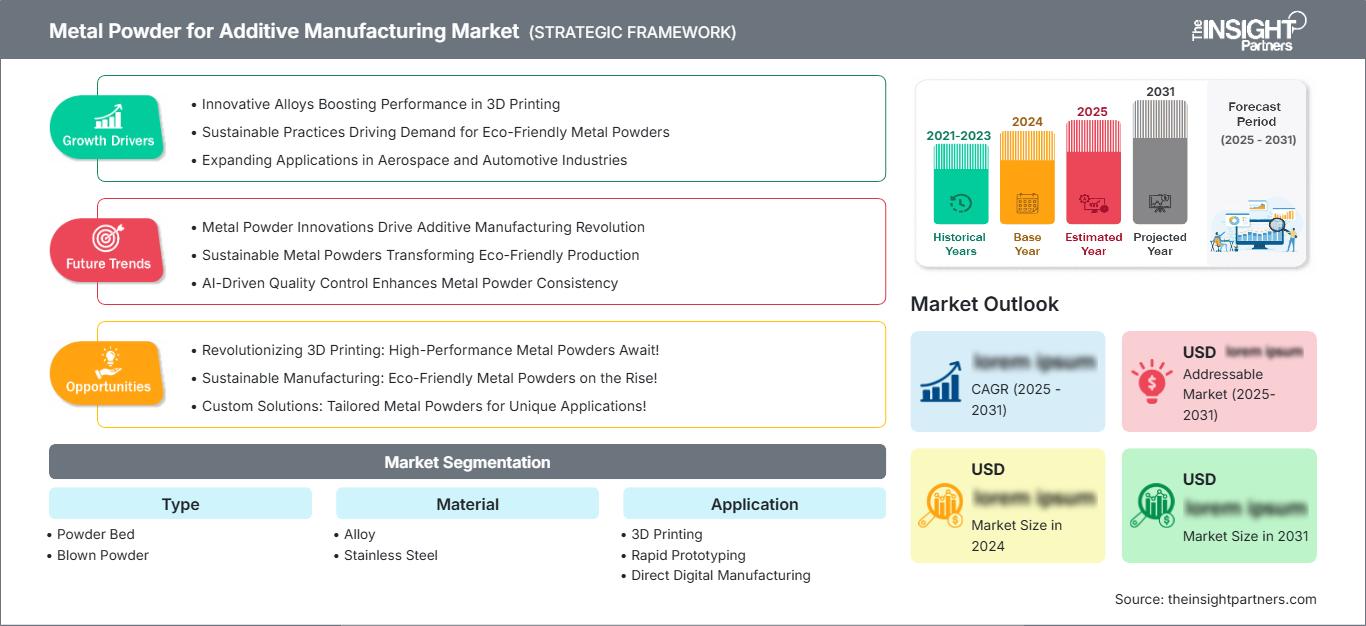
Metal Powder for Additive Manufacturing Market: Strategic Insights
Regional Insights
North America Metal Powder for Additive Manufacturing Market
North America held a share of 31%–34% in the global metal powder for additive manufacturing market for metal powder for additive manufacturing in 2025, thus being the biggest regional market. Adoption in aerospace, defense, healthcare, and industrial manufacturing remains robust. Availability of advanced facilities of additive manufacturing, well-developed supply chains, and major players producing metal powders contributes to the rapid commercialization of metal powders. This region is anticipated to witness a CAGR of 13.5%–15.0% from 2026 to 2034 due to continued investments in industrial innovation.
Government investment in advanced manufacturing, increasing use of industrial 3D printing, and growing domestic production of metal powder help to remain competitive. Aerospace manufacturers start using titanium and nickel alloy powders to make lightweight parts, whereas healthcare organizations increase production of customized orthopedic implants and dental goods. Closer cooperation between national laboratories, research centers, and private manufacturers will enhance the process of powder qualification, boost production and help to make the regional supply chain more resilient.
U.S. Metal Powder for Additive Manufacturing Market
The United States represented 78%–82% of the North American market in 2025 and remains the largest national contributor to regional demand. Supported by a strong aerospace industry, expanding defense budgets, and continuous technological innovation, the country is anticipated to record a CAGR of 13.8%–15.2% during 2026–2034. Extensive investments in additive manufacturing research and industrial-scale production continue to stimulate demand for premium-quality alloy and stainless steel powders.
Leading manufacturers and technology developers continue expanding domestic production capacities to reduce dependence on imported specialty powders. Aerospace companies increasingly qualify additively manufactured flight-critical components, while medical device manufacturers utilize metal powders for patient-specific implants and surgical instruments. Automotive manufacturers are also integrating additive manufacturing into tooling, prototyping, and selected production applications, further supporting domestic market expansion and strengthening the country's leadership in industrial innovation.
Europe Metal Powder for Additive Manufacturing Market
Europe captured 27%–30% of the global market in 2025 and is forecast to expand at a CAGR of 13.0%–14.5% during 2026–2034. Germany remains the leading country due to its highly developed automotive, industrial engineering, and machinery manufacturing sectors. The region also benefits from strong research funding, advanced manufacturing initiatives, and growing adoption of digital production technologies throughout industrial supply chains.
The UK is developing its capacity for additive manufacturing in areas of aerospace, healthcare, and defense. The efforts of national research institutions and innovation collaboration initiatives help develop the commercial use of innovative metallic materials. More efforts aimed at using sustainable manufacturing technology contribute to the development of the market.
Germany remains the leading country in European production due to the presence of engineering and industrial equipment makers. France, Italy, and Spain are also developing their capacity for additive manufacturing in aerospace manufacturing and industrial automation. Partnerships of universities, technology institutes, and industrial firms will increase competitiveness in the region and promote the use of innovative metal powder technologies.
APAC Metal Powder for Additive Manufacturing Market
Asia Pacific accounted for 28%–31% of global demand in 2025 and is projected to register the fastest regional expansion at a CAGR of 15.5%–17.0% during 2026–2034. China leads regional consumption, followed by Japan, South Korea, and India, supported by expanding industrial manufacturing capabilities and increasing adoption of digital production technologies.
Government initiatives encouraging advanced manufacturing, combined with growing investments in aerospace, electronics, automotive, and medical device production, continue strengthening regional demand. Australia also contributes through mining expertise and advanced materials research, supporting development of high-quality metallic feedstocks for industrial additive manufacturing applications.
Middle East & Africa Metal Powder for Additive Manufacturing Market
CAGR growth of 12.0%–13.5% is forecasted for the period 2026–2034 in the Middle East & Africa market owing to diversification and advancement in manufacturing technology. Saudi Arabia stands out in terms of the demand within the region due to industrial modernization projects, and the UAE keeps on investing in aerospace innovation, healthcare manufacturing, and digital manufacturing.
The significance of South Africa remains high owing to the presence of the mining industry and metallurgical capabilities, and the Rest of MEA region steadily develops the capacity for industrial manufacturing.
Segmentation Analysis
Type
The Type segment is projected to grow at a CAGR of 14.0%–15.0% during 2026–2034. The metal powder for additive manufacturing market scope continues to expand as manufacturers adopt different powder delivery technologies according to production complexity, material utilization efficiency, and application requirements. Continuous improvements in powder flowability, deposition precision, and process automation are strengthening adoption across industrial manufacturing environments.
- Powder Bed: Widely utilized for producing highly complex and precision-engineered components with excellent dimensional accuracy. Strong adoption across aerospace, healthcare, and tooling applications supports sustained commercial demand and continuous process innovation.
- Blown Powder: Preferred for repairing high-value industrial components and manufacturing large metallic structures. The technology offers greater flexibility for directed energy deposition processes while reducing material waste in specialized industrial applications.
Material
The Material segment is anticipated to register a CAGR of 15.0%–16.5% during 2026–2034 as industries increasingly demand high-performance metallic materials capable of delivering superior mechanical strength, corrosion resistance, and thermal stability. Continuous alloy development and improvements in atomization technologies are expanding material availability for industrial applications.
- Alloy: Represents the dominant material category due to exceptional strength-to-weight ratio, fatigue resistance, and compatibility with aerospace, defense, energy, and medical manufacturing applications requiring advanced engineering performance.
- Stainless Steel: Maintains significant demand owing to excellent corrosion resistance, durability, and cost effectiveness. Industrial machinery, tooling, medical devices, and automotive applications continue driving consistent utilization across multiple manufacturing industries.
Application
The Application segment is forecast to expand at a CAGR of 14.8%–15.8% during 2026–2034. Increasing commercialization of additive manufacturing across industrial sectors is encouraging broader utilization of advanced metal powders. Higher production efficiency, shorter lead times, and improved design flexibility continue strengthening adoption for both prototype development and serial production.
- 3D Printing: The largest application owing to widespread deployment across aerospace, healthcare, automotive, and industrial manufacturing. Continuous improvements in printer capabilities and certified metal powders are accelerating production-scale implementation.
- Rapid Prototyping: Enables faster product development, engineering validation, and design optimization while reducing development costs. Manufacturers increasingly rely on rapid prototyping to shorten innovation cycles and improve product performance before commercialization.
- Direct Digital Manufacturing: Expanding adoption for end-use production components supports long-term market growth. Manufacturers increasingly utilize this approach to produce lightweight, customized, and complex components while minimizing inventory requirements and material waste.
Opportunity Snapshot
| Application | Revenue Contribution | Trend Tag | Adoption Stage |
| 3D Printing | High | Industrial Production | Mature |
| Rapid Prototyping | Medium | Design Validation | Mature |
| Direct Digital Manufacturing | High | Mass Customization | Scaling |
Metal Powder for Additive Manufacturing Market Growth Drivers and Impact Analysis
Growing aerospace and defense qualification of additively manufactured components
The aerospace and defense industries continue expanding certification of additively manufactured metallic components for aircraft engines, structural assemblies, satellites, and military equipment. Organizations such as the Federal Aviation Administration (FAA) and the European Union Aviation Safety Agency (EASA) have progressively approved additive manufacturing processes for selected flight-critical applications, encouraging broader commercialization. Titanium, nickel-based superalloys, and specialty alloy powders are increasingly preferred because they enable lightweight structures without compromising mechanical performance. The growing production of next-generation commercial aircraft, rising defense modernization programs, and increasing demand for fuel-efficient systems are creating sustained demand for premium-quality metal powders. As more components complete qualification programs, powder manufacturers are investing in capacity expansion, advanced atomization technologies, and digital quality assurance systems to support long-term industrial requirements.
Expansion of industrial digital manufacturing and smart factory initiatives
Industrial manufacturers are integrating additive manufacturing into digital production environments to improve flexibility, reduce lead times, and optimize inventory management. Smart factories increasingly combine industrial automation, digital twins, artificial intelligence, and advanced manufacturing systems to enable decentralized production of complex metal components. Instead of maintaining extensive inventories of spare parts, manufacturers can produce components on demand using certified metal powders, lowering warehousing costs and shortening maintenance cycles. Automotive, industrial equipment, healthcare, and energy sectors are expanding investments in digital manufacturing infrastructure, supporting consistent growth in powder consumption. These developments are also encouraging closer collaboration among software providers, printer manufacturers, and material suppliers, improving production efficiency while accelerating commercial adoption across multiple industrial sectors.
Increasing demand for high-performance materials in healthcare applications
Healthcare manufacturers continue expanding the use of metal additive manufacturing for orthopedic implants, spinal devices, cranial implants, dental restorations, and surgical instruments. Titanium and stainless steel powders are particularly valued because of their biocompatibility, corrosion resistance, and mechanical reliability. Customized implants produced through additive manufacturing improve patient outcomes by matching individual anatomical requirements while reducing surgical complexity. Aging populations, increasing orthopedic procedures, and growing investments in advanced medical technologies continue supporting market expansion worldwide. As hospitals and medical device companies adopt personalized treatment approaches, demand for certified medical-grade powders is expected to rise steadily. This trend is encouraging powder manufacturers to develop tighter quality standards, enhanced traceability systems, and specialized materials for regulated healthcare applications.
Metal Powder for Additive Manufacturing Market Future Trends
Development of sustainable powder production ecosystems
Sustainability is becoming a defining factor in the metal powder for additive manufacturing market trends as manufacturers increasingly invest in recycled feedstocks, energy-efficient atomization technologies, and closed-loop powder management systems. Industrial users are seeking suppliers capable of reducing carbon emissions while maintaining consistent powder quality and performance. Advanced recycling methods that recover unused powder without compromising material integrity are expected to improve resource efficiency and lower production costs. Over the forecast period, greater adoption of renewable energy, digital process monitoring, and environmentally responsible manufacturing practices is expected to strengthen competitiveness while helping manufacturers comply with evolving environmental regulations and customer sustainability objectives.
Expansion of customized alloy development for specialized industries
Material innovation is expected to accelerate as powder manufacturers develop application-specific alloys for aerospace, medical, energy, electronics, and defense industries. Rather than relying solely on conventional metallic materials, companies are increasingly designing powders with optimized mechanical strength, corrosion resistance, thermal conductivity, and fatigue performance. Artificial intelligence-assisted alloy development and computational material engineering are expected to reduce research timelines while enabling rapid commercialization of next-generation metallic powders. These advancements will allow manufacturers to address increasingly specialized industrial requirements and support broader adoption of additive manufacturing for high-value, mission-critical applications across global manufacturing sectors.
Metal Powder for Additive Manufacturing Market Opportunities
Localization of advanced powder manufacturing facilities
Many governments are prioritizing domestic production of strategic materials to reduce supply chain risks and strengthen industrial resilience. Metal powder for additive manufacturing market Forecasts indicate that localized powder manufacturing facilities will attract significant investments across North America, Europe, and Asia Pacific as aerospace, defense, healthcare, and energy industries seek secure material supplies. Establishing regional production capabilities can reduce logistics costs, shorten delivery times, and improve responsiveness to industrial customers. Companies investing in advanced gas atomization, plasma atomization, and digital quality control technologies are expected to strengthen competitive positioning while benefiting from government incentives supporting advanced manufacturing and critical materials development.
Commercial expansion into energy and industrial equipment manufacturing
Energy generation, oil and gas, industrial machinery, and heavy equipment manufacturers increasingly recognize the advantages of additive manufacturing for producing high-value replacement components and customized equipment. Metal powders enable fabrication of complex geometries that improve thermal performance, reduce weight, and extend component service life. As industrial operators continue modernizing aging infrastructure and improving operational efficiency, demand for specialized metallic powders is expected to increase steadily. Material suppliers capable of developing application-specific alloys, supporting component certification, and providing comprehensive technical assistance will be well positioned to capture emerging opportunities across industrial manufacturing value chains.
Recent Developments
- July 2026: AE Industrial Partners, LP (“AE Industrial” or the “Firm”), a private investment firm focused on technologies and services considered critical to aerospace and national and economic security, acquired Powder Alloy Corporation (“PAC” or “the Company”), a leading producer of highly engineered metallic, ceramic, and thermal spray powders used across mission-critical surface enhancement and joining applications.
- May 2026: Mimir signed an agreement to acquire Osprey, Sandvik’s metal powder business, through a carve-out. The acquisition establishes a standalone global platform in gas-atomised metal powders — one of the most critical and least substitutable input materials in next-generation manufacturing, with exposure to structurally growing end markets including defence, space, medical technology and energy.
Frequently Asked Questions

- Comprehensive Market Sizing and Forecast Analysis
- Detailed Segmentation Analysis
- In-Depth Market Dynamics Assessment
- Regional and Country-Level Insights
- Competitive Landscape and Company Benchmarking
- Strategic Business Intelligence
Recent Reports
Testimonials

The Insight Partners' SCADA System Market report is comprehensive, with valuable insights on current trends and future forecasts. The team was highly professional, responsive, and supportive throughout. We are very satisfied and highly recommend their services.
RAN KEDEM Partner, Reali Technologies LTDs
I requested a report on a very specific software market and the team produced the report in a few days. The information was very relevant and well presented. I then requested some changes and additions to the report. The team was again very responsive and I got the final report in less than a week.
JEAN-HERVE JENN Chairman, Future Analytica
We worked with The Insight Partners for an important market study and forecast. They gave us clear insights into opportunities and risks, which helped shape our plans. Their research was easy to use and based on solid data. It helped us make smart, confident decisions. We highly recommend them.
PIYUSH NAGPAL Sr. Vice President, High Beam Global
The Insight Partners delivered insightful, well-structured market research with strong domain expertise. Their team was professional and responsive throughout. The user-friendly website made accessing industry reports seamless. We highly recommend them for reliable, high-quality research services
YUKIHIKO ADACHI CEO, Deep Blue, LLC.
This is the first time I have purchased a market report from The Insight Partners.While I was unsure at first, I visited their web site and felt more comfortable to take the risk and purchase a market report.I am completely satisfied with the quality of the report and customer service. I had several questions and comments with the initial report, but after a couple of dialogs over email with their analyst I believe I have a report that I can use as input to our strategic planning process.Thank you so much for taking the extra time and making this a positive experience.I will definitely recommend your service to others and you will be my first call when we need further market data.
JOHN SUZUKI President and Chief Executive Officer, Board Director, BK Technologies
I wish to appreciate your support and the professionalism you displayed in the course of attending to my request for information regarding to infectious disease IVD market in Nigeria. I appreciate your patience, your guidance, and the fact that you were willing to offer a discount, which eventually made it possible for us to close a deal. I look forward to engaging The Insight Partners in the future, all thanks to the impression you have created in me as a result of this first encounter.
DR CHIJIOKE ONYIA MANAGING DIRECTOR, PineCrest Healthcare Ltd.Reason to Buy
- Informed Decision-Making
- Understanding Market Dynamics
- Competitive Analysis
- Identifying Emerging Markets
- Customer Insights
- Market Forecasts
- Risk Mitigation
- Boosting Operational Efficiency
- Strategic Planning
- Investment Justification
- Tracking Industry Innovations
- Aligning with Regulatory Trends





 Get Free Sample for