
Metastatic Cancer Drug Market Outlook & Growth 2034
Coverage: By Cancer Type (Breast Cancer, Lung Cancer, Liver Cancer, Hematological Cancer, Brain Cancer, Prostate Cancer, Pancreatic Cancer); Route of Administration (Intravenous, Intramuscular, Oral); Drug Class (HER2 Inhibitor, Immune Checkpoint Inhibitor, PARP Inhibitor, Kinase Inhibitor); Product (Branded and Generic & Biosimilar); and Geography
- Status : Data Released
- Report Code : TIPRE00028616
- Category : Life Sciences
- No. of Pages : 150
- Available Report Formats :


- Last update date : January 23, 2026


2025 Market Size
US$ 60.60 Bn
Base year value
2034 Forecast
US$ 88.70 Bn
Projected by 2034
CAGR 2026-2034
4.32 %
Growth rate
Addressable Market
US$ 677.86 Bn
(2026-2034)
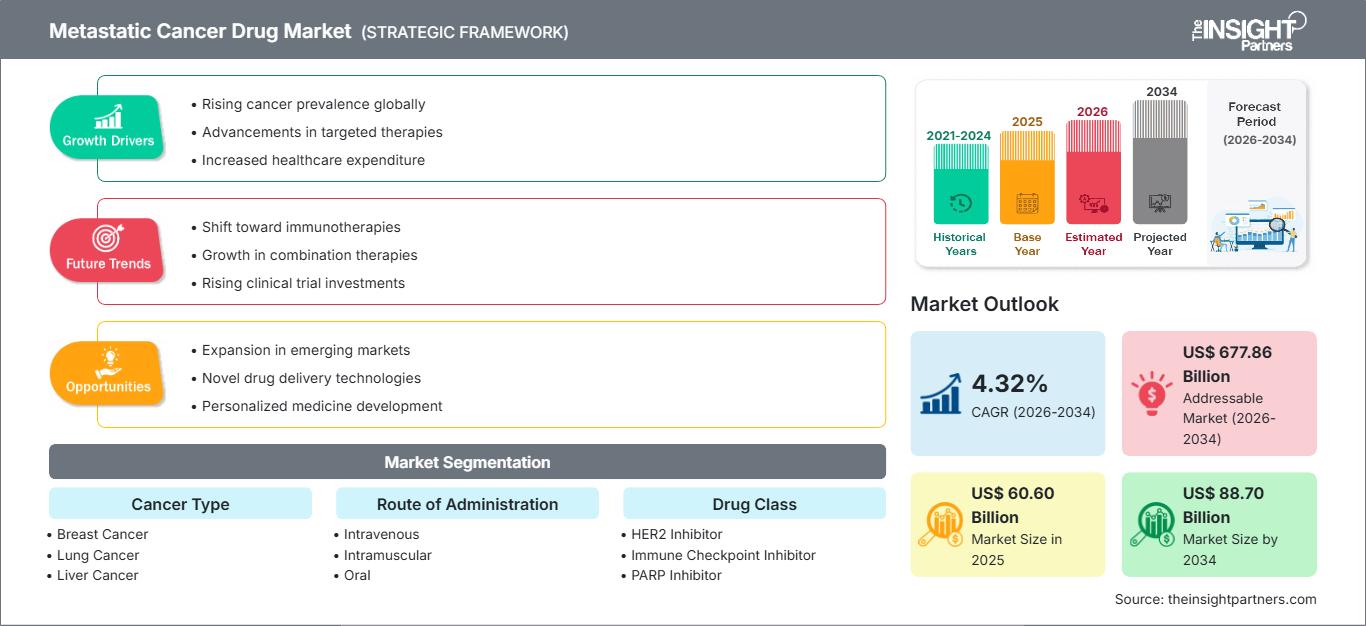
The metastatic cancer drug market size is expected to reach US$ 88.70 billion by 2034 from US$ 60.60 billion in 2025. The market is anticipated to register a CAGR of 4.32% during 2026–2034.
Metastatic Cancer Drug Market Analysis
The metastatic cancer drug market is expanding quickly, driven by the increasing global prevalence of cancer and the advancements in drug discovery and development. Treatment is shifting from conventional chemotherapy to highly specific targeted therapies and immunotherapies, offering improved patient outcomes. Technologies such as genomic profiling, liquid biopsy, and the integration of Artificial Intelligence (AI) and Machine Learning (ML) are increasingly being used to identify specific molecular targets, leading to the development of personalized treatment regimens. The market is highly competitive, with major pharmaceutical and biotech companies focusing on new product launches, strategic acquisitions, and collaborations to strengthen their oncology portfolios. The continuous need for effective, less toxic treatments for advanced-stage cancer ensures sustained market growth.
Metastatic Cancer Drug Market Overview
Metastatic cancer drugs are utilized for the treatment of advanced-stage cancer that has spread from the primary site to other parts of the body. These drugs are designed to slow tumor progression, manage symptoms, and enhance the patient’s quality of life. The market is characterized by complex and expensive therapies, including monoclonal antibodies, tyrosine kinase inhibitors, and advanced cellular and gene therapies. The increasing understanding of tumor cells at a molecular level is fueling the demand for precision medicine and biomarker-driven therapies. Effective metastatic cancer treatment often involves combination regimens, which require specialized delivery systems and administration, primarily through hospital-based centers and specialty clinics.
Market Assessment and Insights
- Global market for Metastatic Cancer Drug was valued at US$ 60.60 Billion in 2025
- Annual market size is expected to reach US$ 88.70 Billion by 2034
- Total addressable market (TAM) during 2026-2034 is projected to reach approximately US$ 677.86 Billion
- Market is anticipated to register a CAGR of 4.32% during the forecast period
- The United States represents a key market, supported by Rising cancer prevalence globally, Advancements in targeted therapies, Increased healthcare expenditure, as well as evolving industry dynamics
- Market analysis covers North America, Europe, Asia-Pacific, South and Central America, Middle East and Africa, with growth evaluated across the forecast period
- Market opportunities such as Expansion in emerging markets, Novel drug delivery technologies, Personalized medicine development are expected to influence market dynamics and addressable market
- Report profiles industry participants, including AbbVie Inc., Amgen Inc., Bristol-Myers Squibb Company, F. HOFFMANN-LA ROCHE LTD., Novartis AG, ASTRAZENECA PLC., Eli Lilly and Company, MERCK KGaA, Pfizer Inc. (Arena Pharmaceutical GmbH), while analyzing competitive strategies and innovation developments
-
Source: The Insight Partners' analysis based on proprietary research, government publications, company annual reports, investor presentations, industry databases, and expert interviews.
● REPORT CUSTOMIZATION
Tailor This Report To Align With Your Specific Business Requirements
This report can be customized to align precisely with your business objectives, scope, and target markets. Customization options include tailored segmentation, geography, competitive analysis, and strategic insights to support informed decision-making.
Customize This Report →WHAT YOU CAN ADJUST
- ● Segmentations
- ● Geography
- ● Competitive Analysis
- ● Language Preferences
Metastatic Cancer Drug Market: Strategic Insights
-
Get Top Key Market Trends of this report.This FREE sample will include data analysis, ranging from market trends to estimates and forecasts.
Metastatic Cancer Drug Market Drivers and Opportunities
Market Drivers:
- Rising Prevalence of Metastatic Cancers: The increasing incidence of various cancers worldwide, attributed to aging populations and lifestyle factors, leads to a larger pool of patients requiring advanced metastatic treatment.
- Accelerated FDA/EMA Approvals & Label Expansions: Streamlined regulatory pathways for breakthrough therapies and the expansion of existing drug labels to cover additional metastatic indications boost market introduction and revenue.
- Surge in Immunotherapy Adoption: The high clinical success and increasing regulatory approvals of cancer immunotherapies, such as immune checkpoint inhibitors, across various aggressive metastatic subtypes (e.g., metastatic lung, breast, and melanoma) are major growth factors.
Market Opportunities:
- Precision Medicine & Companion Diagnostics Uptake: Developing personalized medicine solutions enhances treatment efficacy and patient outcomes by tailoring treatment regimens based on a patient's unique genomic and molecular profile.
- AI-Driven Diagnostic Tools & Treatment Planning: Investment in AI-driven tools can improve early detection, refine diagnostic accuracy, and optimize complex treatment planning for metastatic cases, offering significant value to healthcare providers.
- Expansion into Emerging Markets: The growing healthcare infrastructure and rising awareness in regions like Asia-Pacific, Latin America, and the Middle East & Africa offer untapped opportunities for providers to expand the accessibility of innovative therapies.
Metastatic Cancer Drug Market Report Segmentation Analysis
The Metastatic Cancer Drug Market share is analyzed across various segments to provide a clearer understanding of its structure, growth potential, and emerging trends. Below is the standard segmentation approach used in most industry reports:
By Cancer Type:
- Breast Cancer
- Lung Cancer
- Liver Cancer
- Hematological Cancer
- Brain Cancer
- Prostate Cancer
- Pancreatic Cancer
By Route of Administration:
- Intravenous
- Intramuscular
- Oral
By Drug Class:
- HER2 Inhibitor
- Immune Checkpoint Inhibitor
- PARP Inhibitor
- Kinase Inhibitor
By Product:
- Branded and Generic & Biosimilar
By Geography:
- North America
- Europe
- Asia-Pacific
- South & Central America
- Middle East & Africa
Metastatic Cancer Drug Market Report Scope
| Report Attribute | Details |
|---|---|
| Market size in 2025 | US$ 60.60 Billion |
| Market Size by 2034 | US$ 88.70 Billion |
| Global CAGR (2026 - 2034) | 4.32% |
| Historical Data | 2021-2024 |
| Forecast period | 2026-2034 |
| Segments Covered |
By Cancer Type
|
| Regions and Countries Covered |
North America
|
| Market leaders and key company profiles |
|
Metastatic Cancer Drug Market Players Density: Understanding Its Impact on Business Dynamics
The Metastatic Cancer Drug Market is growing rapidly, driven by increasing end-user demand due to factors such as evolving consumer preferences, technological advancements, and greater awareness of the product's benefits. As demand rises, businesses are expanding their offerings, innovating to meet consumer needs, and capitalizing on emerging trends, which further fuels market growth.
Metastatic Cancer Drug Market Share Analysis by Geography
North America is projected to dominate the Metastatic Cancer Drug Market. The region's leadership is driven by its robust and advanced healthcare infrastructure, the presence of major pharmaceutical and biotech companies, substantial R&D investment, and a mature reimbursement landscape.
The market shows a different growth trajectory in each region:
North America
- Market Share: Holds the highest market share, underpinned by the early and wide adoption of advanced therapies.
- Key Drivers: High cancer prevalence, strong Medicare reimbursement, and a mature clinical trial ecosystem.
- Trends: Continued focus on precision medicine and the rapid adoption of cell and gene therapy approaches.
Europe
- Market Share: Significant market share, with growth driven by a high burden of cancer and government initiatives.
- Key Drivers: High per capita healthcare expenditure and streamlined regulatory processes (EMA) for new cancer treatments.
- Trends: Growing investment in developing and adopting tumor-agnostic treatments and biomarker-guided therapies.
Asia Pacific
- Market Share: The fastest-growing regional market, driven by large patient pools in countries like China and India.
- Key Drivers: Government-backed healthcare improvements, rising health awareness, and rapidly expanding pharmaceutical manufacturing capacity.
- Trends: Focus on generic and biosimilar drug development to improve access, and increasing integration of molecular diagnostics for targeted treatments.
South and Central America
- Market Share: Emerging region with steady progress and a growing number of cancer cases.
- Key Drivers: Increasing healthcare spending and a rise in medical tourism for advanced treatments.
- Trends: Expansion of affordable, imported pharmaceutical drugs and growing focus on clinical trial participation.
Middle East and Africa
- Market Share: Emerging market with strong growth potential, led by digital transformation and healthcare initiatives in the UAE and Saudi Arabia.
- Key Drivers: Major national digital and AI strategies fostering innovation in healthcare and expanding healthcare infrastructure.
- Trends: Increasing integration of telemedicine and expanding access to global cancer treatment protocols.
Metastatic Cancer Drug Market Players Density: Understanding Its Impact on Business Dynamics
The Metastatic Cancer Drug Market is characterized by intense competition among global pharmaceutical giants and innovative biotechnology firms. Major players are engaged in a constant race for new drug discovery and expanded indications, with a focus on targeted, immune-modulating, and cell/gene therapies.
The competitive landscape is driving vendors to differentiate through:
- Companies are continually launching or gaining approvals for new targeted drugs that focus on specific genomic mutations (e.g., HER2, KRAS, BRAF), commanding a dominant market share.
- Heavy investment is focused on developing next-generation immunotherapies, including novel checkpoint inhibitors and cell therapies like CAR-T, which offer the highest growth potential.
- The industry is moving towards complex combination therapies (e.g., combining targeted therapy with immunotherapy or chemotherapy) to overcome drug resistance and improve overall survival rates.
Opportunities and Strategic Moves
- Focusing on Next-Generation Oncology Therapeutics: Companies are heavily investing in developing and scaling up production for cell and gene therapies, which are projected to have the highest CAGR in the market.
- Strategic Mergers and Acquisitions (M&A): Large pharmaceutical companies are acquiring smaller biotech firms with promising pipeline assets to quickly integrate innovative technologies, such as antibody-drug conjugates (ADCs) and novel immunotherapies, into their portfolios.
- Precision Medicine Collaboration: Vendors are forging alliances with diagnostics companies to co-develop companion diagnostics essential for identifying patients who will benefit most from targeted therapies.
Major Companies Operating in the Metastatic Cancer Drug Market Are:
- AbbVie Inc.
- Amgen Inc.
- Bristol-Myers Squibb Company
- F. HOFFMANN-LA ROCHE LTD.
- Novartis AG
- ASTRAZENECA PLC.
- Eli Lilly and Company
- MERCK KGaA
- Pfizer Inc. (Arena Pharmaceutical GmbH)
Disclaimer: The companies listed above are not ranked in any particular order.
Metastatic Cancer Drug Market News and Recent Developments
- For instance, on May 14, 2025, AbbVie announced that EMRELIS™ (telisotuzumab vedotin-tllv) has been granted accelerated approval by the U.S. Food and Drug Administration (FDA) for the treatment of adult patients with locally advanced or metastatic, non-squamous non-small cell lung cancer (NSCLC) with high c-Met protein overexpression (OE) who have received a prior systemic therapy.
- On March 28, 2025, Novartis announced that the US Food and Drug Administration (FDA) approved Pluvicto for patients with prostate-specific membrane antigen (PSMA)-positive metastatic castration-resistant prostate cancer (mCRPC) who have been treated with an androgen receptor pathway inhibitor (ARPI) therapy and are considered appropriate to delay chemotherapy.
- For instance, on January 31, 2025, Roche announced that the U.S. Food and Drug Administration (FDA) had approved a label expansion for the PATHWAY® anti-HER2/neu (4B5) Rabbit Monoclonal Primary Antibody* to identify patients with HR-positive, HER2-ultralow metastatic breast cancer who may be eligible for treatment with ENHERTU®.
- On January 17, 2025, Amgen announced that the U.S. Food and Drug Administration (FDA) had approved LUMAKRAS® (sotorasib) in combination with Vectibix® (panitumumab) for the treatment of adult patients with KRAS G12C-mutated metastatic colorectal cancer (mCRC), as determined by an FDA-approved test, who have received prior fluoropyrimidine-, oxaliplatin- and irinotecan-based chemotherapy.
Metastatic Cancer Drug Market Report Coverage and Deliverables
The "Metastatic Cancer Drug Market Size and Forecast (2021–2034)" report provides a detailed analysis of the market covering below areas:
- Metastatic Cancer Drug Market size and forecast at global, regional, and country levels for all the key market segments covered under the scope
- Metastatic Cancer Drug Market trends, as well as market dynamics such as drivers, restraints, and key opportunities
- Detailed PEST and SWOT analysis
- Metastatic Cancer Drug Market analysis covering key market trends, global and regional framework, major players, regulations, and recent market developments
- Industry landscape and competition analysis covering market concentration, heat map analysis, prominent players, and recent developments in the Metastatic Cancer Drug Market. Detailed company profiles
Frequently Asked Questions

- Comprehensive Market Sizing and Forecast Analysis
- Detailed Segmentation Analysis
- In-Depth Market Dynamics Assessment
- Regional and Country-Level Insights
- Competitive Landscape and Company Benchmarking
- Strategic Business Intelligence
Recent Reports
Testimonials

The Insight Partners' SCADA System Market report is comprehensive, with valuable insights on current trends and future forecasts. The team was highly professional, responsive, and supportive throughout. We are very satisfied and highly recommend their services.
RAN KEDEM Partner, Reali Technologies LTDs
I requested a report on a very specific software market and the team produced the report in a few days. The information was very relevant and well presented. I then requested some changes and additions to the report. The team was again very responsive and I got the final report in less than a week.
JEAN-HERVE JENN Chairman, Future Analytica
We worked with The Insight Partners for an important market study and forecast. They gave us clear insights into opportunities and risks, which helped shape our plans. Their research was easy to use and based on solid data. It helped us make smart, confident decisions. We highly recommend them.
PIYUSH NAGPAL Sr. Vice President, High Beam Global
The Insight Partners delivered insightful, well-structured market research with strong domain expertise. Their team was professional and responsive throughout. The user-friendly website made accessing industry reports seamless. We highly recommend them for reliable, high-quality research services
YUKIHIKO ADACHI CEO, Deep Blue, LLC.
This is the first time I have purchased a market report from The Insight Partners.While I was unsure at first, I visited their web site and felt more comfortable to take the risk and purchase a market report.I am completely satisfied with the quality of the report and customer service. I had several questions and comments with the initial report, but after a couple of dialogs over email with their analyst I believe I have a report that I can use as input to our strategic planning process.Thank you so much for taking the extra time and making this a positive experience.I will definitely recommend your service to others and you will be my first call when we need further market data.
JOHN SUZUKI President and Chief Executive Officer, Board Director, BK Technologies
I wish to appreciate your support and the professionalism you displayed in the course of attending to my request for information regarding to infectious disease IVD market in Nigeria. I appreciate your patience, your guidance, and the fact that you were willing to offer a discount, which eventually made it possible for us to close a deal. I look forward to engaging The Insight Partners in the future, all thanks to the impression you have created in me as a result of this first encounter.
DR CHIJIOKE ONYIA MANAGING DIRECTOR, PineCrest Healthcare Ltd.Reason to Buy
- Informed Decision-Making
- Understanding Market Dynamics
- Competitive Analysis
- Identifying Emerging Markets
- Customer Insights
- Market Forecasts
- Risk Mitigation
- Boosting Operational Efficiency
- Strategic Planning
- Investment Justification
- Tracking Industry Innovations
- Aligning with Regulatory Trends





 Get Free Sample for