
Microfluidic Components Market Growth, Trends & Forecast by 2034
Coverage: by Product Type (Micropumps, Flow and Pressure Controllers, Flow and Pressure Sensors, Nozzles, Valves, Others); Industry Vertical (Aerospace and Defense, Automotive, Healthcare, Consumer Electronics, Oil and Gas, Others) , and Geography (North America, Europe, Asia Pacific, and South and Central America)
- Status : Data Released
- Report Code : TIPRE00007110
- Category : Manufacturing and Construction
- No. of Pages : 150
- Available Report Formats :


- Last update date : July 20, 2026


2025 Market Size
US$ 5.91 Bn
Base year value
2034 Forecast
US$ 12.47 Bn
Projected by 2034
CAGR 2026-2034
9.79 %
Growth rate
Addressable Market
US$ 87.34 Bn
(2026-2034)
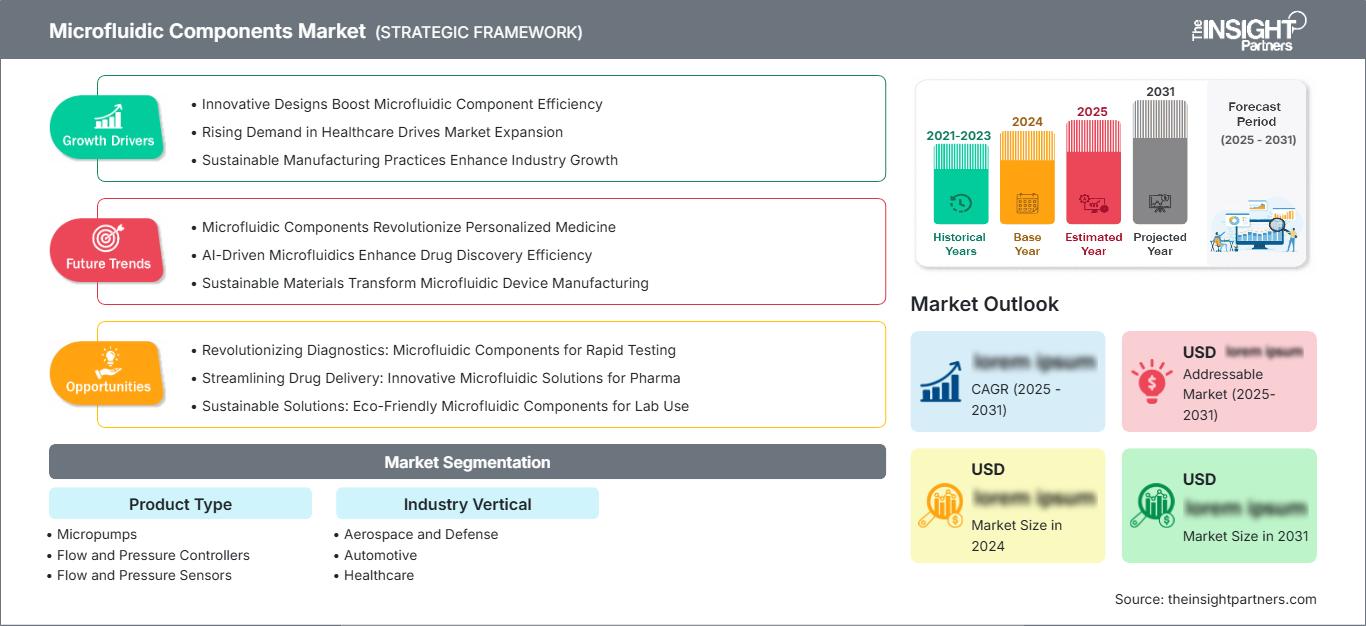
The Microfluidic Components Market was valued at US$ 5.91 Billion in 2025 and is projected to reach US$ 12.47 Billion by 2034, expanding at a CAGR of 9.79% from 2026 to 2034. Growth reflects wider integration of miniature fluid-control assemblies across healthcare, aerospace, automotive, consumer electronics, and energy systems, where compact dosing, precision sensing, and reliable flow regulation are increasingly critical.
Across North America, demand is supported by point-of-care testing investment, aircraft component modernization, and semiconductor-related manufacturing controls. The Microfluidic Components Market size in the region is expected to expand at an estimated 8.7–9.3% CAGR, with U.S. adoption led by medical device developers, laboratory automation users, and defense suppliers requiring accurate liquid handling in compact and ruggedized platforms.
Microfluidic Components Market Assessment and Insights
- North America held 36–39% share in 2025 and is growing at 8.7–9.3% CAGR between 2026–2034, supported by diagnostics, aerospace maintenance, and advanced laboratory automation demand.
- US represented 78–82% of North America in 2025 and is advancing at 8.8–9.4% CAGR between 2026–2034 through healthcare instrumentation and defense-grade fluidic controls.
- Europe accounted for 25–28% share in 2025 and is growing at 8.1–8.8% CAGR between 2026–2034, led by Germany, the UK, France, Italy, and Spain.
- Asia Pacific captured 24–27% share in 2025 and is expanding at 10.8–11.6% CAGR between 2026–2034, led by China, Japan, South Korea, and India.
- Largest Segment Healthcare held 42–46% market share in 2025 and is growing at 10.0–10.7% CAGR between 2026–2034 due to diagnostics and drug discovery adoption.
- High Growth Segment Consumer Electronics held 12–15% market share in 2025 and is growing at 11.4–12.2% CAGR between 2026–2034 as compact cooling and sensor modules scale.
- Key companies analyzed in detail: Aignep S.p.A., Cellix Limited, Christian Bürkert GmbH and Co. KG, Dolomite Microfluidics, ELVESYS Group, Fluigent S.A., Microfluidics International Corporation, Parker-Hannifin Corporation, SMC Corporation, and The Lee Company.
Source: The Insight Partners' analysis based on proprietary research, government publications, company annual reports, investor presentations, industry databases, and expert interviews.
The technology of flow control has come out of lab experiments to enter the world of sub-systems being incorporated into clinical devices, dosing systems, avionics tests, thermal applications, and industrial process controls. Dynamics of production processes are changing towards polymer moldings, precision machining, glass bonding, and hybrid systems incorporating pumps, sensors, valves, and controllers. Growth of the Microfluidic Components market is further fueled by the demand for low sample consumption, rapid tests, and digitally controlled fluids.
Manufacturers should expect to focus on scalability, higher tolerances, and industry-specific modules within the next ten years. The Asia-Pacific region will benefit from electronic supply chains and localized healthcare solutions, whereas the European region will benefit from engineered valves and controllers. Emphasis on the regulation of diagnostics, renewable energy infrastructure, and aircraft safety systems will drive the development of validated components as opposed to laboratory equipment.
Microfluidic Components Market Report Scope
| Report Attribute | Details |
|---|---|
| Market size in 2025 | US$ 5.91 Billion |
| Market Size by 2034 | US$ 12.47 Billion |
| Global CAGR (2026 - 2034) | 9.79% |
| Historical Data | 2021-2024 |
| Forecast period | 2026-2034 |
Microfluidic Components Market Analysis
The demand is growing to be more dependent on decentralization of diagnosis, drug testing, precise dosing and small-scale control systems. The healthcare industry is still the biggest market due to the reduction of reagent amount and increased speed of sample preparation through microfluidics, whereas the aerospace and automotive industries appreciate reliable fluidic delivery amid limited space and weight resources. The entire eco-system covers material suppliers, chip producers, controller makers, sensors providers, subcontractors, and end-customers-OEMs.
Supply conditions are improving as component vendors standardize fittings, software interfaces, and pressure ranges, but custom projects still dominate high-value applications. Buyers increasingly request validated assemblies rather than standalone parts, which raises switching costs and favors suppliers with application engineering teams. The Microfluidic Components Market analysis indicates that reliability, chemical compatibility, response time, and integration support now influence procurement as much as unit price.
The level of competition is relatively low because the market is divided into specialized companies offering solutions for research instrumentation and large automation firms offering products for industries. Some of the firms that gain an advantage due to their production of pneumatic and fluid control technologies include Aignep S.p.A., Christian Bürkert GmbH and Co. KG, Parker-Hannifin Corporation, SMC Corporation, and The Lee Company.
The positioning strategy is gravitating towards deeper platforms, continuous services, and software control. Regulated customers within the diagnostics and aerospace sectors tend to favor vendors who can offer assistance with the processes of qualification, documentation, and availability throughout their life cycle. The investment is hence flowing into closed-loop controllers, precise pressure sensors, non-reactive materials, and application kits.
● REPORT CUSTOMIZATION
Tailor This Report To Align With Your Specific Business Requirements
This report can be customized to align precisely with your business objectives, scope, and target markets. Customization options include tailored segmentation, geography, competitive analysis, and strategic insights to support informed decision-making.
Customize This Report →WHAT YOU CAN ADJUST
- ● Segmentations
- ● Geography
- ● Competitive Analysis
- ● Language Preferences
Microfluidic Components Market: Strategic Insights
Regional Insights
North America Microfluidic Components Market
North America accounted for 36–39% share in 2025 and is expected to grow at 8.7–9.3% CAGR through 2034. The region benefits from diagnostic decentralization, advanced bioprocessing research, aerospace aftermarket requirements, and semiconductor manufacturing controls. The Microfluidic Components Market share is highest here because OEMs often source validated pumps, sensors, and valves for regulated platforms.
Hospitals and laboratories continue to adopt compact diagnostic cartridges, while defense and aviation programs require miniature fluidic assemblies for testing, fuel handling, and environmental control. Supply chain resilience is also influencing sourcing decisions, encouraging regional partnerships with component suppliers that can provide documentation, low-volume engineering support, and scalable production for commercial launch.
U.S. Microfluidic Components Market
The U.S. represented 78–82% of North America in 2025 and is projected to expand at 8.8–9.4% CAGR. The demand is predominantly found in diagnostics, life science instrumentation, aerospace testing, and precision manufacturing. There is an extensive presence of the company through The Lee Company, Parker-Hannifin Corporation, and Microfluidics International Corporation that enables domestic availability of engineered flow-control components.
Current applications of the components include pressure controllers and flow sensors in organ-on-chip research and cell analysis and automated sample preparation. Miniature valves and nozzles are being used by aerospace manufacturers for testing equipment and environmental systems. Increasing procurement requirements include traceability, chemical resistance, and vendor continuity.
Europe Microfluidic Components Market
Europe held 25–28% share in 2025 and is forecast to grow at 8.1–8.8% CAGR. Germany leads regional demand through industrial automation, precision valves, automotive testing, and engineering-intensive medical devices. The UK contributes through microfluidic research clusters and specialist instrumentation, while France benefits from pressure-control innovation and life-science adoption.
France, Italy, and Spain add demand through diagnostics localization, electronics assembly, and energy monitoring projects. European buyers often prioritize compliance documentation, material safety, and long lifecycle support, creating opportunities for Christian Bürkert GmbH and Co. KG, Fluigent S.A., ELVESYS Group, and Aignep S.p.A. in regulated and semi-custom applications.
APAC Microfluidic Components Market
APAC captured 24–27% share in 2025 and is expected to advance at 10.8–11.6% CAGR, the fastest regional pace. China takes a leading position in terms of electronics, diagnostics, and industrial automation, with Japan and South Korea providing support for manufacturing at high precision levels. India is growing in the field of healthcare testing and contract engineering services, and Australia participates by means of research and mining surveillance.
Growing demand for pumps, valves, and sensors within the regions due to governmental support of domestic medical equipment, semiconductors, and advanced manufacturing creates an opportunity not only for international companies but also for the development of local manufacturers.
Middle East & Africa Microfluidic Components Market
The Middle East and Africa are projected to grow at 7.2–7.9% CAGR, led by Saudi Arabia and the UAE. Energy infrastructure, water testing, and hospital modernization create targeted demand for miniature flow and pressure systems. South Africa supports research, diagnostics, and mining applications, while the rest of MEA remains project-driven.
Adoption is concentrated in imported analytical equipment, oil and gas monitoring systems, and specialized clinical laboratories. Local assembly is limited, but infrastructure investment and energy diversification are increasing interest in ruggedized sensors and valves that perform reliably in high-temperature and remote operating environments.
Segmentation Analysis
Product Type
Product Type is expected to grow at 9.3–10.1% CAGR between 2026–2034 as OEMs integrate pumps, controllers, sensors, nozzles, and valves into compact assemblies. The Microfluidic Components Market scope across product categories is widening as customers seek modularity, lower dead volume, and digitally monitored fluid delivery for regulated and industrial environments.
- Micropumps support controlled liquid transfer in diagnostics, drug discovery, and portable devices, where repeatability, low pulsation, and compatibility with biological fluids influence design selection.
- Flow and Pressure Controllers are strategically important in research automation and droplet generation, enabling stable experiments, faster protocol changes, and improved reproducibility across multi-channel workflows.
- Flow and Pressure Sensors provide closed-loop feedback for miniature systems, helping users detect blockages, maintain process stability, and document performance in regulated or mission-critical applications.
- Nozzles serve dispensing, atomization, cooling, and reagent delivery needs, with demand rising where precise droplet formation, uniform output, and compact assembly footprints are required.
- Valves remain essential for switching, isolation, and dosing functions, particularly in diagnostic cartridges, pneumatic controls, analytical instruments, and aerospace systems requiring reliable cycling.
Industry Vertical
Industry Vertical is expected to expand at 9.6–10.4% CAGR between 2026–2034 as adoption broadens from healthcare into aerospace, automotive, electronics, and oil and gas. The segment benefits from cross-industry demand for miniaturized systems that reduce fluid waste, support automation, and perform reliably under constrained operating conditions.
- Aerospace and Defense uses miniature valves, nozzles, and pressure devices in test systems, environmental controls, and mission equipment where weight reduction and reliability matter.
- Automotive demand is linked to fuel systems, thermal management, battery testing, and sensor validation, with suppliers prioritizing robust components for automated production lines.
- Healthcare remains the leading vertical because diagnostic cartridges, organ-on-chip platforms, and drug screening workflows require precise fluid handling with minimal sample volumes.
- Consumer Electronics is gaining strategic relevance through compact cooling, ink delivery, wearable diagnostics, and micro-dispensing functions that require reliable miniature flow paths.
- Oil and Gas adopts sensors, valves, and controllers for analytical sampling, corrosion monitoring, and harsh-environment process control across upstream and downstream operations.
Opportunity Snapshot
| Industry Vertical | Revenue Contribution | Trend Tag | Adoption Stage |
| Aerospace and Defense | Medium | Rugged Control | Scaling |
| Automotive | Medium | Battery Testing | Scaling |
| Healthcare | High | Rapid Testing | Mature |
| Consumer Electronics | Medium | Micro Cooling | Emerging |
| Oil and Gas | Low | Remote Sensing | Emerging |
Microfluidic Components Market Growth Drivers and Impact Analysis
Decentralized Diagnostics and Low-Volume Testing
The trend in healthcare is towards conducting tests closer to the patient, thus increasing the need for miniaturized pumping, valve, sensor, and control components integrated within a cartridge platform. Microfluidic technologies ensure reduced sample and reagent consumption, reduced turnaround time, and enable multiplexing; hence, they fit well into infectious diseases, cancer, and chronic diseases applications. The effect on suppliers will be from being sellers of single lab components to suppliers of subsystems that can be integrated into instruments. Suppliers of components that have documentation, sterilization capability, and stable performance from batch to batch stand a higher chance of being successful in OEM projects.
Precision Automation in Industrial and Aerospace Systems
Industrial consumers are turning to smaller fluid control modules for better dosing precision, process reproducibility, and maintenance performance. The aerospace and defense industry is driving further usage due to test stands, environmental controls, and analysis systems needing resilient miniature systems capable of performing under vibration, changing pressures, and reliability requirements. This driver broadens the potential market size outside of the medical industry and lessens reliance on research laboratories. Suppliers with knowledge in pneumatics, valves with long cycle lifetimes, and application engineering will be able to capitalize on applications valuing these qualities over low costs.
Integration of Sensors, Software, and Closed-Loop Control
The increasing need for closed-loop systems results from the demand for real-time assurance of flow rates, pressure consistency, risk of obstruction, and test replication. The combination of sensors and controllers, along with software, makes the process easier to set up and more suitable for automation in the laboratory, electronics assembly lines, and energy tracking. The business benefits include increased average selling prices per system and customer loyalty resulting from the software interface, calibration, and accessories. Hardware accuracy paired with control software makes the difference in a market dominated by commoditized components.
Microfluidic Components Market Future Trends
Application-Specific Modular Platforms
The next evolution in market development will be characterized by the design of modular platforms tailored for particular uses rather than general laboratory systems. More often, it is required from suppliers to deliver prevalidated modules for organ-on-a-chip systems, droplet formation, diagnostic sample preparation, electronic components cooling, and sampling analysis. This way, customers will be able to implement solutions more quickly and with greater confidence. The use of these modules can substantially decrease OEM time-to-market process and simplify integration and certification processes. With a growing number of users in healthcare, biotech, industrial testing, and electronics industries, more attention is paid to workflow efficiency, scalability, and implementation simplicity. This makes it an advantage for vendors having wide product lines, the ability to control through software, and knowledge of applications, since purchasing will be based not only on the component parameters but also on the entire solution efficiency.
Scalable Manufacturing and Material Innovation
The Microfluidic Components Market forecast indicates that manufacturing will increasingly shift toward scalable polymer processing, hybrid bonding techniques, additive prototyping, and chemically inert materials that balance performance with cost efficiency. As production volumes expand across diagnostics, life sciences, and electronics applications, customers will demand tighter tolerances, lower variability, and more reliable supply continuity. Material selection is also becoming increasingly application-specific, with biocompatible polymers, glass, stainless steel, and elastomers chosen according to pressure requirements, chemical compatibility, solvent exposure, and sterilization needs. This trend is expected to differentiate suppliers capable of delivering consistent, high-volume production quality from those focused primarily on research-stage customization.
Microfluidic Components Market Opportunities
OEM Partnerships for Diagnostic Cartridge Platforms
Durable revenue possibilities can be created for the component suppliers through early involvement in the development of cartridge and near-patient diagnostics systems. Early involvement is critical because it provides for optimization of the pumps, valves, sensors and connectors for compatibility with the chemistry, manufacturing and regulatory considerations. It would also provide for recurring revenue generation if the components are part of the manufacturing process for the instruments or consumables. Companies that can offer prototype development and validation and scalable manufacturing will be well-positioned to win the platform business.
Industrial Monitoring in Energy and Advanced Manufacturing
The Microfluidic Components Market presents significant opportunities in energy and advanced manufacturing applications, where operators increasingly require compact, high-precision analytical systems for fluid sampling, corrosion monitoring, leak detection, cooling management, and process verification. Microfluidic assemblies enable accurate analysis while reducing reagent consumption, supporting real-time monitoring, and facilitating automated decision-making in environments where manual sampling is costly, time-intensive, or unsafe. Their compact size and ability to deliver rapid analytical results make them particularly valuable in remote facilities, process plants, and critical infrastructure operations. The opportunity is especially strong for ruggedized valves, sensors, controllers, and fluid-handling components capable of withstanding pressure fluctuations, temperature extremes, and exposure to chemically aggressive fluids. Suppliers can strengthen their market position by developing application-specific modules and partnering with system integrators, automation companies, and energy service providers, as end users typically adopt these technologies as part of broader monitoring, diagnostics, and predictive maintenance platforms rather than as standalone components. As industries continue to pursue greater operational efficiency, safety, and digitalization, demand for reliable microfluidic solutions in industrial environments is expected to increase steadily.
Recent Developments
- February 2026: Fluigent S.A. announced its 2026 microfluidics event program, including SLAS 2026 in Boston and IPGG User Day in Paris, where the company highlighted laboratory automation, organ-on-chip flow control, and microfluidic system setup for research and industrial users.
- February 2026: Tsubaki Nakashima has launched manufacturing capabilities for microfluidic plates, enabling customers to expand their microfluidics-related businesses. Through a strategic partner, the company’s Engineered Plastic Components business has already established initial manufacturing capabilities in the UK. This includes equipment that supports customer collaboration on design and prototyping, enabling the development of application-specific solutions.
- January 2025: Fluigent S.A. participated in SLAS 2025 and related workshops to showcase microfluidic solutions, including the Omi automated organ-on-chip platform, supporting broader adoption of controlled flow systems in laboratory automation, drug discovery, and life-science experimentation.
Frequently Asked Questions

- Comprehensive Market Sizing and Forecast Analysis
- Detailed Segmentation Analysis
- In-Depth Market Dynamics Assessment
- Regional and Country-Level Insights
- Competitive Landscape and Company Benchmarking
- Strategic Business Intelligence
Recent Reports
Testimonials

The Insight Partners' SCADA System Market report is comprehensive, with valuable insights on current trends and future forecasts. The team was highly professional, responsive, and supportive throughout. We are very satisfied and highly recommend their services.
RAN KEDEM Partner, Reali Technologies LTDs
I requested a report on a very specific software market and the team produced the report in a few days. The information was very relevant and well presented. I then requested some changes and additions to the report. The team was again very responsive and I got the final report in less than a week.
JEAN-HERVE JENN Chairman, Future Analytica
We worked with The Insight Partners for an important market study and forecast. They gave us clear insights into opportunities and risks, which helped shape our plans. Their research was easy to use and based on solid data. It helped us make smart, confident decisions. We highly recommend them.
PIYUSH NAGPAL Sr. Vice President, High Beam Global
The Insight Partners delivered insightful, well-structured market research with strong domain expertise. Their team was professional and responsive throughout. The user-friendly website made accessing industry reports seamless. We highly recommend them for reliable, high-quality research services
YUKIHIKO ADACHI CEO, Deep Blue, LLC.
This is the first time I have purchased a market report from The Insight Partners.While I was unsure at first, I visited their web site and felt more comfortable to take the risk and purchase a market report.I am completely satisfied with the quality of the report and customer service. I had several questions and comments with the initial report, but after a couple of dialogs over email with their analyst I believe I have a report that I can use as input to our strategic planning process.Thank you so much for taking the extra time and making this a positive experience.I will definitely recommend your service to others and you will be my first call when we need further market data.
JOHN SUZUKI President and Chief Executive Officer, Board Director, BK Technologies
I wish to appreciate your support and the professionalism you displayed in the course of attending to my request for information regarding to infectious disease IVD market in Nigeria. I appreciate your patience, your guidance, and the fact that you were willing to offer a discount, which eventually made it possible for us to close a deal. I look forward to engaging The Insight Partners in the future, all thanks to the impression you have created in me as a result of this first encounter.
DR CHIJIOKE ONYIA MANAGING DIRECTOR, PineCrest Healthcare Ltd.Reason to Buy
- Informed Decision-Making
- Understanding Market Dynamics
- Competitive Analysis
- Identifying Emerging Markets
- Customer Insights
- Market Forecasts
- Risk Mitigation
- Boosting Operational Efficiency
- Strategic Planning
- Investment Justification
- Tracking Industry Innovations
- Aligning with Regulatory Trends





 Get Free Sample for