
Mine Drilling Machines Market Trends, Demand & Growth by 2034
Coverage: By Application (Drilling Rigs, Drilling Jumbos, Rock Drill, Surface Crawlers); Operation (Diesel Operated, Battery Operated); Drilling Technique (Rotary, Track, Compact Core, Down-the-Hole, Tophammer); Drill Fluid Used (Liquid filled, Foam filled, Air filled) , and Geography (North America, Europe, Asia Pacific, and South and Central America)
- Status : Data Released
- Report Code : TIPRE00021334
- Category : Manufacturing and Construction
- No. of Pages : 150
- Available Report Formats :


- Last update date : July 20, 2026


2025 Market Size
US$ 8.44 Bn
Base year value
2034 Forecast
US$ 13.02 Bn
Projected by 2034
CAGR 2026-2034
4.93 %
Growth rate
Addressable Market
US$ 97.37 Bn
(2026-2034)
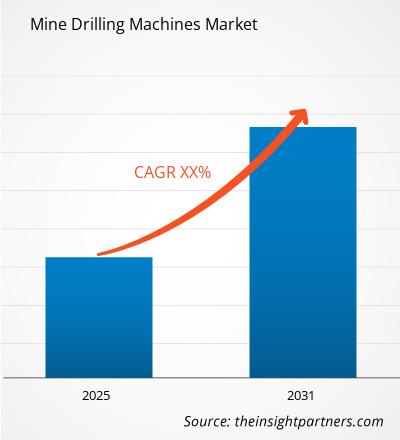
The Mine Drilling Machines Market is projected to increase from US$ 8.44 Billion in 2025 to US$ 13.02 Billion by 2034, registering a CAGR of 4.93% during 2026–2034. Demand is being shaped by continued mine development, orebody complexity, deeper underground operations, and the shift toward automated and lower-emission drilling platforms across surface and underground mining environments.
Across North America, equipment replacement cycles, critical mineral policy support, and fleet modernization are expected to sustain an estimated 4.6–5.2% CAGR through 2034. The Mine Drilling Machines Market size in the region is supported by copper, lithium, potash, gold, and aggregates activity, while mine operators are prioritizing safer drilling, lower ventilation loads, and digital productivity tools.
Mine Drilling Machines Market Assessment and Insights
- North America held 29–31% share in 2025 and is projected to grow at 4.6–5.2% CAGR between 2026–2034, led by mine electrification, critical minerals, and safety-led underground equipment upgrades.
- US represented 72–76% of North America in 2025 and is expected to grow at 4.7–5.3% CAGR, supported by copper, lithium, and aggregates drilling.
- Europe accounted for 18–20% share in 2025 and should expand at 4.1–4.7% CAGR, with Sweden, Finland, Germany, and Poland leading modernization demand.
- Asia Pacific captured 34–36% share in 2025 and is forecast to grow at 5.2–5.8% CAGR, driven by China, India, Australia, Indonesia, and mineral security programs.
- Largest Segment Drilling Rigs held 34–36% market share in 2025 and are expected to grow at 4.5–5.1% CAGR, reflecting broad surface and underground applicability.
- High-Growth Segment Battery-operated machines held 12–14% market share in 2025 and are expected to grow at 7.8–8.6% CAGR as mines reduce diesel exposure.
- Key companies analyzed in detail: Komatsu Ltd., Sandvik AB, Caterpillar Inc., Metso Corporation, Atlas Copco AB, Liebherr-International AG, Mine Master Sp. z o.o., Epiroc AB, Boart Longyear Group Ltd., Doosan Corporation
Source: The Insight Partners' analysis based on proprietary research, government publications, company annual reports, investor presentations, industry databases, and expert interviews.
The application of technology in the drilling process has made the drilling process less mechanical and more electronic. The rotary drilling and down-the-hole drilling systems will continue dominating in the production drilling process, while the top hammer system will be optimized for more accurate and lower energy consumption. Growth in the Mine Drilling Machines Market will be driven by ore grade deterioration, where drilling becomes more accurate and frequent.
The future market growth in demand will be dominated by places developing copper, lithium, nickel, potash, iron ore, and gold projects. Environmental pressure for reducing emissions of diesel particulates, heat in the mine, and exposure of workers will drive mines to move to battery electric tramming, drill automation, and data-based maintenance. In emerging markets, with limited access to skilled labor, operators’ independence will be an advantage.
Mine Drilling Machines Market Report Scope
| Report Attribute | Details |
|---|---|
| Market size in 2025 | US$ 8.44 Billion |
| Market Size by 2034 | US$ 13.02 Billion |
| Global CAGR (2026 - 2034) | 4.93% |
| Historical Data | 2021-2024 |
| Forecast period | 2026-2034 |
Mine Drilling Machines Market Analysis
Demand is based on the expansion of the mines, the renewal of old drill fleets, and the need to increase meters per shift drilled. Buyers are looking for an optimum balance between productivity and compliance with environmental regulations. Automation, telematics, and energy-saving compressors are critical considerations when buying drills. Drill OEMs, suppliers of bits and consumables, manufacturers of hydraulic components, systems integrators for battery power systems, software vendors for fleet management, and mining contractors all play roles in equipment choice.
The dynamics of supply will depend on steel availability, electronics, hydraulics, and battery supplies, with lead times also being determined by mine-specific customization. Owners of mines are becoming more concerned about the total cost of ownership, as opposed to the purchase price only, where ventilation savings, fuel savings, and lower downtime can compensate for a higher initial price.
There is high competition amongst global OEMs with diverse product ranges, as well as specialized companies dealing with underground drilling and exploration and also consumables. Sandvik AB, Epiroc AB, Komatsu Ltd., Caterpillar Inc., and Atlas Copco AB are increasingly automating and going for electric machines, whereas Boart Longyear Group Ltd. and Mine Master Sp. z o.o. add value with their explorations and underground expertise.
The strategic focus is on service contracts, digital monitoring, remote operating, as well as modular systems, which cause minimal disturbances at the mine site. Metso Corporation, Liebherr-International AG, and Doosan Corporation offer adjacent services in the form of mining and heavy equipment. The capital investment potential is highest for battery-operated machines, automatic drilling, as well as lifecycle management.
● REPORT CUSTOMIZATION
Tailor This Report To Align With Your Specific Business Requirements
This report can be customized to align precisely with your business objectives, scope, and target markets. Customization options include tailored segmentation, geography, competitive analysis, and strategic insights to support informed decision-making.
Customize This Report →WHAT YOU CAN ADJUST
- ● Segmentations
- ● Geography
- ● Competitive Analysis
- ● Language Preferences
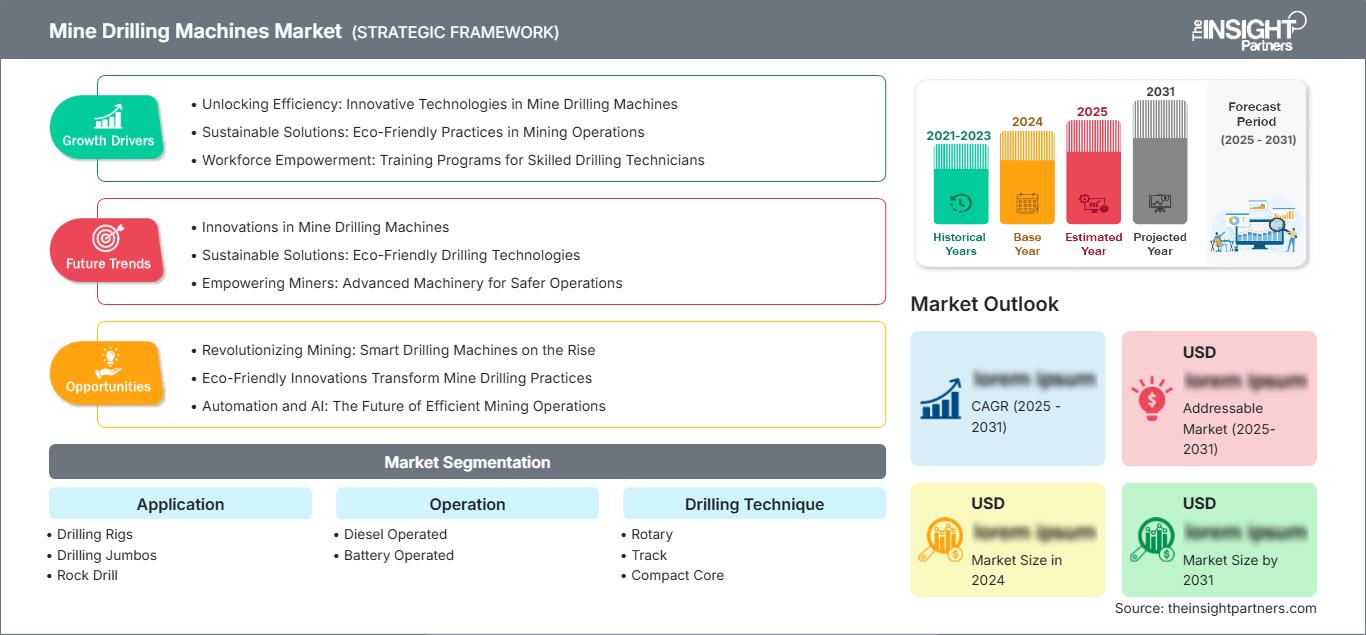
Mine Drilling Machines Market: Strategic Insights
Regional Insights
North America Mine Drilling Machines Market
North America held 29–31% of global revenue in 2025 and is projected to expand at 4.6–5.2% CAGR through 2034. The region benefits from copper, lithium, gold, potash, coal reclamation, and aggregates activity, alongside upgrades in underground ventilation and worker safety. The Mine Drilling Machines Market share is supported by U.S. and Canadian operators replacing diesel fleets with automated and battery-ready units.
Procurement decisions increasingly prioritize machine uptime, remote diagnostics, and drill accuracy in hard-rock deposits. Canada contributes demand through potash, nickel, and gold operations, while Mexico supports surface drilling for base metals. Public policy around critical minerals, permitting reforms, and domestic supply chains is encouraging exploration drilling and brownfield mine extensions.
U.S. Mine Drilling Machines Market
The U.S. accounted for 72–76% of North American demand in 2025 and is expected to grow at 4.7–5.3% CAGR during 2026–2034. Copper, lithium, rare earth, aggregates, and underground hard-rock projects are increasing demand for drilling rigs, jumbos, and rock drills. Large OEM presence, dealer networks, and component support improve equipment adoption across Western mining states.
Application trends show stronger use of rotary systems in surface mines and drilling jumbos in underground development. Mine operators are applying automation to improve shift productivity and reduce exposure in hazardous headings. Battery-operated units are still a minority of installed fleets, but adoption is rising where ventilation costs and diesel particulate controls materially affect operating economics.
Europe Mine Drilling Machines Market
Europe represented 18–20% share in 2025 and is projected to grow at 4.1–4.7% CAGR. Sweden and Finland lead underground modernization, supported by base metals, iron ore, and battery mineral investments. Germany contributes to equipment engineering and quarrying demand, while Poland adds coal-transition and hard-rock activity. The region favors low-emission drilling because ventilation, labor safety, and energy efficiency standards are comparatively strict.
The UK market is smaller but stable, with tunneling, aggregates, and mineral exploration supporting compact and surface crawler demand. France, Italy, and Spain rely more on quarrying, industrial minerals, and infrastructure-linked excavation, creating steady demand for rock drills and surface crawlers rather than large underground fleets. European buyers emphasize lifecycle service, operator safety, and compatibility with digital mine planning systems.
APAC Mine Drilling Machines Market
APAC held 34–36% share in 2025 and is forecast to expand at 5.2–5.8% CAGR, making it the fastest regional growth area. China leads scale demand through coal, iron ore, copper, and industrial minerals, while Australia remains a technology adopter in autonomous surface drilling and battery-electric pilots.
India is increasing exploration and production capacity for coal, iron ore, limestone, and critical minerals. Japan and South Korea contribute through technology supply chains and overseas mining interests, while Indonesia supports surface crawler and rotary demand through coal, nickel, and infrastructure-linked mineral projects.
Middle East & Africa Mine Drilling Machines Market
The Middle East & Africa is expected to grow at 4.8–5.4% CAGR as Saudi Arabia, the UAE, South Africa, and the rest of MEA expand minerals, quarrying, and infrastructure activity. Saudi Arabia is the leading growth country, supported by mining diversification and industrial policy.
South Africa sustains demand through gold, platinum group metals, coal, and manganese mines, especially for underground development and rock drilling. The UAE supports quarrying and construction-linked drilling, while African copper belts and gold provinces drive demand for durable, serviceable equipment suited to remote operating conditions.
Segmentation Analysis
Application
The application segment is projected to grow at 4.6–5.2% CAGR during 2026–2034. Mine operators select machines according to drilling depth, bench geometry, underground access, rock hardness, and production cycle requirements. The market scope across applications is broad because exploration, blasting, development, and reinforcement each require different platform capabilities.
- Drilling Rigs remain the largest application due to surface production, exploration, and blast-hole drilling needs, offering high utilization across coal, metals, industrial minerals, and quarrying operations.
- Drilling Jumbos are critical for underground development, where boom precision, operator visibility, automation readiness, and cycle-time control determine heading advance rates and safety performance.
- Rock Drill demand is sustained by hard-rock mining, tunneling, and quarrying, where compact design, percussion efficiency, and maintenance accessibility influence daily productivity.
- Surface Crawlers support mobile drilling across benches, slopes, and remote sites, making them strategically important for flexible production, road cuts, and open-pit expansion.
Operation
The operation segment is expected to grow at 5.1–5.7% CAGR, supported by a dual transition in mine power strategies. Diesel-operated machines remain essential where infrastructure is limited, while battery-operated units gain traction in underground mines with strict ventilation, heat, and emissions requirements.
- Diesel-operated machines retain the largest installed base because they offer mobility, refueling convenience, and reliability in remote mines where electrical infrastructure remains limited or uneven.
- Battery-operated machines are gaining strategic relevance in underground mines, where zero-emission tramming, lower heat generation, and reduced ventilation costs support higher investment justification.
Drilling Technique
The drilling technique segment is forecast to grow at 4.7–5.3% CAGR as mines optimize methods for geology, hole diameter, fragmentation, and energy efficiency. Technique selection affects consumable use, drilling speed, wall stability, and downstream blasting outcomes, making it a central factor in total operating cost.
- Rotary drilling is widely used in surface operations and softer to medium formations, where consistent penetration rates and large-diameter holes support high-volume production.
- Track techniques support stable machine movement across uneven terrain, giving contractors and mine operators flexibility in bench drilling, slope work, and remote access sites.
- Compact Core drilling supports exploration and geological sampling, where sample integrity, depth control, and mobility are more important than production-scale hole volumes.
- Down-the-Hole drilling is preferred in hard and fractured rock, where hammer placement near the bit improves energy transfer, hole straightness, and penetration consistency.
- Tophammer drilling supports smaller to medium hole diameters, offering fast setup, strong maneuverability, and practical use in tunneling, quarries, and underground development.
Drill Fluid Used
The drill fluid used segment is projected to expand at 4.4–5.0% CAGR as mine operators match flushing media to hole stability, dust control, formation type, and environmental constraints. Fluid selection affects bit life, cuttings removal, worker exposure, and drilling continuity in both surface and underground settings.
- Liquid filled systems are used where cooling, cuttings transport, and borehole stability are priorities, particularly in deeper holes and formations prone to heat buildup.
- Foam filled drilling supports difficult formations by improving cuttings lift with lower water use, making it useful where hole cleaning and formation control are challenging.
- Air filled drilling remains important in dry formations and surface operations, offering fast cuttings removal, lower fluid handling complexity, and practical dust-management requirements.
Opportunity Snapshot
| Application | Revenue Contribution | Trend Tag | Adoption Stage |
| Drilling Rigs | High | Autonomous Rigs | Mature |
| Drilling Jumbos | Medium | Underground Advance | Scaling |
| Rock Drill | Medium | Hard-Rock Precision | Mature |
| Surface Crawlers | Medium | Mobile Benches | Scaling |
Mine Drilling Machines Market Growth Drivers and Impact Analysis
Critical Mineral Expansion Raises Drilling Intensity
Mine Drilling Machines Market forecast indicates that growth in copper, lithium, nickel, zinc, and rare earth mining projects is increasing drilling intensity during both exploration and production phases. The new deposits need additional delineation drilling, better grade control and blasting accuracy due to deeper and lower-grade ore bodies and complicated geological structures. This results in growing requirements for drilling equipment, jumbos, rock drills and crawler platforms designed to perform in various ground conditions. Positive dynamics can be observed in the drilling equipment market due to the increased brownfield expansion and the resuscitation of historical mines and underground extensions in order to guarantee the supply of rare earths. Equipment manufacturers can take advantage of it by providing drilling machines, consumables, automation solutions and service programs.
Safety Regulation Accelerates Automation Adoption
Pressure is mounting on mining operations to decrease exposure of operators to unsupported ground, blast, heat, dust, and diesel particulate emissions. Automation of drill control, tele-operated drills, collision prevention, and electronic drill plans enable mining operations to achieve standardized performance quality while avoiding hazardous environments. These benefits have the most significance in underground hard rock mining, where development and reinforcement headings determine production rates and safety performance. Supplier systems that combine sensing, equipment health management, and remote diagnostics can contribute to increased buyer confidence in automation systems. With increasing regulatory and insurance standards, automated drill capability is becoming an essential rather than optional component in mining procurements.
Fleet Electrification Reduces Underground Cost Pressure
Battery-operated drilling equipment is gaining attention because diesel engines add ventilation demand, heat load, maintenance complexity, and emissions-management costs in underground mines. Although battery machines require charging infrastructure and a higher upfront investment, they can lower operating costs where ventilation is a major cost center. The Mine Drilling Machines Market is therefore moving toward mixed fleets, with battery tramming, cable-electric drilling, and modular power systems gaining commercial relevance. Suppliers that offer practical charging solutions, battery safety systems, and service support will be better positioned to serve mines transitioning gradually rather than replacing whole fleets at once.
Mine Drilling Machines Market Future Trends
Autonomous Drill Fleets Move Toward Integrated Mine Control
Mine Drilling Machines Market trends point toward drill fleets that operate as connected production assets rather than standalone machines. Future systems will link drill plans, geology models, machine guidance, fragmentation targets, and maintenance data in near real time. It would also be possible to alter hole configurations, track drilling deviation, and synchronize blasting without manual intervention. It is especially pertinent in cases of large surface mines and deep underground mines, where labor shortages and hazards prevent increased productivity. OEMs producing platforms that can work in conjunction with mining planning software and mixed-brand fleets will gain a strategic advantage as customers seek integrated control rooms.
Modular Power Architectures Become Procurement Differentiators
The drilling fleets in the future will have modular power systems, which give the mines an option of choosing whether they want to use diesel, battery, cable electric, or a hybrid power system according to their requirements. This would reduce the risks of using any new technology because they could gradually move towards zero emission machines by converting only some of the machines into zero emission first. This would help OEMs cater to regions with low grid capacity, tough climatic conditions, or poor logistics infrastructure. In the coming years, the procurers would be looking for flexibility in machines' power systems.
Mine Drilling Machines Market Opportunities
Service-Led Contracts for Remote Mining Regions
Remote mines in Africa, Latin America, Australia, and parts of Asia need high machine availability but often face long logistics chains, limited skilled labor, and difficult access to replacement components. This creates an opportunity for OEMs and distributors to offer service-led contracts covering maintenance planning, spare parts, digital diagnostics, operator training, and rebuild programs. The Mine Drilling Machines Market can capture higher recurring revenue when equipment sales are bundled with uptime guarantees and remote support. Customers benefit from predictable operating costs, while suppliers strengthen aftermarket retention and data visibility across the installed fleet.
Battery Conversion Pathways for Underground Fleets
It will be difficult for many underground mines to adopt a full diesel replacement strategy due to a lack of available alternatives. This makes it possible to have an opportunity in relation to the gradual conversion of equipment to battery systems. Suppliers of battery-powered drilling equipment, charging tests, ventilation effects and other transition packages for particular headings or zones may be supplied. Such an opportunity minimizes risks and allows mines to determine their benefits such as fuel efficiency, lower temperatures and reduced emissions from diesel engines. This opportunity is best suited for regions with developed mining activity.
Recent Developments
- May 2026: Epiroc is taking a big step forward for underground automation by expanding its Deep Automation portfolio also to include solutions for underground drilling and bolting. The updated Deep Automation concept supports customers at every stage of their automation journey, from remote operations to higher levels of autonomy, while ensuring safe and predictable performance combined with consistent results.
- April 2026: Sandvik AB has secured an order from Glencore to supply three DR413i rotary blasthole drill rigs for the restart of the Bajo de la Alumbrera copper mine in Argentina. The order was booked in Q1 2026. The first DR413i is scheduled to arrive in Argentina in April, with the remaining two following in Q4 2026.
- November 2025: Sandvik AB is expanding its industry-leading battery-electric underground drill offering to include a battery-powered cable bolter. Sandvik DS422iE is a battery-electric rock reinforcement drill rig designed for cement grouted cable-bolt installation in underground mines and tunnels.
Frequently Asked Questions

- Comprehensive Market Sizing and Forecast Analysis
- Detailed Segmentation Analysis
- In-Depth Market Dynamics Assessment
- Regional and Country-Level Insights
- Competitive Landscape and Company Benchmarking
- Strategic Business Intelligence
Recent Reports
Testimonials

The Insight Partners provided valuable market intelligence that supported our global go-to-market strategy. Their team was professional, responsive, and attentive to our feedback, providing thoughtful analysis and helpful methodological clarifications throughout the project.
Junmo Kim Chief Financial Officer (CFO), Enertech Co., Ltd.
The Insight Partners' SCADA System Market report is comprehensive, with valuable insights on current trends and future forecasts. The team was highly professional, responsive, and supportive throughout. We are very satisfied and highly recommend their services.
RAN KEDEM Partner, Reali Technologies LTDs
I requested a report on a very specific software market and the team produced the report in a few days. The information was very relevant and well presented. I then requested some changes and additions to the report. The team was again very responsive and I got the final report in less than a week.
JEAN-HERVE JENN Chairman, Future Analytica
We worked with The Insight Partners for an important market study and forecast. They gave us clear insights into opportunities and risks, which helped shape our plans. Their research was easy to use and based on solid data. It helped us make smart, confident decisions. We highly recommend them.
PIYUSH NAGPAL Sr. Vice President, High Beam Global
The Insight Partners delivered insightful, well-structured market research with strong domain expertise. Their team was professional and responsive throughout. The user-friendly website made accessing industry reports seamless. We highly recommend them for reliable, high-quality research services
YUKIHIKO ADACHI CEO, Deep Blue, LLC.
This is the first time I have purchased a market report from The Insight Partners.While I was unsure at first, I visited their web site and felt more comfortable to take the risk and purchase a market report.I am completely satisfied with the quality of the report and customer service. I had several questions and comments with the initial report, but after a couple of dialogs over email with their analyst I believe I have a report that I can use as input to our strategic planning process.Thank you so much for taking the extra time and making this a positive experience.I will definitely recommend your service to others and you will be my first call when we need further market data.
JOHN SUZUKI President and Chief Executive Officer, Board Director, BK Technologies
I wish to appreciate your support and the professionalism you displayed in the course of attending to my request for information regarding to infectious disease IVD market in Nigeria. I appreciate your patience, your guidance, and the fact that you were willing to offer a discount, which eventually made it possible for us to close a deal. I look forward to engaging The Insight Partners in the future, all thanks to the impression you have created in me as a result of this first encounter.
DR CHIJIOKE ONYIA MANAGING DIRECTOR, PineCrest Healthcare Ltd.Reason to Buy
- Informed Decision-Making
- Understanding Market Dynamics
- Competitive Analysis
- Identifying Emerging Markets
- Customer Insights
- Market Forecasts
- Risk Mitigation
- Boosting Operational Efficiency
- Strategic Planning
- Investment Justification
- Tracking Industry Innovations
- Aligning with Regulatory Trends





 Get Free Sample for