
Mobile Device Accessories Market Demand, Trends & Forecast by 2034
Coverage: by Product (Battery, Headphones, Chargers, Power Bank, and External Storage); Distribution Channel (Online and Offline); Price (Premium, Mid-range, and Low-range), and Geography (North America, Europe, Asia Pacific, and South and Central America)
- Status : Data Released
- Report Code : TIPTE00002199
- Category : Electronics and Semiconductor
- No. of Pages : 150
- Available Report Formats :


- Last update date : September 30, 2026


2025 Market Size
US$ 108.09 Bn
Base year value
2034 Forecast
US$ 201.35 Bn
Projected by 2034
CAGR 2026-2034
7.16 %
Growth rate
Addressable Market
US$ 1,396.66 Bn
(2026-2034)
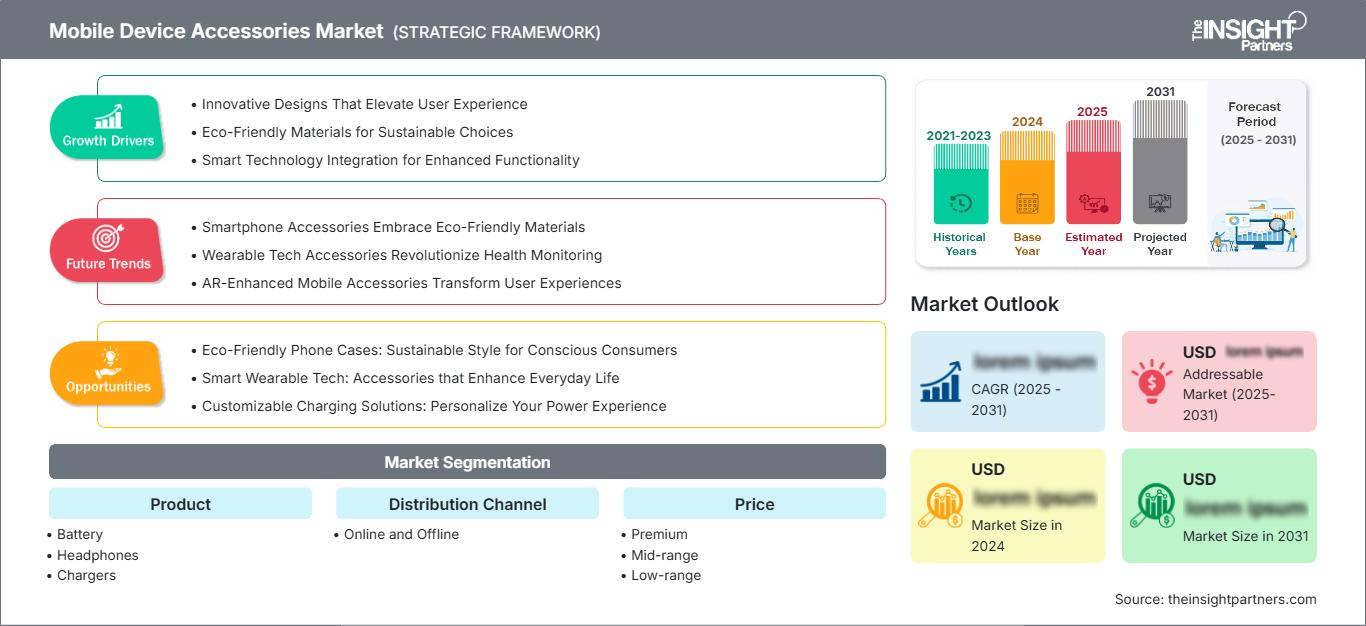
The mobile device accessories market is valued at US$ 108.09 Billion in 2025 and is projected to reach US$ 201.35 Billion by 2034, expanding at a CAGR of 7.16% during 2026–2034. The category encompasses charging, audio, battery, and storage products that extend smartphone functionality and support increasingly connected lifestyles. Product innovation is shifting toward faster charging, wireless interoperability, compact designs, and higher-performance audio experiences.
North America is positioned for steady expansion, with the mobile device accessories market size supported by premium smartphone ownership, high accessory replacement frequency, and established omnichannel retail infrastructure. A modeled regional CAGR of 6.4–7.1% for 2026–2034 reflects continued adoption of wireless charging, premium headphones, portable power solutions, and accessories designed around longer device usage cycles.
Mobile Device Accessories Market Assessment and Insights
- North America: The region is estimated to hold a 27–30% mobile device accessories market share in 2025 and expand at a 6.4–7.1% CAGR between 2026–2034, supported by premium devices, replacement demand, mature e-commerce, and strong branded accessory penetration.
- US: The US represents approximately 79–83% of North American demand in 2025 and is modeled to grow at a 6.3–7.0% CAGR through 2034, led by premium audio and charging products.
- Europe: Europe is estimated at a 21–24% share in 2025, growing at a 6.1–6.8% CAGR through 2034. Germany, the UK, France, Italy, and Spain benefit from USB-C standardization, premium audio adoption, and sustainability-oriented purchasing.
- Asia Pacific: Asia Pacific commands an estimated 39–42% share in 2025 and is expected to expand at a 7.6–8.4% CAGR. China, India, Japan, and South Korea combine large device populations, manufacturing depth, and expanding online retail.
- Largest Segment: The Chargers segment is modeled at a 24–28% market share in 2025, with a 7.0–7.7% CAGR during 2026–2034, reflecting essential replacement and fast-charging adoption.
- High Growth Segment: Online distribution is estimated at a 7.8–8.6% CAGR, with a 36–40% share in 2025, supported by convenience, assortment breadth, reviews, and direct-to-consumer availability.
- Key companies analyzed in detail: Samsung Electronics Co., Ltd.; Sony Corporation; BYD Company Ltd.; Energizer Holdings, Inc.; Bose Corporation; Beats; Sennheiser Electronics GmbH & Co. KG; Panasonic Corporation; Toshiba Corporation; Griffin Technologies.
Source: The Insight Partners' analysis based on proprietary research, government publications, company annual reports, investor presentations, industry databases, and expert interviews.
The market segment has shifted from mere protective accessories to sophisticated accessories that integrate well with smart gadgets. The advent of USB-C standardization, gallium nitride-based fast chargers, Qi2 wireless chargers, adaptive audio, active noise cancellation, and higher-capacity battery cells has resulted in changes in specifications of product offerings. Production has become more concentrated within electronics ecosystems in East Asia, but brands have expanded their sourcing to avoid issues related to counterfeiting, component volatility, and interoperability.
In the coming years, opportunities will arise in regions such as India, Southeast Asia, Latin America, the Middle East, and certain African economies. Government focus on standardizing charging interfaces and e-waste management practices will benefit compliant accessories. Innovations in recycled material use, modularity, power management, and audio accessories driven by software will offer opportunities for manufacturers willing to provide products with superior performance and environmental credentials.
Mobile Device Accessories Market Report Scope
| Report Attribute | Details |
|---|---|
| Market size in 2025 | US$ 108.09 Billion |
| Market Size by 2034 | US$ 201.35 Billion |
| Global CAGR (2026 - 2034) | 7.16% |
| Historical Data | 2021-2024 |
| Forecast period | 2026-2034 |
Mobile Device Accessories Market Analysis
Rising demand for accessories is linked to the installed base of smartphones and not just shipments of handsets alone. The longer period of handset replacement ensures that the users replace their chargers, headphones, power banks, and external memory, keeping the same handsets. This trend helps in driving the market for mobile device accessories through repeated after-market sales while USB-C compatibility helps reduce incompatibility issues.
The value chain in the mobile device accessories market includes semiconductor suppliers, battery cell suppliers, component suppliers, assembly of accessories, branded manufacturers, distribution channel, market places, and retail sales channels. Components such as power management integrated circuits, lithium ion batteries, wireless charging components, audio processing units, connectors, and memory still continue to be key inputs. Sourcing strategies focus more on dual sourcing and regional inventories due to component shortages or logistics challenges.
The competition in the mobile device accessories market is based on handset ecosystem companies and specialist audio, power, and battery brands. Samsung Electronics Co., Ltd. capitalizes on device integration whereas Sony Corporation and Bose Corporation highlight high-end audio features, but Panasonic Corporation and Energizer Holdings, Inc. have maintained a presence in the power-based categories. Beats and Sennheiser Electronics GmbH & Co. KG further enhance the high-end audio portfolio, whereas BYD Company Ltd. provides battery expertise.
Strategic positioning in the mobile device accessories market is now becoming more dependent on certification, ecosystem fit, reliability, and channel performance than mere specifications. Toshiba Corporation and Griffin Technologies capitalize on specialized accessory and storage opportunities, while market leaders keep on enhancing their direct online offerings. Partnering with retailers and device OEMs is crucial as bundling can help in raising attachment rate and reducing customer acquisition cost.
● REPORT CUSTOMIZATION
Tailor This Report To Align With Your Specific Business Requirements
This report can be customized to align precisely with your business objectives, scope, and target markets. Customization options include tailored segmentation, geography, competitive analysis, and strategic insights to support informed decision-making.
Customize This Report →WHAT YOU CAN ADJUST
- ● Segmentations
- ● Geography
- ● Competitive Analysis
- ● Language Preferences
Mobile Device Accessories Market: Strategic Insights
Regional Insights
North America mobile device accessories market
The mobile device accessories market report shows that North America is estimated to represent 27–30% of 2025 demand and is modeled to expand at a 6.4–7.1% CAGR through 2034. High smartphone adoption rates, presence of specialty retail, good market penetration, and the readiness to pay for certified accessories are some of the strengths of the region. Premium headphones, wireless chargers, GaN adapters, and power banks of large capacity still represent crucial revenue sources. The US represents the main source of demand in the region, whereas Canada adds its value via e-commerce development and premium electronics consumption.
Replacements are driven by the need to replace accessories frequently, the need to travel, remote working arrangements, and the growing number of connected devices that people own. People also compare charging speeds, temperature resistance, reliability, warranty terms, and other factors before buying. Regulations on charging standards promote the adoption of standardized products. Brand reputation is also crucial as people relate safety and reliability of charging to protection of their devices.
U.S. mobile device accessories market
The US accounts for approximately 79–83% of North American demand in 2025 and is projected to grow at a 6.3–7.0% CAGR. It is due to the high levels of accessory penetration, high level of online shopping, possession of premium smartphones, and widespread distribution via electronics retailers, carrier stores, and official brand websites. The Samsung Electronics Co., Ltd., Sony Corporation, Bose Corporation, Beats, Energizer Holdings, Inc., and many other well-known brands provide high-level visibility among consumers in the fields of audio and power products.
The highest demand for chargers, headphones, power banks, and external memory is driven by the ease of online shopping and comparative analysis of products. Premium consumers pay a lot of attention to noise cancellation, wireless charging capabilities, small GaN power adapters, and reliable battery management. The frequency of accessory replacement is higher than the frequency of mobile phone replacement, which allows accessory sales despite fewer smartphone replacements.
Europe mobile device accessories market
According to the mobile device accessories market forecast, Europe is estimated to hold a 21–24% share in 2025 and is modeled to grow at a 6.1–6.8% CAGR through 2034. Demand centers are represented by the United Kingdom, Germany, France, Italy, and Spain, while regulations play an increasingly important role in the design, packaging, and purchasing of products.
The United Kingdom combines strong online shopping activity with demand for high-end audio and charging accessories. In Germany, there is focus on reliability and compliance in technical and durable electronics, favoring branded chargers and headphones. There is increasing demand in France for high-end and eco-friendly accessories. In Italy and Spain, growth in online shopping, tourist-related purchases of power accessories, and use of wireless audio plays a part. Germany is clearly the strongest single European market due to its electronics consumer base and retail infrastructure.
APAC mobile device accessories market
APAC is estimated at a 39–42% share in 2025 and is modeled to expand at a 7.6–8.4% CAGR, making it the leading regional growth engine. China is the top country with regard to demand in the region, followed by Japan, South Korea, India, and Australia. High usage of smartphones, manufacturing prowess, and online shopping have contributed to increased accessibility of products.
Integration of electronics supply chain is common in China, but India has combined growth in use of smartphones with manufacturing of electronics. Japan and South Korea are more focused on advanced audio and charging products, but Australia prefers high-end accessories through retail stores and online platforms.
Middle East & Africa mobile device accessories market
Middle East and Africa demand is modeled to expand at a 6.8–7.7% CAGR through 2034. Saudi Arabia and the UAE lead premium consumption, while South Africa remains an important African distribution hub. MEA (Rest of MEA) is more sensitive to prices, as it involves charging devices and power banks.
Reliability of energy sources provides an advantage for portable power products in select African economies; whereas, tourism, smart city investments, and smartphone usage drive the need for such products in Gulf economies. Saudi Arabia is the biggest opportunity in the region due to investments in digital infrastructure and high consumer electronics expenditure. UAE demand is driven by connections to international retail, whereas South Africa has strong electronics distribution along with growing e-commerce demand.
Segmentation Analysis
Product
The Product segment is expected to remain the principal revenue contributor, with a modeled CAGR of 6.8–7.5% from 2026–2034. Chargers and headphones benefit from frequent replacement, while batteries, power banks, and external storage address portability and device longevity. Product differentiation increasingly centers on charging speed, thermal control, audio intelligence, capacity, durability, and compatibility. The mobile device accessories market scope therefore extends beyond basic add-ons toward connected, performance-oriented products.
- Battery: Batteries address replacement and backup requirements across portable devices. Demand is influenced by battery degradation, device longevity, safety standards, and consumer preference for dependable replacement components.
- Headphones: Headphones remain a major entertainment and communication accessory, with demand shifting toward wireless connectivity, active noise cancellation, spatial audio, low-latency performance, and ergonomic designs.
- Chargers: Chargers are essential accessories with strong replacement frequency. Fast charging, GaN technology, multi-port configurations, USB-C compatibility, and improved thermal management are shaping purchasing decisions.
- Power Bank: Power banks serve travelers, commuters, outdoor users, and consumers managing multiple connected devices. Capacity, charging speed, compactness, and battery safety increasingly determine product selection.
- External Storage: External storage supports users handling photographs, videos, applications, and work files. Higher-capacity portable solutions benefit creators and professionals requiring device-independent data management.
Distribution Channel
Distribution Channel is projected to record a 7.2–8.0% CAGR during 2026–2034. Online retail is gaining importance because accessories are easy to compare, ship, bundle, and reorder. Offline stores remain relevant for immediate purchases, demonstrations, warranty confidence, and compatibility assistance. The balance between both channels will depend on product complexity, consumer trust, price sensitivity, and brand visibility.
- Online: Online channels provide broad assortment, transparent specifications, customer reviews, promotional pricing, and convenient delivery. Brand-owned stores and marketplaces increasingly use personalized recommendations and bundled accessory offers.
- Offline: Offline channels remain important for immediate availability, physical evaluation, retailer assistance, and warranty reassurance. Electronics stores and carrier outlets retain relevance for premium and device-specific accessories.
Price
Price segmentation is projected to grow at a 6.6–7.3% CAGR during 2026–2034. Premium products benefit from advanced features and ecosystem integration, while mid-range products capture consumers seeking balanced performance. Low-range products remain important in price-sensitive economies, where affordability and replacement convenience often outweigh advanced specifications.
- Premium: Premium accessories emphasize advanced audio, charging performance, materials, durability, and ecosystem integration. They are particularly relevant among flagship-device users and consumers seeking differentiated experiences.
- Mid-range: Mid-range products balance price and functionality, attracting consumers who prioritize reliable performance without paying for every premium feature. This category benefits from broad retail availability.
- Low-range: Low-range products compete primarily on affordability and accessibility. They remain strategically important across emerging economies and high-volume replacement channels where basic functionality drives purchasing decisions.
Opportunity Snapshot
| Distribution Channel | Revenue Contribution | Trend Tag | Adoption Stage |
|---|---|---|---|
| Online | High | Digital Bundles | Scaling |
| Offline | High | Retail Convenience | Mature |
Mobile Device Accessories Market Growth Drivers and Impact Analysis
Expansion of Fast-Charging and Wireless Power Ecosystems
Fast charging is revolutionizing chargers from being simple peripherals to performance peripherals where power delivery, thermal design, port design, and certifications become important factors in influencing consumer decisions. Increased prevalence of USB-C means that there is less hassle around compatibility while Qi2 makes wireless charging experience more consistent across all compatible devices. All these developments might increase the average selling prices of chargers due to consumer readiness to upgrade old chargers with new ones if their performance is significantly improved. Companies can benefit from selling multi-port chargers for different types of devices such as smartphones, earbuds, watches, and tablets. There are multiple stakeholders involved in the process such as component manufacturers, certification providers, retailers, and brands as they have to balance safety, compatibility, and efficiency in their product design.
Rising Demand for Premium Wireless Audio Experiences
Wireless audio is becoming an increasingly important accessory category as consumers use smartphones for communication, entertainment, gaming, fitness, and content creation. Active noise cancellation, adaptive equalization, spatial audio, improved microphones, and low-latency connectivity are raising the functional value of headphones and earbuds. Premium models can command higher prices because consumers increasingly evaluate comfort, call clarity, battery life, and software features alongside sound quality. For manufacturers, this trend encourages investment in acoustic engineering, digital signal processing, artificial intelligence, and companion applications. Retailers also benefit because audio products offer strong opportunities for demonstrations, bundles, and cross-selling. The category creates recurring replacement potential as consumers upgrade for improved comfort, connectivity, and intelligent features rather than waiting for complete handset replacement.
Longer Smartphone Replacement Cycles Supporting Accessory Spending
Consumers retaining smartphones for longer periods can continue spending on accessories even when handset replacement slows. As device ownership duration increases, chargers, headphones, power banks, and storage products provide relatively affordable ways to refresh functionality without purchasing a new phone. This dynamic supports aftermarket resilience and encourages brands to design accessories with broader compatibility. Manufacturers can benefit from universal standards that allow one product to serve several generations of devices. Retailers also gain from replacement-led traffic because accessories can be purchased independently of handset launches. The resulting demand profile is less dependent on annual smartphone upgrade volumes and more connected to usage intensity, travel, entertainment, remote work, and multi-device ownership. This creates a stable foundation for recurring accessory purchases across developed and emerging economies.
Mobile Device Accessories Market Future Trends
AI-Enabled Accessories Become Part of Connected Device Ecosystems
The mobile device accessories market trends indicate that AI-enabled accessories are likely to become increasingly integrated with smartphones, particularly in headphones and wearable audio products. Future devices may use local processing and cloud-connected intelligence to provide adaptive sound, real-time translation, contextual controls, personalized equalization, and improved voice isolation. Such functionality will shift purchasing decisions from hardware specifications toward ecosystem usefulness. Manufacturers that combine sensors, microphones, low-power processors, and companion software can create differentiated experiences that encourage repeat purchases. The trend may also increase switching costs because consumers could prefer accessories that integrate deeply with their existing device ecosystem. Over time, intelligent accessories are expected to occupy a larger portion of premium portfolios, while simplified versions gradually migrate into mid-range products as component costs decline.
Sustainable Materials and Circular Accessory Design Gain Importance
Environmental considerations are expected to influence accessory design more strongly as regulators and consumers focus on electronic waste, packaging, repairability, and material efficiency. Manufacturers are likely to increase recycled plastics, paper-based packaging, replaceable components, and longer-life battery solutions. Charging products may particularly benefit from modular architectures that extend useful life when connectors or cables fail. Product labeling and material traceability could become important purchasing factors for environmentally conscious consumers and institutional buyers. Brands may also develop collection programs that recover batteries, plastics, metals, and electronic components from discarded accessories. This transition creates differentiation opportunities for companies able to demonstrate measurable environmental improvements without compromising charging safety, acoustic performance, durability, or price competitiveness.
Mobile Device Accessories Market Opportunities
Localized Manufacturing and Regional Supply Chain Development
Manufacturers can pursue opportunities by establishing or expanding localized production for high-volume chargers, power banks, cables, and audio components. Regional manufacturing reduces exposure to freight disruptions, tariff changes, inventory delays, and concentrated supplier risk. India, Southeast Asia, Mexico, and selected Eastern European locations offer potential for assembly and component ecosystem development. Companies can prioritize products with standardized architectures because these are easier to manufacture across multiple locations. Local sourcing can also improve responsiveness to regional demand patterns and shorten replenishment cycles. Investment decisions should consider labor availability, component ecosystems, certification infrastructure, logistics connectivity, and government manufacturing incentives. A diversified footprint can strengthen supply continuity while enabling brands to customize products, packaging, and channel strategies for specific consumer markets.
Premiumization Through Multi-Device Accessory Ecosystems
A significant opportunity exists in developing accessory ecosystems capable of serving several devices through coordinated charging, audio, and storage solutions. Consumers increasingly operate smartphones alongside earbuds, tablets, watches, laptops, and other connected products, creating demand for accessories that reduce cable clutter and simplify power management. Brands can respond with multi-port GaN chargers, wireless charging stations, synchronized audio products, and storage solutions designed around common connectivity standards. Premium ecosystem bundles can increase transaction value while improving customer retention. Companies should focus on interoperability rather than proprietary limitations because consumers increasingly expect accessories to work across devices. Strategic partnerships with handset manufacturers, retailers, and digital platforms can accelerate distribution while helping brands collect product feedback and identify emerging accessory use cases.
Frequently Asked Questions

- Comprehensive Market Sizing and Forecast Analysis
- Detailed Segmentation Analysis
- In-Depth Market Dynamics Assessment
- Regional and Country-Level Insights
- Competitive Landscape and Company Benchmarking
- Strategic Business Intelligence
Recent Reports
Testimonials

The Insight Partners provided valuable market intelligence that supported our global go-to-market strategy. Their team was professional, responsive, and attentive to our feedback, providing thoughtful analysis and helpful methodological clarifications throughout the project.
Junmo Kim Chief Financial Officer (CFO), Enertech Co., Ltd.
The Insight Partners' SCADA System Market report is comprehensive, with valuable insights on current trends and future forecasts. The team was highly professional, responsive, and supportive throughout. We are very satisfied and highly recommend their services.
RAN KEDEM Partner, Reali Technologies LTDs
I requested a report on a very specific software market and the team produced the report in a few days. The information was very relevant and well presented. I then requested some changes and additions to the report. The team was again very responsive and I got the final report in less than a week.
JEAN-HERVE JENN Chairman, Future Analytica
We worked with The Insight Partners for an important market study and forecast. They gave us clear insights into opportunities and risks, which helped shape our plans. Their research was easy to use and based on solid data. It helped us make smart, confident decisions. We highly recommend them.
PIYUSH NAGPAL Sr. Vice President, High Beam Global
The Insight Partners delivered insightful, well-structured market research with strong domain expertise. Their team was professional and responsive throughout. The user-friendly website made accessing industry reports seamless. We highly recommend them for reliable, high-quality research services
YUKIHIKO ADACHI CEO, Deep Blue, LLC.
This is the first time I have purchased a market report from The Insight Partners.While I was unsure at first, I visited their web site and felt more comfortable to take the risk and purchase a market report.I am completely satisfied with the quality of the report and customer service. I had several questions and comments with the initial report, but after a couple of dialogs over email with their analyst I believe I have a report that I can use as input to our strategic planning process.Thank you so much for taking the extra time and making this a positive experience.I will definitely recommend your service to others and you will be my first call when we need further market data.
JOHN SUZUKI President and Chief Executive Officer, Board Director, BK Technologies
I wish to appreciate your support and the professionalism you displayed in the course of attending to my request for information regarding to infectious disease IVD market in Nigeria. I appreciate your patience, your guidance, and the fact that you were willing to offer a discount, which eventually made it possible for us to close a deal. I look forward to engaging The Insight Partners in the future, all thanks to the impression you have created in me as a result of this first encounter.
DR CHIJIOKE ONYIA MANAGING DIRECTOR, PineCrest Healthcare Ltd.Reason to Buy
- Informed Decision-Making
- Understanding Market Dynamics
- Competitive Analysis
- Identifying Emerging Markets
- Customer Insights
- Market Forecasts
- Risk Mitigation
- Boosting Operational Efficiency
- Strategic Planning
- Investment Justification
- Tracking Industry Innovations
- Aligning with Regulatory Trends





 Get Free Sample for