
Mobile Power Plants Market Outlook and Strategic Insights by 2034
Coverage: By Fuel Type (Natural Gas, Diesel, and Others); Application (Oil & Gas, Emergency Power, and Remote Area Electrification), and Geography
- Status : Data Released
- Report Code : TIPEL00002040
- Category : Manufacturing and Construction
- No. of Pages : 150
- Available Report Formats :


- Last update date : July 27, 2026


2025 Market Size
US$ 2.08 Bn
Base year value
2034 Forecast
US$ 3.12 Bn
Projected by 2034
CAGR 2026-2034
4.6 %
Growth rate
Addressable Market
US$ 23.60 Bn
(2026-2034)
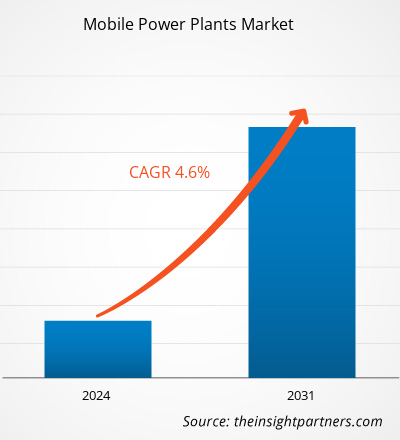
The Mobile Power Plants market size was estimated at US$ 2.08 Billion in 2025 and is forecasted to reach US$ 3.12 Billion by 2034, growing at a CAGR of 4.6% during the period 2026-2034. Demand for mobile power plants will be driven by fast deployment of generation capacity in response to outages in the grid, oil & gas activities, temporary industrial requirements, and remote electrification initiatives where construction of generation assets is delayed or unfeasible.
Purchase of mobile power plants in North America is projected to witness a CAGR between 4.2% and 4.8% up to 2034 driven by resilient power generation, increased load on data centers, outage management, and electrification requirements in the oilfields. Growth in the Mobile Power Plants Market size in North America is fueled by gas turbines, emissions-compliant diesel generators, and rental solutions to mitigate upfront capital investments.
Mobile Power Plants Market Assessment and Insights
- North America accounted for 28–30% share in 2025 and is growing at a CAGR range of 4.2–4.8% during 2026–2034, supported by data centers, industrial resilience, and oilfield demand.
- US represented 78–82% of North America in 2025 and is growing at a CAGR range of 4.3–4.9% during 2026–2034, led by grid-constrained commercial loads.
- Europe held 21–23% share in 2025 and is growing at a CAGR range of 3.8–4.4% during 2026–2034, with Germany, the UK, France, Italy, and Spain leading temporary capacity needs.
- Asia Pacific captured 30–32% share in 2025 and is growing at a CAGR range of 5.0–5.6% during 2026–2034, led by China, India, Japan, South Korea, and Australia.
- Largest Segment Natural Gas held a market share range of 55–59% in 2025, growing at a CAGR range of 4.7–5.3% during 2026–2034 due to cleaner dispatch and utility use.
- High Growth Segment Remote Area Electrification held a market share range of 24–27% in 2025, growing at a CAGR range of 5.3–5.9% during 2026–2034 as off-grid programs expand.
- Key companies analyzed in detail: Aggreko Limited, New APR Energy LLC, GE Vernova Inc., Kawasaki Heavy Industries, Ltd., MAPNA Group, MYTILINEOS Energy & Metals, PW Power Systems LLC, Siemens Energy AG, Solar Turbines Incorporated, and Turbine Technology Services Corporation.
Source: The Insight Partners' analysis based on proprietary research, government publications, company annual reports, investor presentations, industry databases, and expert interviews.
The mobile generation sector has evolved from being emergency rental backup to becoming an engineered fast-power system that is more efficient, environmentally friendly, and rapidly deployable. Gas turbines, diesel trailer packages, control systems, switchgear, and fuel management are now packaged as portable power solutions and not standalone generators. This will ensure mobilization predictability, optimized asset utilization, and compatibility with decentralized power systems for utilities, resource extraction locations, and industrial temporary camps.
In the future, the factors driving adoption will be grid congestion, remote electrification needs, disaster recovery efforts, and stricter emission regulations. Developing countries with poor transmission infrastructure will purchase flexibility capacity, while developed nations will deploy mobile generation units to address interconnection bottlenecks. Investments will also be made in monitoring technologies, hybrid-capability configurations, and cleaner fuel systems.
Mobile Power Plants Market Report Scope
| Report Attribute | Details |
|---|---|
| Market size in 2025 | US$ 2.08 Billion |
| Market Size by 2034 | US$ 3.12 Billion |
| Global CAGR (2026 - 2034) | 4.6% |
| Historical Data | 2021-2024 |
| Forecast period | 2026-2034 |
Mobile Power Plants Market Analysis
The market is driven by three interrelated sources of demand, including fast-tracked utility peaking plants, industrial reliability needs, and field operations. Utilities need temporary generating capacity in seasonal spikes and transmission expansion programs, while oil and gas producers deploy mobile assets to run drilling, compression, and process equipment. The trend is toward modular solutions for transportable turbines and generators, engineered for repeated installation in regional markets.
The availability of fuel is an important element in procurement decisions. Natural gas units have a competitive advantage where there is access to pipelines and/or LNG logistics, while diesel fuels still matter for backup purposes and difficult conditions. Buyers also consider life-cycle costs, environmental compliance, maintenance and logistics support, and ramp rates. In light of outage frequency, grid reliability issues, and dispersed load, vendors with equipment and logistics capabilities can earn repeated orders.
The competitive landscape is influenced by fleet size, turbine efficiencies, network services, and financial agility. International gas turbine manufacturers compete with rental companies and regional engineering companies. Aggreko Limited prioritizes distributed rental capacity, whereas GE Vernova Inc. and PW Power Systems LLC are known for their aeroderivative turbine designs that suit rapid responses from utilities and off-grid industrial facilities.
Competitive position becomes an aspect of decarbonization capability. Siemens Energy AG, Kawasaki Heavy Industries, Ltd., Solar Turbines Incorporated, and MYTILINEOS Energy & Metals are part of ecosystems of gas turbines, EPC, and energy infrastructure providers. In addition, new APR Energy LLC demonstrates the advantages of the redeployment business model, and MAPNA Group and Turbine Technology Services Corporation assist with local implementation and maintenance services in infrastructure-dependent regions.
● REPORT CUSTOMIZATION
Tailor This Report To Align With Your Specific Business Requirements
This report can be customized to align precisely with your business objectives, scope, and target markets. Customization options include tailored segmentation, geography, competitive analysis, and strategic insights to support informed decision-making.
Customize This Report →WHAT YOU CAN ADJUST
- ● Segmentations
- ● Geography
- ● Competitive Analysis
- ● Language Preferences
Mobile Power Plants Market: Strategic Insights
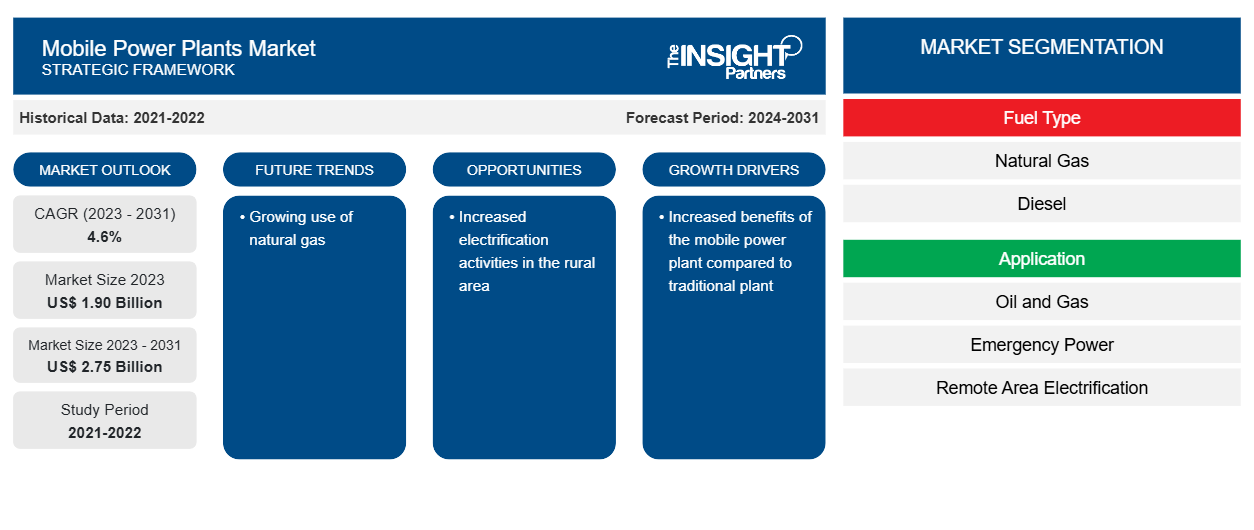
Regional Insights
North America Mobile Power Plants Market
North America represented 28–30% of 2025 revenue and is projected to grow at a CAGR range of 4.2–4.8% during 2026–2034. The Mobile Power Plants Market share in the region reflects utility reliability spending, severe-weather preparedness, and temporary power demand from construction, mining, data centers, and upstream oil and gas. Grid interconnection queues have increased interest in bridge power, particularly for projects that cannot wait for permanent substations or transmission upgrades.
Natural gas solutions are increasingly attractive due to emission requirements and economic conditions for solutions based on turbines. Diesel continues to play an important role in emergency backup situations due to its portability and ability to work independent of the gas supply system. The best opportunities for suppliers will be found by those who have depots in North America and meet emission requirements.
U.S. Mobile Power Plants Market
North America is represented by the United States, covering 78-82% of the continent, and will continue growing at a CAGR between 4.3% and 4.9% up to 2034. The demand is driven by data center clusters, shale basins, utility outage programs, states vulnerable to disasters, and temporary industrial power loads. Examples of new deployments of APR Energy LLC for data centers and utilities in 2025 can be used to highlight fast-track mobile gas turbines helping address grid capacity issues.
Company representation includes rental companies, turbine OEMs, and service providers. GE Vernova Inc., Solar Turbines Incorporated, Siemens Energy AG, PW Power Systems LLC, and Aggreko Limited participate in projects that require rapid deployment, service provision, and know-how of regulations. Applications are extending beyond emergency power to provide power solutions for business growth and utility peak periods.
Europe Mobile Power Plants Market
Europe held 21–23% share in 2025 and is forecast to grow at a CAGR range of 3.8–4.4% during 2026–2034. The UK is a leading rental and temporary power market because of aging network assets, event power demand, and distributed industrial requirements. Germany leads in engineered mobile capacity linked to industrial resilience, grid balancing, and backup systems for energy-intensive manufacturing clusters.
France, Italy, and Spain contribute through emergency preparedness, island and remote community support, and temporary generation for infrastructure works. Europe’s stricter emissions rules favor gas-fired and cleaner diesel packages with improved control systems. The region’s growth is measured rather than rapid because permanent grid upgrades, renewable integration, and permitting frameworks influence the need for relocatable thermal generation.
APAC Mobile Power Plants Market
APAC accounted for 30–32% share in 2025 and is projected to grow at a CAGR range of 5.0–5.6% through 2034. China remains the leading country due to industrial load growth, coastal infrastructure, and emergency response capacity, while India supports demand through remote electrification, mining, and grid reinforcement needs.
Japan and South Korea emphasize resilient backup for critical facilities and industrial continuity, whereas Australia uses mobile power for mining, remote communities, and temporary project sites. Policy focus on energy security, rural access, and industrial expansion supports flexible generation procurement across the Mobile Power Plants Market.
Middle East & Africa Mobile Power Plants Market
Middle East & Africa is expected to grow at a CAGR range of 4.6–5.2% during 2026–2034. Saudi Arabia and the UAE lead demand through oil and gas operations, remote industrial sites, and infrastructure expansion, while South Africa uses temporary power to reduce outage exposure.
Rest of MEA demand is linked to mining, utility shortfalls, and electrification gaps. Gas units are preferred where fuel networks exist, but diesel remains important for rapid deployment. The region’s energy context favors providers with turnkey logistics, harsh-environment equipment, and long-duration operation capability.
Segmentation Analysis
Fuel Type
Fuel Type is projected to grow at a CAGR range of 4.4–5.0% during 2026–2034. The Mobile Power Plants Market scope under fuel choice is shaped by emissions rules, fuel logistics, operating duration, and site criticality. Natural gas increasingly supports cleaner, longer-duration deployments, while diesel remains strategically important where fuel infrastructure is limited or immediate emergency response is required.
- Natural Gas leads deployments where pipeline access, LNG supply, or cleaner fuel mandates support turbine-based operation, offering lower local emissions and stronger fit for utility and industrial bridge power.
- Diesel remains essential for emergency response, isolated sites, and short-term projects because stored fuel availability, rugged generator designs, and rapid start capability support mission-critical continuity.
Application
Application is projected to grow at a CAGR range of 4.8–5.4% during 2026–2034. Demand varies by operating profile: oil and gas requires robust off-grid supply, emergency power prioritizes speed and reliability, and remote electrification emphasizes sustained operation with manageable logistics. Procurement decisions increasingly consider mobility, emissions performance, digital monitoring, and the ability to scale capacity in modular blocks.
- Oil and Gas uses mobile power for drilling, compression, pumping, and processing sites where grid access is limited, project timelines are compressed, and uptime directly affects production economics.
- Emergency Power relies on deployable fleets for disaster recovery, utility outages, hospitals, data centers, and public infrastructure, creating recurring need for standby contracts and rapid mobilization.
- Remote Area Electrification supports communities, mining zones, islands, and construction corridors where permanent grid extension is delayed, costly, or technically difficult, making flexible generation strategically valuable.
Opportunity Snapshot
| Application | Revenue Contribution | Trend Tag | Adoption Stage |
| Oil and Gas | High | Field Power | Mature |
| Emergency Power | Medium | Outage Resilience | Scaling |
| Remote Area Electrification | Medium | Offgrid Access | Emerging |
Mobile Power Plants Market Growth Drivers and Impact Analysis
Grid Congestion and Delayed Interconnections
The growth of industrial loads, electrification of buildings, and data centers is outpacing transmission expansion. Mobile generation fills the gap where utilities take time for permitting, transformers, substations, or lines to be built. This trend has commercial value since businesses get up and running faster without losing productivity and postpone investment decisions on permanent infrastructure until demand is established. With a ready fleet and standard solutions, mobile generation companies can cut the timeline of such projects from years to months.
Rising Need for Emergency and Disaster Recovery Power
Weather events, wildfire threats, flooding problems, and aging electrical infrastructure have boosted the worth of fast deployment power capabilities for utility companies, hospitals, water facilities, telecommunications firms, and public entities. Fast deployment plants enable operators of such critical infrastructure to resume operations either until repairs on damaged infrastructure are completed or until the load is shifted elsewhere. The business effect in this case will be a trend towards standby arrangements in advance, fleet staging ahead of events, and contingency plans across multiple sites.
Remote Industrialization and Resource Development
Mining, oil and gas drilling, construction and manufacturing facilities in remote areas usually start operations before grid power is available. Mobile power stations are well-suited for these applications because they allow capacity to be tailored to the phases of development and reduce high capital costs in the initial stages. It works best when there are commodity cycles, exploration periods, or uncertainties in the availability of the power plant infrastructure. Mobile power stations can help operators scale capacity in accordance with production and can relocate the equipment once the project has ended.
Mobile Power Plants Market Future Trends
Hybrid-Ready Mobile Generation Platforms
Mobile Power Plants market trends include an increase in hybrid power plants that combine thermal generation with battery storage and future renewable generation capabilities. Such systems decrease the use of fuel during off-peak load times and make it possible for silent operation around environmentally sensitive areas. Going forward, customers will demand products that can work as part of microgrids and renewable energy sources in addition to having digital dispatch capabilities. Manufacturers that can produce hybrid-compatible equipment will benefit from increased usage rates and compliance with new emissions standards.
Digital Fleet Optimization and Predictive Service
Remote monitoring, asset telemetry, and predictive maintenance will become central to mobile power economics. Operators are seeking higher fleet availability, lower unplanned downtime, and better fuel-performance visibility across dispersed sites. Digital platforms can track load profiles, component health, emissions performance, and service intervals, allowing suppliers to schedule maintenance before failures occur. This trend will favor companies with integrated controls, service analytics, and global field support because customers increasingly evaluate generation contracts on delivered uptime, compliance transparency, and total operating cost.
Mobile Power Plants Market Opportunities
Bridge Power for Data Centers and Digital Infrastructure
Data center developers are facing power availability constraints while artificial intelligence, cloud computing, and edge facilities accelerate demand. Mobile Power Plants Market Forecasts indicate attractive opportunities for fast-track generation that can support campuses before permanent grid service arrives. Investors can target fleet expansion, gas turbine packages, and behind-the-meter contracts tied to high-credit customers. The opportunity is not only capacity rental; it includes engineering, permitting support, fuel management, emissions compliance, and long-term service agreements that turn temporary power into a strategic development enabler.
Electrification Support for Remote Communities
Remote communities, islands, and isolated industrial corridors need reliable power where grid extension is costly or slow. Mobile plants can provide phased electrification while governments, utilities, and development agencies assess permanent solutions. Companies can pursue partnerships that combine mobile generation with storage, efficiency controls, and local service training. This opportunity is strongest where load growth is uncertain, because relocatable assets reduce stranded-investment risk. Suppliers that structure flexible financing and operations support can capture demand from public utilities, mining zones, and off-grid infrastructure programs.
Recent Developments
- June 2026: Atlas Copco has introduced the FCS 220-240, a mobile rapid charging station designed to deliver electricity directly at the point of use. Suitable for temporary installation across construction, industrial and events applications, the system enables operators to quickly deploy high-power charging infrastructure wherever it is needed.
- April 2025: APR Energy LLC secured a contract to deliver 150 MW of fast power to support Mexico’s national utility in Baja California. The project will mobilize six high-output mobile gas turbines, with operational readiness targeted within 90 days, demonstrating accelerated deployment for utility-scale temporary capacity.
- March 2025: GE Vernova Inc. launched next generation of mobile aeroderivative gas turbines, “power plants on wheels” delivering reliable and efficient power anywhere, whether on or off the grid. The new TM2500* Dry Low Emissions (DLE) is GE Vernova’s waterless, mobile 34MW power plant that offers higher-efficiency performance, up to 39 percent efficiency, with reduced NOx emissions and waste.
Frequently Asked Questions

- Comprehensive Market Sizing and Forecast Analysis
- Detailed Segmentation Analysis
- In-Depth Market Dynamics Assessment
- Regional and Country-Level Insights
- Competitive Landscape and Company Benchmarking
- Strategic Business Intelligence
Recent Reports
Testimonials

The Insight Partners' SCADA System Market report is comprehensive, with valuable insights on current trends and future forecasts. The team was highly professional, responsive, and supportive throughout. We are very satisfied and highly recommend their services.
RAN KEDEM Partner, Reali Technologies LTDs
I requested a report on a very specific software market and the team produced the report in a few days. The information was very relevant and well presented. I then requested some changes and additions to the report. The team was again very responsive and I got the final report in less than a week.
JEAN-HERVE JENN Chairman, Future Analytica
We worked with The Insight Partners for an important market study and forecast. They gave us clear insights into opportunities and risks, which helped shape our plans. Their research was easy to use and based on solid data. It helped us make smart, confident decisions. We highly recommend them.
PIYUSH NAGPAL Sr. Vice President, High Beam Global
The Insight Partners delivered insightful, well-structured market research with strong domain expertise. Their team was professional and responsive throughout. The user-friendly website made accessing industry reports seamless. We highly recommend them for reliable, high-quality research services
YUKIHIKO ADACHI CEO, Deep Blue, LLC.
This is the first time I have purchased a market report from The Insight Partners.While I was unsure at first, I visited their web site and felt more comfortable to take the risk and purchase a market report.I am completely satisfied with the quality of the report and customer service. I had several questions and comments with the initial report, but after a couple of dialogs over email with their analyst I believe I have a report that I can use as input to our strategic planning process.Thank you so much for taking the extra time and making this a positive experience.I will definitely recommend your service to others and you will be my first call when we need further market data.
JOHN SUZUKI President and Chief Executive Officer, Board Director, BK Technologies
I wish to appreciate your support and the professionalism you displayed in the course of attending to my request for information regarding to infectious disease IVD market in Nigeria. I appreciate your patience, your guidance, and the fact that you were willing to offer a discount, which eventually made it possible for us to close a deal. I look forward to engaging The Insight Partners in the future, all thanks to the impression you have created in me as a result of this first encounter.
DR CHIJIOKE ONYIA MANAGING DIRECTOR, PineCrest Healthcare Ltd.Reason to Buy
- Informed Decision-Making
- Understanding Market Dynamics
- Competitive Analysis
- Identifying Emerging Markets
- Customer Insights
- Market Forecasts
- Risk Mitigation
- Boosting Operational Efficiency
- Strategic Planning
- Investment Justification
- Tracking Industry Innovations
- Aligning with Regulatory Trends





 Get Free Sample for