
Modular Construction Market Demand, Trends & Forecast by 2034
Coverage: by Product (Roofs & Floor Walls, Columns & Beams); Material (Concrete, Steel, Plastic, and Wood); and End-User (Commercial, Industrial, and Residential), and Geography (North America, Europe, Asia Pacific, and South and Central America)
- Status : Data Released
- Report Code : TIPMC00002625
- Category : Manufacturing and Construction
- No. of Pages : 150
- Available Report Formats :


- Last update date : July 28, 2026


2025 Market Size
US$ 112.34 Bn
Base year value
2034 Forecast
US$ 173.97 Bn
Projected by 2034
CAGR 2026-2034
4.98 %
Growth rate
Addressable Market
US$ 1,299.34 Bn
(2026-2034)
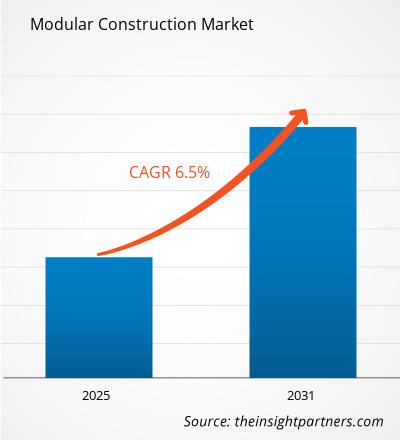
The global Modular Construction Market is expected to increase from US$ 112.34 Billion in 2025 to US$ 173.97 Billion by 2034 at a CAGR of 4.98%. This trend is from project-based prefabrication towards standardized and factory-driven building systems due to uncertainties in project schedules, shortage of on-site labor, high costs, and increasing sustainability standards in commercial, industrial, and residential construction.
The North American region remains structurally significant, with a regional CAGR forecast for 2026-2034 in the 4.4%-4.9% range. The Modular Construction Market size in the North American region is boosted by the scarcity of houses, the deficiency in skilled labor, healthcare expansion, and the public sector’s desire for quicker school and community facilities, especially in urban areas.
Modular Construction Market Assessment and Insights
- North America accounted for 27–30% share in 2025 and is expected to grow at a 4.4–4.9% CAGR between 2026–2034, led by workforce shortages, data center demand, education upgrades, and multifamily housing programs.
- US represented 76–80% of North America in 2025 and is projected to expand at a 4.5–5.0% CAGR between 2026–2034, supported by healthcare, education, and affordable housing.
- Europe held 25–28% share in 2025 and is forecast to grow at a 4.0–4.6% CAGR between 2026–2034, led by the UK, Germany, France, Sweden, and the Netherlands.
- Asia Pacific captured 34–38% share in 2025 and is projected to grow at a 5.4–6.1% CAGR between 2026–2034, with China, Japan, India, South Korea, and Australia driving adoption.
- Largest Segment Commercial held 42–46% market share in 2025 and is expected to grow at a 4.7–5.2% CAGR between 2026–2034 due to offices, retail, hospitality, and institutional demand.
- High Growth Segment Residential held 31–35% market share in 2025 and is projected to grow at a 5.5–6.2% CAGR between 2026–2034 as housing shortages intensify.
- Key companies analyzed in detail: ACS Actividades de Construcción y Servicios S.A., Komatsu Ltd., Bouygues Construction, Kiewit Corporation, Laing O'Rourke plc, Skanska AB, ATCO Ltd., Balfour Beatty plc, Taisei Corporation, and System House R&C Co., Ltd.
Source: The Insight Partners' analysis based on proprietary research, government publications, company annual reports, investor presentations, industry databases, and expert interviews.
The technology of factory-based delivery has evolved from temporary accommodation at sites to engineered building systems utilizing Building Information Modeling (BIM), standard interfaces, predictable frame structures, and so on. The market can use benefits of design and manufacture processes, where roofs, floors, walls, columns, and beams can be manufactured with quality control procedures. Production facilities can become closer to construction routes to decrease transportation costs, module risks and installation delays.
During the forecast period, investments are expected to focus on housing programs in Asia Pacific, education and healthcare projects in North America, and low-carbon refurbishment in Europe. There would be policies concerning the efficiency of buildings, delivery of public infrastructure and creation of resilient housing supply. Developers with standardized design, predictable supply chain and manufacturing capacity are expected to win higher conversion rates than project-based assemblers.
Modular Construction Market Report Scope
| Report Attribute | Details |
|---|---|
| Market size in 2025 | US$ 112.34 Billion |
| Market Size by 2034 | US$ 173.97 Billion |
| Global CAGR (2026 - 2034) | 4.98% |
| Historical Data | 2021-2024 |
| Forecast period | 2026-2034 |
Modular Construction Market Analysis
Factors affecting demand include schedule compression, shortage of skilled labor, and accountability for construction waste. The market growth will be most robust wherever owners can replicate the designs at many sites like hotels, schools, housing for workers, hospitals, and manufacturing support buildings. Controlled manufacturing enables better tolerance management and minimizes weather-induced disruptions on-site.
The ecosystem comprises architects, engineers, module manufacturers, material suppliers, logistics companies, crane service providers, building inspectors, and developers. Supply chain dynamics remain vulnerable to steel costs, concrete availability, wood certification, transportation permits, and factory utilization. Companies that coordinate early design lock-in, procurement planning, and site preparation can reap financial gains from the speed of modular construction.
Positioning strategy now leans toward integrating delivery capabilities rather than manufacturing alone. The analysis on the Modular Construction Market reveals that ACS Actividades de Construcción y Servicios S.A., Bouygues Construction, Skanska AB, Kiewit Corporation, and Balfour Beatty plc will be supported by infrastructure connections, whereas Laing O'Rourke plc and ATCO Ltd. focus on off-site skills and asset reusability.
Key investments include automated welding, digital twins, low-carbon concrete, MEP integration for modules, and factories close to high-demand urban areas. Komatsu Ltd., Taisei Corporation, and System House R&C Co., Ltd. have positioned themselves according to the industrialized Japanese building model, whereas international constructors are relying on collaboration and pipeline projects to reduce underutilization of their factories.
● REPORT CUSTOMIZATION
Tailor This Report To Align With Your Specific Business Requirements
This report can be customized to align precisely with your business objectives, scope, and target markets. Customization options include tailored segmentation, geography, competitive analysis, and strategic insights to support informed decision-making.
Customize This Report →WHAT YOU CAN ADJUST
- ● Segmentations
- ● Geography
- ● Competitive Analysis
- ● Language Preferences
Modular Construction Market: Strategic Insights
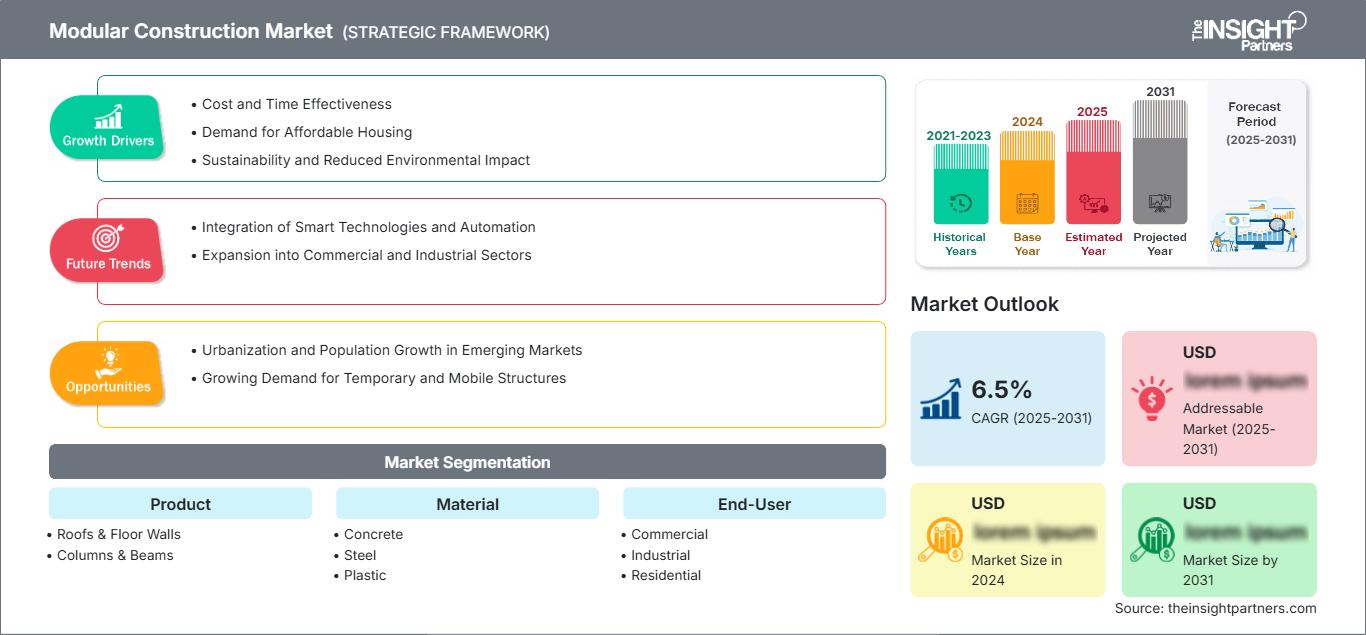
Regional Insights
North America Modular Construction Market
North America accounted for 27–30% of global revenue in 2025 and is forecast to expand at a 4.4–4.9% CAGR between 2026–2034. The Modular Construction Market share is supported by public education upgrades, healthcare capacity additions, industrial workforce housing, and a shortage of skilled trades across metropolitan construction markets.
Demand is strongest where building owners need predictable delivery, repeatable layouts, and lower disruption around occupied sites. Factory-built classrooms, clinics, multifamily units, and commercial modules are gaining acceptance because local permitting bodies increasingly recognize standardized inspection pathways. However, interstate transport limits, union rules, and fragmented building codes still influence project economics.
U.S. Modular Construction Market
The U.S. accounted for 76–80% of North America's share in 2025 and is expected to witness a 4.5–5.0% CAGR through 2034. Usage is prevalent in those states which are suffering from expensive housing, overcrowding in schools, upgrading of hospitals, and limited contractor capacity, especially those where developers have an ability to standardize floorplates of several projects.
According to the Modular Construction Market forecast, there is widespread use of the product by companies such as ATCO Ltd., Kiewit Corporation, Skanska AB, and Balfour Beatty plc that work in infrastructure-related, commercial and institutional construction ecosystems. Examples of application areas include medical facilities, student dormitories, workforce accommodations, hotel rooms and mid-rise apartments, where controlled manufacturing lowers rework.
Europe Modular Construction Market
In 2025, Europe accounted for 25-28% and is predicted to expand at a CAGR of 4.0-4.6% during 2026-2034. UK is a dominant adopter owing to residential, education, health care, and defense related accommodations, whereas Germany has industrial precision, efficient building practices, and demand for fast urban infill.
France has support from public infrastructure upgrades and low carbon buildings. Italy and Spain are small yet growing regions due to increasing demand for tourism, social housing, and earthquake-resistant construction. Major players supporting this region include Bouygues Construction, ACS Actividades de Construcción y Servicios S.A., Laing O'Rourke plc, and Skanska AB.
APAC Modular Construction Market
APAC region held 34-38% share in 2025 and is expected to maintain 5.4-6.1% CAGR growth up until 2034. China ranks as the leader, driven by the development of urban areas, the capacity of hospitals, and government support for industrialized building techniques.
Countries like Japan, South Korea, India, and Australia contribute to the rising demand due to aging infrastructure, labor shortages, the provision of social housing, and mining- or energy-oriented housing. Komatsu Ltd., Taisei Corporation, and System House R&C Co., Ltd. have expertise in prefabrication, and India benefits from its large scale.
Middle East & Africa Modular Construction Market
Middle East & Africa is forecast to grow at a 4.8–5.5% CAGR through 2034. Saudi Arabia is the leading country, with large-scale housing, tourism, logistics, and energy-linked development requiring faster site mobilization and standardized worker accommodation.
The UAE is adopting modular systems for hospitality, education, and commercial fit-outs, while South Africa and the Rest of MEA use modular formats for clinics, schools, mining camps, and remote infrastructure. Climate resilience, water scarcity, and remote logistics strengthen the case for factory-controlled production.
Segmentation Analysis
Product
Product is projected to grow at a 4.6–5.1% CAGR during 2026–2034 as developers increasingly specify integrated structural kits rather than isolated prefabricated pieces. The Modular Construction Market scope across product categories is shaped by repeatable building envelopes, standardized connection systems, crane handling limits, and faster installation sequences that reduce site congestion.
- Roofs & Floor Walls represent core building envelope demand, supporting faster enclosure, weather protection, and interior sequencing for commercial, residential, and institutional projects requiring repeatable layouts.
- Columns & Beams are strategically important in multi-story modules and industrial buildings, where load-bearing precision, connection strength, and transport-safe fabrication influence structural reliability.
Material
Material is expected to grow at a 4.8–5.4% CAGR between 2026–2034, led by steel and concrete systems that balance strength, fire performance, transportability, and code acceptance. Material selection depends on seismic requirements, embodied carbon targets, span length, moisture exposure, and local supply chains.
- Concrete remains important for fire resistance, acoustic performance, and durability in institutional, residential, and infrastructure-adjacent projects where lifecycle performance outweighs transport weight concerns.
- Steel supports high-strength frames, repeatable fabrication, and modular stacking, making it central to hotels, worker housing, commercial buildings, and industrial support facilities.
- Plastic is used selectively in panels, fittings, insulation, and lightweight components where corrosion resistance, modular integration, and reduced maintenance improve operating efficiency.
- Wood benefits from low-carbon building demand and strong design flexibility, especially in residential, education, and hospitality projects where timber-hybrid systems meet sustainability objectives.
End-User
End-User is forecast to grow at a 5.0–5.6% CAGR during 2026–2034 as owners prioritize faster asset activation and reduced onsite disruption. Commercial demand leads current revenue, while residential adoption is accelerating where housing shortages, affordability pressures, and policy-backed delivery targets favor standardized modular formats.
- Commercial is the largest end-user category, supported by hotels, offices, retail, education, and healthcare projects that benefit from repeatable rooms, faster opening schedules, and controlled quality.
- Industrial demand comes from logistics hubs, mining sites, energy projects, and manufacturing campuses needing worker accommodation, control rooms, site offices, and rapid support infrastructure.
- Residential is the high-growth end-user category as cities pursue affordable homes, student housing, senior living, and multifamily units with shorter schedules and reduced neighborhood disruption.
Opportunity Snapshot
| End-User | Revenue Contribution | Trend Tag | Adoption Stage |
| Commercial | High | Hotel Rooms | Mature |
| Industrial | Medium | Workforce Camps | Scaling |
| Residential | High | Urban Housing | Scaling |
Modular Construction Market Growth Drivers and Impact Analysis
Labor Constraints and Schedule Certainty
Shortages of labor in the construction sector are leading owners towards manufacturing led production where small specialized groups will be able to produce standardized pieces with increased efficiency. The market will benefit from parallel site work and manufacture process which takes shorter than a sequential building process. It will be more effective especially in the case of hospitals, schools, hotels, and worker’s housing because it is related to income, services, and social effects when delays in opening occur. What is important is that it will not only increase the pace but also will improve the transparency of cost because of no weather dependency, rework, and coordination risks.
Urban Housing Shortages and Affordability Pressure
The persistent housing shortage is pushing urban areas and developers to assess modular systems that could shorten delivery periods and minimize disruptions. Multifamily apartments, student housing, senior housing, and affordable housing can especially benefit from the modular system since there is the potential for standardizing the designs but not restricting creativity in designing. There are benefits for the market, since factories will have the ability to mass-produce bathrooms, room pods, and structure units. The most effective cases for modular housing are those in which factory inspection is accepted and multiple project sites are available.
Sustainability Mandates and Waste Reduction
Embodied carbon, material wastage, carbon dioxide emitted by transportation, and the energy efficiency of buildings have been gaining increasing attention with environmental legislation. Modular construction helps achieve this goal in a way that includes optimization of cuts, better storage, less re-work, and integration of insulation and MEP with energy efficient modules prior to installation. This is beneficial for the market, as both government organizations and private owners begin to consider their sustainability targets when making procurement decisions. Such an effect is evident in Europe and in some regions of North America due to mandatory green-building standards for schools, hospitals, office buildings, and even homes.
Modular Construction Market Future Trends
Digital Manufacturing and BIM-to-Factory Integration
Modular Construction Market trends will increasingly center on BIM-to-factory workflows that connect design models, procurement schedules, robotic fabrication, and quality records. As owners demand greater certainty, manufacturers will use digital twins to simulate module interfaces, transport constraints, crane sequencing, and installation tolerances before production begins. This trend will reduce late-stage redesign, improve supplier coordination, and support predictive maintenance for modular assets after occupancy. Over time, factories able to translate design data directly into production instructions will differentiate through lower error rates, faster approvals, and stronger compliance documentation across regulated building categories.
Low-Carbon Hybrid Material Systems
Hybrid systems combining steel, engineered timber, low-carbon concrete, and recyclable polymer components will become more influential as building owners seek measurable reductions in embodied carbon. Future specifications are expected to favor materials that balance structural integrity, fire safety, acoustic performance, transport efficiency, and lifecycle documentation. Modular factories can standardize these assemblies more effectively than fragmented site construction, creating repeatable sustainability outcomes. Adoption will be strongest in education, residential, healthcare, and public buildings where procurement teams increasingly require carbon reporting, waste minimization, and adaptable layouts that can extend building service life.
Modular Construction Market Opportunities
Regional Factory Networks Near Demand Centers
Investors can capture value by developing regional factory networks close to high-volume construction corridors. Transport distance, road permitting, module dimensions, and crane availability strongly influence project economics, so proximity to urban housing, logistics, healthcare, and education demand is a competitive advantage. The opportunity is strongest where developers can aggregate repeat projects and where public agencies are standardizing procurement. Strategic partnerships between contractors, manufacturers, and material suppliers can reduce plant underutilization risk. Facilities designed for flexible product lines will be better positioned to serve commercial, residential, and industrial demand cycles.
Modular Solutions for Public Infrastructure
Public infrastructure presents a clear opportunity because schools, clinics, emergency response facilities, and affordable housing often require fast deployment, budget discipline, and standardized quality. Modular construction can help agencies expand capacity without long site closures or major community disruption. Procurement teams should bundle similar projects, define approved module specifications, and align inspections with factory production schedules. This approach creates bankable pipelines for suppliers while improving public delivery outcomes. The strongest opportunities will emerge in regions where regulatory bodies recognize off-site inspections and where funding programs reward lower waste and faster completion.
Recent Developments
- July 2026: SLB Limited announced an agreement with Liberty Energy Inc. to form a strategic alliance that will deliver modular infrastructure and integrated power generation solutions for new data center projects globally. The collaboration will bring together complementary expertise in modular infrastructure, power generation and operations to support the rapid deployment of new data center capacity and help the world’s leading AI companies address increasingly complex energy requirements.
- 2026: Modular Building Institute organized 2026 World of Modular conference and trade shows at Las Vegas between April 20-23. This attracts professionals from around the world who are involved in the modular and offsite construction industries as a place to network, exchange ideas, learn from experts, discuss challenges, display new products, and receive well-deserved recognition.
- 2025: ATCO Structures was awarded contracts to provide space rental, workforce housing, and permanent modular construction solutions supporting critical mineral exploration and mining, gold and silver mining, nuclear generation, air transportation, and urban infrastructure projects in western and central Canada, as well as a cultural centre project in northern Canada. These awards comprise over 400 modular units and total US$103 million in sale and lease contracts.
Frequently Asked Questions

- Comprehensive Market Sizing and Forecast Analysis
- Detailed Segmentation Analysis
- In-Depth Market Dynamics Assessment
- Regional and Country-Level Insights
- Competitive Landscape and Company Benchmarking
- Strategic Business Intelligence
Recent Reports
Testimonials

The Insight Partners' SCADA System Market report is comprehensive, with valuable insights on current trends and future forecasts. The team was highly professional, responsive, and supportive throughout. We are very satisfied and highly recommend their services.
RAN KEDEM Partner, Reali Technologies LTDs
I requested a report on a very specific software market and the team produced the report in a few days. The information was very relevant and well presented. I then requested some changes and additions to the report. The team was again very responsive and I got the final report in less than a week.
JEAN-HERVE JENN Chairman, Future Analytica
We worked with The Insight Partners for an important market study and forecast. They gave us clear insights into opportunities and risks, which helped shape our plans. Their research was easy to use and based on solid data. It helped us make smart, confident decisions. We highly recommend them.
PIYUSH NAGPAL Sr. Vice President, High Beam Global
The Insight Partners delivered insightful, well-structured market research with strong domain expertise. Their team was professional and responsive throughout. The user-friendly website made accessing industry reports seamless. We highly recommend them for reliable, high-quality research services
YUKIHIKO ADACHI CEO, Deep Blue, LLC.
This is the first time I have purchased a market report from The Insight Partners.While I was unsure at first, I visited their web site and felt more comfortable to take the risk and purchase a market report.I am completely satisfied with the quality of the report and customer service. I had several questions and comments with the initial report, but after a couple of dialogs over email with their analyst I believe I have a report that I can use as input to our strategic planning process.Thank you so much for taking the extra time and making this a positive experience.I will definitely recommend your service to others and you will be my first call when we need further market data.
JOHN SUZUKI President and Chief Executive Officer, Board Director, BK Technologies
I wish to appreciate your support and the professionalism you displayed in the course of attending to my request for information regarding to infectious disease IVD market in Nigeria. I appreciate your patience, your guidance, and the fact that you were willing to offer a discount, which eventually made it possible for us to close a deal. I look forward to engaging The Insight Partners in the future, all thanks to the impression you have created in me as a result of this first encounter.
DR CHIJIOKE ONYIA MANAGING DIRECTOR, PineCrest Healthcare Ltd.Reason to Buy
- Informed Decision-Making
- Understanding Market Dynamics
- Competitive Analysis
- Identifying Emerging Markets
- Customer Insights
- Market Forecasts
- Risk Mitigation
- Boosting Operational Efficiency
- Strategic Planning
- Investment Justification
- Tracking Industry Innovations
- Aligning with Regulatory Trends





 Get Free Sample for