
Modular Conveyor Belts Market Demand, Share & Growth by 2034
Coverage: By Product Type (Plastic Conveyor Belts, Metal Conveyor Belts, Rubber Conveyor Belts, Other); Application (Food Industry, Chemical Industry, Agricultural, Mining, Other) , and Geography (North America, Europe, Asia Pacific, and South and Central America)
- Status : Data Released
- Report Code : TIPRE00022617
- Category : Manufacturing and Construction
- No. of Pages : 150
- Available Report Formats :


- Last update date : July 27, 2026


2025 Market Size
US$ 5.53 Bn
Base year value
2034 Forecast
US$ 8.06 Bn
Projected by 2034
CAGR 2026-2034
4.82 %
Growth rate
Addressable Market
US$ 63.44 Bn
(2026-2034)
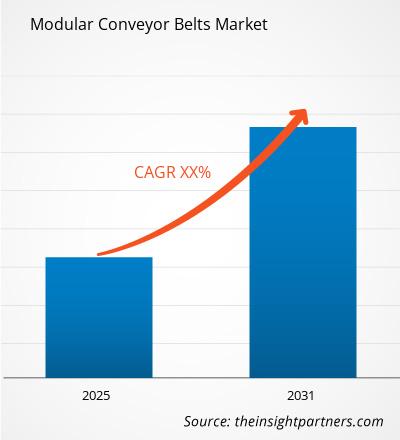
The value of the Modular Conveyor Belts Market size stood at US$ 5.53 Billion in 2025 and it is forecasted to be US$ 8.06 Billion by 2034 at a CAGR of 4.82% in the period between 2026 and 2034. The need is based on modular conveyor design which facilitates ease of maintenance, hygiene, curved design and high-speed conveying in food, chemical, agriculture and mining applications where continuity of production and hygiene become important.
In North America, the Modular Conveyor Belts Market is propelled by the need for food processing automation and warehouse upgrades along with more sanitization in direct contact conveying operations. The market is estimated to grow at a CAGR in the range of 4.3-4.8% in the period between 2026 and 2034 driven by the demand for replacement of wash-down capable plastic modular belts, upgrades for parcel handling and reduced downtime in labor-intensive environments.
Modular Conveyor Belts Market Assessment and Insights
- North America accounted for 31–34% share in 2025 and is expected to grow at a CAGR of 4.3–4.8% during 2026–2034, driven by hygienic food processing, automated packaging, and high replacement demand.
- US represented 77–81% of North America in 2025 and is projected to grow at a CAGR of 4.2–4.7% during 2026–2034, supported by food, parcel, and warehouse automation.
- Europe held 25–28% share in 2025 and is expected to grow at a CAGR of 4.0–4.5% during 2026–2034, led by Germany, the UK, France, Italy, and Spain.
- Asia Pacific captured 29–32% share in 2025 and is projected to grow at a CAGR of 5.2–5.8% during 2026–2034, led by China, Japan, India, South Korea, and Australia.
- Largest Segment Plastic Conveyor Belts held 54–58% Modular Conveyor Belts Market share in 2025 and is expected to grow at a CAGR of 5.0–5.5% during 2026–2034, supported by hygienic and lightweight applications.
- High Growth Segment Food Industry accounted for 39–43% market share in 2025 and is projected to grow at a CAGR of 5.3–5.9% during 2026–2034, reflecting sanitation-led automation.
- Key companies analyzed in detail: mk Technology Group, Hongsbelt International, Ammeraal Beltech, Afher Eurobelt, Nercon Eng. and Mfg. Inc., Tsubakimoto Chain Co., FlexLink AB, Habasit Holding AG, Intralox LLC, and Omtech Food Conveying System
Source: The Insight Partners' analysis based on proprietary research, government publications, company annual reports, investor presentations, industry databases, and expert interviews.
The trend in the product development of belts is towards advanced belt designs using detectable plastic, open-hinge cleaning system, improved transfer efficiency and better chemical resistance. The manufacturing process for conveyor belts is shifting from conventional fabrication methods to using an inventory of standard modules coupled with application-specific accessories so that integrators can speed up the installation process while dealing with complicated layouts such as meat processing, beverage packing, fertilizer handling, grain elevators and mineral transfer lines.
Future market drivers for this industry include new manufacturing belts in India, Southeast Asia, and the Gulf, due to food-processing capability, cold chain developments and mining logistics. The favorable regulations on food-contact material, worker safety, and sanitation processes are likely to fuel the replacement of fabric belts with modular belts.
Modular Conveyor Belts Market Report Scope
| Report Attribute | Details |
|---|---|
| Market size in 2025 | US$ 5.53 Billion |
| Market Size by 2034 | US$ 8.06 Billion |
| Global CAGR (2026 - 2034) | 4.82% |
| Historical Data | 2021-2024 |
| Forecast period | 2026-2034 |
Modular Conveyor Belts Market Analysis
Drivers for the Modular Conveyor Belts Market include increased automation, heightened requirements for food safety, and the requirement to minimize disruptions due to belt alignment, splice failure, or contamination incidents. Processors are opting for modular plastic belts due to the advantages offered by their open designs such as drainage, washing down, and ability to replace parts. The industry includes resin suppliers, manufacturers of steel wires, belt makers, conveyor OEMs, system integrators, motor and drives, and maintenance distributors.
Factors impacting supply still include costs of polymers, availability of stainless steel, and fabrications in various regions. End users are gradually moving away from looking at cost per unit towards total lifecycle value, including ease of cleaning, accessibility of spare parts, downtime savings, and integration with digital systems.
Modular Conveyor Belts Market Report competitive dynamics take place between global belting manufacturers and system integrators. Intralox LLC, Habasit Holding AG, Ammeraal Beltech, and Hongsbelt International compete in terms of technology, hygiene-friendly belt design, and application engineering. However, FlexLink AB, mk Technology Group, Nercon Eng. and Mfg. Inc., and Omtech Food Conveying System compete in terms of line system integration.
Financial flows go towards modular conveyor lines with easy changeover, low-power drives, and serviceable belt sections. Technical competence in heavy duty and chain belt conveying is provided by Tsubakimoto Chain Co. Afher Eurobelt provides modular plastic belt expertise for the European and export markets. Positioning in the market increasingly involves documentation of regulatory compliance, validated cleaning, geographic presence in service, and capability to retrofit systems without long downtime.
● REPORT CUSTOMIZATION
Tailor This Report To Align With Your Specific Business Requirements
This report can be customized to align precisely with your business objectives, scope, and target markets. Customization options include tailored segmentation, geography, competitive analysis, and strategic insights to support informed decision-making.
Customize This Report →WHAT YOU CAN ADJUST
- ● Segmentations
- ● Geography
- ● Competitive Analysis
- ● Language Preferences
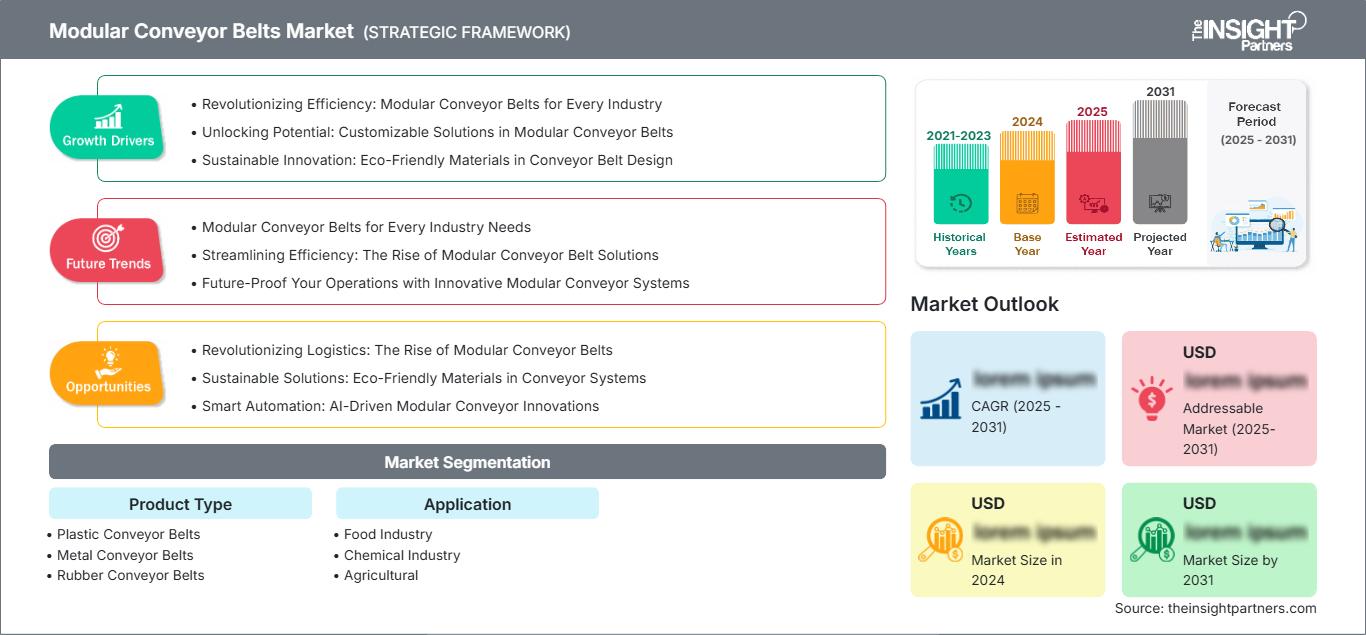
Modular Conveyor Belts Market: Strategic Insights
Regional Insights
North America Modular Conveyor Belts Market
North America occupied 31–34% market share in 2025 and is expected to experience CAGR of 4.3–4.8% from 2026 to 2034. The share of North America is attributed to significant installed base of these belts in packaging applications such as meat, bakery, beverages, parcels, and pharmaceuticals. Demand for replacement parts will be driven by food contact requirements, maintenance practices, and automation. Demand is high when there is a requirement for belt types which are capable of surviving wash down chemicals, temperature changes, and sanitization. Direct drive modular belts, open surface belts, and detectable modular belts have gained popularity as these minimize harborage points and make validations easier. In addition, timely delivery of replacement modular parts and technical assistance become important for seasonal production schedules.
U.S. Modular Conveyor Belts Market
The US accounted for 77–81% of North America in 2025 and is expected to grow at a CAGR of 4.2–4.7% during 2026–2034. Demand is concentrated in poultry, bakery, dairy, snack food, e-commerce sortation, and beverage packaging. Company presence is strong through Intralox LLC, Habasit Holding AG, Ammeraal Beltech, FlexLink AB, and Nercon Eng. and Mfg. Inc. Application trends show rising adoption of tight-transfer belts for cans, pouches, and delicate bakery products, alongside hygienic modules for raw protein. Manufacturers are also retrofitting legacy conveyors rather than replacing complete lines, creating steady aftermarket demand for sprockets, rods, side guards, wear strips, and belt modules suited to existing frames.
Europe Modular Conveyor Belts Market
The Europe region accounted for 25–28% of the market in 2025, and it is forecasted to grow at a CAGR of 4.0–4.5% in the period 2026–2034, with Germany being the top country. Bakery, ready-to-eat meal, and cold chain logistics spending in the UK is bolstered by hygienic conveyor belts, which assist manufacturers in allergen segregation and product changeovers. Germany is boosted by exports, automation engineering, and manufacture of food processing machinery, making the use of modular belt systems viable. France, Italy, and Spain contribute to the demand owing to their dairy, confectionery, fruit handling, fishery, and packaging industries. There is an emphasis in Europe on equipment that is safe and CE-approved, easily cleaned, quiet, and efficient in its drives.
APAC Modular Conveyor Belts Market
APAC has achieved a 29-32% market share in 2025 and is expected to record a growth rate of 5.2-5.8% CAGR between 2026 and 2034. The leading APAC nations include China, Japan, South Korea, India, and Australia, who are developing automated systems in food processing and packaging, mining logistics, and agriculture. Government support for modernizing manufacturing processes, enhancing cold chain development, and improving mining efficiency has led to an increase in the use of modular systems. India and Southeast Asia have been underserved, hence offering scope for retrofits due to the shift from manual conveyance systems to modular belt conveyors.
Middle East & Africa Modular Conveyor Belts Market
Middle East & Africa is expected to grow at a CAGR of 4.6–5.1% during 2026–2034, with Saudi Arabia leading demand. Saudi Arabia, the UAE, South Africa, and Rest of MEA are investing in food security, mining logistics, ports, and industrial zones. Energy and infrastructure projects support durable conveying in aggregates, chemicals, and packaged goods. Food-processing investments in Gulf markets are also increasing demand for modular plastic belts that withstand cleaning chemicals and high ambient temperatures while supporting localized production targets..
Segmentation Analysis
Product Type
Product Type is expected to grow at a CAGR of 4.7–5.2% during 2026–2034. The Modular Conveyor Belts Market scope across product types is shaped by hygienic plastics, corrosion-resistant metals, and rubber belts used where impact absorption or grip matters. Selection depends on temperature, chemical exposure, cleaning frequency, load profile, and integration with sprockets or chain-driven systems.
- Plastic Conveyor Belts dominate demand because they offer modular repair, lightweight operation, washdown compatibility, and broad surface options for food processing, packaging, accumulation, drainage, and curved conveyor layouts.
- Metal Conveyor Belts serve high-temperature, abrasive, and heavy-duty uses such as baking ovens, freezers, mining, chemicals, and heat-treatment processes where stainless steel strength and dimensional stability are essential.
- Rubber Conveyor Belts remain strategically important in agricultural and mining transfer where impact resistance, traction, and bulk-material handling performance outweigh the need for frequent hygienic disassembly.
Application
Application is projected to grow at a CAGR of 4.9–5.4% during 2026–2034. Food remains the anchor application, but chemical, agricultural, and mining users are increasing modular adoption where downtime, corrosion, cleaning, and route flexibility influence total operating cost. Application-specific belt design is becoming more important than generic belt replacement decisions.
- Food Industry leads demand as processors require sanitary designs, detectable materials, drainage, tight transfers, and belts compatible with repeated cleaning across meat, bakery, dairy, produce, and ready-meal lines.
- Chemical Industry uses modular belts for controlled movement of packaged chemicals, fertilizers, resins, and containers where chemical resistance, corrosion management, and predictable tracking support safer plant operations.
- Agricultural applications include grain, fruit, vegetable, seed, and feed handling, where modular sections reduce repair time and enable open surfaces for dirt, moisture, and debris management.
- Mining applications focus on durable belts for sorting, screening, and transfer support, particularly where modular repair can reduce stoppages in abrasive, dusty, or remote operating environments.
Opportunity Snapshot
| Application | Revenue Contribution | Trend Tag | Adoption Stage |
| Food Industry | High | Hygienic Lines | Mature |
| Chemical Industry | Medium | Corrosion Control | Scaling |
| Agricultural | Medium | Postharvest Handling | Scaling |
| Mining | Low | Abrasive Transfer | Emerging |
Modular Conveyor Belts Market Growth Drivers and Impact Analysis
Hygienic Automation in Food Processing
Food producers are upgrading conveying lines to reduce contamination risk, improve cleaning validation, and lower labor exposure during washdown. Modular plastic belts support open-hinge access, drainage, detectable components, and quick section replacement, making them suitable for meat, bakery, dairy, seafood, and prepared-food operations. The impact is direct: plants can reduce sanitation bottlenecks, maintain higher line availability, and standardize preventive maintenance. This driver also strengthens aftermarket demand because processors require spare modules, rods, sprockets, and wear components that can be stocked locally and replaced without specialized splicing crews.
Retrofit Demand Across Aging Conveyor Lines
Many industrial sites operate conveyor frames that remain structurally usable but rely on older belts with tracking, cleaning, or repair limitations. Retrofitting modular belts allows operators to improve uptime without replacing entire conveyor systems, which is attractive when capital budgets are staged. This driver is especially visible in packaging, agriculture, and chemical handling, where curved layouts, inclines, and variable product dimensions require flexible belt surfaces. Suppliers that offer engineering support, compatible sprockets, and fast module availability are positioned to capture recurring retrofit spending.
Rising Need for Durable Bulk Handling
Agricultural and mining operations are adopting modular solutions where broken sections, belt misalignment, and abrasive wear can interrupt production. Rubber and metal modular formats address impact, heat, and heavy-load requirements, while plastic modules support lighter agricultural sorting and washing lines. The market impact is stronger demand for belts engineered around load distribution, drainage, and repairability rather than only tensile strength. This shift benefits suppliers able to combine material science with field-service support in remote or seasonal operating environments.
Modular Conveyor Belts Market Future Trends
Sensor-Ready Belt Platforms
Modular Conveyor Belts Market trends are moving toward belts and conveyor components that integrate with condition monitoring, load sensing, and predictive maintenance systems. Future platforms will not only move products but also provide operating signals on wear, misalignment, sanitation cycles, and throughput variation. This evolution will help processors schedule maintenance before failure, reduce emergency belt replacements, and document line performance for audits. Suppliers that design belts, sprockets, and accessories with sensor compatibility will be better positioned in automated plants.
Materials Designed for Lower Cleaning Burden
Next-generation belt materials will focus on reducing water, chemicals, and time required for cleaning while maintaining strength under aggressive sanitation. Food plants are expected to favor non-porous surfaces, improved hinge access, detectable polymers, and designs that reduce product buildup. Chemical and agricultural users will also benefit from surfaces that resist residue accumulation. The trend supports measurable operating gains because cleaning time, wastewater treatment, labor scheduling, and product-changeover speed increasingly influence conveyor investment decisions.
Modular Conveyor Belts Market Opportunities
Localized Aftermarket Service Networks
Modular Conveyor Belts Market Forecasts point to strong recurring revenue opportunities in spare modules, rods, sprockets, wear strips, and field service. Suppliers can strengthen customer retention by building regional stocking points, mobile service teams, and retrofit assessment programs. This is particularly attractive in food, agriculture, and mining, where downtime during harvest, peak processing, or batch production can be costly. Companies that reduce lead times and provide documented installation guidance can convert replacement demand into long-term service relationships.
Application-Specific Belt Engineering
There is a clear opportunity to develop belts around specific product challenges rather than broad industry categories. Examples include low-friction accumulation for cans, open-grid drainage for produce, high-grip incline belts for packaged foods, and abrasion-resistant modules for minerals. This approach enables premium pricing because the belt becomes part of process optimization, not a commodity replacement. Vendors that combine lab testing, application engineering, and customer trials can improve adoption confidence and shorten qualification cycles.
Recent Developments
- March 2026: Intralox LLC introduced latest belting, components, and equipment, including Series 1600 and 1800 FoodSafe Heavy-Duty Edge (HDE) belting, new ThermoDrive sidewall closure types, and A23 material options designed to improve throughput, food safety, and downtime control. HDE belts set the standard for hygienic, reliable performance.
- March 2026: Interroll Group presented the IFOY Award-winning Modular Conveyor Platform (MCP) with PLAY functionality at LogiMAT 2025. With the intelligent, decentralized control and commissioning solution, conveyor systems are planned and commissioned using layout and flow configuration instead of classic PLC programming with zone-based conveying.
- March 2026: Hairise (Mu jia Automation Technology(shanghai)Co. Ltd.) will showcase conveyor solutions designed for efficient product transportation, stable production flow, easy maintenance, and flexible layout integration. Visitors will have the chance to learn more about our conveyor belt products, modular belt systems, plastic chain conveyors, spiral conveyor solutions, and customized conveyor equipment.
Frequently Asked Questions

- Comprehensive Market Sizing and Forecast Analysis
- Detailed Segmentation Analysis
- In-Depth Market Dynamics Assessment
- Regional and Country-Level Insights
- Competitive Landscape and Company Benchmarking
- Strategic Business Intelligence
Recent Reports
Testimonials

The Insight Partners' SCADA System Market report is comprehensive, with valuable insights on current trends and future forecasts. The team was highly professional, responsive, and supportive throughout. We are very satisfied and highly recommend their services.
RAN KEDEM Partner, Reali Technologies LTDs
I requested a report on a very specific software market and the team produced the report in a few days. The information was very relevant and well presented. I then requested some changes and additions to the report. The team was again very responsive and I got the final report in less than a week.
JEAN-HERVE JENN Chairman, Future Analytica
We worked with The Insight Partners for an important market study and forecast. They gave us clear insights into opportunities and risks, which helped shape our plans. Their research was easy to use and based on solid data. It helped us make smart, confident decisions. We highly recommend them.
PIYUSH NAGPAL Sr. Vice President, High Beam Global
The Insight Partners delivered insightful, well-structured market research with strong domain expertise. Their team was professional and responsive throughout. The user-friendly website made accessing industry reports seamless. We highly recommend them for reliable, high-quality research services
YUKIHIKO ADACHI CEO, Deep Blue, LLC.
This is the first time I have purchased a market report from The Insight Partners.While I was unsure at first, I visited their web site and felt more comfortable to take the risk and purchase a market report.I am completely satisfied with the quality of the report and customer service. I had several questions and comments with the initial report, but after a couple of dialogs over email with their analyst I believe I have a report that I can use as input to our strategic planning process.Thank you so much for taking the extra time and making this a positive experience.I will definitely recommend your service to others and you will be my first call when we need further market data.
JOHN SUZUKI President and Chief Executive Officer, Board Director, BK Technologies
I wish to appreciate your support and the professionalism you displayed in the course of attending to my request for information regarding to infectious disease IVD market in Nigeria. I appreciate your patience, your guidance, and the fact that you were willing to offer a discount, which eventually made it possible for us to close a deal. I look forward to engaging The Insight Partners in the future, all thanks to the impression you have created in me as a result of this first encounter.
DR CHIJIOKE ONYIA MANAGING DIRECTOR, PineCrest Healthcare Ltd.Reason to Buy
- Informed Decision-Making
- Understanding Market Dynamics
- Competitive Analysis
- Identifying Emerging Markets
- Customer Insights
- Market Forecasts
- Risk Mitigation
- Boosting Operational Efficiency
- Strategic Planning
- Investment Justification
- Tracking Industry Innovations
- Aligning with Regulatory Trends





 Get Free Sample for