
Mooring Cleats Market Size, Trends & Demand by 2034
Coverage: By Product Type (Aluminum, Stainless Steel, Others); Application (Marine Engineering, Hoisting Freight, Fishing, Others) , and Geography (North America, Europe, Asia Pacific, and South and Central America)
- Status : Data Released
- Report Code : TIPRE00022039
- Category : Manufacturing and Construction
- No. of Pages : 150
- Available Report Formats :


- Last update date : July 27, 2026


2025 Market Size
US$ 19.05 Bn
Base year value
2034 Forecast
US$ 31.96 Bn
Projected by 2034
CAGR 2026-2034
6.68 %
Growth rate
Addressable Market
US$ 240.21 Bn
(2026-2034)
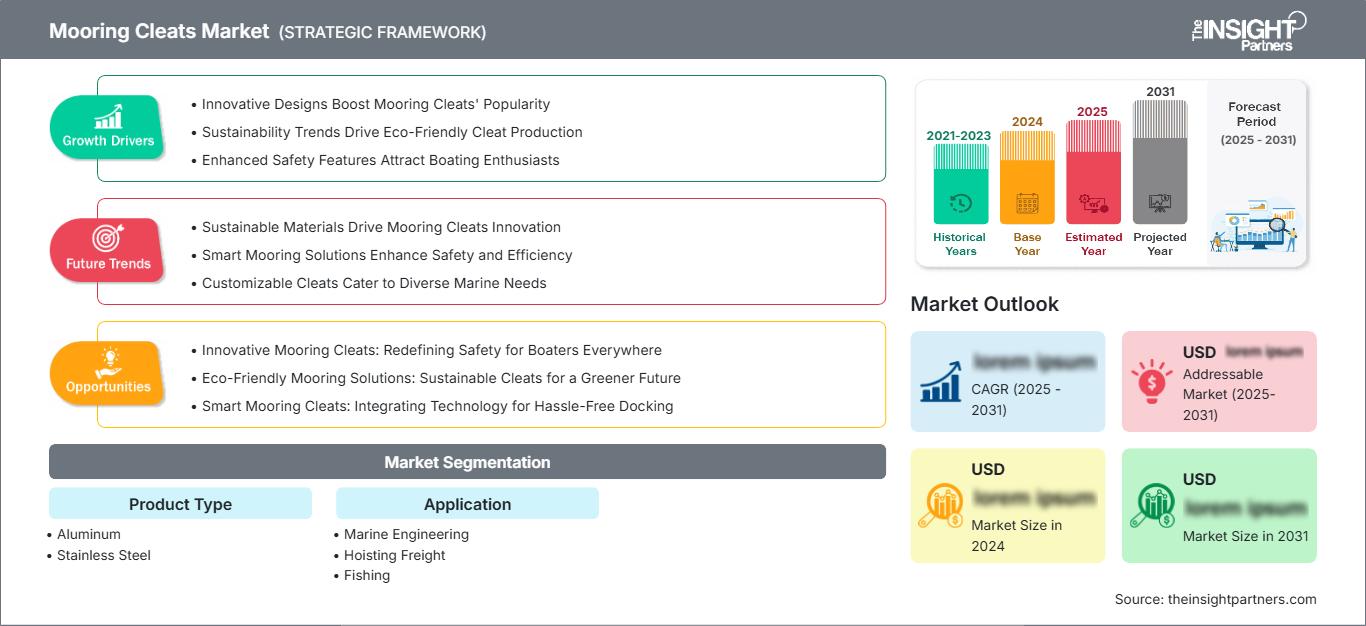
The Mooring Cleats Market was sized at US$ 19.05 Billion in 2025, reaching US$ 31.96 Billion by 2034, with a CAGR of 6.68% between 2026 and 2034. The market's growth will be driven by vessel safety considerations, marina improvements, commercial port improvements, and corrosion removal in deck and dock fitting in marine engineering, freight hoisting, and fishing industries.
In North America, the purchases are expected to grow at an estimated rate of 6.2–6.8% CAGR due to increasing marina refurbishment, recreational boating, and waterfront development impacting the growth of the Mooring Cleats Market size. The United States stays as the key demand hub, whereas Canada provides demand through fishing port improvement and small vessel facilities renovation.
Mooring Cleats Market Assessment and Insights
- North America accounted for 33–36% share in 2025 and is expected to grow at a CAGR between 6.2–6.8% during 2026–2034, supported by marina upgrades and recreational vessel berthing demand.
- US represented 72–76% of North America in 2025 and is projected to grow at a CAGR between 6.3–6.9% during 2026–2034.
- Europe held 26–29% share in 2025 and is likely to grow at 5.7–6.3% CAGR, led by the UK, Germany, France, Italy, and Spain.
- Asia Pacific captured 22–25% share in 2025 and is forecast to grow at 7.1–7.8% CAGR, driven by China, Japan, South Korea, India, and Australia.
- Largest Segment Stainless Steel held 54–58% market share in 2025 and is projected to grow at 6.4–7.0% CAGR due to durability in saline environments.
- High Growth Segment Marine Engineering held 40–44% market share in 2025 and is expected to grow at 7.0–7.7% CAGR as ports and marinas upgrade mooring systems.
- Key companies analyzed in detail: Accon Marine, ARITEX Cading S.A., Atlantic Marine, AISTER, Flat-Top Cleats, Goiot Systems, MacElroy Company, NOMEN Products GmbH, Schoellhorn-Albrecht Machine Co., Inc., and Walcon Marine Ltd.
Source: The Insight Partners' analysis based on proprietary research, government publications, company annual reports, investor presentations, industry databases, and expert interviews.
The evolution of product development has gone from cast fittings to cleats with improved weight distribution, smooth rope contact, anodized surfaces, and enhanced anti-corrosion protection. Manufacturers of Mooring Cleats have been working towards increased machining accuracy and proper metal alloys due to the need for prolonged performance, maintenance savings, and ease of fitting into aluminum pontoon structures, timber piers, steel deck structures, and boat superstructures.
Looking to the coming years, it can be anticipated that there will be more procurement in developing nations due to developments in fishing ports, tourism marinas, offshore stations, and inland waterways. It can be assumed that the demand for such products will arise from the need for safe berthing and storm-proof moorings, as well as adherence to marine standards. This means that the demand will be driven by specifications and not by discretionary purchasing.
Mooring Cleats Market Report Scope
| Report Attribute | Details |
|---|---|
| Market size in 2025 | US$ 19.05 Billion |
| Market Size by 2034 | US$ 31.96 Billion |
| Global CAGR (2026 - 2034) | 6.68% |
| Historical Data | 2021-2024 |
| Forecast period | 2026-2034 |
Mooring Cleats Market Analysis
Requirements vary depending on the need to moor the vessel under varying conditions of wind, tide, and load. Demand for Mooring Cleats Market is highest where there is high demand for line handling due to marina berths, cargoes, and fishery fleets. Customers consider the strength rating, base design, surface finishing, quality of materials, and suitability for dock surfaces prior to approvals for either replacement or new builds.
This will include metal suppliers, foundries, machining firms, suppliers of marine components, pontoon manufacturers, ship building yards, and infrastructure providers. The stainless steel material makes use of its strong properties, while aluminum is used for deck work to make light deck structures and modular pontoons. Supply changes will be dependent upon alloy prices and certifications.
The competition will remain fragmented with each specialist relying on the engineering capability of load-tested solutions, customization, and compatibility with pontoon systems. Mooring Cleats Market report suggests that the rivalry between Accon Marine, Goiot Systems, Walcon Marine Ltd., and Schoellhorn-Albrecht Machine Co., Inc. hinges on engineering prowess whereas NOMEN Products GmbH and ARITEX Cading S.A. specialize in luxury yacht and unique marine hardware products.
Investments are allocated to the standardization of the products, corrosion resistance finishes, and modular installation systems to speed up the dock construction process. MacElroy Company, Atlantic Marine, AISTER, Flat-Top Cleats, and others focus their operations on the aspects of regional distribution, customization, and applications performance. The competitive advantage will rest on the proven load ratings, reliability of supply, and compatibility with marina and vessel design packages.
● REPORT CUSTOMIZATION
Tailor This Report To Align With Your Specific Business Requirements
This report can be customized to align precisely with your business objectives, scope, and target markets. Customization options include tailored segmentation, geography, competitive analysis, and strategic insights to support informed decision-making.
Customize This Report →WHAT YOU CAN ADJUST
- ● Segmentations
- ● Geography
- ● Competitive Analysis
- ● Language Preferences
Mooring Cleats Market: Strategic Insights
Regional Insights
North America Mooring Cleats Market
The North America market holds about 33-36% of total global revenue in 2025 and has a CAGR of 6.2-6.8% for 2026-2034. Marina renovation, recreational boating, coastal tourism, and designing storm-resistant berths drive the demand replacement. The Mooring Cleats Market share is dominated by the United States, with additional demand from Canada due to maintenance of harbors and fishing fleets. The regional consumers focus on load-tested stainless steel and aluminum fittings used for floating pontoons, fixed docks, and workboat decks. The manufacturers will gain from existing marine supply chains and regular renovation cycles. Higher importance of safer public waterfronts and high-quality facilities in marinas is expected to continue upgrading the specifications in yacht clubs, municipal harbors, commercial fishing ports, and multi-purpose waterfront developments.
U.S. Mooring Cleats Market
The U.S. held a share of 72-76% of North America revenue in 2025 and is expected to grow at a CAGR of 6.3-6.9% till 2034. The market drivers include demand for recreational marinas, commercial docks, shipyards, inland waterways, and fishing terminals. The presence of Accon Marine, MacElroy Company, and Schoellhorn-Albrecht Machine Co., Inc. locally makes the supply strong for replacement and engineering applications. In terms of applications, stainless steel has gained popularity for coastal docks, while heavy-duty steel cleats have become popular for use in workboats, barges, and industrial ships. The aluminum continues to play an important role in lightweight pontoon systems and yacht equipment. Clear load ratings, corrosion resistance, and fast delivery become crucial for U.S. consumers.
Europe Mooring Cleats Market
The share of Europe in 2025 stood at 26-29%, whereas it is forecasted to experience growth at a 5.7-6.3% CAGR during the period of 2026-2034. The countries leading Europe include the United Kingdom, Germany, France, Italy, and Spain. The United Kingdom gets the help of marina upgrades and coastal recreational boat building, whereas Germany helps through engineering-focused dock facilities, inland waterways, and marine equipment standards. In contrast, France, Italy, and Spain offer their contribution through yacht manufacturing, Mediterranean marina upgrading, and fishing harbor rebuilding. The companies like Goiot Systems, NOMEN Products GmbH, AISTER, and ARITEX Cading S.A. exemplify the presence of luxury deck hardware along with engineered marine infrastructure in the region. The stainless steel continues to be preferred due to its resistance to saltwater, attractiveness, and longevity.
APAC Mooring Cleats Market
In APAC, the share stood at 22–25%, and it is anticipated to expand with a CAGR of 7.1–7.8%. China drives the segment with shipbuilding and port operations, whereas Japan and South Korea fuel the market with marine engineering and commercial vessels maintenance. Both India and Australia aid the development of the market due to the construction of fishing ports and tourism ports. Increased construction of port facilities and local shipbuilding will increase the demand for mooring cleats. Those companies offering affordable and anti-corrosion products will be expected to gain larger market shares in the Mooring Cleats Market.
Middle East & Africa Mooring Cleats Market
The Middle East & Africa segment is forecasted to grow 5.9–6.5% CAGR, with Saudi Arabia and the UAE representing the major procurers of the region. Marina tourism, marine service bases, port logistics and coastal real estate development generate a need for improved quality cleats. The contribution from South Africa comes from its fishing, commercial harbor operations and recreational boating activities. Specifiers in energy and infrastructure projects require heavy duty mooring solutions on service vessels, industrial docks and mixed waterfronts. The requirement for cleats in the rest of MEA is project based, yet is more inclined towards corrosion resistance due to high temperature, saline and sun exposure.
Segmentation Analysis
Product Type
Product Type is projected to grow at 6.1–6.8% CAGR during 2026–2034 as buyers select materials based on corrosion exposure, load rating, weight, and deck compatibility. The Mooring Cleats Market scope across product types is defined by stainless steel durability in commercial settings and aluminum adoption in pontoons, yachts, and modular marine infrastructure.
- Aluminum cleats serve lightweight docks, leisure boats, and pontoon systems where corrosion resistance, low mass, and easier installation matter for marina operators and yacht builders.
- Stainless Steel cleats dominate premium and commercial applications because they combine strength, corrosion resistance, appearance retention, and lower replacement frequency in exposed coastal and industrial environments.
Application
Application is forecast to grow at 6.6–7.2% CAGR during 2026–2034 as cleats become integral to safe berthing, cargo handling, and fishing operations. Marine engineering leads because dock builders, port authorities, and marina developers specify fittings as part of broader structural systems rather than standalone accessories.
- Marine Engineering remains the largest application, covering ports, marinas, pontoons, shipyards, and waterfront infrastructure where cleats must align with structural loads and safety specifications.
- Hoisting Freight applications require robust fittings for cargo handling areas, barges, and industrial docks where temporary securing points help manage equipment, lines, and operational safety.
- Fishing demand is recurring because fleets and harbors replace worn cleats frequently, especially where saltwater exposure, rope abrasion, and daily vessel movements accelerate hardware fatigue.
Opportunity Snapshot
| Application | Revenue Contribution | Trend Tag | Adoption Stage |
| Marine Engineering | High | Marina Retrofit | Scaling |
| Hoisting Freight | Medium | Cargo Safety | Mature |
| Fishing | Medium | Harbor Renewal | Scaling |
Mooring Cleats Market Growth Drivers and Impact Analysis
Port and Marina Infrastructure Modernization
Modernization of ports, marinas, fishing harbors, and waterfront assets is a direct driver because cleats are specified during berth construction, pontoon replacement, and dock safety upgrades. Operators are shifting from low-cost fittings to load-rated hardware that reduces liability and supports vessel mix flexibility. This improves demand visibility for manufacturers, particularly when cleats are bundled with engineered marina systems. The impact is strongest in coastal cities investing in tourism, logistics capacity, and public waterfront access. As infrastructure owners extend asset life, replacement programs increasingly include stainless steel and aluminum cleats with documented performance, making the Mooring Cleats Market less dependent on discretionary boating cycles.
Rising Focus on Vessel Safety and Load Reliability
Safety expectations are rising because cleat failure can damage vessels, docks, cargo, and nearby infrastructure. Commercial operators, marina managers, and shipyards therefore evaluate fittings by load rating, fixing method, rope contact geometry, and resistance to fatigue. This shifts purchasing toward engineered products rather than commodity hardware. The effect is visible in demand for stronger bases, four-bolt designs, polished surfaces, and marine-grade alloys. Suppliers that provide technical drawings, installation guidance, and test evidence gain credibility with contractors and facility owners. Over time, this driver should raise average selling prices and strengthen specification control across replacement and new-build projects.
Expansion of Recreational Boating and Coastal Tourism
Recreational boating and coastal tourism expand the installed base of berths, docks, yacht clubs, and waterfront service facilities. Each new berth requires multiple securing points, while premium marinas often specify better finishes and corrosion resistance to protect vessel value and maintain visual standards. Seasonal usage also accelerates wear in high-traffic facilities, creating recurring replacement demand. This driver supports aluminum cleats in pontoons and stainless steel cleats in visible deck applications. It also benefits manufacturers with broad size ranges, fast distribution, and customization options for yacht builders. As tourism marinas become more service-intensive, hardware quality becomes part of operational reliability.
Mooring Cleats Market Future Trends
Material Engineering for Lower Lifecycle Cost
Mooring Cleats Market trends will increasingly center on lifecycle economics rather than unit price. Buyers are expected to prefer alloys, surface treatments, and machining methods that extend service intervals in saltwater, high-UV, and high-load settings. Anodized aluminum, polished stainless steel, and smoother rope-bearing surfaces will gain attention because they reduce corrosion, abrasion, and premature line wear. Suppliers may also expand documentation around recyclability and material origin as marina developers respond to sustainability requirements. This trend should reward manufacturers that can prove performance through testing, provide consistent finishes, and adapt designs for modular pontoons, yacht decks, and industrial docks.
Integrated Mooring Hardware Packages
Future procurement is likely to move toward integrated hardware packages that combine cleats, bollards, brackets, fasteners, and installation guidance within dock or pontoon systems. This approach reduces design risk for contractors and helps asset owners standardize maintenance. Manufacturers that collaborate with marina builders and naval architects can secure earlier specification influence. Digital product libraries, load tables, and application drawings will become more important in tendering. As projects become more modular, cleats will be evaluated not only as fittings but also as structural interface components within broader berthing systems.
Mooring Cleats Market Opportunities
Specification Partnerships with Marina Contractors
Suppliers can unlock growth by partnering earlier with marina contractors, pontoon manufacturers, and waterfront engineering consultants. Early involvement helps match cleat capacity, fastener design, and material choice with vessel size, berth exposure, and deck substrate. This reduces rework for contractors and increases repeat specification for manufacturers. Opportunity is strongest in refurbishments where owners want safer fittings without replacing entire dock systems. Companies that offer load documentation, installation templates, and product families across multiple berth classes can improve conversion rates. Such partnerships also support bundled sales with bollards, ladders, pedestals, and access systems.
Premium Replacement Programs for Coastal Assets
A large installed base of older docks, fishing harbors, yacht clubs, and workboat facilities creates an actionable replacement opportunity. Corroded or undersized cleats can be upgraded during scheduled maintenance, storm hardening, or insurance-driven safety reviews. Manufacturers can target this base with retrofit-friendly designs, clear sizing guides, and distributor inventory programs. Premium replacement is particularly attractive because buyers often value reliability and compliance more than lowest cost once failure risk is visible. Stainless steel products, heavy-duty aluminum systems, and custom-fabricated cleats should benefit where asset owners seek longer service life without extensive structural changes.
Recent Developments
- 2026: Fendequip Mooring Products Ltd showcases its mooring and deck equipment at METSTRADE 2026. The company showcase wide variety of mooring and deck equipment including Inflatable Yacht Fenders, Cleats, Fender Hooks, Fender Covers, Chafe Gear and more that help users to save storage space, secure gear safely, and prevent rope damage.
- May 2024: SEAFLO launched Nylon Cleats that is resistance to corrosion, highly durable allowing them to withstand exposure to saltwater, sunlight, and other harsh marine conditions.
- January 2024: The IMO Maritime Safety Committee (MSC) has issued new requirements related to towing and mooring equipment. Starting 1 January 2024, SOLAS Regulation II-1/3-8 will come into effect, introducing updates to towing and mooring. This includes extended regulatory scope on towing and mooring arrangement and equipment for both new and existing ships.
Frequently Asked Questions

- Comprehensive Market Sizing and Forecast Analysis
- Detailed Segmentation Analysis
- In-Depth Market Dynamics Assessment
- Regional and Country-Level Insights
- Competitive Landscape and Company Benchmarking
- Strategic Business Intelligence
Recent Reports
Testimonials

The Insight Partners' SCADA System Market report is comprehensive, with valuable insights on current trends and future forecasts. The team was highly professional, responsive, and supportive throughout. We are very satisfied and highly recommend their services.
RAN KEDEM Partner, Reali Technologies LTDs
I requested a report on a very specific software market and the team produced the report in a few days. The information was very relevant and well presented. I then requested some changes and additions to the report. The team was again very responsive and I got the final report in less than a week.
JEAN-HERVE JENN Chairman, Future Analytica
We worked with The Insight Partners for an important market study and forecast. They gave us clear insights into opportunities and risks, which helped shape our plans. Their research was easy to use and based on solid data. It helped us make smart, confident decisions. We highly recommend them.
PIYUSH NAGPAL Sr. Vice President, High Beam Global
The Insight Partners delivered insightful, well-structured market research with strong domain expertise. Their team was professional and responsive throughout. The user-friendly website made accessing industry reports seamless. We highly recommend them for reliable, high-quality research services
YUKIHIKO ADACHI CEO, Deep Blue, LLC.
This is the first time I have purchased a market report from The Insight Partners.While I was unsure at first, I visited their web site and felt more comfortable to take the risk and purchase a market report.I am completely satisfied with the quality of the report and customer service. I had several questions and comments with the initial report, but after a couple of dialogs over email with their analyst I believe I have a report that I can use as input to our strategic planning process.Thank you so much for taking the extra time and making this a positive experience.I will definitely recommend your service to others and you will be my first call when we need further market data.
JOHN SUZUKI President and Chief Executive Officer, Board Director, BK Technologies
I wish to appreciate your support and the professionalism you displayed in the course of attending to my request for information regarding to infectious disease IVD market in Nigeria. I appreciate your patience, your guidance, and the fact that you were willing to offer a discount, which eventually made it possible for us to close a deal. I look forward to engaging The Insight Partners in the future, all thanks to the impression you have created in me as a result of this first encounter.
DR CHIJIOKE ONYIA MANAGING DIRECTOR, PineCrest Healthcare Ltd.Reason to Buy
- Informed Decision-Making
- Understanding Market Dynamics
- Competitive Analysis
- Identifying Emerging Markets
- Customer Insights
- Market Forecasts
- Risk Mitigation
- Boosting Operational Efficiency
- Strategic Planning
- Investment Justification
- Tracking Industry Innovations
- Aligning with Regulatory Trends





 Get Free Sample for