
Narrow Band Filters Market Size, Share & Demand by 2034
Coverage: By Type (Tinted Glass, Floating Glass, Others); Application (Biochemical Instruments, Medical Devices, Optical Gauges, Other) , and Geography (North America, Europe, Asia Pacific, and South and Central America)
- Status : Data Released
- Report Code : TIPRE00015328
- Category : Electronics and Semiconductor
- No. of Pages : 150
- Available Report Formats :


- Last update date : September 30, 2026


2025 Market Size
US$ 542.82 Mn
Base year value
2034 Forecast
US$ 1,355.66 Mn
Projected by 2034
CAGR 2026-2034
10.70 %
Growth rate
Addressable Market
US$ 8,404.10 Mn
(2026-2034)
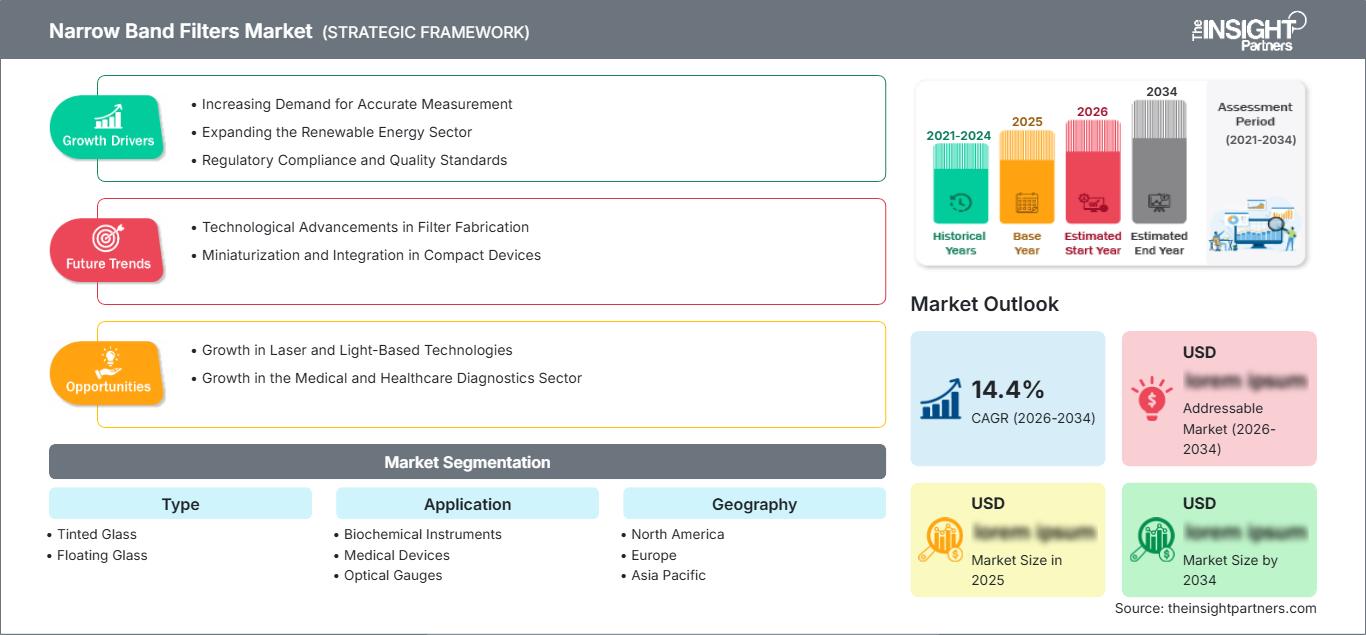
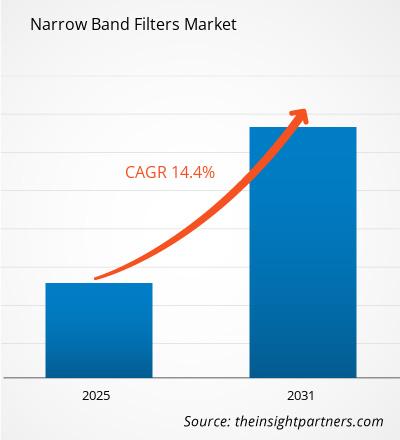
The narrow band filters market is projected to expand from US$ 542.82 Million in 2025 to US$ 1,355.66 Million by 2034, reflecting a CAGR of 10.70% during 2026–2034. Growth is supported by increasing requirements for precise wavelength isolation across spectroscopy, biomedical instrumentation, optical measurement, imaging, and laser systems. Advancements in thin-film deposition, coating uniformity, substrate engineering, and compact optical architectures are strengthening performance requirements across specialized instrumentation.
North America is expected to maintain a strong position as precision photonics, medical diagnostics, defense imaging, and scientific instrumentation expand. The regional narrow band filters market size is supported by an estimated 9.4–10.0% CAGR from 2026–2034, with demand influenced by research spending, advanced manufacturing, and increasing deployment of high-selectivity optical components in analytical systems.
Narrow Band Filters Market Assessment and Insights
- North America: The region is estimated to represent 31–35% narrow band filters market share in 2025 and expand at a 9.4–10.0% CAGR between 2026–2034, supported by photonics manufacturing, medical instrumentation, defense optics, and research infrastructure.
- US: The US is estimated to account for 72–76% of North America share in 2025, advancing at a 9.2–9.8% CAGR between 2026–2034 through strong scientific and medical optics demand.
- Europe: Europe is estimated at 25–29% share in 2025 with a 9.6–10.2% CAGR between 2026–2034, led by Germany, the UK, France, Italy, and precision instrumentation clusters.
- Asia Pacific: Asia Pacific is estimated at 30–34% share in 2025 and a 11.4–12.0% CAGR between 2026–2034, led by China, Japan, South Korea, and India through electronics, healthcare, and photonics investment.
- Largest Segment: Tinted Glass is estimated at 62–66% market share in 2025, with a 10.1–10.7% CAGR from 2026–2034, supported by established optical instrument applications.
- High Growth Segment: Medical Devices represents an estimated 31–35% market share in 2025, with a 12.0–12.8% CAGR from 2026–2034, driven by diagnostic and imaging applications.
- Key companies analyzed in detail: Asahi Spectra Co., Ltd.; HHV Ltd.; Alluxa, Inc.; Optics Balzers AG; LASER COMPONENTS; Edmund Optics, Inc.; iXblue; Materion Corporation; Knight Optical Ltd.; Coherent Corp.
Source: The Insight Partners' analysis based on proprietary research, government publications, company annual reports, investor presentations, industry databases, and expert interviews.
The growth of the industry is due to a transition from traditional absorptive filtering to advanced interference coatings that provide high levels of spectral selectivity. The increase in thin film deposition, use of multilayer dielectric designs, computerized coating machines, and enhanced substrate flatness has resulted in higher repeatability. Companies are designing more and more filters on the basis of the whole optical system rather than supplying single components.
Further development will probably include miniaturization, specific coatings for particular applications, and scalable customization. New photonics ecosystem in India, China, South Korea, and Southeast Asia will provide new opportunities for manufacturing; existing clusters in Europe and North America will continue to play an important role in producing high-end systems. Medical equipment regulations, environmental monitoring, and aerospace instrument requirements will drive demand for traceable optical performance and component certification.
Narrow Band Filters Market Report Scope
| Report Attribute | Details |
|---|---|
| Market size in 2025 | US$ 542.82 Million |
| Market Size by 2034 | US$ 1,355.66 Million |
| Global CAGR (2026 - 2034) | 10.70% |
| Historical Data | 2021-2024 |
| Forecast period | 2026-2034 |
Narrow Band Filters Market Analysis
Narrow band filters' market growth will follow the demand for wavelength selective optical systems. Suppliers start from optical substrates, coating materials, and deposition technology to proceed to multilayer coating, precise metrology, cutting, mounting, and systems integration. Specifications that include center wavelength, bandwidth, transmission, blocking, angular sensitivity, and environment durability will come in more frequently and will be the criteria for purchase along with cost.
According to the narrow band filters market report, the dynamics of supply are determined by coating equipment, process control, optical metrology, and substrates available. The production efficiency increases as suppliers standardize their coating platforms without compromising the possibility of customized designs. The value chain thus rewards suppliers with material science, coating, and inspection capabilities. Lead times are an important factor because filters can become qualification critical parts for medical, scientific, and aerospace instrumentation.
Market analysis of the narrow band filters reveals that the competitive environment is highly fragmented with specialist manufacturers of filters, precision optics and diversified photonics firms. Alluxa places its focus on thin-film deposition techniques and highly selective filters, whereas Edmund Optics has a wide range of filters from bandpass, notch, dichroic, laser, fluorescence and machine vision. Coherent Corp. provides expertise in thin film filters along with photonics manufacturing and optical communications.
Customization, repeatability and application engineering has become key considerations for positioning strategy more than availability of components. Asahi Spectra Co. Ltd., HHV Ltd., Optics Balzers AG, LASER COMPONENTS, Materion Corporation, Knight Optical Ltd., and iXblue cater to specific needs for scientific, industrial, military and medical applications. Priorities for investments include automation of coating processes, metrology, durable films and vertically integrated manufacturing process to lower qualification risks.
● REPORT CUSTOMIZATION
Tailor This Report To Align With Your Specific Business Requirements
This report can be customized to align precisely with your business objectives, scope, and target markets. Customization options include tailored segmentation, geography, competitive analysis, and strategic insights to support informed decision-making.
Customize This Report →WHAT YOU CAN ADJUST
- ● Segmentations
- ● Geography
- ● Competitive Analysis
- ● Language Preferences
Narrow Band Filters Market: Strategic Insights
Regional Insights
North America narrow band filters market
North America is estimated to hold 31–35% share in 2025 and expand at a 9.4–10.0% CAGR through 2034. The United States is seen as the leading regional demand center, with applications including medical diagnostics, laboratory instrumentation, aerospace imaging, spectroscopy, defense systems, and advanced manufacturing. Canada’s contribution comes from its research centers, development in photonics technology, and optical engineering.
The narrow band filters market forecast shows that demand from the region is bolstered by precision manufacturing capabilities at home and collaboration between optical component manufacturers and instrument manufacturers. North American buyers have demands for wavelength customization, high blocking characteristics, environmental stability, and quality control. Various types of demand come from universities, national laboratories, medical-device manufacturers, and defense contractors. Research in photonics is expected to drive replacement and new instrument demand.
U.S. narrow band filters market Market
The US accounts for an estimated 72–76% of North America share in 2025 and is projected to grow at a 9.2–9.8% CAGR through 2034. The demand comprises optical products such as biomedical instruments, spectroscopy, aerospace imagery, machine vision, laser technology, and analytical instrumentation. Domestic firms like Alluxa, Edmund Optics, Materion Corporation, and Coherent Corp. bolster national capacities in specialized optical technologies.
Application requirements are now shifting toward smaller optical products which feature tight spectral control and dependable operation under adverse conditions. The medical industry demands constant optical behavior, whereas environmental endurance is the requirement of the defense and aerospace industry. The demand from research organizations stems from specialized filters made for fluorescence, spectroscopy, astronomy, and laser diagnostics.
Europe narrow band filters market Market
Europe represents approximately 25–29% share in 2025 and is projected to grow at a 9.6–10.2% CAGR, with Germany leading regional demand through precision engineering, scientific instruments, industrial optics, and medical technology. The UK remains important for photonics research, defense optics, and laboratory instrumentation.
A combination of optical manufacturing excellence and highly industrialized automation and research exists in Germany. There is a high demand for products in spectroscopy, microscopy, machine vision, and precision metrology; the country's existing engineering clusters enable the development of customized filters. The contribution from France includes its presence in aerospace, defense, scientific research, and medical instrumentation markets. The Italian and Spanish contribution includes the provision of specialized optics, imaging, and industrial applications. European purchasing increasingly focuses on repeatability, traceability, and environmental compliance.
APAC narrow band filters market Market
APAC is estimated at 30–34% share in 2025 with a 11.4–12.0% CAGR, making it the fastest-growing major region. China leads, followed by Japan, South Korea, India, and Australia. Electronics manufacturing, medical equipment, industrial imaging, research, and photonics investment support demand.
China benefits from expanding precision manufacturing and domestic optical supply chains. Japan contributes advanced instrumentation and coating expertise, while South Korea combines semiconductor and display ecosystems. India is developing photonics, healthcare, and scientific manufacturing capabilities, and Australia supports research-driven optical applications. Industrial policy, technology localization, and increasing investment in high-value electronics are expected to create additional opportunities for specialized filter suppliers.
Middle East & Africa narrow band filters market Market
Middle East and Africa demand is supported by laboratory instrumentation, healthcare modernization, security imaging, energy-related sensing, and scientific infrastructure. Saudi Arabia and the UAE lead adoption through technology investment, while South Africa remains important for research and industrial applications. Regional growth is estimated at a 9.4–10.1% CAGR through 2034.
Saudi Arabia and the UAE are developing advanced healthcare and technology infrastructure, creating opportunities for precision imaging and diagnostic equipment. South Africa contributes through scientific research, mining-related sensing, and industrial measurement. The rest of the region remains smaller but can benefit from modernization of laboratories and healthcare systems. Investment in infrastructure and energy diversification should gradually broaden specialized optical applications.
Segmentation Analysis
Type
The Type segment is characterized by distinct optical performance requirements across spectroscopy, imaging, and measurement systems. Tinted Glass remains the largest category because of established manufacturing processes and broad integration into optical assemblies. Floating Glass is increasingly relevant where designers require controlled optical properties and stable substrate characteristics. The segment is projected to record a 10.0–10.8% CAGR from 2026–2034. The narrow band filters market scope is expanding as manufacturers improve coating compatibility and substrate engineering.
- Tinted Glass: Tinted Glass maintains broad application relevance where selective attenuation, wavelength control, and reliable optical behavior are required. Its established production base supports consistent integration across laboratory and industrial optical assemblies.
- Floating Glass: Floating Glass serves applications requiring controlled substrate quality and dimensional consistency. Its role is strengthening as optical designers seek stable platforms for advanced coatings and precision wavelength-selection assemblies.
Application
The Application segment is becoming more specification-driven as instrument designers demand precise spectral isolation, compact dimensions, and stable transmission. Biochemical Instruments remain important because fluorescence and spectroscopy systems require selective wavelength management. Medical Devices are gaining momentum as imaging and diagnostic platforms become more sophisticated. Optical Gauges provide another specialized demand base. The segment is projected to advance at a 10.8–11.6% CAGR from 2026–2034.
- Biochemical Instruments: Biochemical Instruments use selective optical filtering for fluorescence, spectroscopy, and analytical workflows. Demand follows laboratory automation and higher sensitivity requirements in research and diagnostic environments.
- Medical Devices: Medical Devices increasingly incorporate wavelength-selective optics for imaging, sensing, and diagnostic systems. Their strategic importance rises as compact instrumentation requires reliable spectral discrimination within integrated optical modules.
- Optical Gauges: Optical Gauges depend on controlled wavelength transmission for measurement accuracy and contrast. Industrial automation and precision inspection support continued adoption where optical measurement replaces contact-based techniques.
Opportunity Snapshot
| Application | Revenue Contribution (High/Medium/Low) | Trend Tag | Adoption Stage |
|---|---|---|---|
| Biochemical Instruments | High | Fluorescence Control | Mature |
| Medical Devices | High | Diagnostic Imaging | Scaling |
| Optical Gauges | Medium | Precision Sensing | Scaling |
Narrow Band Filters Market Growth Drivers and Impact Analysis
Expansion of Precision Biomedical and Analytical Instrumentation
Growing sophistication in biomedical and analytical instruments is increasing the need for reliable wavelength selection. Fluorescence microscopy, flow cytometry, biochemical analysis, spectroscopy, and diagnostic imaging depend on optical components that isolate useful spectral information while suppressing interference. Edmund Optics identifies fluorescence microscopy, clinical chemistry, spectroscopy, and imaging among established optical-filter applications.
This application diversity reduces dependence on any single end-use category and supports specialized product development. Manufacturers able to deliver repeatable center wavelengths, steep spectral edges, high transmission, and durable coatings can capture higher-value instrument programs. The impact extends across component qualification, custom engineering, and production automation, because medical and laboratory customers generally require consistent performance over repeated instrument generations.
Higher Spectral Selectivity in Advanced Photonic Systems
Advanced photonic systems increasingly require filters that distinguish closely spaced wavelengths without creating excessive insertion loss. Applications in Raman spectroscopy, LIDAR, spectral imaging, laser diagnostics, and fluorescence increasingly rely on precisely engineered interference coatings. Alluxa's current product portfolio illustrates this direction through narrowband and ultra-narrowband filters designed for applications including fluorescence microscopy, Raman spectroscopy, LIDAR, and spectral imaging.
Higher selectivity increases the importance of deposition uniformity, coating stress management, and optical metrology. Consequently, suppliers with proprietary coating processes can differentiate through performance consistency rather than commodity pricing. This driver also encourages closer collaboration between filter manufacturers and system designers during early-stage optical architecture development.
Miniaturization of Optical Assemblies
Miniaturization is changing filter specifications as instrument manufacturers seek smaller modules without sacrificing spectral performance. Compact medical devices, portable analytical instruments, aerospace payloads, and embedded sensing platforms require thin substrates, low-stress coatings, and predictable optical behavior within restricted mechanical envelopes. Low-stress deposition technologies can reduce substrate deformation and preserve alignment when thin components are integrated into compact assemblies. This trend increases demand for advanced coating processes, precision mounting, and application-specific engineering. It also shifts purchasing decisions toward suppliers capable of jointly optimizing substrate selection, coating design, mechanical packaging, and testing. Over time, smaller optical assemblies can expand the addressable application base by enabling wavelength-selective functionality in instruments that previously lacked sufficient space for conventional filter architectures.
Narrow Band Filters Market Future Trends
Ultra-Narrow Spectral Architectures
The narrow band filters market trends are increasingly shaped by ultra-narrow spectral architectures designed for applications requiring exceptional wavelength discrimination. Future products are expected to combine tighter bandwidths with higher transmission and deeper out-of-band blocking. Such combinations can improve signal-to-noise ratios in spectroscopy, fluorescence, astronomy, and laser diagnostics. Thin-film deposition platforms will increasingly incorporate automated process control, improved monitoring, and computational design to maintain repeatability across complex multilayer stacks. Another important direction is the integration of multiple spectral functions within one component, reducing optical-path length and simplifying instrument design. Multiband filters may gain importance where systems must detect several signals simultaneously. This evolution should favor suppliers with sophisticated modeling, coating, metrology, and application-engineering capabilities.
Application-Specific Integrated Optical Modules
Future systems are likely to move beyond standalone filters toward application-specific optical modules that combine filtering, mounting, detection, and alignment functions. Such integration can reduce assembly complexity and improve repeatability in medical devices, biochemical instruments, and industrial sensing equipment. Manufacturers may increasingly offer prequalified filter assemblies engineered around specific detector responses, illumination sources, and mechanical constraints. This approach can shorten instrument development cycles because customers receive components already optimized for system-level performance. Greater integration may also encourage partnerships between coating specialists, precision optics manufacturers, and instrument original equipment manufacturers. Suppliers that develop configurable platforms while preserving customization capability can address multiple applications without creating entirely new production architectures for every customer.
Narrow Band Filters Market Opportunities
Localized Precision Optics Manufacturing in Emerging APAC Economies
The narrow band filters Forecasts indicate significant opportunity for localized precision optics manufacturing across emerging APAC economies. India, Southeast Asia, and selected Chinese manufacturing clusters can attract investment as instrument producers seek diversified supply chains and shorter qualification cycles. Opportunity exists in coating equipment, optical metrology, substrate preparation, filter assembly, and testing services. Partnerships between established coating specialists and regional precision manufacturers could accelerate technology transfer while maintaining stringent quality requirements. Investors can target facilities capable of producing application-specific components rather than competing solely on standardized catalog products. Healthcare instrumentation, laboratory automation, industrial sensing, and defense electronics offer potential anchor applications. Building local engineering teams will be important because wavelength specifications often require iterative design and application-level validation.
High-Value Custom Filters for Medical and Scientific Instruments
Specialized medical and scientific instruments create opportunities for suppliers to move toward higher-value customized filter solutions. Customers increasingly require optical components matched to detectors, illumination sources, numerical apertures, mechanical packages, and environmental conditions. This creates room for companies offering design consultation, simulation, coating development, prototyping, qualification, and volume manufacturing as one coordinated service. Custom filter programs can also create stronger customer relationships because replacement specifications become embedded within instrument architectures. Investment should therefore prioritize coating flexibility, metrology, clean manufacturing, and engineering software rather than capacity expansion alone. Suppliers can further differentiate through rapid prototyping and documented performance data. These capabilities are particularly relevant to emerging diagnostic platforms, advanced microscopy, biochemical analysis, and specialized optical measurement systems.
Frequently Asked Questions

- Comprehensive Market Sizing and Forecast Analysis
- Detailed Segmentation Analysis
- In-Depth Market Dynamics Assessment
- Regional and Country-Level Insights
- Competitive Landscape and Company Benchmarking
- Strategic Business Intelligence
Recent Reports
Testimonials

The Insight Partners provided valuable market intelligence that supported our global go-to-market strategy. Their team was professional, responsive, and attentive to our feedback, providing thoughtful analysis and helpful methodological clarifications throughout the project.
Junmo Kim Chief Financial Officer (CFO), Enertech Co., Ltd.
The Insight Partners' SCADA System Market report is comprehensive, with valuable insights on current trends and future forecasts. The team was highly professional, responsive, and supportive throughout. We are very satisfied and highly recommend their services.
RAN KEDEM Partner, Reali Technologies LTDs
I requested a report on a very specific software market and the team produced the report in a few days. The information was very relevant and well presented. I then requested some changes and additions to the report. The team was again very responsive and I got the final report in less than a week.
JEAN-HERVE JENN Chairman, Future Analytica
We worked with The Insight Partners for an important market study and forecast. They gave us clear insights into opportunities and risks, which helped shape our plans. Their research was easy to use and based on solid data. It helped us make smart, confident decisions. We highly recommend them.
PIYUSH NAGPAL Sr. Vice President, High Beam Global
The Insight Partners delivered insightful, well-structured market research with strong domain expertise. Their team was professional and responsive throughout. The user-friendly website made accessing industry reports seamless. We highly recommend them for reliable, high-quality research services
YUKIHIKO ADACHI CEO, Deep Blue, LLC.
This is the first time I have purchased a market report from The Insight Partners.While I was unsure at first, I visited their web site and felt more comfortable to take the risk and purchase a market report.I am completely satisfied with the quality of the report and customer service. I had several questions and comments with the initial report, but after a couple of dialogs over email with their analyst I believe I have a report that I can use as input to our strategic planning process.Thank you so much for taking the extra time and making this a positive experience.I will definitely recommend your service to others and you will be my first call when we need further market data.
JOHN SUZUKI President and Chief Executive Officer, Board Director, BK Technologies
I wish to appreciate your support and the professionalism you displayed in the course of attending to my request for information regarding to infectious disease IVD market in Nigeria. I appreciate your patience, your guidance, and the fact that you were willing to offer a discount, which eventually made it possible for us to close a deal. I look forward to engaging The Insight Partners in the future, all thanks to the impression you have created in me as a result of this first encounter.
DR CHIJIOKE ONYIA MANAGING DIRECTOR, PineCrest Healthcare Ltd.Reason to Buy
- Informed Decision-Making
- Understanding Market Dynamics
- Competitive Analysis
- Identifying Emerging Markets
- Customer Insights
- Market Forecasts
- Risk Mitigation
- Boosting Operational Efficiency
- Strategic Planning
- Investment Justification
- Tracking Industry Innovations
- Aligning with Regulatory Trends





 Get Free Sample for