
Negative Pressure Wound Therapy Devices Market Size, Growth & Demand by 2034
Coverage: By Product (Conventional NPWT Devices, Single-use NPWT Devices, and NPWT Accessories), Wound Type (Chronic Wounds [Diabetic Foot Ulcers, Pressure Ulcers, Venous Leg Ulcers, and Other Chronic Wounds], Acute Wounds [Surgical and Traumatic Wounds, Burns]), End User (Hospitals, Specialty Clinics, Homecare Settings, and Others), and Geography (North America, Europe, Asia Pacific, Middle East and Africa, and South and Central America)
- Status : Published
- Report Code : TIPRE00043064
- Category : Life Sciences
- No. of Pages : 309
- Available Report Formats :


- Last update date : March 24, 2026


2025 Market Size
US$ 3.61 Bn
Base year value
2034 Forecast
US$ 6.76 Bn
Projected by 2034
CAGR 2026-2034
7.5 %
Growth rate
Addressable Market
US$ 47.46 Bn
(2026-2034)
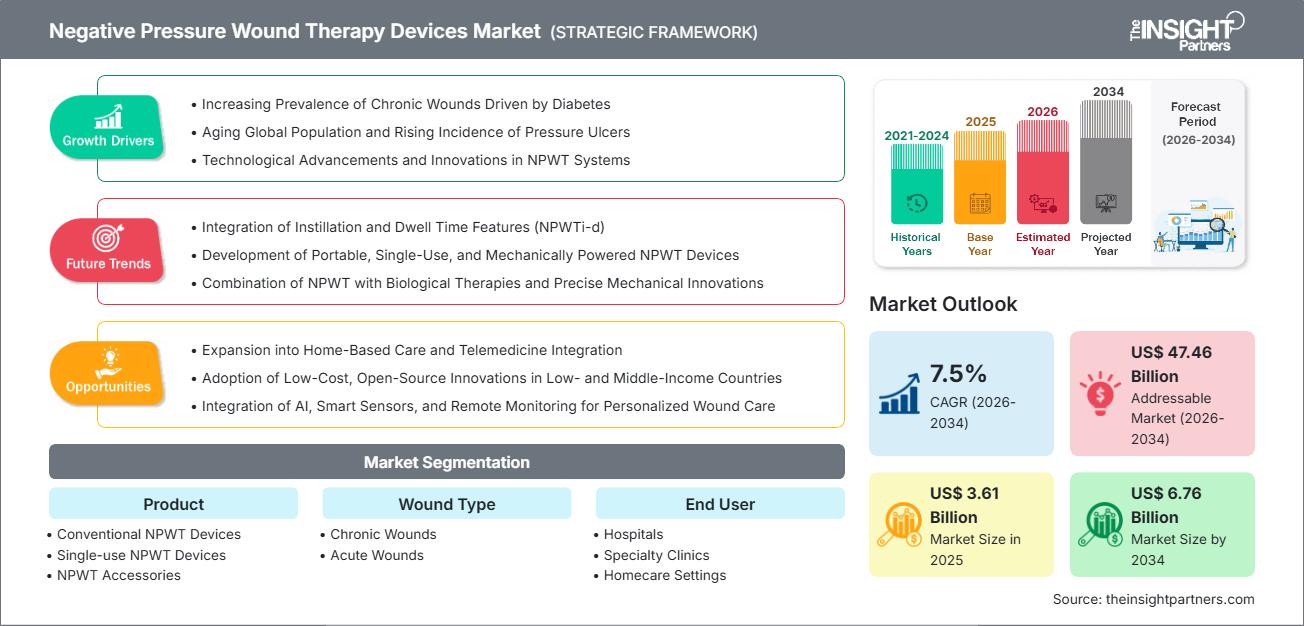
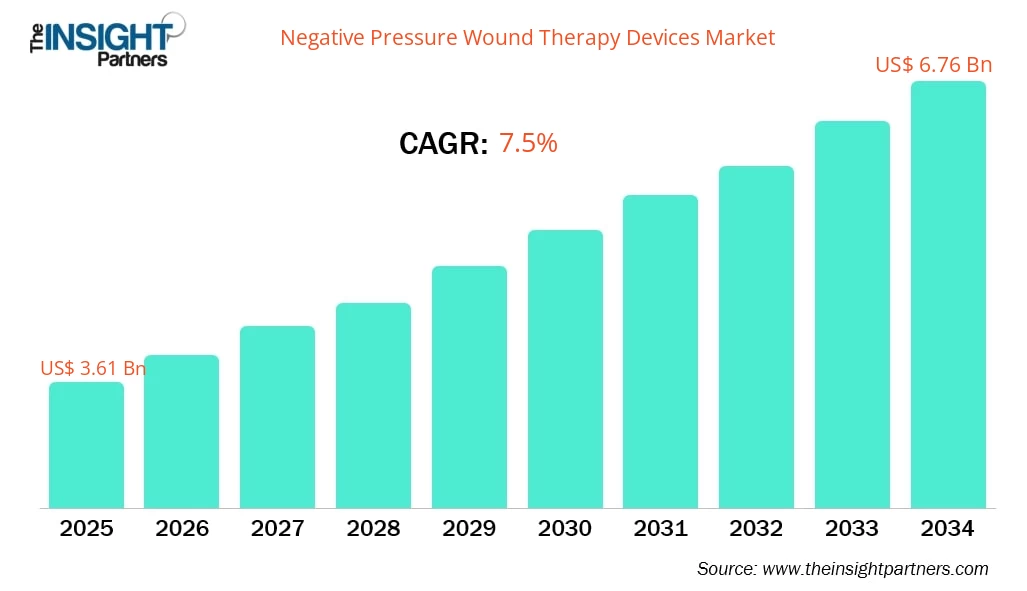
The negative pressure wound therapy devices market size is expected to reach US$ 6.76 billion by 2034 from US$ 3.61 billion in 2025. The market is anticipated to register a CAGR of 7.5% during 2026–2034.
Negative Pressure Wound Therapy Devices Market Analysis
The negative pressure wound therapy devices market is driven by rising chronic wounds, surgical procedures, and aging populations. Technological advancements, portable systems, and home care adoption fuel growth, while high costs and reimbursement challenges restrain expansion across emerging and developed healthcare markets.
Negative Pressure Wound Therapy Devices Market Overview
The negative pressure wound therapy devices market focuses on advanced wound management solutions that promote faster healing and infection control. Increasing hospitalizations, trauma cases, and demand for effective postoperative care support market growth. Manufacturers emphasize product innovation, ease of use, and expanded clinical applications to strengthen their global presence. Rising awareness among clinicians and patients, coupled with expanding outpatient settings, continues to enhance adoption rates worldwide.
Market Assessment and Insights
- North America dominated the market with 46.8% share in 2025.
- Asia Pacific is poised to grow at a CAGR of 7.9% over the forecast period.
- United States market is projected to grow at a CAGR of 7.8% over the forecast period.
- By Product, the Conventional NPWT Devices segment accounted for the largest market share of 51.5% in 2025.
- By Wound Type, the Chronic Wounds segment is anticipated to witness the fastest growth, registering a CAGR of 7.9% over the forecast period
- By Chronic Wounds, the Diabetic Foot Ulcers segment accounted for the largest market share of 41.9% in 2025.
- By Acute Wounds, the Surgical and Traumatic Wounds segment is anticipated to witness the fastest growth, registering a CAGR of 6.4% over the forecast period
- By End User, the Hospitals segment accounted for the largest market share of 48.8% in 2025.
- The report profiles key industry players such as Cardinal Health Inc, Smith & Nephew Plc, Molnlycke Health Care AB, Coloplast AS, Carilex Medical, Genadyne Biotechnologies, Inc., Medela AG, Paul Hartmann AG, DeRoyal Industries Inc, Convatec Inc, while also analyzing key developments in novel ideas, disruptive products, and innovative services that could reshape the future market and reveal emerging themes across the industry.
Source: The Insight Partners' analysis based on proprietary research, government publications, company annual reports, investor presentations, industry databases, and expert interviews.
● REPORT CUSTOMIZATION
Tailor This Report To Align With Your Specific Business Requirements
This report can be customized to align precisely with your business objectives, scope, and target markets. Customization options include tailored segmentation, geography, competitive analysis, and strategic insights to support informed decision-making.
Customize This Report →WHAT YOU CAN ADJUST
- ● Segmentations
- ● Geography
- ● Competitive Analysis
- ● Language Preferences
Negative Pressure Wound Therapy Devices Market: Strategic Insights
-
Get Top Key Market Trends of this report.This FREE sample will include data analysis, ranging from market trends to estimates and forecasts.
Negative Pressure Wound Therapy Devices Market Drivers and Opportunities
Market Drivers:
- Increasing Prevalence of Chronic Wounds Driven by Diabetes: Increasing cases of diabetes, ulcers, and pressure injuries drive demand for effective wound management solutions.
- Aging Global Population and Rising Incidence of Pressure Ulcers: Elderly patients are more prone to slow-healing wounds, boosting NPWT device adoption.
- Technological Advancements and Innovations in NPWT Systems: Improved portable and smart NPWT systems enhance treatment efficiency and usability.
Market Opportunities:
- Expansion into Home-Based Care and Telemedicine Integration: Increased preference for home-based treatment creates opportunities for portable NPWT devices.
- Adoption of Low-Cost, Open-Source Innovations in Low- and Middle-Income Countries: Improving healthcare infrastructure in developing regions opens new revenue streams.
- Integration of AI, Smart Sensors, and Remote Monitoring for Personalized Wound Care: Integration of digital monitoring and disposable systems attracts wider clinical adoption.
Negative Pressure Wound Therapy Devices Market Report Segmentation Analysis
The negative pressure wound therapy devices market is categorized into distinct segments to understand its structure, growth prospects, and emerging trends. Below is the standard segmentation approach used in industry reports:
By Product:
- Conventional NPWT Devices: Reusable negative pressure wound therapy systems used in hospitals for acute and chronic wounds. Include a powered pump, canister, tubing, and foam dressings. Suitable for high-exudate, surgical, trauma, and large wounds.
- Single-use NPWT Devices: Portable, disposable NPWT systems designed for outpatient and home care. Lightweight, canister-free or small-canister devices providing continuous negative pressure. Ideal for low-to-moderate exudate wounds and postoperative incision management.
- NPWT Accessories: Consumables and components used with NPWT systems, including foam or gauze dressings, canisters, tubing sets, drapes, connectors, and filters. Drive recurring revenue and require frequent replacement during therapy duration.
By Wound Type:
- Chronic Wounds: Slow-healing wounds that fail to progress through normal healing stages within 4–12 weeks. Common types include diabetic foot ulcers, pressure ulcers, and venous leg ulcers. Often associated with comorbidities, infection risk, and high recurrence rates.
- Acute Wounds: Sudden-onset wounds caused by surgery, trauma, burns, or injury that typically follow a predictable healing process. With proper care, they heal within weeks. Includes surgical incisions, lacerations, and traumatic wounds requiring short-term management.
By End User:
- Hospitals and Specialty Clinics: Hospitals and specialty clinics are the largest end users in the market, driven by the high volume of acute, complex, and post-surgical wounds managed in these settings.
- Homecare: The homecare segment is witnessing rapid growth, as healthcare systems increasingly shift toward outpatient and home-based care models. NPWT devices designed for home use enable patients with chronic wounds, postoperative incisions, or long-term healing needs to receive effective therapy outside hospital settings.
- Others: The "others" segment includes long-term care facilities, nursing homes, rehabilitation centers, and military or emergency care settings. While smaller in market share compared to hospitals and home care, this segment plays a crucial role in managing chronic, non-healing wounds among patients requiring extended supervision.
By Geography:
- North America
- Europe
- Asia Pacific
- South & Central America
- Middle East & Africa
Negative Pressure Wound Therapy Devices Market Report Scope
| Report Attribute | Details |
|---|---|
| Market size in 2025 | US$ 3.61 Billion |
| Market Size by 2034 | US$ 6.76 Billion |
| Global CAGR (2026 - 2034) | 7.5% |
| Historical Data | 2021-2024 |
| Forecast period | 2026-2034 |
| Segments Covered |
By Product
|
| Regions and Countries Covered |
North America
|
| Market leaders and key company profiles |
|
Negative Pressure Wound Therapy Devices Market Players Density: Understanding Its Impact on Business Dynamics
The Negative Pressure Wound Therapy Devices Market is growing rapidly, driven by increasing end-user demand due to factors such as evolving consumer preferences, technological advancements, and greater awareness of the product's benefits. As demand rises, businesses are expanding their offerings, innovating to meet consumer needs, and capitalizing on emerging trends, which further fuels market growth.
Negative Pressure Wound Therapy Devices Market Share Analysis by Geography
The negative pressure wound therapy devices market in Asia Pacific is experiencing rapid growth driven by rising chronic disease prevalence, increasing surgical procedures, and a growing aging population. Improving healthcare infrastructure, expanding medical tourism, and greater awareness of advanced wound care technologies support market expansion. Emerging markets in South & Central America, the Middle East, and Africa present untapped opportunities.
Market growth varies across regions due to differences in healthcare infrastructure, economic development, regulatory frameworks, and awareness of advanced wound care solutions. Below is a summary of market share and trends by region:
1. North America
- Market Share: Holds a significant portion of the global market
- Key Drivers:
- High prevalence of chronic wounds: The high prevalence of chronic wounds in the region drives consistent demand for advanced wound care therapies.
- Advanced healthcare infrastructure
- Favorable reimbursement policies
- Trends: Adoption of portable and wireless NPWT systems for home and outpatient care.
2. Europe
- Market Share: Substantial share owing to early, stringent EU regulations
- Key Drivers:
- Growing geriatric population: The growing geriatric population contributes to higher incidences of pressure ulcers and diabetic wounds, boosting device demand.
- Rising surgical procedures
- Technological innovations in NPWT devices.
- Trends: Increased use of NPWT in outpatient clinics and home care settings.
3. Asia Pacific
- Market Share: Fastest-growing region with dominant market share
- Key Drivers:
- Increase in diabetes and chronic disease cases: The surge in diabetes and chronic illnesses is creating significant demand for effective wound healing therapies.
- Improving healthcare infrastructure
- Rising medical tourism
- Trends: Expansion of portable NPWT systems for home and rural healthcare applications.
4. Middle East and Africa
- Market Share: Small market share, growing at a rapid pace
- Key Drivers:
- Growing healthcare investment: Investments in healthcare infrastructure facilitate the adoption of advanced wound care technologies.
- Rising awareness of advanced wound care
- Increasing trauma and injury cases
- Trends: Focus on cost-effective NPWT solutions to improve accessibility in emerging markets.
5. South & Central America
- Market Share: Growing Market with steady progress
- Key Drivers:
- Expanding healthcare facilities: Expansion of healthcare facilities increases access to advanced therapies.
- Rising incidence of chronic wounds
- Increasing adoption of modern medical devices
- Trends: Growing use of NPWT devices in hospital and home care settings.
High Market Density and Competition
Competition is intense due to the presence of major global players such as Cardinal Health Inc; Direct Healthcare Group; Smith & Nephew Plc; DeRoyal Industries Inc; Medela AG; Paul Hartmann AG; Pensar Medical; 3M Co; Molnlycke Health Care AB; and Lohmann & Rauscher GmbH & Co KG.
This high level of competition urges companies to stand out by offering:
- Innovative device designs
- Enhanced clinical efficacy
- Cost-effective solutions
- Comprehensive customer support
- Expanded product portfolio.
Opportunities and Strategic Moves
- Home healthcare expansion: Rising preference for home-based treatments opens new markets for portable NPWT devices.
- Product innovation: The development of disposable, wireless, and smart NPWT devices attracts wider clinical usage.
Other companies analyzed during the course of research:
- Genadyne Biotechnologies, Inc.
- Devon Medical Products
- Talley Group Ltd.
- ATMOS MedizinTechnik GmbH & Co. KG
- Carilex Medical
- WuHan VSD Medical Science & Technology Co., Ltd.
- Guard Medical Inc.
Negative Pressure Wound Therapy Devices Market News and Recent Developments
- Smith+Nephew Announces Findings on Single-Use NPWT Devices in Orthopedic and Cardiovascular Surgery (October 2025)- Smith+Nephew announced findings from a newly published, first-of-its-kind comparative study of single-use negative pressure wound therapy (sNPWT) devices in orthopedic and cardiovascular surgery. Analyzing real-world data from over 22,000 patients in the Premier PINC AI Healthcare Database, the analysis revealed that prophylactic use of PICO sNPWT (-80 mmHg) significantly reduces the risk of wound dehiscence, hospital length of stay (LoS), and overall healthcare costs compared to the PrevenaTM -125 mmHg sNPWT device.
- Pensar Medical Enters a Strategic Partnership with Centurion Therapeutics in August 2024. Pensar Medical has entered a strategic partnership with Centurion Therapeutics to distribute its MicroDoc single-use NPWT (sNPWT) platform. This collaboration is designed to improve patient care and broaden access to cutting-edge wound management solutions.
Negative Pressure Wound Therapy Devices Market Report Coverage and Deliverables
The "Negative Pressure Wound Therapy Devices Market Size and Forecast (2021–2031)" report provides a detailed analysis of the market covering below areas:
- Negative Pressure Wound Therapy Devices Market size and forecast at global, regional, and country levels for all the key market segments covered under the scope
- Negative Pressure Wound Therapy Devices Market trends, as well as market dynamics such as drivers, restraints, and key opportunities
- Detailed PEST and SWOT analysis
- Negative Pressure Wound Therapy Devices Market For Healthcare analysis covering key market trends, global and regional framework, major players, regulations, and recent market developments
- Industry landscape and competition analysis covering market concentration, heat map analysis, prominent players, and recent developments for the negative pressure wound therapy devices market
- Detailed company profiles
Frequently Asked Questions

- Comprehensive Market Sizing and Forecast Analysis
- Detailed Segmentation Analysis
- In-Depth Market Dynamics Assessment
- Regional and Country-Level Insights
- Competitive Landscape and Company Benchmarking
- Strategic Business Intelligence
Recent Reports
Testimonials

The Insight Partners' SCADA System Market report is comprehensive, with valuable insights on current trends and future forecasts. The team was highly professional, responsive, and supportive throughout. We are very satisfied and highly recommend their services.
RAN KEDEM Partner, Reali Technologies LTDs
I requested a report on a very specific software market and the team produced the report in a few days. The information was very relevant and well presented. I then requested some changes and additions to the report. The team was again very responsive and I got the final report in less than a week.
JEAN-HERVE JENN Chairman, Future Analytica
We worked with The Insight Partners for an important market study and forecast. They gave us clear insights into opportunities and risks, which helped shape our plans. Their research was easy to use and based on solid data. It helped us make smart, confident decisions. We highly recommend them.
PIYUSH NAGPAL Sr. Vice President, High Beam Global
The Insight Partners delivered insightful, well-structured market research with strong domain expertise. Their team was professional and responsive throughout. The user-friendly website made accessing industry reports seamless. We highly recommend them for reliable, high-quality research services
YUKIHIKO ADACHI CEO, Deep Blue, LLC.
This is the first time I have purchased a market report from The Insight Partners.While I was unsure at first, I visited their web site and felt more comfortable to take the risk and purchase a market report.I am completely satisfied with the quality of the report and customer service. I had several questions and comments with the initial report, but after a couple of dialogs over email with their analyst I believe I have a report that I can use as input to our strategic planning process.Thank you so much for taking the extra time and making this a positive experience.I will definitely recommend your service to others and you will be my first call when we need further market data.
JOHN SUZUKI President and Chief Executive Officer, Board Director, BK Technologies
I wish to appreciate your support and the professionalism you displayed in the course of attending to my request for information regarding to infectious disease IVD market in Nigeria. I appreciate your patience, your guidance, and the fact that you were willing to offer a discount, which eventually made it possible for us to close a deal. I look forward to engaging The Insight Partners in the future, all thanks to the impression you have created in me as a result of this first encounter.
DR CHIJIOKE ONYIA MANAGING DIRECTOR, PineCrest Healthcare Ltd.Reason to Buy
- Informed Decision-Making
- Understanding Market Dynamics
- Competitive Analysis
- Identifying Emerging Markets
- Customer Insights
- Market Forecasts
- Risk Mitigation
- Boosting Operational Efficiency
- Strategic Planning
- Investment Justification
- Tracking Industry Innovations
- Aligning with Regulatory Trends





 Get Free Sample for