
NLP in Education Market Share, Size & Demand by 2034
NLP in Education Market Size and Forecasts (2021 - 2034), Global and Regional Share, Trends, and Growth Opportunity Analysis Report Coverage : By Offering (Solutions, Services), Model Type (Rule-based, Statistical, Hybrid), Application (Sentiment Analysis and Data Extraction, Intelligent Tutoring and Langauge Learning, Others)
- Status : Data Released
- Report Code : TIPRE00039838
- Category : Technology, Media and Telecommunications
- No. of Pages : 150
- Available Report Formats :


- Last update date : August 06, 2026


2025 Market Size
US$ 1.33 Bn
Base year value
2034 Forecast
US$ 4.04 Bn
Projected by 2034
CAGR 2026-2034
13.13 %
Growth rate
Addressable Market
US$ 23.32 Bn
(2026-2034)
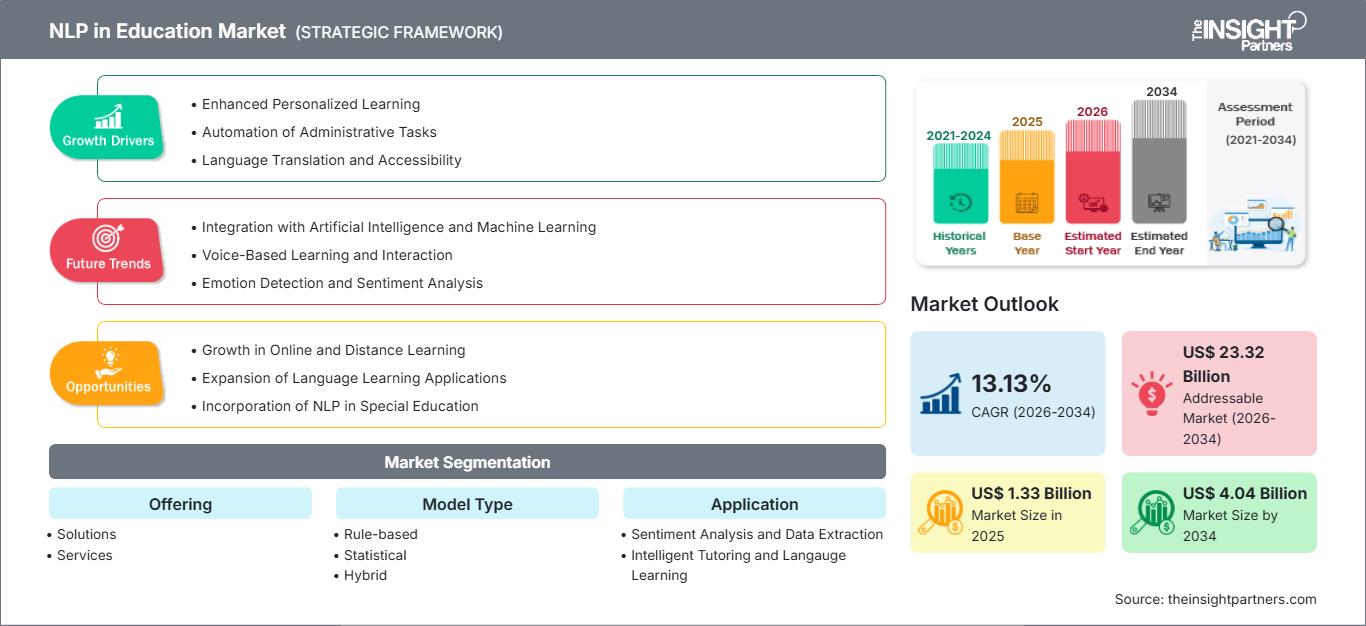
The NLP in education market was valued at US$ 1.33 Billion in 2025 and is estimated to reach US$ 4.04 Billion by 2034, expanding at a CAGR of 13.13% between 2026 and 2034. Growth is fueled by rising adoption of automated essay scoring, intelligent tutoring systems, and language learning applications across K-12 and higher education institutions. Educational technology providers are integrating natural language processing capabilities to personalize learning pathways, reinforcing the NLP in education market as a critical driver of adaptive, data-informed instruction.
North America maintains substantial momentum, with the NLP in education market size in the region reflecting early institutional adoption of AI-driven learning platforms and strong edtech venture investment. Structural drivers such as widespread digital classroom infrastructure and growing demand for personalized language acquisition tools are compelling school districts and universities to formalize NLP-based assessment and tutoring deployments, sustaining regional growth through the forecast period.
NLP in Education Market Assessment and Insights
- North America: Holds an estimated 36–40% revenue share in 2025 and is projected to grow at a CAGR of 12.3–13.2% between 2026 and 2034, supported by mature edtech infrastructure and strong venture funding.
- US: Commands nearly 88–92% of North America's share in 2025, expanding at a CAGR of 12.1–13.0% through 2034, led by higher education adoption.
- Europe: Accounts for approximately 22–26% share in 2025, growing at a CAGR of 13.0–14.0% between 2026 and 2034, with the UK, Germany, and France leading regional deployment through digital learning initiatives.
- Asia Pacific: Represents nearly 21–25% share in 2025 and is forecast to expand at the fastest CAGR of 15.8–17.0% through 2034, led by China, India, and Japan amid large-scale digital education expansion.
- Largest Segment: The Solutions offering held an estimated 60–64% market share in 2025 and is projected to grow at a CAGR of 13.0–13.9% between 2026 and 2034, driven by platform-based deployment.
- High Growth Segment: Intelligent Tutoring and Language Learning applications are the fastest-growing segment, holding 40–44% share in 2025 and expanding at a CAGR of 14.8–15.9% through 2034, propelled by personalized learning demand.
- Key companies analyzed in detail: International Business Machines Corporation, Microsoft Corporation, Google LLC, Amazon Web Services, Inc., SAS Institute Inc., Baidu, Inc., Welocalize, Inc., NICE Ltd., ABBYY Solutions Ltd., Width.ai.
Source: The Insight Partners' analysis based on proprietary research, government publications, company annual reports, investor presentations, industry databases, and expert interviews.
Educational technology has progressed markedly from rule-based grammar checkers and static vocabulary drills toward sophisticated transformer-based language models capable of contextual essay evaluation and adaptive dialogue-driven tutoring. This evolution reflects broader advances in deep learning architectures, enabling platforms to interpret student intent, detect comprehension gaps, and generate personalized feedback loops that were previously unattainable through conventional keyword-matching or template-based assessment systems used in earlier classroom software generations, supporting growth in the NLP in Education Market share.
Moving forward, uptake is forecasted to increase for emerging markets in Southeast Asia, Latin America, and Sub-Saharan Africa, where mobile-first language learning becomes popular amongst underserved students. Increased institutional backing in multilingual NLP models, along with digital literacy programs from governments, would also boost adoption, especially as regulators set rules on student data privacy on AI-enabled educational platforms.
NLP in Education Market Report Scope
| Report Attribute | Details |
|---|---|
| Market size in 2025 | US$ 1.33 Billion |
| Market Size by 2034 | US$ 4.04 Billion |
| Global CAGR (2026 - 2034) | 13.13% |
| Historical Data | 2021-2024 |
| Forecast period | 2026-2034 |
NLP in Education Market Analysis
Demand for automated language processing tools is intensifying as institutions confront rising enrollment in language learning programs alongside persistent educator shortages, reinforcing NLP in education market growth through scalable, technology-assisted instruction. The value chain includes model developers, cloud computing providers, and edtech specialists working together in order to integrate NLP functionality into the learning management system, thus allowing for real-time feedback generation without the need for a large amount of manual work involved in grading.
The supply dynamics work in favor of vendors who provide trained and customizable language models suitable for various curricula and languages. Specialized providers become more integrated with larger cloud providers in order to have access to scalable computing power, while technology companies incorporate NLP capabilities directly into classroom productivity solutions.
This NLP in education market analysis reveals intensifying competition among cloud infrastructure leaders and specialized language technology providers. International Business Machines Corporation and Microsoft Corporation use their broad corporate connections to integrate assessment tools utilizing NLP technology into existing software infrastructure within institutions, while Google LLC and Amazon Web Services, Inc. offer scalable cloud-based APIs for language models in order to develop customized edtech solutions.
Positioning becomes increasingly focused on multilingual and specific verticals as Baidu, Inc. enhances tools for Mandarin-language education and Welocalize, Inc. launches localization-focused educational content services. SAS Institute Inc. and NICE Ltd. keep on developing analytics-driven assessment modules, while ABBYY Solutions Ltd. and Width.ai develop document intelligence and custom NLP models for niche clients.
● REPORT CUSTOMIZATION
Tailor This Report To Align With Your Specific Business Requirements
This report can be customized to align precisely with your business objectives, scope, and target markets. Customization options include tailored segmentation, geography, competitive analysis, and strategic insights to support informed decision-making.
Customize This Report →WHAT YOU CAN ADJUST
- ● Segmentations
- ● Geography
- ● Competitive Analysis
- ● Language Preferences
NLP in Education Market: Strategic Insights
Regional Insights
North America NLP in Education Market
North America held an estimated 36–40% revenue share of the global NLP in education market in 2025 and is projected to grow at a CAGR of 12.3–13.2% between 2026 and 2034. Leadership in the area is attributed to the presence of a comprehensive digital classrooms infrastructure, high venture capital flows in edtech ventures, and an early adoption of AI-powered tutoring and assessments.
Structural advantages that the region enjoys are a teacher shortage driving adoption of automation, increasing demand for personalized language instruction from immigrant and bilingual students, and increasing government grants for digital learning programs. In Canada, similar trends are emerging due to the implementation of provincial digital education programs, whereas in Mexico, the growth of the private education industry adds to the demand incrementally through English language platforms.
U.S. NLP in Education Market
The United States commands approximately 88–92% of North America's NLP in education revenue share in 2025 and is forecast to expand at a CAGR of 12.1–13.0% through 2034. This dominance reflects concentrated higher education technology spend, robust K-12 edtech procurement budgets, and a dense presence of major cloud and language model providers supporting continuous platform innovation across diverse institutional settings, according to the NLP in Education Market report.
The corporate presence is widespread with International Business Machines Corporation, Microsoft Corporation, Google LLC, and Amazon Web Services, Inc., having considerable domestic presence that serves school districts and universities. The application trends in education technology include automated essay grading, chatbots for conversational language training and understanding, and other such applications where institutions prefer scalable AI-based learning over personal tutoring.
Europe NLP in Education Market
Europe accounted for approximately 22–26% share of the global NLP in education market in 2025, growing at a CAGR of 13.0–14.0% between 2026 and 2034. Momentum in the region is characterized by high-level multilingual education policies and increasing institutional investments in platforms for adaptive learning catering to varied linguistic communities in member states implementing digital education modernization strategies.
The UK has been a leader in the region based on high budgets allocated to higher education technology and a significant presence of language learning startups in the region. Germany comes second in terms of adoption, based on vocational education digitalization and high demand for technical language learning tools. France, Italy, and Spain show continuous adoption levels owing to digital literacy programs in place at the national level and bilingual education programs.
APAC NLP in Education Market
Asia Pacific held nearly 21–25% share of the NLP in the education market in 2025 and is projected to expand at the fastest regional CAGR of 15.8–17.0% through 2034. China leads adoption through large-scale government-backed digital education programs, followed by India's expanding English-language learning demand, while Japan, South Korea, and Australia contribute steady growth via institutional AI tutoring investment.
Industrial and policy drivers include national digital education strategies, rising smartphone penetration enabling mobile-first learning platforms, and growing private tutoring market formalization across densely populated urban centers. India's vast student population and China's aggressive AI-in-education policy further reinforce regional platform adoption, positioning APAC as the fastest-growing contributor to global market expansion.
Middle East and Africa NLP in Education Market
The Middle East and Africa region is witnessing steady adoption, with Saudi Arabia emerging as the leading market amid Vision 2030-aligned education modernization and substantial government investment in AI-powered learning infrastructure. The region is projected to grow at a CAGR of 12.5–13.4% between 2026 and 2034, supported by expanding digital classroom rollouts and rising English-language proficiency initiatives.
The UAE follows closely, driven by international school network expansion and strong government digital education funding. South Africa and the Rest of MEA contribute incremental demand through mobile learning platform adoption and growing private sector investment in literacy-focused NLP tools addressing underserved student populations across the broader region.
Segmentation Analysis
Offering
The Solutions segment is projected to grow at a CAGR of 13.0–13.9% between 2026 and 2034. This defines the core NLP in education market scope, encompassing platform-based software enabling automated assessment, tutoring, and language comprehension analysis that institutions deploy to scale personalized instruction across large and diverse student populations efficiently.
- Solutions: Platform-based software dominates institutional procurement, offering automated scoring, adaptive tutoring, and comprehension analytics integrated directly within learning management ecosystems.
- Services: Implementation, training, and customization services support institutions lacking internal technical expertise, driving demand among smaller districts pursuing outsourced deployment support.
Model Type
Hybrid models are projected to grow at a CAGR of 14.5–15.5% between 2026 and 2034, reflecting institutional preference for combining rule-based accuracy with statistical adaptability. This approach balances interpretability with contextual understanding, enabling more reliable automated feedback generation across varied linguistic and curricular contexts within diverse classroom environments, according to the NLP in Education Market forecast.
- Rule-based: Structured grammar and syntax checking tools remain relevant for foundational language instruction, offering predictable, transparent feedback mechanisms favored by early-grade educators.
- Statistical: Machine learning-driven models support large-scale essay evaluation and pattern recognition, enabling scalable assessment across diverse student writing samples and comprehension levels.
- Hybrid: Combining rule-based precision with statistical adaptability, hybrid models are increasingly favored for balancing accuracy and contextual flexibility across varied classroom applications.
Application
Intelligent Tutoring and Language Learning applications in the NLP in Education Market are projected to grow at a CAGR of 14.8–15.9% between 2026 and 2034, driven by rising demand for personalized, conversational learning experiences. Institutions increasingly deploy these tools to supplement instructor capacity, particularly within language acquisition programs facing persistent staffing shortages and growing multilingual student enrollment.
- Sentiment Analysis and Data Extraction: Institutions leverage these tools for automated feedback analysis and administrative document processing, streamlining assessment workflows and reducing manual review burden significantly.
- Intelligent Tutoring and Language Learning: Conversational AI tutors and adaptive language platforms address personalized instruction needs, supporting diverse learners through scalable, always-available practice environments.
Opportunity Snapshot
| Application | Revenue Contribution | Trend Tag | Adoption Stage |
| Sentiment Analysis and Data Extraction | Medium | Feedback Automation | Scaling |
| Intelligent Tutoring and Language Learning | High | Conversational Tutoring | Scaling |
NLP in Education Market Growth Drivers and Impact Analysis
Persistent Educator Shortages Driving Automation Adoption
Widespread teacher shortages across primary, secondary, and higher education institutions are compelling administrators to adopt NLP-powered tools capable of automating time-intensive tasks, including essay grading, language proficiency assessment, and personalized feedback generation, driving growth in the NLP in Education Market. This technology allows current faculty members to deal with more students while maintaining the same level of effort put in, thus solving the staffing issues that many schools face around the world. Institutions have reported decreases in turnaround time regarding the grading process after implementing automated assessment tools, which increases the confidence of administration to scale up the use of such technology. This factor is most noticeable in language learning programs, as individualized conversational practices have been difficult to implement because of time constraints from teachers.
Expanding Demand for Personalized and Adaptive Learning Pathways
The educational establishments today acknowledge that a one-size-fits-all teaching approach is not enough to cater to the varying pace of learning and understanding among students and therefore, continue investing in the development of adaptive learning technologies powered by NLP, which allows them to dynamically adjust the level of difficulty of the learning materials based on the learning patterns of each particular student. It enables the technology to determine what kind of knowledge gaps each student has and adjust the materials accordingly to ensure a personalized learning experience that could not be achieved before through traditional teaching methods. The pressure from parents and administration for better learning results makes vendors develop more advanced personalization algorithms.
Rising Institutional Investment in Multilingual Education Technology
The increasing mobility of international students and the growing number of immigrants in the education system of individual countries are contributing to significant investments into the development of multilingual NLP technologies that would cater to different language backgrounds. Platforms that can serve both native and non-native speakers of English are becoming increasingly needed at universities and schools, which contributes to the emergence of sophisticated translation-based learning platforms and testing mechanisms. Government-backed funding for language learning technologies in educational settings further emphasizes this trend, especially for countries experiencing dramatic changes in their demographics. The importance of this driver is reflected in the fact that institutions that demonstrate proficiency in multilingual solutions are seeing improvements in the enrollment and retention rates of international and immigrant students.
NLP in Education Market Future Trends
Generative AI Integration Within Conversational Tutoring Systems
Emerging NLP in education market trends indicate accelerating integration of generative AI capabilities within tutoring platforms, enabling more naturalistic, context-aware dialogue rather than scripted response trees. Next-generation systems will increasingly support open-ended student questions, providing dynamically generated explanations tailored to individual comprehension levels rather than predetermined answer sets. This shift positions conversational tutoring as a genuine supplement to human instruction rather than a limited practice tool, fundamentally expanding platform capability and institutional value proposition. Vendors capable of ensuring factual accuracy and age-appropriate content generation within generative frameworks will likely capture disproportionate institutional trust and adoption across both K-12 and higher education segments through the forecast period.
Multimodal Learning Analytics Combining Text, Speech, and Behavioral Data
Educational NLP solutions are becoming increasingly adept at employing multimodal analysis, whereby text analysis is supplemented with speech analysis and behavioral indicators to form a complete learner profile. The combination allows for a more sophisticated evaluation of language skills that includes not only text comprehension but also pronunciation and conversational fluency. Institutions are becoming more interested in obtaining information about learners in their entirety than just from texts, which is why vendors are starting to develop multimodal technologies. In this way, the industry trend of converging education technologies into student analytics solutions puts multimodal NLP ability as a competitive advantage for vendors within language and intelligent tutoring application domains.
NLP in Education Market Opportunities
Expansion Into Underserved K-12 and Rural Education Markets
Rural and underserved K-12 districts represent substantial untapped opportunity, as limited access to specialized language instructors and constrained technology budgets have historically restricted NLP-powered tool adoption relative to well-funded urban and suburban institutions. Declining cloud-based platform costs and simplified deployment models are lowering barriers, enabling vendors to reach resource-constrained districts through tiered, affordable subscription offerings. State and federal digital equity grant programs present efficient channels for expanding platform access among underserved populations. Vendors developing low-bandwidth, mobile-compatible solutions specifically addressing rural infrastructure constraints stand to capture meaningful incremental demand as digital equity initiatives continue expanding across geographically dispersed and historically underserved educational markets nationwide.
Development of Specialized Multilingual and Low-Resource Language Models
A significant opportunity exists for vendors developing NLP capabilities supporting low-resource and regional languages currently underserved by mainstream English-centric platforms. Educational institutions across Africa, South Asia, and Latin America increasingly seek locally relevant language learning and assessment tools, yet available solutions often inadequately address linguistic diversity beyond major global languages. Vendors investing in specialized model training for underrepresented languages can establish meaningful competitive differentiation while addressing genuine institutional need. As international development organizations increasingly prioritize education technology access, partnerships supporting low-resource language model development present substantial long-term growth potential for vendors willing to invest in specialized linguistic infrastructure beyond dominant global language markets.
Frequently Asked Questions

- Comprehensive Market Sizing and Forecast Analysis
- Detailed Segmentation Analysis
- In-Depth Market Dynamics Assessment
- Regional and Country-Level Insights
- Competitive Landscape and Company Benchmarking
- Strategic Business Intelligence
Recent Reports
Testimonials

The Insight Partners' SCADA System Market report is comprehensive, with valuable insights on current trends and future forecasts. The team was highly professional, responsive, and supportive throughout. We are very satisfied and highly recommend their services.
RAN KEDEM Partner, Reali Technologies LTDs
I requested a report on a very specific software market and the team produced the report in a few days. The information was very relevant and well presented. I then requested some changes and additions to the report. The team was again very responsive and I got the final report in less than a week.
JEAN-HERVE JENN Chairman, Future Analytica
We worked with The Insight Partners for an important market study and forecast. They gave us clear insights into opportunities and risks, which helped shape our plans. Their research was easy to use and based on solid data. It helped us make smart, confident decisions. We highly recommend them.
PIYUSH NAGPAL Sr. Vice President, High Beam Global
The Insight Partners delivered insightful, well-structured market research with strong domain expertise. Their team was professional and responsive throughout. The user-friendly website made accessing industry reports seamless. We highly recommend them for reliable, high-quality research services
YUKIHIKO ADACHI CEO, Deep Blue, LLC.
This is the first time I have purchased a market report from The Insight Partners.While I was unsure at first, I visited their web site and felt more comfortable to take the risk and purchase a market report.I am completely satisfied with the quality of the report and customer service. I had several questions and comments with the initial report, but after a couple of dialogs over email with their analyst I believe I have a report that I can use as input to our strategic planning process.Thank you so much for taking the extra time and making this a positive experience.I will definitely recommend your service to others and you will be my first call when we need further market data.
JOHN SUZUKI President and Chief Executive Officer, Board Director, BK Technologies
I wish to appreciate your support and the professionalism you displayed in the course of attending to my request for information regarding to infectious disease IVD market in Nigeria. I appreciate your patience, your guidance, and the fact that you were willing to offer a discount, which eventually made it possible for us to close a deal. I look forward to engaging The Insight Partners in the future, all thanks to the impression you have created in me as a result of this first encounter.
DR CHIJIOKE ONYIA MANAGING DIRECTOR, PineCrest Healthcare Ltd.Reason to Buy
- Informed Decision-Making
- Understanding Market Dynamics
- Competitive Analysis
- Identifying Emerging Markets
- Customer Insights
- Market Forecasts
- Risk Mitigation
- Boosting Operational Efficiency
- Strategic Planning
- Investment Justification
- Tracking Industry Innovations
- Aligning with Regulatory Trends





 Get Free Sample for