
Non-oriented Cold Rolled Electrical Steel Market Growth, Size & Forecast by 2034
Coverage: By Type (Fully Processed, Semi-processed); Application (Power Generation, AC Motor, Household Appliances, Others) , and Geography (North America, Europe, Asia Pacific, and South and Central America)
- Status : Data Released
- Report Code : TIPRE00019212
- Category : Chemicals and Materials
- No. of Pages : 150
- Available Report Formats :


- Last update date : September 15, 2026


2025 Market Size
US$ 16.55 Bn
Base year value
2034 Forecast
US$ 23.78 Bn
Projected by 2034
CAGR 2026-2034
4.63 %
Growth rate
Addressable Market
US$ 188.05 Bn
(2026-2034)
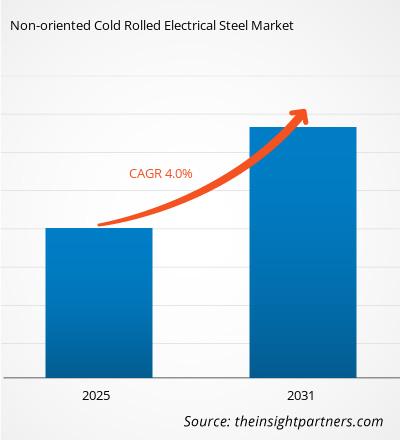
The non-oriented cold rolled electrical steel market is valued at US$ 16.55 Billion in 2025 and is projected to reach US$ 23.78 Billion by 2034, expanding at a CAGR of 4.63% during 2026–2034. Demand is supported by increasing electrification, higher motor efficiency requirements, renewable power integration, and investment in electrical equipment. High-grade steel development is increasingly focused on reducing core losses while maintaining manufacturability and dimensional stability.
North America is expected to register a 4.1–4.8% CAGR during 2026–2034, supported by replacement of aging power equipment, industrial motor upgrades, data-center electricity demand, and continued electrification of transportation. The non-oriented cold rolled electrical steel market size is also influenced by regional efforts to strengthen domestic steel supply chains and secure strategically important electrical materials for energy-transition applications.
Non-oriented Cold Rolled Electrical Steel Market Assessment and Insights
- North America: The region is expected to hold a 17–21% non-oriented cold rolled electrical steel market share in 2025 and grow at a 4.1–4.8% CAGR between 2026–2034, supported by industrial motor replacement, grid modernization, data-center construction, and localized electrical-steel supply.
- US: The US is estimated to represent 70–76% of North America's 2025 demand, expanding at a 4.2–4.9% CAGR during 2026–2034 as efficient motors, generators, and electrification projects increase material requirements.
- Europe: Europe is projected to account for a 23–27% share in 2025 and grow at a 4.3–5.0% CAGR between 2026–2034, led by Germany, France, Italy, and the UK through automotive electrification and industrial efficiency investments.
- Asia Pacific: Asia Pacific is estimated to command a 48–53% share in 2025 and expand at a 4.8–5.5% CAGR during 2026–2034, with China, Japan, South Korea, and India leading electrical-equipment and motor production.
- Largest Segment: Fully Processed is expected to hold a 62–68% market share in 2025, expanding at a 4.4–5.0% CAGR during 2026–2034, reflecting demand for ready-to-use motor and generator cores.
- High Growth Segment: Electric Motors is projected to represent a 38–44% market share in 2025, growing at a 4.9–5.5% CAGR during 2026–2034, driven by EVs, industrial automation, and energy-efficient motors.
- Key companies analyzed in detail: Cleveland-Cliffs Inc. (AK Steel), Ansteel Group Corporation Limited, China Baowu Steel Group Corporation Limited, Tata Steel Limited (Cogent), JFE Steel Corporation, Maanshan Iron & Steel Company Limited, NLMK Group, Nippon Steel Corporation, Shougang Group, and Taiyuan Iron and Steel (Group) Co., Ltd.
Source: The Insight Partners' analysis based on proprietary research, government publications, company annual reports, investor presentations, industry databases, and expert interviews.
Technology advancements in the production of electrical steel include thinner gauges, narrower thickness tolerances, enhanced insulation of the surface, and reduced specific core losses. The market for the non-oriented cold rolled electrical steel will be more differentiated in terms of magnetic properties rather than in the commodity steel volume alone. Modern technology allows manufacturers to cater to high-efficiency motors, generators, compressors, and traction devices where losses have an impact on the performance.
During the forecast period, investments will most probably be made into capacities for high-grade electrical steel in Asia and selected Europe and North America plants. Energy electrification policies, grid upgrades, renewables and data centers power needs will help to drive the market. On the other hand, supply chain policy in certain regions may stimulate production locally.
Non-oriented Cold Rolled Electrical Steel Market Report Scope
| Report Attribute | Details |
|---|---|
| Market size in 2025 | US$ 16.55 Billion |
| Market Size by 2034 | US$ 23.78 Billion |
| Global CAGR (2026 - 2034) | 4.63% |
| Historical Data | 2021-2024 |
| Forecast period | 2026-2034 |
Non-oriented Cold Rolled Electrical Steel Market Analysis
Non-oriented cold rolled electrical steel is highly correlated with the growth of demand for motors, generators, compressors, and any other rotating electrical machines. The electrical steel makers turn low-carbon steel into the silicon-alloyed grades via hot rolling, cold rolling, annealing, coating, and finishing operations. Then the core makers proceed with slitting, stamping, stacking and assembling the laminations. Materials choice is based on magnetic losses, permeability, thickness, strength, coating, and stamping ability.
The demand is influenced by energy-efficiency considerations rather than solely increasing demand per unit. The electric cars need laminations with very high-performance motors, while industrial motors should be more and more efficient. Renewable energy sources also demand generators and associated electrical equipment. The supply is concentrated among those steelmakers who possess technological know-how since consistent magnetic properties require advanced process control, special annealing facilities, and significant investments.
The non-oriented cold rolled electrical steel market forecast shows that competitive activity revolves around superior-quality products and regional availability. Cleveland-Cliffs Inc. still has electrical-steel manufacturing capability in North America, while Cogent, an affiliate of Tata Steel, JFE Steel Corporation, Nippon Steel Corporation, Ansteel Group Corporation Limited, and China Baowu Steel Group Corporation Limited participate in supply chains in Asia and Europe. Supply chain players are NLMK Group, Shougang Group, Taiyuan Iron and Steel (Group) Co., Ltd., and Maanshan Iron & Steel Company Limited.
The non-oriented cold rolled electrical steel market trends show combining capacity expansions with higher-quality product development. For example, JFE Steel's development of high-quality non-oriented electrical-steel capacity in Kurashiki demonstrates this approach, while Asian producers continue to produce thinner and lower loss products. Thus, competitive position is related to yield, magnetic properties, coating, qualification, and ability to serve customers in automotive and industrial segments for many years.
● REPORT CUSTOMIZATION
Tailor This Report To Align With Your Specific Business Requirements
This report can be customized to align precisely with your business objectives, scope, and target markets. Customization options include tailored segmentation, geography, competitive analysis, and strategic insights to support informed decision-making.
Customize This Report →WHAT YOU CAN ADJUST
- ● Segmentations
- ● Geography
- ● Competitive Analysis
- ● Language Preferences
Non-oriented Cold Rolled Electrical Steel Market: Strategic Insights
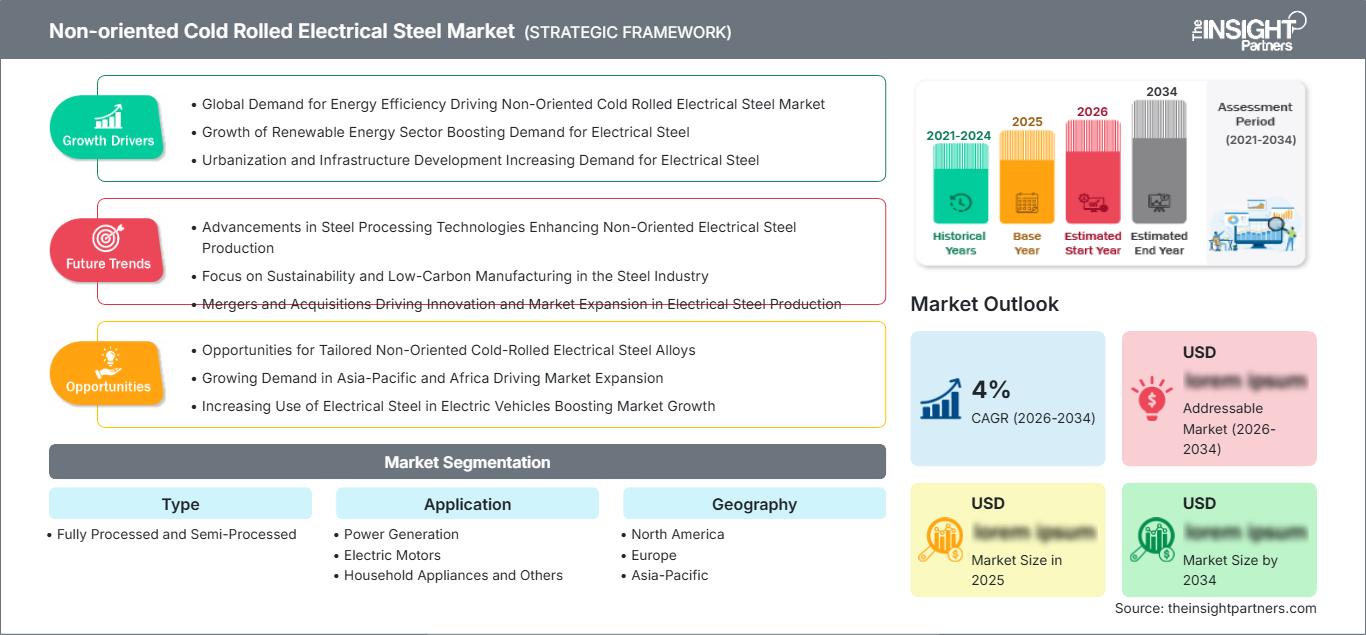
Regional Insights
North America non-oriented cold rolled electrical steel market
North America is estimated to account for 17–21% of the non-oriented cold rolled electrical steel market in 2025, with demand concentrated in the US. The regional outlook is supported by industrial motor replacement, grid modernization, generator demand, and expanding electricity consumption from data centers. The regional CAGR is projected at 4.1–4.8% during 2026–2034, with domestic supply resilience remaining strategically important for electrical-equipment manufacturers.
Automobiles electrification is another source of demand, especially when it comes to the demand for high-quality laminations for traction motors. In Canada, supply will come through industrial machinery and power facilities, and Mexico will gain through its automobile industry and electrical equipment industry. Manufacturers will be focusing on supplying high-strength, low-loss laminations along with deliveries. Supply policies will include local manufacture and diversification as a result of logistic risk and international uncertainties.
U.S. non-oriented cold rolled electrical steel Market
The US represents approximately 70–76% of North America's 2025 demand, with a projected 4.2–4.9% CAGR through 2034. Consumption is associated with motor applications in industries, generators, compressors, appliances, and transport that is becoming more electrified. Increased electricity consumption in data centers is also boosting the demands for efficient rotating machinery as well as backup generator sets. Cleveland-Cliffs Inc. continues to be an important player domestically.
There is an increasing need for higher gauge tolerances, enhanced magnetic properties, as well as consistent coating. Automotive applications continue to be critical due to the use of traction motors that could utilize special non-oriented steel grades. Investments in power grids and manufacturing reshoring in the US would likely help in meeting the demand for electrical machinery.
Europe non-oriented cold rolled electrical steel Market
Europe is projected to represent 23–27% of global demand in 2025, expanding at 4.3–5.0% through 2034. Germany is still the dominant player due to the presence of the automobile industry, industrial machines, generators, and motors. The UK's contribution comes through power facilities and industrial machines, while France, Italy, and Spain have a significant capacity of producing electrical machines and machines.
This dominance of Germany is due to its huge automobile industry and industrial sector, which uses the high-quality electrical steel in traction motors and industrial motors more and more. France has an advantage due to electrical machines from the aerospace industry, power facilities, and industrial machines. Italy's advantage is due to the manufacture of motors, appliances, and electromechanics, while that of Spain lies in renewable generation and industrial electrification.
APAC non-oriented cold rolled electrical steel Market
APAC is expected to hold 48–53% of 2025 demand and record a 4.8–5.5% CAGR through 2034, making it the leading regional market. China continues to hold sway, with Japan, South Korea, and India coming in second. There is considerable captive demand and manufacturing economies of scale because of the large motor, appliances, automotive, generator, and steel production ecosystem.
China produces electric vehicles and also has an industrial machinery sector that ensures high quality consumption, while Japan and South Korea are more concerned with premium magnetic performance. India has growing electricity systems and manufacturing investments, thereby increasing demand. Australia is relatively small but has advantages from its grid and renewable energy infrastructure.
Middle East & Africa non-oriented cold rolled electrical steel Market
Middle East and Africa represent a smaller demand base, with consumption concentrated in Saudi Arabia, the UAE, South Africa, and other industrial economies. The region is expected to expand at approximately 3.8–4.6% CAGR through 2034, supported by power infrastructure, industrial diversification, renewable generation, and equipment replacement.
In this regard, Saudi Arabia will dominate investments in the region, while the UAE will take advantage of infrastructure development and data centers. South Africa needs further development of the grid and industries, hence creating a need for motors and generators. There will be constant dependency on imports of electrical steel in MEA, although there may be some processing near the end market.
Segmentation Analysis
Type
Fully Processed and Semi-Processed grades serve different downstream manufacturing requirements. The Type segment is projected to expand at a 4.3–4.9% CAGR during 2026–2034. Fully processed material remains preferred where consistent magnetic properties and immediate stamping capability are required, while semi-processed grades offer flexibility for manufacturers with downstream annealing capabilities. This distinction defines the non-oriented cold rolled electrical steel market scope across motor, generator, and appliance applications.
- Fully Processed: Fully processed grades arrive with final magnetic characteristics and insulation coatings, reducing downstream treatment requirements. They are widely used for motors and generators where controlled losses, reliable stamping, and consistent core performance are essential.
- Semi-Processed: Semi-processed grades allow customers to complete final annealing and magnetic-property development. Their flexibility can benefit manufacturers with specialized processing capabilities, although additional production steps increase process-management requirements.
Application
Application demand is projected to increase at a 4.6–5.2% CAGR during 2026–2034, supported by electrification and higher efficiency requirements. Motors represent the largest demand pool because electrical steel forms the magnetic core of numerous rotating machines. Power-generation equipment and household appliances provide complementary consumption, with efficiency standards increasingly influencing material specifications.
- Power Generation: Generator manufacturers use non-oriented electrical steel for rotating cores requiring low magnetic losses and dependable performance. Renewable generation, distributed power, and replacement of aging equipment support continued material demand.
- Electric Motors: Electric motors constitute the central application area because laminations directly influence efficiency and thermal performance. EV traction motors, industrial automation, pumps, compressors, and HVAC equipment expand the addressable requirement for high-grade material.
- Household Appliances: Compressors, washing machines, refrigerators, air-conditioning equipment, and other appliances use electrical steel in motors. Efficiency labeling and consumer preference for lower operating costs encourage manufacturers to optimize motor-core materials.
- Others: Other applications include specialized rotating machinery and electrical equipment requiring controlled magnetic characteristics. Their contribution remains diversified across industrial equipment and emerging electromechanical applications.
Opportunity Snapshot
| Application | Revenue Contribution (High/Medium/Low) | Trend Tag | Adoption Stage |
|---|---|---|---|
| Power Generation | High | Grid Modernization | Mature |
| Electric Motors | High | EV Traction | Scaling |
| Household Appliances | Medium | Efficient Compressors | Mature |
| Others | Low | Industrial Motors | Scaling |
Non-oriented Cold Rolled Electrical Steel Market Growth Drivers and Impact Analysis
Electric Vehicle Motor Electrification
The manufacturing of electric vehicles leads to the rising demand for quality electrical-steel laminations due to the performance parameters of the traction motors. The selection criteria of the material is shifting from cost to such factors as core loss, magnetic flux density, mechanical strength, and high-frequency performance. It makes the manufacturers invest in making thinner lamination sheets and better insulations. However, the use of rotating electrical machines is not limited to passenger cars as the same machines are used in electric buses, commercial vehicles, two-wheelers, and hybrids. As motor designs become more compact, material suppliers that can combine low losses with stamping durability are better positioned to secure long-term customer qualifications and recurring programs.
Rising Efficiency Requirements for Industrial Motors
Industrial motors account for a substantial share of electricity consumption in manufacturing, pumping, ventilation, refrigeration, and material handling. Higher efficiency requirements encourage motor manufacturers to reduce magnetic losses in stator and rotor cores. Electrical steel plays a key role in the losses and thus is an engineering parameter, along with copper use, motor design, and controls, when choosing material. The demand is, therefore, tilting towards materials that provide consistent magnetic properties with productivity in punching. There is another dimension due to automation, since many motors are now running at varying speeds and loads. This makes it beneficial for the electrical steel to have consistent behavior. Such a pattern of replacement enables the demand even when there is little overall growth in motor units.
Expansion of Renewable Power and Grid Infrastructure
Renewable generation requires extensive electrical infrastructure, including generators, motors, auxiliary systems, and grid equipment. Although transformers primarily use grain-oriented electrical steel, non-oriented grades remain important for rotating machinery associated with generation and balance-of-system equipment. Wind and other renewable installations also increase demand for high-efficiency electrical machines. Grid modernization creates an additional structural driver as utilities replace aging equipment and expand transmission and distribution capacity. The effect is particularly relevant in emerging economies where electricity demand is increasing alongside industrialization. Manufacturers supplying electrical machines therefore benefit from infrastructure investment even when automotive demand fluctuates. The interaction between renewable generation, industrial electrification, and power reliability creates a diversified demand base that reduces dependence on a single application segment.
Non-oriented Cold Rolled Electrical Steel Market Future Trends
Ultra-Thin Gauge Electrical Steel for High-Speed Motors
Future product development is expected to emphasize ultra-thin electrical-steel gauges designed for high-speed motors and advanced traction systems. Reducing sheet thickness can lower eddy-current losses, particularly as motor operating frequencies increase. Producers are likely to combine thinner gauges with higher silicon content, optimized annealing, improved surface insulation, and tighter dimensional tolerances. The objective will be to achieve lower losses without creating excessive brittleness or compromising punching productivity. Development programs may increasingly be co-designed with motor manufacturers because electrical-steel performance depends on the complete core geometry and operating frequency. As vehicle platforms move toward smaller, lighter, and faster motors, qualification requirements will become more demanding. Suppliers capable of reliably producing thin, high-strength grades should gain greater relevance in premium applications.
Electrical Steel Designed for Data-Center Power Equipment
Data-center expansion is creating a new indirect demand pathway for high-efficiency electrical steels. Large facilities require substantial electricity infrastructure, including generators, cooling equipment, pumps, compressors, and motor-driven systems. Future electrical-machine designs will increasingly prioritize energy efficiency because even small reductions in operating losses can produce meaningful savings across continuously operating facilities. Electrical-steel suppliers may therefore develop grades optimized for motors and generators used in high-utilization environments. Product specifications could increasingly emphasize low losses at operating frequencies relevant to modern power systems, alongside mechanical robustness and manufacturing consistency. This trend also creates opportunities for suppliers to work directly with equipment manufacturers on customized grades. The resulting applications may broaden the addressable market beyond automotive electrification and conventional industrial machinery.
Non-oriented Cold Rolled Electrical Steel Market Opportunities
Localized High-Grade Production Capacity
Investment in regional high-grade production represents a strategic opportunity as governments and industrial manufacturers seek greater supply security for critical electrical materials. Asia is likely to remain the largest production base, but North America, Europe, and India offer opportunities for localized capacity serving automotive, industrial, and energy customers. New projects can target premium grades rather than commodity volumes, improving economics through product differentiation. Producers can also integrate advanced annealing, coating, and finishing capabilities to reduce dependence on external processors. Partnerships with motor manufacturers and automotive suppliers can accelerate qualification and improve utilization rates. The opportunity is particularly attractive where import dependence is high and domestic electrification programs are expanding. Capacity planning should prioritize flexible production lines capable of handling multiple gauges and grades.
Integrated Material-to-Motor Customer Partnerships
Electrical-steel producers can capture additional value by moving closer to motor and generator manufacturers through technical partnerships. Instead of supplying standardized coils alone, producers can collaborate on grade selection, lamination design, punching behavior, coating performance, and core-loss optimization. Such relationships can reduce qualification risk and create longer-term supply agreements. Digital simulation and process data can further support joint optimization of steel grades with motor geometries and operating frequencies. The strategy is particularly relevant for EV traction motors, where small changes in material properties can influence efficiency, weight, and thermal management. Suppliers that provide technical support alongside material can become embedded in customer development programs, raising switching costs. This approach also helps producers anticipate future grade requirements before large-scale capacity investments are committed.
Recent Developments
- September 17, 2025: ArcelorMittal showcased upgraded high-polarisation non-oriented electrical steels, self-bonding varnish solutions, and low-loss iCARe 420Save grades at Coiltech Italia 2025. The company highlighted applications spanning industrial equipment and e-mobility, reinforcing its focus on high-performance electrical steels for efficient motors and traction systems.
- August 4, 2025: JFE Steel Corporation announced a major expansion of electrical-steel manufacturing capacity in India with JSW Steel. The companies committed approximately JPY 120 billion for expansion and working capital, targeting combined oriented electrical-steel capacity of 350,000 tonnes per year across Vijayanagar and Nashik. The investment reflects rising Indian electricity and electrical-equipment demand.
Frequently Asked Questions

- Comprehensive Market Sizing and Forecast Analysis
- Detailed Segmentation Analysis
- In-Depth Market Dynamics Assessment
- Regional and Country-Level Insights
- Competitive Landscape and Company Benchmarking
- Strategic Business Intelligence
Recent Reports
Testimonials

The Insight Partners' SCADA System Market report is comprehensive, with valuable insights on current trends and future forecasts. The team was highly professional, responsive, and supportive throughout. We are very satisfied and highly recommend their services.
RAN KEDEM Partner, Reali Technologies LTDs
I requested a report on a very specific software market and the team produced the report in a few days. The information was very relevant and well presented. I then requested some changes and additions to the report. The team was again very responsive and I got the final report in less than a week.
JEAN-HERVE JENN Chairman, Future Analytica
We worked with The Insight Partners for an important market study and forecast. They gave us clear insights into opportunities and risks, which helped shape our plans. Their research was easy to use and based on solid data. It helped us make smart, confident decisions. We highly recommend them.
PIYUSH NAGPAL Sr. Vice President, High Beam Global
The Insight Partners delivered insightful, well-structured market research with strong domain expertise. Their team was professional and responsive throughout. The user-friendly website made accessing industry reports seamless. We highly recommend them for reliable, high-quality research services
YUKIHIKO ADACHI CEO, Deep Blue, LLC.
This is the first time I have purchased a market report from The Insight Partners.While I was unsure at first, I visited their web site and felt more comfortable to take the risk and purchase a market report.I am completely satisfied with the quality of the report and customer service. I had several questions and comments with the initial report, but after a couple of dialogs over email with their analyst I believe I have a report that I can use as input to our strategic planning process.Thank you so much for taking the extra time and making this a positive experience.I will definitely recommend your service to others and you will be my first call when we need further market data.
JOHN SUZUKI President and Chief Executive Officer, Board Director, BK Technologies
I wish to appreciate your support and the professionalism you displayed in the course of attending to my request for information regarding to infectious disease IVD market in Nigeria. I appreciate your patience, your guidance, and the fact that you were willing to offer a discount, which eventually made it possible for us to close a deal. I look forward to engaging The Insight Partners in the future, all thanks to the impression you have created in me as a result of this first encounter.
DR CHIJIOKE ONYIA MANAGING DIRECTOR, PineCrest Healthcare Ltd.Reason to Buy
- Informed Decision-Making
- Understanding Market Dynamics
- Competitive Analysis
- Identifying Emerging Markets
- Customer Insights
- Market Forecasts
- Risk Mitigation
- Boosting Operational Efficiency
- Strategic Planning
- Investment Justification
- Tracking Industry Innovations
- Aligning with Regulatory Trends





 Get Free Sample for