
Non-Wood Fiber Market Growth, Trends & Forecast by 2034
Coverage: By Source (Straw, Bagasse, Bamboo, Cotton, Others); Application (Paper Making, Textiles, Others); End-Use Industry (Textiles, Construction, Automotive, Consumer Goods and Others), and Geography (North America, Europe, Asia Pacific, and South and Central America)
- Status : Data Released
- Report Code : TIPRE00027399
- Category : Chemicals and Materials
- No. of Pages : 150
- Available Report Formats :


- Last update date : September 15, 2026


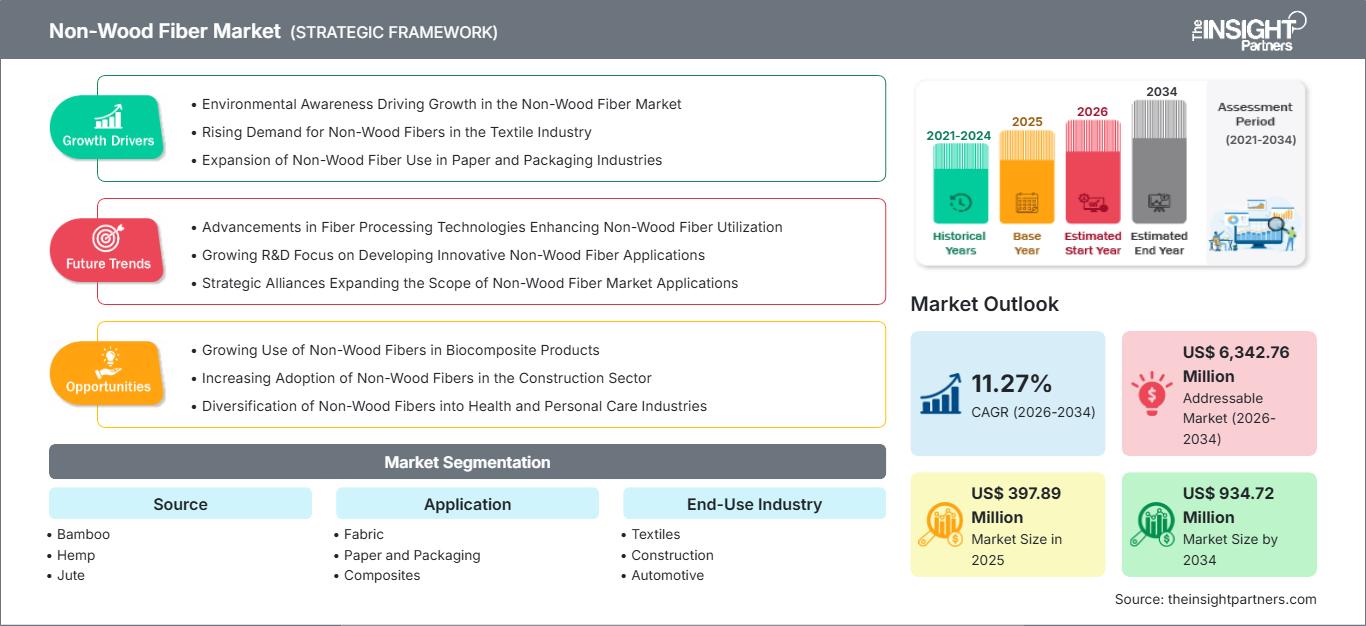
2025 Market Size
US$ 397.89 Mn
Base year value
2034 Forecast
US$ 934.72 Mn
Projected by 2034
CAGR 2026-2034
11.27 %
Growth rate
Addressable Market
US$ 6,342.76 Mn
(2026-2034)
The non-wood fiber market is valued at US$ 397.89 million in 2025 and is projected to reach US$ 934.72 million by 2034, registering a CAGR of 11.27% from 2026 to 2034. Commercialization is being driven by rising preference for low impact feedstock and circular materials. The market will continue to grow as manufacturers look for alternative options to use instead of traditional wood pulp fibers in textiles, packaging, composites, insulations, and other end-products.
North America is set to experience steady growth due to growing investments in molded fibers, sustainable packaging and bio-materials. North American non-wood fiber market size is anticipated to record a CAGR of 9.5-10.5% between 2026 and 2034, on the back of substitution in packaging applications and utilization of local biomass.
Non-Wood Fiber Market Assessment and Insights
- North America: The region is estimated to account for 24–28% share in 2025 and grow at a 9.5–10.5% CAGR between 2026–2034, supported by molded fiber packaging, agricultural-residue utilization, and investment in domestic biobased manufacturing capacity.
- US: The US represents approximately 78–82% of North America's 2025 demand, with the market growing at 9.7–10.7% CAGR between 2026–2034, driven by packaging substitution and renewable-material investment.
- Europe: Europe holds approximately 27–31% share in 2025 and is expected to grow at 10.2–11.2% CAGR between 2026–2034. Germany, France, Italy, the UK, and Spain are important markets due to circular-economy policies and sustainable textile development.
- Asia Pacific: Asia Pacific represents approximately 31–35% share in 2025 and is projected to expand at 12.0–13.0% CAGR between 2026–2034, led by China, India, Japan, South Korea, and Australia, where textile, packaging, and biomass-processing capabilities are substantial.
- Largest Segment: Paper and Packaging is estimated at 31–35% market share in 2025, expanding at 11.8–12.8% CAGR from 2026–2034 as brands replace selected fossil-based and wood-intensive packaging materials.
- High Growth Segment: Composites is estimated at 18–22% market share in 2025, growing at 12.5–13.5% CAGR from 2026–2034 as automotive, construction, and consumer applications adopt lightweight bio-based reinforcement.
- Key companies analyzed in detail: Goonvean Fibres, Shanghai Tenbro Bamboo Textile Co., Ltd., AWA Paper & Technological Company, Inc., Genera Inc., Willamette Falls Paper Company, Chempolis Oy, Zume Inc., Bio-Lutions International AG, EcoPlanet Bamboo Group, and Bamboo Australia.
Source: The Insight Partners' analysis based on proprietary research, government publications, company annual reports, investor presentations, industry databases, and expert interviews.
The sector is shifting from the use of unorganized natural fiber to engineered feedstocks, which have the ability to provide consistent fiber quality. There is an increased amount of bamboo, hemp, jute, agricultural waste, and biopolymers being refined mechanically, chemically, and pulped in order to modify their fibers. Investment is also being made in integrated production facilities that can produce more than one product from a single biomass stream.
During the forecast period, the growing centers of production in India, Southeast Asia, Latin America, and some parts of Europe are anticipated to gain investments due to high availability of biomass. Pressure on single-use plastic, forest conservation programs, renewable material acquisition, and company sustainability goals are anticipated to boost commercialization. Nonetheless, commercialization is expected to depend on feedstock sourcing, quality, logistics, and cost-effectiveness.
Non-Wood Fiber Market Report Scope
| Report Attribute | Details |
|---|---|
| Market size in 2025 | US$ 397.89 Million |
| Market Size by 2034 | US$ 934.72 Million |
| Global CAGR (2026 - 2034) | 11.27% |
| Historical Data | 2021-2024 |
| Forecast period | 2026-2034 |
Non-Wood Fiber Market Analysis
The non-wood fiber market is influenced by the availability of substitution in packaging, textiles, insulation, and reinforcement. The development of non-wood fiber industry is especially linked to companies that search for raw material substitutes for the traditional wood pulps or petrochemicals. There is an integrated value chain comprising of feedstock suppliers, processors, fiber producers, converters, compounders, and brands, where yield, distance, processing, and specifications play major roles in terms of profitability.
Different feedstocks have different supply conditions. Bamboo is characterized by high biomass regeneration capacity and good networks of cultivation in Asia, hemp and jute by increased usage as textiles and technical fibers. In addition, agricultural residues represent a cheap source of raw material but also need to be collected and pre-processed. That is why producers become more inclined to coordinate vertically their feedstock sourcing.
The competition consists of specialized fiber processors as well as vertically integrated biomaterials corporations. Goonvean Fibres operates in technical fiber processing, while Shanghai Tenbro Bamboo Textile Co., Ltd. engages in bamboo-based textile applications. AWA Paper & Technological Company, Inc. deals with specialized paper applications, whereas Genera Inc. has diversified into integrated non-wood fiber and molded fiber manufacturing.
The strategic positioning is becoming increasingly dependent on access to biomass, specialized processing technologies, applications, and partnerships downstream. Chempolis Oy specializes in biomass fractionation technologies, whereas Bio-Lutions International AG specializes in decentralized biomass processing. EcoPlanet Bamboo Group specializes in plantation-based bamboo knowledge, whereas Zume Inc. has focused on molded fiber packaging. The non-wood fiber market report suggests that size alone is no longer enough, and application-specific performance becomes increasingly important for investments.
● REPORT CUSTOMIZATION
Tailor This Report To Align With Your Specific Business Requirements
This report can be customized to align precisely with your business objectives, scope, and target markets. Customization options include tailored segmentation, geography, competitive analysis, and strategic insights to support informed decision-making.
Customize This Report →WHAT YOU CAN ADJUST
- ● Segmentations
- ● Geography
- ● Competitive Analysis
- ● Language Preferences
Non-Wood Fiber Market: Strategic Insights
Regional Insights
North America non-wood fiber market
The North American region represents around 24–28% non-wood fiber market share in 2025 and is expected to grow at 9.5–10.5% CAGR during 2026–2034. The US will dominate the regional demand owing to its highly evolved packaging-conversion infrastructure, robust consumer-goods manufacturing sector, and increasing availability of agricultural residues. Canada will contribute through the use of forestry alternatives, natural fibers, and sustainable building materials.
Packaging will continue to be the main route to commercialization, especially molded fiber and specialty papers. Investments in domestic biobased production capacity are making renewable raw materials more accessible and lowering dependency on foreign raw materials. The regional market will also benefit from the commitment of brand owners towards recyclable and compostable packaging, but material choice will still be driven by performance criteria of moisture, grease resistance, strength, and shelf life.
U.S. non-wood fiber Market
The United States constitutes about 78-82% of the non-wood fiber market of North America in 2025, with growth anticipated at 9.7-10.7% CAGR between 2026 and 2034. The demand will be high in sustainable packaging, technical fibers, insulation, and composite materials. Availability of biomass within the country will confer a competitive advantage on firms building integrated supply chains.
Genera Inc. is an example of firms engaging in integrated processing of non-wood fiber, while Zume Inc. has engaged in development of molded fiber packaging. Applications will place more emphasis on renewability, recyclability, biodegradability, and low material footprint. Packaging converters will continue to be key customers, while applications in construction and automotive industry can be enhanced through improved processing of fibers.
Europe non-wood fiber Market
The European market constitutes 27-31% share in 2025 and is forecasted to grow at a CAGR of 10.2-11.2% from 2026-2034. Europe’s market is dominated by Germany, France, Italy, the UK, and Spain, with their policies on the use of circular materials, sustainable packaging, and textiles contributing to their market dominance. Germany is well-endowed with an industrial ecosystem for bio-based materials, whereas France promotes the growth of hemp fibers and agricultural fibers.
APAC non-wood fiber Market
The APAC region has 31-35% market share in 2025 and expected to register 12.0-13.0% CAGR from 2026-2034, to become the highest growth region. China dominates on account of bamboo textiles, packaging, and manufacturing base. Japan and South Korea focus on materials science, whereas India gains due to bamboo, jute, cotton scrap, and agricultural residue.
Middle East & Africa non-wood fiber Market
MEA and Africa constitute an emerging market owing to the use of diversified packaging, agriculture residue, and sustainability programs for the industry. Both Saudi Arabia and UAE are establishing capabilities in circular economy and manufacturing, while South Africa offers agricultural and natural fiber materials. Other parts of MEA have biomass potential but limited infrastructure. The region is expected to grow at 8.5–9.5% CAGR between 2026 and 2034, with Saudi Arabia being the key Gulf market.
Segmentation Analysis
Source
The source segment is expected to expand at 11.0–12.0% CAGR from 2026–2034. Feedstock selection increasingly depends on fiber consistency, cultivation intensity, processing requirements, regional availability, and end-use specifications. Bamboo and jute have established supply chains, while hemp is gaining technical applications. Biopolymers provide an engineered pathway where conventional natural fibers cannot meet performance requirements. The non-wood fiber market scope therefore increasingly includes both naturally occurring fibers and renewable engineered feedstocks.
- Bamboo: Bamboo is strategically important because of rapid biomass regeneration, established Asian supply chains, and suitability for textile, pulp, packaging, and composite applications. Its versatility supports integrated processing models.
- Hemp: Hemp fiber is gaining attention in textiles, insulation, composites, and specialty materials. Its combination of strength, low density, and renewable cultivation characteristics supports premium applications and technical product development.
- Jute: Jute remains an established natural fiber for packaging, textiles, mats, and reinforcement. Its existing cultivation and processing infrastructure provides cost advantages in applications where high-end engineered performance is unnecessary.
- Cotton: Cotton-derived fiber streams increasingly include recovered and recycled material from textile waste. Their importance is linked to circular textile manufacturing and opportunities to reduce virgin-material consumption.
- Biopolymers: Biopolymer-based fibers enable controlled material properties and compatibility with engineered applications. They are particularly relevant where manufacturers require renewable content alongside predictable processing characteristics.
Application
Application demand is projected to grow at 11.5–12.5% CAGR from 2026–2034, reflecting broader substitution across packaging, textiles, construction materials, and lightweight engineered products. Performance requirements differ substantially by application, making processing technology and downstream formulation critical. Packaging provides immediate volume opportunities, while composites and insulation offer higher-value technical pathways.
- Fabric: Fabric applications include apparel, home textiles, technical textiles, and blended materials. Demand is supported by brands seeking renewable fibers, although softness, dyeability, durability, and price remain important purchasing criteria.
- Paper and Packaging: Paper and packaging represent the largest application category because molded fiber and specialty pulp can replace selected conventional materials. Product development increasingly focuses on barrier performance, food-contact suitability, recyclability, and compostability.
- Composites: Composite applications use non-wood fibers as reinforcement in polymer matrices. Lightweight construction, automotive components, panels, and consumer products create opportunities where strength-to-weight performance and renewable content are valued.
- Insulation Materials: Natural-fiber insulation benefits from low density and thermal-acoustic properties. Adoption is concentrated in sustainable construction projects requiring renewable materials and lower embodied impacts.
End-Use Industry
The end-use industry segment is expected to record 11.2–12.2% CAGR from 2026–2034. Textiles remain a major outlet, while construction and automotive applications offer significant opportunities because manufacturers increasingly evaluate renewable reinforcement and insulation materials. Consumer goods provide additional demand through packaging, household products, and lifestyle materials.
- Textiles: Textile manufacturers are increasing experimentation with bamboo, hemp, jute, and recycled cotton fibers. Blended fabrics help balance sustainability objectives with softness, durability, cost, and established manufacturing processes.
- Construction: Construction applications include insulation, boards, reinforcement, and bio-based composites. Demand is influenced by green-building objectives, thermal performance requirements, and interest in lower-carbon building materials.
- Automotive: Automotive manufacturers are evaluating natural fibers for interior panels, trim components, acoustic systems, and composite structures. Weight reduction and renewable-material content are major adoption considerations.
- Consumer Goods: Consumer goods applications include packaging, household products, personal accessories, and molded components. Brand sustainability commitments and consumer preferences are encouraging substitution where performance requirements can be maintained.
Opportunity Snapshot
| Application | Revenue Contribution | Trend Tag | Adoption Stage |
|---|---|---|---|
| Fabric | High | Sustainable Textiles | Scaling |
| Paper and Packaging | High | Fiber Packaging | Mature |
| Composites | Medium | Lightweight Reinforcement | Scaling |
| Insulation Materials | Medium | Bio Insulation | Emerging |
Non-Wood Fiber Market Growth Drivers and Impact Analysis
Expansion of sustainable packaging and material substitution
The replacement of selected plastic and fossil-intensive packaging formats is creating a significant commercial pathway for renewable fibers. Foodservice containers, trays, protective packaging, and specialty paper products increasingly require recyclable, compostable, or renewable-content alternatives. This shift benefits processors capable of producing consistent fiber morphology and meeting barrier, strength, and food-contact requirements. The impact extends beyond packaging producers because feedstock suppliers and agricultural processors can monetize previously underutilized biomass. As brand owners establish material-footprint targets, converters are likely to evaluate non-wood fibers alongside recycled paper, molded pulp, and biopolymer solutions. Commercial success will depend on achieving acceptable unit economics while preserving machinability, moisture resistance, and product integrity across high-speed converting operations.
Growing utilization of agricultural and renewable biomass residues
Agricultural residues provide an important feedstock opportunity because they can convert low-value biomass into fibers, pulp, reinforcement, or intermediate materials. Straw, bagasse, bamboo residues, cotton waste, and other biomass streams can reduce dependence on conventional wood inputs when collection and preprocessing systems are economically viable. Integrated biorefineries can further improve economics by extracting multiple products from the same feedstock. This approach reduces reliance on a single revenue stream and can improve resource utilization. The resulting business model is particularly relevant in regions with concentrated agricultural production. However, successful projects require reliable aggregation, moisture management, storage systems, preprocessing infrastructure, and stable offtake agreements to manage seasonal and geographic variability.
Increasing demand for renewable reinforcement and insulation
Construction and automotive manufacturers are increasingly evaluating natural fibers as reinforcement or insulation materials because they can provide low density alongside renewable content. In composites, fiber treatment and surface modification can improve compatibility with polymer matrices, enabling applications in interior panels, semi-structural components, and consumer products. In construction, natural-fiber insulation can contribute thermal and acoustic functionality while supporting renewable-material specifications. These applications create higher-value opportunities than commodity fiber sales because customers evaluate technical performance rather than fiber price alone. Producers that develop application-specific grades, consistent dimensions, moisture management, and reliable bonding characteristics can therefore access specialized markets. Certification, durability testing, fire performance, and long-term supply reliability remain essential commercialization requirements.
Non-Wood Fiber Market Future Trends
Integrated biorefineries will broaden non-wood feedstock economics
Future processing facilities are likely to move beyond single-product fiber production toward integrated biorefineries that separate biomass into cellulose, hemicellulose, lignin, sugars, fibers, and chemical intermediates. Such platforms can improve economics by distributing production costs across multiple revenue streams. Bamboo, agricultural residues, grasses, and other lignocellulosic feedstocks are particularly suitable for this model because their components can serve different industries. Technology providers are expected to emphasize higher fractionation selectivity, lower chemical consumption, closed-loop water systems, and energy integration. The result should be greater flexibility in selecting feedstocks and final products. Over time, this trend could reduce the dependence of fiber producers on commodity pricing and create closer relationships between biomass suppliers, processors, chemical companies, textile manufacturers, packaging converters, and construction-material producers.
Engineered natural fibers will gain importance in technical applications
The next stage of development will increasingly involve engineered fibers rather than minimally processed natural materials. Fiber length, surface chemistry, moisture behavior, thermal stability, and dispersion characteristics can be modified to meet application-specific requirements. Automotive and construction manufacturers are likely to encourage suppliers to develop grades compatible with existing compounding and forming equipment. In textiles, blending and finishing technologies should improve softness, durability, dye uptake, and dimensional stability. Packaging producers will prioritize fiber structures that deliver strength and barrier performance without compromising recyclability or compostability. This non-wood fiber market trend and technical evolution can expand addressable applications while reducing the perception that renewable fibers are suitable only for low-performance products. Standardized testing and certification will become increasingly important as adoption moves into regulated and performance-critical applications.
Non-Wood Fiber Market Opportunities
Develop regional feedstock-to-fiber processing clusters
Investment opportunities are emerging around regional processing clusters that locate fiber conversion facilities close to agricultural and plantation feedstocks in the non-wood fiber market forecast. Such clusters can reduce transportation costs, improve biomass freshness, and create dependable relationships between growers and processors. India, Southeast Asia, Latin America, and selected European regions offer attractive conditions because of available bamboo, hemp, jute, agricultural residues, and established manufacturing ecosystems. Investors can improve project economics by combining fiber production with pulp, biochemicals, lignin, or energy generation. Partnerships with agricultural cooperatives can also strengthen feedstock security and rural income generation. The most attractive projects are likely to integrate preprocessing, storage, fiber conversion, quality testing, and downstream application development rather than relying solely on spot biomass procurement.
Build specialty grades for automotive and construction applications
A second opportunity lies in developing premium fibers engineered for demanding industrial applications. Automotive and construction customers require consistent mechanical properties, moisture resistance, dimensional stability, fire performance, and predictable processing behavior. Suppliers can differentiate through surface treatment, fiber sizing, hybrid reinforcement, controlled fiber geometry, and application-specific formulations. This strategy can generate higher margins than commodity natural fibers while creating longer-term customer relationships. Partnerships with compounders, Tier 1 automotive suppliers, insulation manufacturers, and construction-material producers can accelerate qualification. Companies should prioritize technical validation and lifecycle assessment alongside cost optimization because purchasing decisions increasingly consider both performance and environmental attributes. Successful commercialization will depend on demonstrating repeatability at industrial scale rather than relying solely on laboratory performance.
Recent Developments
- May 21, 2026: Panda Biotech and Culturewell Trading LLP partnered with Culturewell to establish India’s first integrated hemp fiber-to-yarn supply chain. The arrangement enables certified US-grown industrial hemp fiber to be imported, processed, degummed, and spun into yarn in India, strengthening the connection between US hemp cultivation and India’s textile manufacturing base.
- January 27, 2025: ANDRITZ and Ekolution commissioned a bast-fiber processing line at Ekolution’s new facility in Malmö, Sweden. The installation combines hemp decortication and fiber refining with airlay technology for nonwoven felts, supporting applications spanning insulation, construction, automotive, textiles, packaging, pulp, furniture, and acoustics.
Frequently Asked Questions

- Comprehensive Market Sizing and Forecast Analysis
- Detailed Segmentation Analysis
- In-Depth Market Dynamics Assessment
- Regional and Country-Level Insights
- Competitive Landscape and Company Benchmarking
- Strategic Business Intelligence
Recent Reports
Testimonials

The Insight Partners' SCADA System Market report is comprehensive, with valuable insights on current trends and future forecasts. The team was highly professional, responsive, and supportive throughout. We are very satisfied and highly recommend their services.
RAN KEDEM Partner, Reali Technologies LTDs
I requested a report on a very specific software market and the team produced the report in a few days. The information was very relevant and well presented. I then requested some changes and additions to the report. The team was again very responsive and I got the final report in less than a week.
JEAN-HERVE JENN Chairman, Future Analytica
We worked with The Insight Partners for an important market study and forecast. They gave us clear insights into opportunities and risks, which helped shape our plans. Their research was easy to use and based on solid data. It helped us make smart, confident decisions. We highly recommend them.
PIYUSH NAGPAL Sr. Vice President, High Beam Global
The Insight Partners delivered insightful, well-structured market research with strong domain expertise. Their team was professional and responsive throughout. The user-friendly website made accessing industry reports seamless. We highly recommend them for reliable, high-quality research services
YUKIHIKO ADACHI CEO, Deep Blue, LLC.
This is the first time I have purchased a market report from The Insight Partners.While I was unsure at first, I visited their web site and felt more comfortable to take the risk and purchase a market report.I am completely satisfied with the quality of the report and customer service. I had several questions and comments with the initial report, but after a couple of dialogs over email with their analyst I believe I have a report that I can use as input to our strategic planning process.Thank you so much for taking the extra time and making this a positive experience.I will definitely recommend your service to others and you will be my first call when we need further market data.
JOHN SUZUKI President and Chief Executive Officer, Board Director, BK Technologies
I wish to appreciate your support and the professionalism you displayed in the course of attending to my request for information regarding to infectious disease IVD market in Nigeria. I appreciate your patience, your guidance, and the fact that you were willing to offer a discount, which eventually made it possible for us to close a deal. I look forward to engaging The Insight Partners in the future, all thanks to the impression you have created in me as a result of this first encounter.
DR CHIJIOKE ONYIA MANAGING DIRECTOR, PineCrest Healthcare Ltd.Reason to Buy
- Informed Decision-Making
- Understanding Market Dynamics
- Competitive Analysis
- Identifying Emerging Markets
- Customer Insights
- Market Forecasts
- Risk Mitigation
- Boosting Operational Efficiency
- Strategic Planning
- Investment Justification
- Tracking Industry Innovations
- Aligning with Regulatory Trends





 Get Free Sample for