
North America Sake Market Share, Growth & Forecast by 2034
Coverage: By Type (Ordinary, Junmai, Honjozo, Daiginjo, Ginjo, and Others), End User [On-Premise or Foodservice (Hotels and Restaurants, Bars, Cafes, and Others), Off-Premise or Retail (Supermarkets and Hypermarkets, Specialty Liquor Stores, Online Retail, and Others)], and Country
- Status : Published
- Report Code : TIPRE00042244
- Category : Consumer Goods
- No. of Pages : 161
- Available Report Formats :


- Last update date : February 25, 2026


2025 Market Size
US$ 1.18 Bn
Base year value
2034 Forecast
US$ 2.37 Bn
Projected by 2034
CAGR 2026-2034
8.1 %
Growth rate
Addressable Market
US$ 16.00 Bn
(2026-2034)
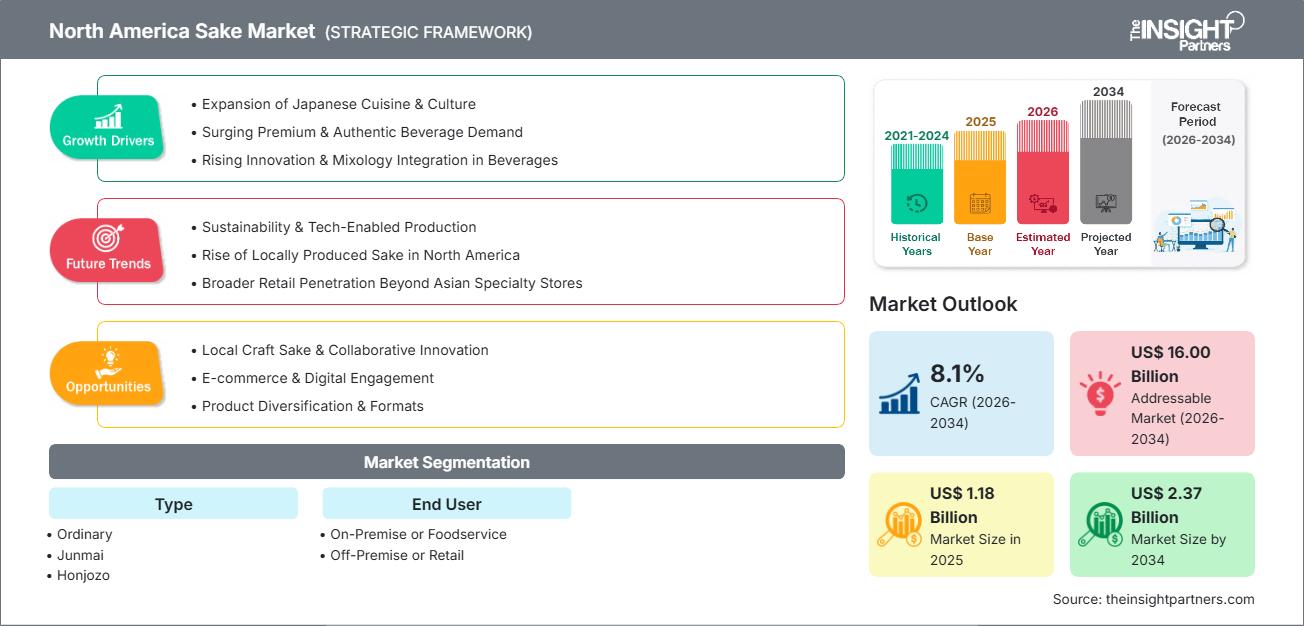
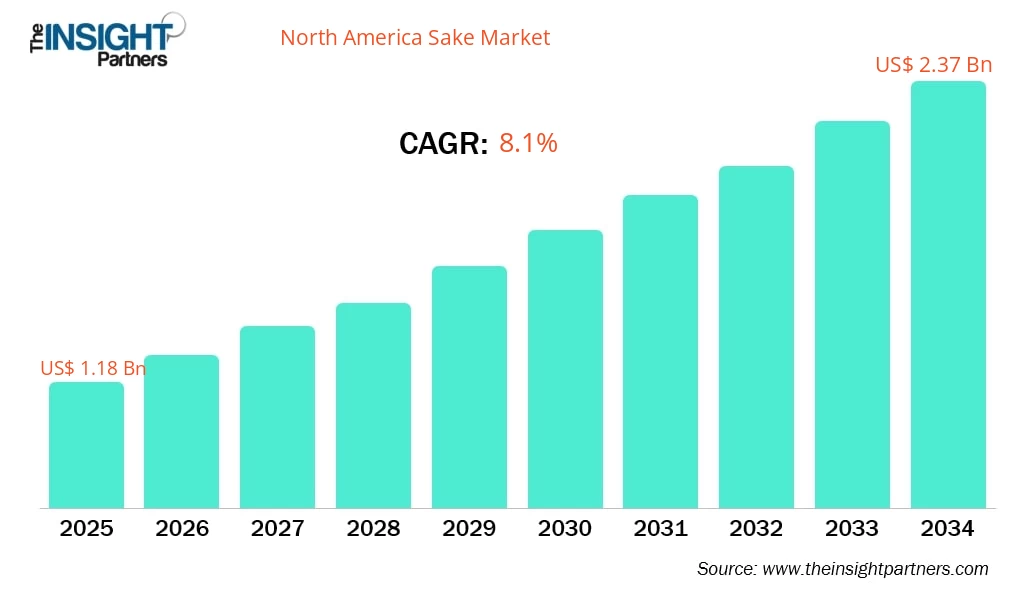
The North America sake market size is projected to reach US$ 2.37 billion by 2034 from US$ 1.18 billion in 2025. The market is expected to register a CAGR of 8.1% from 2026–2034.
North America Sake Market Analysis
The North America sake market is growing steadily, driven by rising interest in premium and craft alcoholic drinks, greater awareness of sake as a versatile option for casual drinking and food pairing, and the ongoing spread of Asian and Japanese cuisine in the region. Higher disposable incomes and a move toward experiential dining boost the demand for high-quality imported sake. Additionally, producers and distributors are hosting tastings and pairing events that help consumers better understand and accept sake.
The rise of locally produced craft sake appeals to consumers looking for freshness and local flavors. Innovations in flavor, packaging, and options like lower-alcohol or flavored sake are attracting a broader audience. The growth of e-commerce and direct-to-consumer sales, along with improved cold-chain logistics for premium sake, is making it easier for people to access these products.
North America Sake Market Overview
Sake is a traditional Japanese alcoholic beverage made from polished rice, water, yeast, and koji mold. It is produced through a multiple-parallel fermentation process that converts starch into sugars and then into alcohol. Unlike wine or beer, sake brewing combines saccharification and fermentation at the same time, creating a smooth flavor that can be dry and crisp or rich and aromatic.
In North America, the market is growing due to the rising popularity of Japanese cuisine. There is more exposure through restaurants, bars, and food pairing events, which have sparked consumer curiosity about artisanal and imported drinks. Key trends show an increasing number of locally brewed craft sake options, a focus on higher quality Junmai and Ginjo styles, and wider distribution in specialty liquor stores and online. Additionally, younger consumers and urban populations want sake as a versatile, lower-acid alternative to wine. This shift supports greater awareness and acceptance throughout the region.
● REPORT CUSTOMIZATION
Tailor This Report To Align With Your Specific Business Requirements
This report can be customized to align precisely with your business objectives, scope, and target markets. Customization options include tailored segmentation, geography, competitive analysis, and strategic insights to support informed decision-making.
Customize This Report →WHAT YOU CAN ADJUST
- ● Segmentations
- ● Geography
- ● Competitive Analysis
- ● Language Preferences
North America Sake Market: Strategic Insights
-
Get Top Key Market Trends of this report.This FREE sample will include data analysis, ranging from market trends to estimates and forecasts.
North America Sake Market: Drivers and Opportunities
Market Drivers:
Consumers are seeking products that have clear origins, skilled craftsmanship, and cultural authenticity. Sake fits these preferences because of its traditional brewing methods, careful production process, and strong ties to Japanese culture. Premium sake types such as Junmai, Ginjo, and Daiginjo appeal to consumers who appreciate complex flavors, artisanal quality, and transparent ingredients. This trend is noticeable among urban, higher-income, and younger adult consumers who are ready to pay more for unique drinking experiences.
The move toward craft and small-batch alcoholic drinks has sparked interest in sake as a choice alongside wine and spirits, particularly in food-pairing and fine dining. Restaurants and specialty bars are featuring premium sake on their curated menus, strengthening its image as a refined beverage option. Imported artisanal brands and locally produced craft sake drive this trend by focusing on authenticity, traditional methods, and storytelling.
Market Opportunities:
Local craft sake production and collaborative innovation meet consumer demand for authenticity, experimentation, and locally made beverages. The rise of sake breweries in North America has improved product accessibility. It allows producers to customize flavor profiles for regional tastes and food pairings. Craft sake makers focus on small-batch production, high-quality ingredients, and transparency in brewing. This approach appeals to consumers who appreciate artisanal and locally sourced products.
Partnerships between sake brewers, craft breweries, wineries, and chefs create new product styles and occasions for consumption. These collaborations encourage experimentation with different rice varieties, yeast strains, fermentation methods, and barrel aging, broadening sake's appeal beyond traditional formats. Collaborations across industries promote consumer awareness through tasting events, brewery tours, and special dining experiences, contributing to the market demand.
North America Sake Market Report Segmentation Analysis
The North America sake market is divided into different segments to give a clearer view of how they work, their growth potential, and the latest trends. Below is the standard segmentation approach used in industry reports:
By Type
- Ordinary: Ordinary sake is an entry-level product that people enjoy because it is affordable and easy to obtain. This sake is consumed for casual drinking and large volume consumption.
- Junmai: Junmai sake is made with only rice, water, yeast, and koji, with no added alcohol. It offers a rich and full-bodied flavor that appeals to consumers seeking quality.
- Honjozo: Honjozo sake has a small amount of distilled alcohol added during brewing, resulting in a lighter, smoother taste and a better aroma.
- Daiginjo: Daiginjo sake is a premium type that uses polished rice and careful brewing methods. It is known for its refined aroma, complex flavors, and higher price.
- Ginjo: Ginjo sake is brewed with polished rice and controlled fermentation. It provides a fragrant and delicate flavor that suits premium and specialty drinking.
- Others: This category includes specialty and emerging sake varieties such as flavored sake, sparkling sake, and aged sake. It caters to niche and experimental tastes.
By End User
- On-Premise / Foodservice: On-premise consumption covers sales through restaurants, bars, cafés, and other premises where sake is consumed at the point of service.
- Off-Premise: Off-premise channels involve retail sales where consumers purchase sake for home consumption, such as supermarkets and hypermarkets, specialty liquor stores, and retail.
By Country:
- US
- Canada
- Mexico
North America Sake Market Report Scope
| Report Attribute | Details |
|---|---|
| Market size in 2025 | US$ 1.18 Billion |
| Market Size by 2034 | US$ 2.37 Billion |
| CAGR (2026 - 2034) | 8.1% |
| Historical Data | 2021-2024 |
| Forecast period | 2026-2034 |
| Segments Covered |
By Type
|
| Regions and Countries Covered |
North America
|
| Market leaders and key company profiles |
|
North America Sake Market Players Density: Understanding Its Impact on Business Dynamics
The North America Sake Market is growing rapidly, driven by increasing end-user demand due to factors such as evolving consumer preferences, technological advancements, and greater awareness of the product's benefits. As demand rises, businesses are expanding their offerings, innovating to meet consumer needs, and capitalizing on emerging trends, which further fuels market growth.
North America Sake Market Players: Density: Understanding Its Impact on Business Dynamics
High Market Density and Competition
Competition is intense due to the presence of established players such as SHEZEN; DAISHICHI SAKE BREWERY CO, LTD; Brooklyn Kura; Nakano Sake Brewery Co., Ltd; Higashiyama Sake Brewery LLC; and HAKUTSURU SAKE BREWING CO., LTD.
This high level of competition urges companies to stand out by offering:
- Diverse product offering
- Sustainable and ethical sourcing
- Competitive pricing models
- Strong customer support and easy integration
Opportunities and Strategic Moves
- Focusing on research and development activities to distinguish themselves in the market
- Expanding global footprint and capabilities through acquisitions of beverage companies.
- Expanding product portfolio with the launch of innovative products
Other companies analyzed during the course of research:
- SHEZEN, DAISHICHI SAKE BREWERY CO, LTD.
- Brooklyn Kura
- Nakano Sake Brewery Co., Ltd
- Higashiyama Sake Brewery LLC
- HAKUTSURU SAKE BREWING CO., LTD
- Yoshinogawa co, Ltd
- SakéOne
- Nihonsakari Co., Ltd.
- Shata Shuzo Co., Ltd.
- Tatsuuma-Honke Brewing Co., Ltd.
North America Sake Market: News and Recent Developments
- The Hakkaisan Group – Collaboration: In April 2025, The Hakkaisan Group, which is known for its sake brand Hakkaisan, announced a partnership with the Dodgers, providing the refined sake as the official beverage for the Major League Baseball team. This partnership with the Dodgers is an important step toward the company's goal of making sake a globally recognized drink.
- Republic National Distributing Company (RNDC) – Collaboration: In December 2024, Republic National Distributing Company (RNDC), a leader in the US alcohol beverage industry, announced a partnership with Origami Sake, the fastest-growing national sake brand. This collaboration is expected to increase Origami Sake's distribution to 19 markets across the country in the coming months.
North America Sake Market Report Coverage and Deliverables
The "North America Sake Market Size and Forecast (2021–2034)" report provides a detailed analysis of the market covering the following areas:
- North America sake market size and forecast at the regional and country levels for all the segments covered under the scope
- North America sake market trends, as well as dynamics such as drivers, restraints, and key opportunities
- Detailed Porter's five forces and SWOT analysis
- North America sake market analysis, covering key trends, global and regional framework, major players, regulations, and recent developments
- Industry landscape and competition analysis covering market concentration, heat map analysis, prominent players, and recent developments for the North America sake market
- Detailed company profiles
Frequently Asked Questions

- Comprehensive Market Sizing and Forecast Analysis
- Detailed Segmentation Analysis
- In-Depth Market Dynamics Assessment
- Regional and Country-Level Insights
- Competitive Landscape and Company Benchmarking
- Strategic Business Intelligence
Recent Reports
Testimonials

The Insight Partners' SCADA System Market report is comprehensive, with valuable insights on current trends and future forecasts. The team was highly professional, responsive, and supportive throughout. We are very satisfied and highly recommend their services.
RAN KEDEM Partner, Reali Technologies LTDs
I requested a report on a very specific software market and the team produced the report in a few days. The information was very relevant and well presented. I then requested some changes and additions to the report. The team was again very responsive and I got the final report in less than a week.
JEAN-HERVE JENN Chairman, Future Analytica
We worked with The Insight Partners for an important market study and forecast. They gave us clear insights into opportunities and risks, which helped shape our plans. Their research was easy to use and based on solid data. It helped us make smart, confident decisions. We highly recommend them.
PIYUSH NAGPAL Sr. Vice President, High Beam Global
The Insight Partners delivered insightful, well-structured market research with strong domain expertise. Their team was professional and responsive throughout. The user-friendly website made accessing industry reports seamless. We highly recommend them for reliable, high-quality research services
YUKIHIKO ADACHI CEO, Deep Blue, LLC.
This is the first time I have purchased a market report from The Insight Partners.While I was unsure at first, I visited their web site and felt more comfortable to take the risk and purchase a market report.I am completely satisfied with the quality of the report and customer service. I had several questions and comments with the initial report, but after a couple of dialogs over email with their analyst I believe I have a report that I can use as input to our strategic planning process.Thank you so much for taking the extra time and making this a positive experience.I will definitely recommend your service to others and you will be my first call when we need further market data.
JOHN SUZUKI President and Chief Executive Officer, Board Director, BK Technologies
I wish to appreciate your support and the professionalism you displayed in the course of attending to my request for information regarding to infectious disease IVD market in Nigeria. I appreciate your patience, your guidance, and the fact that you were willing to offer a discount, which eventually made it possible for us to close a deal. I look forward to engaging The Insight Partners in the future, all thanks to the impression you have created in me as a result of this first encounter.
DR CHIJIOKE ONYIA MANAGING DIRECTOR, PineCrest Healthcare Ltd.Reason to Buy
- Informed Decision-Making
- Understanding Market Dynamics
- Competitive Analysis
- Identifying Emerging Markets
- Customer Insights
- Market Forecasts
- Risk Mitigation
- Boosting Operational Efficiency
- Strategic Planning
- Investment Justification
- Tracking Industry Innovations
- Aligning with Regulatory Trends





 Get Free Sample for