
Orbital Sanders Market Size, Share & Demand by 2034
Coverage: By Type (Pneumatic, Electric, Floor Sander); Application (Wood Work and Furniture, Metal Working, Others), and Geography (North America, Europe, Asia Pacific, and South and Central America)
- Status : Data Released
- Report Code : TIPRE00015833
- Category : Manufacturing and Construction
- No. of Pages : 150
- Available Report Formats :


- Last update date : August 05, 2026


2025 Market Size
US$ 2.14 Bn
Base year value
2034 Forecast
US$ 3.85 Bn
Projected by 2034
CAGR 2026-2034
6.74 %
Growth rate
Addressable Market
US$ 27.07 Bn
(2026-2034)
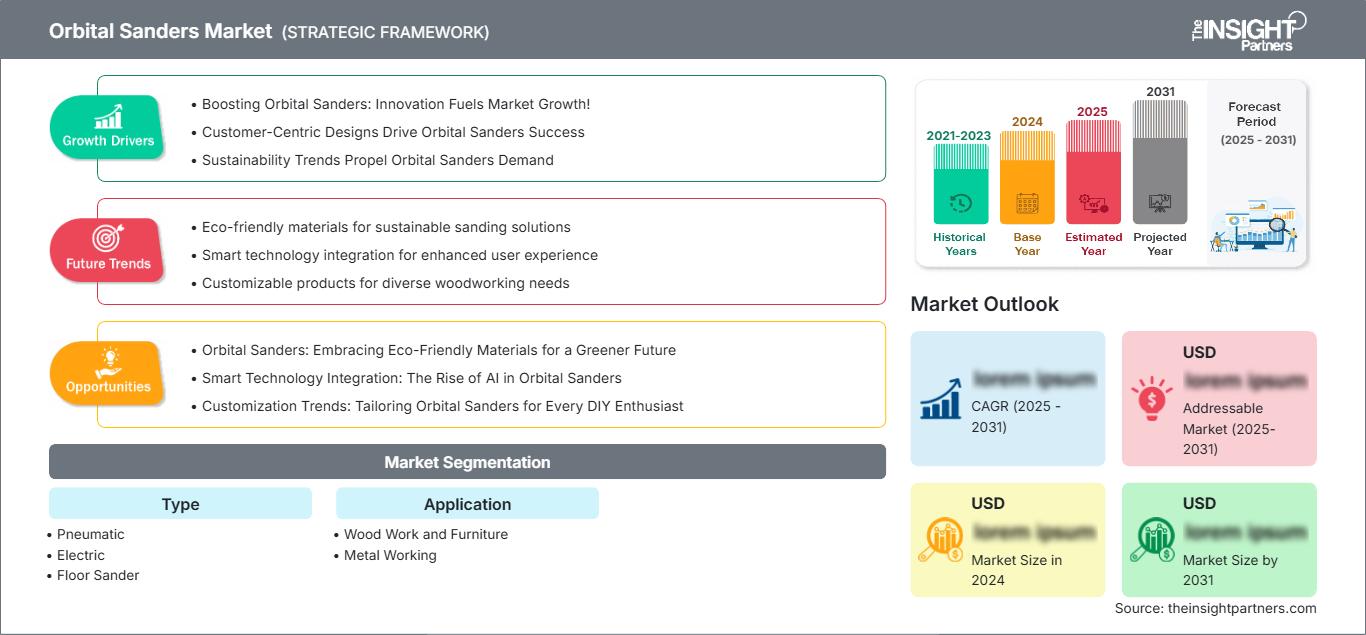
The Orbital Sanders Market was valued at US$ 2.14 Billion in 2025 and is projected to reach US$ 3.85 Billion by 2034, expanding at a CAGR of 6.74% during 2026–2034. Demand is supported by precision finishing requirements in woodworking, furniture production, and metalworking, where orbital motion improves surface uniformity, reduces swirl marks, and supports consistent productivity across professional workshops and industrial finishing lines.
Across North America, demand is expected to advance at a 6.3–6.7% CAGR as contractors, cabinet shops, automotive refinishers, and industrial maintenance teams upgrade sanding systems. The Orbital Sanders Market size in the region benefits from residential remodeling, dust-control compliance, and higher use of pneumatic and electric tools designed for repeatable finishes in wood, coatings, composites, and light metal preparation.
Orbital Sanders Market Assessment and Insights
- North America held 34–36% share in 2025 and is growing at a 6.3–6.7% CAGR between 2026–2034, supported by remodeling, vehicle repair, and workplace dust-control upgrades.
- US accounted for 78–82% of North America in 2025 and is growing at a 6.4–6.8% CAGR between 2026 and 2034 as workshops standardize electric and pneumatic systems.
- Europe held 26–28% share in 2025 and is growing at a 5.8–6.2% CAGR between 2026–2034, led by Germany, the UK, France, Italy, and Spain.
- Asia Pacific held a 24–27% share in 2025 and is growing at a 7.4–7.9% CAGR between 2026 and 2034, led by China, Japan, South Korea, and India.
- Largest Segment Electric held 46–49% market share in 2025 and is growing at a 6.8–7.2% CAGR between 2026–2034 due to cordless adoption.
- High Growth Segment Wood Work and Furniture held 61–64% market share in 2025 and is growing at a 7.1–7.6% CAGR between 2026 and 2034.
- Key companies analyzed in detail: 3M Company, Asia-Pacific Industrial Co., Ltd., APT Tools and Machinery India Private Limited, Atlas Copco (India) Ltd., Chicago Pneumatic, Dynabrade Inc., Ingersoll Rand Inc., Mirka Ltd., Robert Bosch Power Tools GmbH, and Sumake Industrial Co., Ltd.
Source: The Insight Partners' analysis based on proprietary research, government publications, company annual reports, investor presentations, industry databases, and expert interviews.
The development of products in the market has shifted from simple finishing tools to a combination of sanding systems consisting of brushless motors, vacuum ready pads, vibration management, and lighter housing. Manufacturing has become more modular, which allows manufacturers to provide similar platforms for professional users in furniture making, body repair, marine, and metalwork industries by customizing the pads' size, orbit diameter, dust collection, and speed controls.
During the forecast period, new geographic regions will provide additional demand in light of organized furniture manufacturing, renovation works in construction, and maintenance expenditure in industry sectors. The increasing awareness of the regulatory authorities about airborne dust, exposure to dust, and better finishing environment also influences the buying decision towards vacuum compatible sanders and accessories.
Orbital Sanders Market Report Scope
| Report Attribute | Details |
|---|---|
| Market size in 2025 | US$ 2.14 Billion |
| Market Size by 2034 | US$ 3.85 Billion |
| Global CAGR (2026 - 2034) | 6.74% |
| Historical Data | 2021-2024 |
| Forecast period | 2026-2034 |
Orbital Sanders Market Analysis
The drivers of the Orbital Sanders Market Growth include increased customer demands for high finishing quality in the furniture, joinery, metal working, and car refinishing segments. Consumers are demanding machines which minimize the user's physical efforts, manage the dust, and enable reproducible finishing of various materials such as coatings, veneers, panels, and fabricated parts, thus transforming the sanding efficiency into an operational parameter.
The supply chain is represented by suppliers of motors, producers of abrasive pads, providers of pneumatic systems, distributors, and after-sale services. The supply factors involve the availability of electronics for brushless electric machines, the cost of aluminum and composites for housing, and channel stock management cycles. More professionals are concerned about the system integration, including abrasives, hoses, filters, and pad costs.
The competition is high among diverse tool providers and specialist sanders technology providers. Orbital Sanders Market report reveals that 3M Company, Mirka Ltd., Robert Bosch Power Tools GmbH, Dynabrade Inc., Ingersoll Rand Inc., Atlas Copco (India) Ltd., and Chicago Pneumatic offer products based on ergonomics, dust collection, productivity, and industry service range.
Investment is increasingly being made into cordless technology, vibration reduction technologies in pneumatic tools, and complete sanding systems. Asia-Pacific Industrial Co., Ltd., Sumake Industrial Co., Ltd., and APT Tools and Machinery India Private Limited help establish pricing and regional advantage, while global players maintain margins by developing systems for professionals, applications training, replacement parts, and distribution channel support.
● REPORT CUSTOMIZATION
Tailor This Report To Align With Your Specific Business Requirements
This report can be customized to align precisely with your business objectives, scope, and target markets. Customization options include tailored segmentation, geography, competitive analysis, and strategic insights to support informed decision-making.
Customize This Report →WHAT YOU CAN ADJUST
- ● Segmentations
- ● Geography
- ● Competitive Analysis
- ● Language Preferences
Orbital Sanders Market: Strategic Insights
Regional Insights
North America Orbital Sanders Market
In 2025, North America accounted for 34–36% of the total market revenue in terms of revenue. The Orbital Sanders Market share comes from expenditures on remodeling, collision repairs of automobiles, marine services, and the wide availability of vacuum compatible equipment. Contractors and manufacturers value speed of operation, low dust generation, and durability of equipment.
The most demanding countries within North America include the United States, Canada, and Mexico where manufacturing of furniture and industrial facilities together with the established supply chains ensure regular equipment replacement. Occupational Safety and Health Administration (OSHA) requirements, higher wages, and preference for ergonomic power tools increase acceptance of electric and pneumatic systems.
U.S. Orbital Sanders Market
In 2025, the US contributed 78-82% of North America's revenue and will exhibit growth at a CAGR of 6.4-6.8%. Factors contributing to demand include residential renovations, cabinet manufacturing, aerospace composites repair, automotive refinishing shops, and metal finishing activities where controlled stripping and uniform preparation of surfaces are required.
Popular brands such as 3M Company, Dynabrade Inc., Ingersoll Rand Inc., Mirka Ltd., and Robert Bosch Power Tools GmbH have a high degree of visibility via industrial distributors, body shop suppliers, and retail sales channels. Market trends involve dust collection systems, lightweight electric products, and pneumatic tools.
Europe Orbital Sanders Market
The Europe region had a 26-28% market share in 2025 and was expected to exhibit a CAGR of 5.8-6.2%. The major driver for demand in the Europe region includes Germany due to its clustering of machinery, automotive, and furniture. Other drivers include the UK, where there is extensive use in renovation and finishing works carried out by contractors.
There is contribution to the market from France, Italy, and Spain through furniture, yacht interiors, metal fabrications, and restoration works. The European market favors the adoption of electric systems and the abrasive capability of equipment due to energy efficiency and occupational exposure regulations in the area. Companies like Mirka Ltd. and Robert Bosch Power Tools GmbH will thrive in this region.
APAC Orbital Sanders Market
The APAC region has 24-27% market share in 2025, with the fastest growing regional rate of CAGR estimated at 7.4-7.9%. China leads in production and consumption, while Japan and South Korea provide precision finishing in their industries.
India and Australia drive the demand through furniture export, construction fit outs, and maintenance. Support of the policy toward localized manufacturing, increasing organized retail presence, and reduced cost of tools help in scaling up in the region especially for the electric model in wood work, furniture, and light metal finishing.
Middle East & Africa Orbital Sanders Market
Growth rate of Middle East and Africa market has been estimated at 5.5%-5.9% for the next few years owing to high demand in Saudi Arabia and the UAE on account of construction interiors, hospitality interiors, and maintenance linked with infrastructure development. South Africa continues to be the largest industrial market in the region.
RoMEA market is smaller but shows some improvements because of the need of surface preparation tools in energy, mining, and fabrication projects. RoMEA growth is restricted owing to price sensitivity and fragmented distribution, but professional contractors now prefer efficient sanding systems as finish impacts project completion and rework cost.
Segmentation Analysis
Type
Type is projected to grow at a 6.5–7.0% CAGR during 2026–2034. The Orbital Sanders Market scope across type reflects a balance between pneumatic tools used in continuous industrial environments, electric models preferred for mobility and control, and floor sanders serving renovation and flooring contractors. Product choice is shaped by duty cycle, extraction needs, energy source, and finish tolerance.
- Pneumatic models remain strategically important in body shops, factories, and fabrication lines because compressed-air systems enable long operating cycles, lighter tool bodies, and consistent torque under repetitive sanding conditions.
- Electric models lead adoption where portability, variable speed, and lower setup complexity matter, especially for contractors, furniture workshops, and users shifting toward brushless motors and cordless platforms.
- Floor Sander demand is linked to renovation, hardwood floor restoration, and commercial fit-outs, where wider sanding coverage and rental channel availability support specialized but recurring use.
Application
Application is expected to grow at a 6.8–7.3% CAGR during 2026–2034. Wood work and furniture remains the largest use case because surface quality directly affects coatings, assembly value, and perceived product finish. Metal working demand is rising as fabricators use orbital sanding for deburring, paint preparation, weld blending, and maintenance finishing.
- Wood Work and Furniture dominates demand as cabinet makers, flooring installers, joinery shops, and furniture manufacturers require uniform finishing before staining, coating, polishing, and assembly.
- Metal Working is strategically relevant in fabrication, maintenance, and repair operations where controlled sanding supports burr removal, coating adhesion, surface blending, and preparation before painting.
Opportunity Snapshot
| Application | Revenue Contribution | Trend Tag | Adoption Stage |
| Wood Work and Furniture | High | Dust Control | Mature |
| Metal Working | Medium | Weld Blending | Scaling |
Orbital Sanders Market Growth Drivers and Impact Analysis
Rising Professional Demand for Cleaner Surface Finishing
Sanding is being considered less as an actual finishing process and more as a compliance and productivity challenge by professional workshops. Improved dust removal, use of HEPA compatible dust extractors, and improved interfaces between abrasives and tool surfaces lower airborne particles, improve cleanup time, and help ensure operators produce uniform finishes regardless of batches. This market driver has an immediate effect on purchasing, as workshops tend to purchase the tools, pads, hoses, filters, and abrasives as a package.
Expansion of Furniture, Remodeling, and Interior Fit-Out Activity
Furniture and interior work require repeated sanding before coating, staining, veneering, and final assembly. As residential remodeling, commercial fit-outs, and customized furniture production expand, contractors need tools that can deliver uniform finishes without excessive labor time. Orbital sanders are preferred because they balance material removal and surface quality across panels, edges, doors, and flooring components. The market impact is visible in higher demand for electric models, floor sanders, and compact tools suited to renovation sites and workshop production.
Shift Toward Ergonomic and Low-Vibration Tool Platforms
Tool buyers are placing greater weight on vibration exposure, operator fatigue, noise, and grip comfort, especially in shops where sanding is performed for several hours per shift. Low-profile designs, balanced motors, soft grips, and improved speed controls help users maintain pressure consistency and reduce surface defects. This strengthens replacement demand because older models remain functional but less efficient. Suppliers that demonstrate measurable comfort, durability, and finish benefits can defend premium positioning in the market.
Orbital Sanders Market Future Trends
Cordless and Brushless Systems Move Into Professional Finishing
Orbital Sanders Market trends will increasingly center on cordless and brushless platforms as battery density improves and tool electronics deliver steadier speed under load. Professional users will adopt cordless models for mobile repair, on-site cabinetry, marine interiors, and localized metal finishing where cords or air hoses restrict movement. This trend will not eliminate pneumatic systems in factories, but it will expand electric tool penetration in mixed-use workshops and contractor fleets that value portability, reduced setup time, and platform battery sharing.
Integrated Dust Management Becomes a Buying Standard
Dust management will evolve from an accessory feature into a baseline specification for professional sanding. Future purchasing decisions will compare extraction efficiency, filter compatibility, antistatic hose design, pad hole patterns, and system mobility. Shops that quantify cleanup time, coating defects, and worker comfort will justify higher investment in matched tools and extraction systems. This will reward suppliers capable of selling complete sanding ecosystems rather than stand-alone tools, particularly in woodworking, automotive refinish, and composite finishing environments.
Orbital Sanders Market Opportunities
Localized Manufacturing and Mid-Tier Professional Tool Lines
Manufacturers can capture growth by building mid-tier professional lines that balance durability, ergonomics, and accessible pricing. Localized assembly in India, Southeast Asia, and selected Middle Eastern hubs can reduce lead times, improve serviceability, and align products with regional power supply and workshop practices. Distribution partnerships with industrial suppliers, woodworking dealers, and rental networks will be critical. The opportunity is strongest where buyers are upgrading from entry-level tools but cannot justify premium imported systems for every workstation.
Aftermarket Ecosystems for Pads, Abrasives, and Extraction
The recurring economics of sanding create an attractive opportunity beyond tool sales. Suppliers can bundle pads, abrasives, backing plates, dust bags, filters, and maintenance kits into application-specific programs for wood, metal, and coatings work. Digital reordering, distributor-managed inventory, and training can increase loyalty while reducing user downtime. This model is especially relevant for industrial workshops and body shops that consume abrasives continuously and need predictable finish quality across operators, materials, and shifts.
Recent Developments
- January 2026: Mirka Ltd announces the release of the next-generation Mirka DEROS II and Mirka DEOS II electric sanders. With this launch, Mirka continues its legacy of innovation by delivering smarter, more ergonomic tools, now expanded to support larger surface applications through the addition of a new 7" sanding platform.
- September 2025: Mirka Ltd introduced Abranet Yellow, a net-based abrasive is designed for hand and machine sanding of ceilings and walls. Abranet Yellow is especially well-suited for long-neck sanders, such as the Mirka LEROS, making it an ideal choice for fast and efficient wall and ceiling sanding. It performs exceptionally well with random orbital and rotary wall sanders, offering smooth compatibility across various sanding tools. Its flexible net construction also makes it suitable for hand sanding blocks, the Mirka DecoSander, and manual use – providing painters with a reliable, dust-free solution for large surfaces and detailed areas.
- March 2024: Mirka Ltd introduces the new, even more compact Mirka DEOS 343 electric orbital sander to further expand the range of lightweight DEOS sanders. The new DEOS version uses a 75x100mm sanding pad, for smooth and efficient sanding of wood, doors, and frames. The new Mirka DEOS 343 is designed for sanding windows, doors and frames and performing correction work on wood filler, in places where size truly matters, and the result really counts.
Frequently Asked Questions

- Comprehensive Market Sizing and Forecast Analysis
- Detailed Segmentation Analysis
- In-Depth Market Dynamics Assessment
- Regional and Country-Level Insights
- Competitive Landscape and Company Benchmarking
- Strategic Business Intelligence
Recent Reports
Testimonials

The Insight Partners' SCADA System Market report is comprehensive, with valuable insights on current trends and future forecasts. The team was highly professional, responsive, and supportive throughout. We are very satisfied and highly recommend their services.
RAN KEDEM Partner, Reali Technologies LTDs
I requested a report on a very specific software market and the team produced the report in a few days. The information was very relevant and well presented. I then requested some changes and additions to the report. The team was again very responsive and I got the final report in less than a week.
JEAN-HERVE JENN Chairman, Future Analytica
We worked with The Insight Partners for an important market study and forecast. They gave us clear insights into opportunities and risks, which helped shape our plans. Their research was easy to use and based on solid data. It helped us make smart, confident decisions. We highly recommend them.
PIYUSH NAGPAL Sr. Vice President, High Beam Global
The Insight Partners delivered insightful, well-structured market research with strong domain expertise. Their team was professional and responsive throughout. The user-friendly website made accessing industry reports seamless. We highly recommend them for reliable, high-quality research services
YUKIHIKO ADACHI CEO, Deep Blue, LLC.
This is the first time I have purchased a market report from The Insight Partners.While I was unsure at first, I visited their web site and felt more comfortable to take the risk and purchase a market report.I am completely satisfied with the quality of the report and customer service. I had several questions and comments with the initial report, but after a couple of dialogs over email with their analyst I believe I have a report that I can use as input to our strategic planning process.Thank you so much for taking the extra time and making this a positive experience.I will definitely recommend your service to others and you will be my first call when we need further market data.
JOHN SUZUKI President and Chief Executive Officer, Board Director, BK Technologies
I wish to appreciate your support and the professionalism you displayed in the course of attending to my request for information regarding to infectious disease IVD market in Nigeria. I appreciate your patience, your guidance, and the fact that you were willing to offer a discount, which eventually made it possible for us to close a deal. I look forward to engaging The Insight Partners in the future, all thanks to the impression you have created in me as a result of this first encounter.
DR CHIJIOKE ONYIA MANAGING DIRECTOR, PineCrest Healthcare Ltd.Reason to Buy
- Informed Decision-Making
- Understanding Market Dynamics
- Competitive Analysis
- Identifying Emerging Markets
- Customer Insights
- Market Forecasts
- Risk Mitigation
- Boosting Operational Efficiency
- Strategic Planning
- Investment Justification
- Tracking Industry Innovations
- Aligning with Regulatory Trends





 Get Free Sample for