
Paraffin Oil Market Demand, Size & Forecast by 2034
Coverage: By Type (Industrial Paraffin Oil, Medical Paraffin Oil); Application (Food, Cosmetics and Personal Care, Paperboard and Packaging, Textile Auxiliaries, Others) , and Geography (North America, Europe, Asia Pacific, and South and Central America)
- Status : Data Released
- Report Code : TIPRE00019647
- Category : Chemicals and Materials
- No. of Pages : 150
- Available Report Formats :


- Last update date : September 22, 2026


2025 Market Size
US$ 1.91 Bn
Base year value
2034 Forecast
US$ 2.26 Bn
Projected by 2034
CAGR 2026-2034
1.89 %
Growth rate
Addressable Market
US$ 18.90 Bn
(2026-2034)
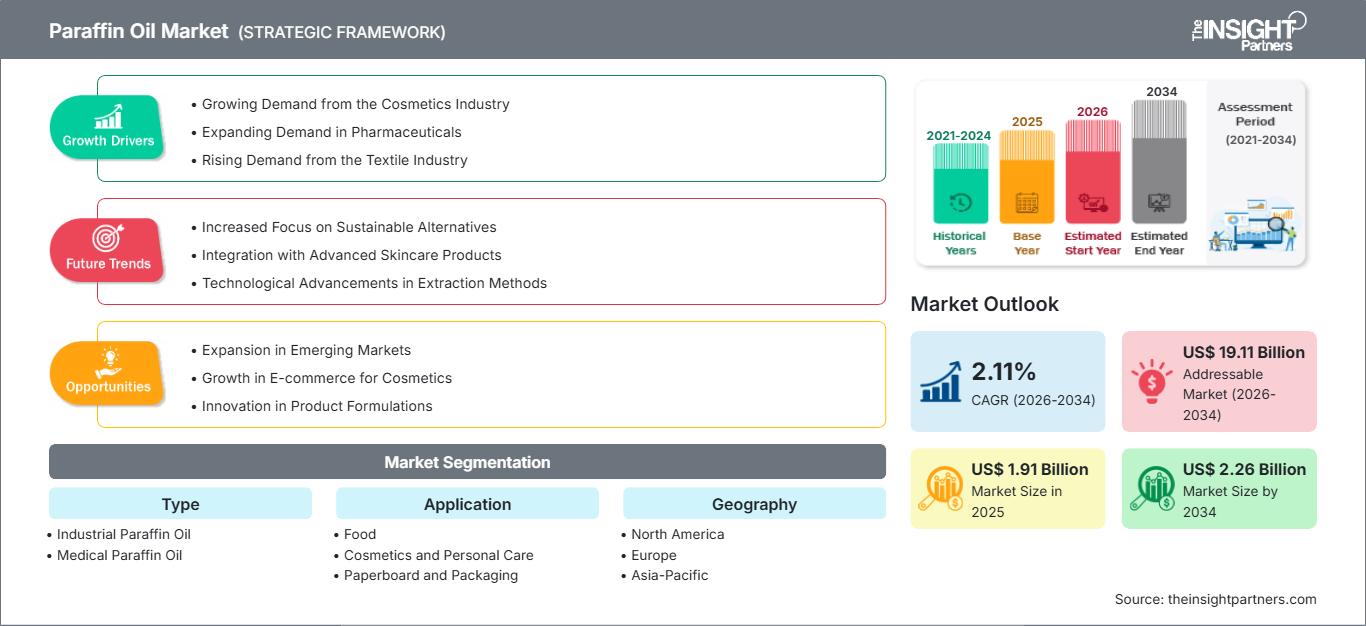
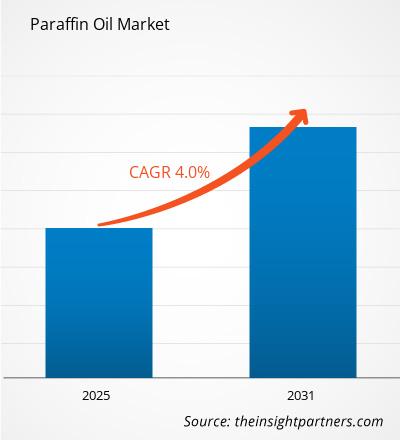
The global Paraffin Oil market was valued at US$ 1.91 billion in 2025 and is expected to reach US$ 2.26 billion by 2034; it is estimated to record a CAGR of 1.89% during 2026-2034.
Paraffin Oil Market Assessment and Insights
- North America: North America represented an estimated 18–22% Paraffin Oil Market share in 2025 and is projected to grow at a 1.8–2.4% CAGR between 2026 and 2034, supported by pharmaceutical, cosmetics, food-contact, and specialty industrial consumption.
- U.S.: The U.S. accounted for approximately 76–80% of North American demand in 2025 and is expected to register a 1.7–2.3% CAGR between 2026 and 2034, led by regulated end uses.
- Europe: Europe held approximately 20–24% share in 2025 and is expected to expand at a 1.5–2.1% CAGR between 2026 and 2034, with Germany, France, Italy, the UK, and Spain supporting pharmaceutical, cosmetics, food, and industrial applications.
- Asia Pacific: Asia Pacific accounted for approximately 42–47% share in 2025 and is forecast to grow at a 2.6–3.3% CAGR between 2026–2034, led by China, India, Japan, South Korea, and Southeast Asian manufacturing centers.
- Largest Segment: Industrial Paraffin Oil held approximately 68–73% market share in 2025 and is expected to grow at a 1.9–2.5% CAGR between 2026–2034, reflecting broad technical and processing applications.
- High Growth Segment: Medical Paraffin Oil represented approximately 27–32% market share in 2025 and is projected to register a 2.5–3.2% CAGR between 2026 and 2034, supported by regulated pharmaceutical and personal care formulations.
- Key companies analyzed in detail: Aromachimie Ltd, Calumet Specialty Products Partners, L.P., China Petroleum & Chemical Corporation, Exxon Mobil Corporation, H&R GmbH, HollyFrontier Refining & Marketing LLC, Indian Oil Corporation Limited, ENEOS Corporation, LANXESS AG, Sasol Limited.
Source: The Insight Partners' analysis based on proprietary research, government publications, company annual reports, investor presentations, industry databases, and expert interviews.
Factors that influence production economics now include refinery design, hydrogenation, quality of raw materials, and the capability to achieve tight specifications on both viscosity and purity grades. Refineries are not just competing on the basis of commodity oil anymore as they have started to produce differentiated white oils for applications in pharmaceuticals, cosmetics, food contact, and specialty industries.
Future Paraffin Oil Market growth should be focused in the Asia Pacific region and other emerging manufacturing regions because of rising refinery capacities, pharmaceutical output, cosmetics, and processed foods. The regulatory environment will give an advantage to those suppliers that can offer consistent purity and documentation of products. Thus, investments would focus on hydrotreating, quality control systems, flexible packaging, and regional logistics facilities as opposed to new capacity to produce commodities.
Paraffin Oil Market Report Scope
| Report Attribute | Details |
|---|---|
| Market size in 2025 | US$ 1.91 Billion |
| Market Size by 2034 | US$ 2.26 Billion |
| Global CAGR (2026 - 2034) | 1.89% |
| Historical Data | 2021-2024 |
| Forecast period | 2026-2034 |
Paraffin Oil Market Analysis
Paraffin Oil Market forecast depends on the presence of a value chain covering refining of crude, fraction separation, hydroprocessing, purification, blending, certification, distribution, and formulation. The need for Paraffin oil is greatest in situations where the product offers such qualities as inertness, lubricity, water repellency, and controllable viscosity. In most cases, the cosmetic and pharmaceutical sectors prefer the highest quality and consistent products whereas industrial consumers focus more on price and availability.
The supply dynamics in the Paraffin Oil Market are highly dependent on the nature of the crude oil, refining economics in that particular region, availability of hydrogen and purification technology. The high-quality grades have to go through more processing and certification, hence making them more differentiated than regular mineral oils. Manufacturers with refining facilities can better handle variability in the crude oil feedstocks, while the distributors still play an important role for small formulations consumers.
According to the Paraffin Oil Market report, there is a fairly concentrated level of competition where large integrated refineries compete with specialist oil companies based on purity, scope of applications, technical specifications, and supply chain efficiency. ExxonMobil Corporation enjoys a diverse range of white oils that includes pharmaceutical, cosmetic, food-grade and specialist uses. Indian Oil Corporation Limited brings together the benefits of refinery integration and specialty white oils, as does LANXESS AG by petroleum white mineral oils for industrial and consumer uses.
Investments in the Paraffin Oil Market are being made for high-end products rather than volume production. H&R GmbH and Calumet Specialty Products Partners, L.P. focus on specialty refining. China Petroleum & Chemical Corporation and ENEOS Corporation have the advantage of refining systems. Sasol Limited utilizes differentiating factors of paraffin chemistry, while Aromachimie Ltd., HollyFrontier Refining & Marketing LLC, and others rely on application-specific grades and regional availability.
● REPORT CUSTOMIZATION
Tailor This Report To Align With Your Specific Business Requirements
This report can be customized to align precisely with your business objectives, scope, and target markets. Customization options include tailored segmentation, geography, competitive analysis, and strategic insights to support informed decision-making.
Customize This Report →WHAT YOU CAN ADJUST
- ● Segmentations
- ● Geography
- ● Competitive Analysis
- ● Language Preferences
Paraffin Oil Market: Strategic Insights
Regional Insights
North America Paraffin Oil Market
According to the Paraffin Oil Market report, North America accounted for approximately 18–22% share in 2025 and is expected to grow at a 1.8–2.4% CAGR through 2034. This is made possible due to a developed pharmaceutical, cosmetic, food processing, and specialty chemicals industry that calls for high-quality mineral oils with defined specifications. Demand is further driven by the presence of well-established refinery facilities and advanced distribution networks catering to formulation manufacturers in the U.S. and Canada.
There are strong dynamics in favor of the U.S. in this regional market as pharmaceutical manufacturing, cosmetics manufacturing, food processing, and formulations manufacture drive demand. Suppliers will have to increasingly provide information regarding purity, quality, regulatory compliance, and supply chain security. There are contributions from Canada in terms of food processing, industrial manufacturing, and cosmetics production, and Mexico adds on through its developing manufacturing and consumer goods industries.
U.S. Paraffin Oil Market
The U.S. represented approximately 76–80% of North American demand in 2025 and is projected to grow at a 1.7–2.3% CAGR through 2034. Use of pharmaceutical and cosmetic grades is of very high purity, whereas food processors make use of mineral oils that are compliant for processing and food contact applications. The use of industrial grade mineral oils continues to be diversified among processing aid, lubricants, release agents, and speciality products.
The Exxon Mobil Corporation has made a big splash through its Marcol and Primol white oil range of products in applications such as pharmaceuticals, cosmetics, food contact, and speciality applications. Applications have become increasingly more important than volumes in terms of growth potential for customers who emphasize documentation, purity, viscosity uniformity, and reliability of supply.
Europe Paraffin Oil Market
Europe held approximately 20–24% share in 2025 and is projected to expand at a 1.5–2.1% CAGR through 2034. The key market is Germany, aided by manufacturing of pharmaceuticals, specialty chemicals, cosmetics, and industrial products. The UK, France, Italy, and Spain generate additional demand through consumer-product and manufacturing bases that are well established.
The UK has demand for the product from industries such as pharmaceuticals, cosmetics, food products, and specialty formulations, with buying increasingly focused on purity and regulatory compliance. Germany has demand arising from a big manufacturing base of chemicals and pharmaceuticals for technical and medical grade. The demand from Europe is through cosmetics, food products, pharmaceuticals, and industrial uses from France, Italy, and Spain.
APAC Paraffin Oil Market
APAC represented approximately 42–47% share in 2025 and is expected to grow at a 2.6–3.3% CAGR through 2034, making it the leading regional market. China is the major consumer region-wise, succeeded by Japan, South Korea, India, and Australia. Development in the manufacture of pharmaceuticals, cosmetics, food-processing industry, and industrial manufacturing drives the demand.
China derives advantages from large-scale manufacturing downstream activities, whereas India has both development in pharmaceuticals/personal care products manufacturing and specialty oil manufacturing downstream to its refineries. In case of Japan and South Korea, high quality of formulations is important, whereas Australia has a smaller but stable market. The government initiatives for regional development in manufacturing localization, specialty chemicals, and refining activities would aid in strengthening the supply chain.
Middle East & Africa Paraffin Oil Market
The Middle East and Africa demand is comparatively smaller but benefits from refining capacity, petrochemical integration, cosmetics manufacturing, and pharmaceutical development. The region is expected to register a 2.0–2.7% CAGR through 2034. Saudi Arabia leads regional demand, followed by the UAE and South Africa, while other markets provide incremental industrial consumption.
The advantages enjoyed by Saudi Arabia include having energy infrastructure that is integrated with the downstream diversification, while the UAE acts as a significant trading and distribution center. South Africa adds value through the manufacturing of various products, food products, cosmetic goods, and industrial uses. The demand for the remaining MEA will be tied to the growth of refining, imported specialty grades, and infrastructure development.
Segmentation Analysis
Type
Type differentiation determines purity requirements, processing intensity, and downstream suitability. Industrial Paraffin Oil remains the dominant category because of broad use across processing and formulation activities, while Medical Paraffin Oil benefits from higher specification requirements. The overall type segment is expected to grow at a 2.0–2.6% CAGR during 2026–2034, with premium medical applications expanding faster than commodity uses.
- Industrial Paraffin Oil: Industrial grades serve processing, lubrication, release, coating, textile, and formulation requirements where controlled viscosity and chemical stability are important. Demand remains diversified across manufacturing sectors and is less dependent on individual downstream industries.
- Medical Paraffin Oil: Medical grades require tighter purity and quality controls for pharmaceutical, topical, and healthcare-related formulations. Their strategic importance is increasing as manufacturers prioritize consistent excipient performance, documented specifications, and compatibility with regulated production systems.
Application
Application diversification reduces dependence on any single downstream sector. Food and cosmetics require high-purity grades, while paperboard and packaging applications use paraffinic oils for selected processing and formulation functions. Textile auxiliaries provide another technical outlet. The application segment is estimated to grow at a 2.1–2.7% CAGR during 2026–2034, supported by specialty formulations and compliance-led substitution.
- Food: Food applications depend on permitted grades and controlled specifications for processing, release, lubrication, or related functions. Buyers emphasize purity, regulatory documentation, and supplier consistency, making certified products more strategically valuable than commodity alternatives.
- Cosmetics and Personal Care: Cosmetics and personal care formulations use refined mineral oils for emollient, conditioning, texture, and formulation functions. Stable quality, low odor, color, and compatibility with finished products influence supplier selection across creams, lotions, hair products, and related preparations.
- Paperboard and Packaging: Packaging-related applications use paraffinic oils in selected processing and material formulations where moisture resistance, lubricity, or controlled surface characteristics are required. Demand is tied to packaging production volumes and formulation requirements rather than direct consumer exposure.
- Textile Auxiliaries: Textile processors use specialty mineral oils in auxiliary formulations requiring lubrication, smoothness, and controlled processing behavior. Demand varies with textile production, finishing activity, and formulation preferences, with higher-value grades gaining relevance where process consistency is critical.
Opportunity Snapshot
| Application | Revenue Contribution | Trend Tag | Adoption Stage |
|---|---|---|---|
| Food | Medium | Food Contact | Mature |
| Cosmetics and Personal Care | High | Skin Care | Mature |
| Paperboard and Packaging | Medium | Process Aid | Scaling |
| Textile Auxiliaries | Low | Fiber Processing | Mature |
Paraffin Oil Market Growth Drivers and Impact Analysis
Rising Demand for High-Purity Formulation Ingredients
The manufacturers of pharmaceuticals and personal care products need their ingredients to be consistent in terms of purity, odour levels, physical properties, and specifications. Such a trend will favour the use of purified paraffinic oils over mineral oils that are not consistent. Exxon Mobil mentions some of its white oils as suitable for personal care, pharmaceutical and cosmetic purposes. On the other hand, the Indian Oil Corporation Ltd offers light liquid paraffin for personal care, pharmaceutical and plastics purposes. In such cases, there is a quality-based demand structure in which competing firms engage in purifying the oils, certification and batch control. Such an opportunity could help producers gain more margin even if total growth levels remain modest.
Expansion of Pharmaceutical and Personal Care Manufacturing
Increasing demand in pharmaceutical production, topical preparations, skincare products, hair care, and other consumer products necessitates the continued requirement for high quality liquid paraffin and white mineral oils. Such uses will need consistent materials that will be capable of working consistently throughout multiple production runs and being suitable to existing formulations. The increase in production capacity in the Asia Pacific region will be especially critical since manufacturers in the region will be serving both local markets and exports. Not only will this increase in demand affect volumes, but there is also the consideration of customer needs to be able to provide technical data and application information. Local distributors will be able to decrease delivery times and better manage inventory requirements for smaller formulators.
Increasing Use of Compliant Oils in Food-Contact Applications
Food processors and packagers have continued to favor materials that conform to safety and purity regulations, especially in instances where there might be accidental contact with food. Regulations take into account the type of use and the conditions under which the mineral oils are to be used and, as such, the need for the proper grade has been emphasized. This provides a setting for the use of materials produced through proper purification processes and quality management. Food processors also require a dependable source due to the fact that switching processing aids involves additional validation and documentation processes. This provides maximum benefit to suppliers who can ensure consistent production, documentation, and product usage. Food consumption is not likely to affect the total volume of the market but will only boost the premium segment.
Paraffin Oil Market Future Trends
Greater Product Differentiation by Purity and Application
The next phase of industry development is likely to emphasize application-specific grades rather than broad commodity classifications. Pharmaceutical, cosmetics, food-contact, and specialty industrial users increasingly require different combinations of viscosity, purity, oxidation stability, and documentation. Producers will therefore continue developing portfolios that address precise formulation requirements instead of relying on a limited set of general-purpose products. Digital quality systems should improve batch traceability and technical-document access, supporting faster qualification by multinational customers. Regional manufacturers may also expand local production of specialized grades to reduce import dependence and improve delivery reliability. These developments should increase the importance of formulation support, regulatory expertise, and technical service in supplier selection. Over time, differentiated grades are likely to account for a larger share of value even when total physical consumption grows relatively slowly.
Integration of Refining Efficiency With Specialty Oil Production
The Paraffin Oil Market trends show that refiners are expected to increasingly connect feedstock optimization, hydroprocessing, purification, and specialty-oil production within integrated operating models. Such integration can improve consistency while reducing the impact of changes in crude characteristics and regional feedstock availability. Advanced processing systems can also support narrower product specifications and flexible production of multiple viscosity grades. Environmental considerations may encourage improvements in energy efficiency, hydrogen management, waste reduction, and process monitoring rather than immediate displacement of mineral-derived oils in applications where technical requirements remain strong. Companies with large refining networks may use these capabilities to secure feedstock advantages, while specialty producers can compete through formulation knowledge and application-specific customization. The result should be a market where operational efficiency and product qualification become increasingly interconnected.
Paraffin Oil Market Opportunities
Localized Specialty Grade Production in Asia Pacific
Manufacturers can pursue localized production and finishing capacity for pharmaceutical, cosmetic, and food-contact grades in high-growth Asian markets. China and India provide particularly attractive downstream ecosystems because pharmaceutical, personal care, food processing, and specialty manufacturing activities create multiple customer pools. Local production can reduce transportation costs, shorten replenishment cycles, and improve responsiveness to regional formulation requirements. Investors should prioritize facilities capable of producing several viscosity ranges rather than single-grade capacity, enabling better asset utilization and customer diversification. Partnerships with pharmaceutical and cosmetics manufacturers can accelerate qualification and improve demand visibility. Suppliers should also invest in regulatory documentation and technical support because these capabilities can differentiate specialty grades from lower-priced imported products. The opportunity is strongest where refinery integration and downstream manufacturing are developing simultaneously.
Premiumization Through Certified Application-Specific Grades
A second opportunity lies in expanding premium grades designed around specific regulatory or technical requirements. Food-contact, pharmaceutical, cosmetics, and specialty industrial customers often value documented purity and consistent performance more than the lowest unit price. Producers can therefore improve value capture through differentiated grades, certification packages, application testing, and technical support. ExxonMobil's portfolio demonstrates how white oils can be positioned across pharmaceuticals, cosmetics, food-contact uses, and specialty applications, while IndianOil provides light liquid paraffin for multiple downstream industries. Suppliers can extend this model through smaller minimum order quantities, regional technical teams, and digital documentation. Investment should focus on purification, analytical testing, packaging flexibility, and customer qualification capabilities. Such strategies can create defensible positions even where aggregate market growth remains comparatively modest.
Recent Developments
- May 2026: Egyptian Linear Alkylbenzene Company (ELAB) — Egyptian Linear Alkylbenzene Company selected Honeywell technologies and engineering services to expand normal paraffin production at its Egypt facility. The project is expected to strengthen domestic paraffin production capacity and improve the facility's ability to serve downstream applications. The development also highlights investment in upgrading paraffin production infrastructure in the Middle East and supports regional supply availability.
- April 2026: Aduro Clean Technologies Inc. — Aduro extended its Hydrochemolytic Technology to highly paraffinic crude oils following bench-scale testing on Uinta Basin yellow wax and black wax feedstocks. The tests produced lighter crude with reduced wax content that remained stable at ambient conditions. The company also filed a continuation-in-part patent application covering the technology's application to paraffinic crude upgrading.
Frequently Asked Questions

- Comprehensive Market Sizing and Forecast Analysis
- Detailed Segmentation Analysis
- In-Depth Market Dynamics Assessment
- Regional and Country-Level Insights
- Competitive Landscape and Company Benchmarking
- Strategic Business Intelligence
Recent Reports
Testimonials

The Insight Partners' SCADA System Market report is comprehensive, with valuable insights on current trends and future forecasts. The team was highly professional, responsive, and supportive throughout. We are very satisfied and highly recommend their services.
RAN KEDEM Partner, Reali Technologies LTDs
I requested a report on a very specific software market and the team produced the report in a few days. The information was very relevant and well presented. I then requested some changes and additions to the report. The team was again very responsive and I got the final report in less than a week.
JEAN-HERVE JENN Chairman, Future Analytica
We worked with The Insight Partners for an important market study and forecast. They gave us clear insights into opportunities and risks, which helped shape our plans. Their research was easy to use and based on solid data. It helped us make smart, confident decisions. We highly recommend them.
PIYUSH NAGPAL Sr. Vice President, High Beam Global
The Insight Partners delivered insightful, well-structured market research with strong domain expertise. Their team was professional and responsive throughout. The user-friendly website made accessing industry reports seamless. We highly recommend them for reliable, high-quality research services
YUKIHIKO ADACHI CEO, Deep Blue, LLC.
This is the first time I have purchased a market report from The Insight Partners.While I was unsure at first, I visited their web site and felt more comfortable to take the risk and purchase a market report.I am completely satisfied with the quality of the report and customer service. I had several questions and comments with the initial report, but after a couple of dialogs over email with their analyst I believe I have a report that I can use as input to our strategic planning process.Thank you so much for taking the extra time and making this a positive experience.I will definitely recommend your service to others and you will be my first call when we need further market data.
JOHN SUZUKI President and Chief Executive Officer, Board Director, BK Technologies
I wish to appreciate your support and the professionalism you displayed in the course of attending to my request for information regarding to infectious disease IVD market in Nigeria. I appreciate your patience, your guidance, and the fact that you were willing to offer a discount, which eventually made it possible for us to close a deal. I look forward to engaging The Insight Partners in the future, all thanks to the impression you have created in me as a result of this first encounter.
DR CHIJIOKE ONYIA MANAGING DIRECTOR, PineCrest Healthcare Ltd.Reason to Buy
- Informed Decision-Making
- Understanding Market Dynamics
- Competitive Analysis
- Identifying Emerging Markets
- Customer Insights
- Market Forecasts
- Risk Mitigation
- Boosting Operational Efficiency
- Strategic Planning
- Investment Justification
- Tracking Industry Innovations
- Aligning with Regulatory Trends





 Get Free Sample for