
Parsnip Harvester Market Trends, Size & Growth by 2034
Coverage: By Type (2 Row Harvester, 3 Row Harvester, 4 Row Harvester, 6 Row Harvester, Others); Distribution Channel (Lease, Direct Sales) , and Geography (North America, Europe, Asia Pacific, and South and Central America)
- Status : Data Released
- Report Code : TIPRE00018747
- Category : Manufacturing and Construction
- No. of Pages : 150
- Available Report Formats :


- Last update date : August 06, 2026


2025 Market Size
US$ 162.73 Mn
Base year value
2034 Forecast
US$ 260.63 Mn
Projected by 2034
CAGR 2026-2034
5.37 %
Growth rate
Addressable Market
US$ 1,919.77 Mn
(2026-2034)
The Parsnip Harvester Market was valued at US$ 162.73 Million in 2025 and is projected to reach US$ 260.63 Million by 2034, growing at a CAGR of 5.37% during 2026–2034. Mechanized lifting, soil separation, and crop handling systems are becoming more important as root vegetable growers respond to labor scarcity, quality requirements, and tighter harvest windows.
North America is expected to record an estimated CAGR range of 5.1–5.6% through 2034, supported by specialized vegetable acreage, high farm labor costs, and wider adoption of automated handling attachments. The Parsnip Harvester Market size in the region is also shaped by replacement demand, dealer-led service coverage, and the shift toward leasing among mid-sized growers.
Parsnip Harvester Market Assessment and Insights
- North America accounted for 28–32% share in 2025 and is expected to grow at a CAGR of 5.1–5.6% during 2026–2034, led by mechanized vegetable farms and leasing demand.
- US represented 72–76% of North America in 2025 and is projected to expand at a CAGR of 5.2–5.7% during 2026–2034.
- Europe held 34–38% share in 2025 and may grow at 4.8–5.3% CAGR during 2026–2034, with the UK, Germany, France, Italy, and Spain leading adoption.
- Asia Pacific captured 18–22% share in 2025 and is forecast to grow at 6.1–6.7% CAGR during 2026–2034, driven by China, India, Japan, South Korea, and Australia.
- Largest Segment 2 Row Harvester held 42–46% market share in 2025 and is expected to grow at 4.9–5.4% CAGR during 2026–2034 due to broad farm compatibility.
- High Growth Segment Lease represented 31–35% market share in 2025 and is projected to grow at 6.2–6.8% CAGR during 2026–2034 as growers reduce upfront capital exposure.
- Key companies analyzed in detail: ASA-LIFT A/S, Cassava Harvester, Elliator, Frutas, HOLMER Maschinenbau GmbH, IMAC S.r.l., Ozbil, Grimme Landmaschinenfabrik GmbH & Co. KG, Miedema, and UNIVERCO.
Source: The Insight Partners' analysis based on proprietary research, government publications, company annual reports, investor presentations, industry databases, and expert interviews.
Product development within the industry has evolved from simple lifting frames to modular machines that offer better belt cleaning, depth control, and reduced bruising. Growers are now assessing the quality of machines with respect to crop loss, speed of the machine in the fields, soil conditions, and availability of operators. Manufacturers are also modifying carrot and beet platforms for parsnips due to the delicacy involved in harvesting the crop.
Within the coming ten years, replacement cycle trends in Europe and North America, alongside first-time mechanization in the Asia Pacific region, will drive growth. Safety regulations in farming, higher wage floors, and the need to reduce waste in the fields will lead to increased upgrades. Leasing programs will open up more markets for seasonal farmers, whereas sales will still matter for large vegetable operations.
Parsnip Harvester Market Report Scope
| Report Attribute | Details |
|---|---|
| Market size in 2025 | US$ 162.73 Million |
| Market Size by 2034 | US$ 260.63 Million |
| Global CAGR (2026 - 2034) | 5.37% |
| Historical Data | 2021-2024 |
| Forecast period | 2026-2034 |
Parsnip Harvester Market Analysis
The Parsnip Harvester Market growth is tied to rising mechanization in root vegetable harvesting, where harvest timing affects freshness, grade-out rates, and storage life. Producers are focusing on machines that can dig up crops deeply rooted in the ground, remove soil effectively, and transport produce in boxes or trailers with little damage.
The supply characteristics continue to be specialized since parsnip harvesting machines are typically customized based on a larger root crop platform as opposed to being manufactured as mass-produced commodity equipment. Availability of parts, hydraulic functionality, and after-sales service are all factors that determine purchase.
Competitive positioning in the Parsnip Harvester Market analysis is shaped by engineering depth, crop-specific customization, and after-sales reach. ASA-LIFT A/S and Grimme Landmaschinenfabrik GmbH & Co. KG benefit from vegetable technology portfolios, while HOLMER Maschinenbau GmbH, Miedema, and UNIVERCO strengthen adjacent root crop expertise.
The investment direction for the future will be towards digital operator interfaces, advanced separation systems, and a ready-to-hire fleet. Small companies like IMAC S.r.l., Ozbil, Elliator, Frutas, and Cassava Harvester rely on local manufacturing, flexible row spacings, and services in order to compete. The main point of differentiation is uptime, crop losses minimization, and season support.
● REPORT CUSTOMIZATION
Tailor This Report To Align With Your Specific Business Requirements
This report can be customized to align precisely with your business objectives, scope, and target markets. Customization options include tailored segmentation, geography, competitive analysis, and strategic insights to support informed decision-making.
Customize This Report →WHAT YOU CAN ADJUST
- ● Segmentations
- ● Geography
- ● Competitive Analysis
- ● Language Preferences
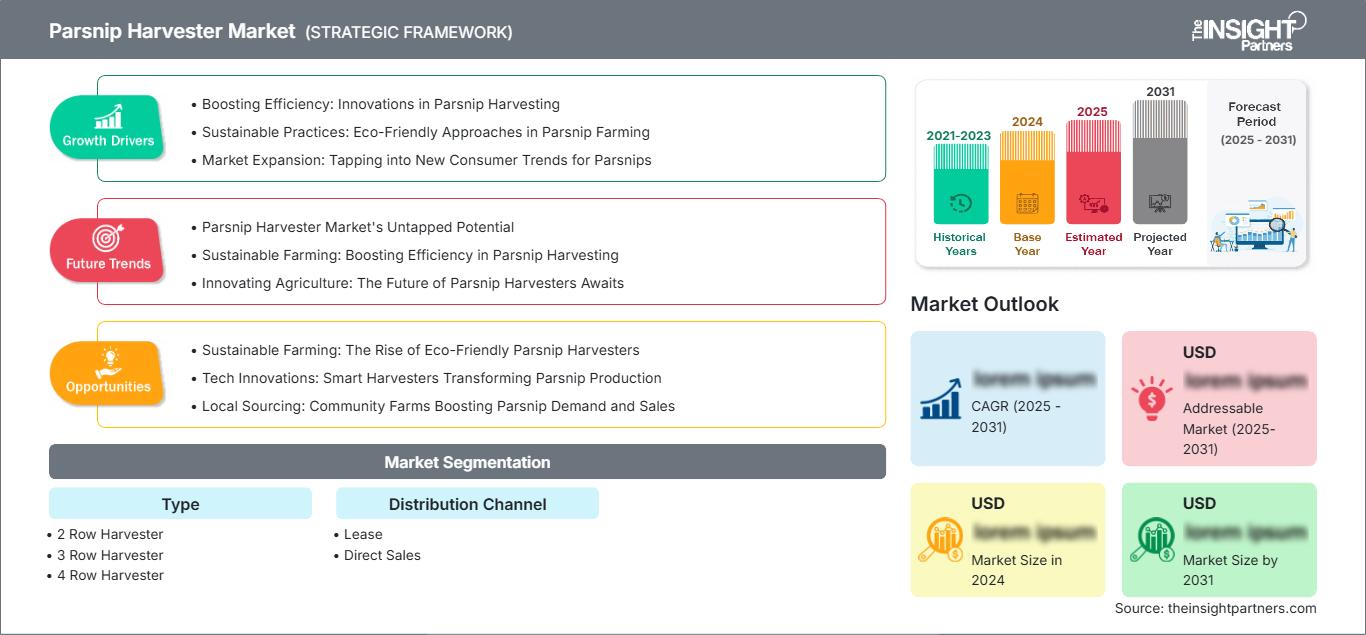
Parsnip Harvester Market: Strategic Insights
Regional Insights
North America Parsnip Harvester Market
North America accounted for 28–32% Parsnip Harvester Market share in 2025 and is expected to grow at a CAGR of 5.1–5.6% during 2026–2034. Large vegetable farms in the U.S. and Canada are adopting multi-row harvesters to stabilize labor requirements during short harvest windows.
The regional market is driven by the combination of higher labor costs on farms, contract harvesting, and the standards required by food processors regarding uniformity of the root crops. It is easier for growers with seasonal parsnip production to consider leasing, while direct selling occurs mainly in diversified vegetable producers.
U.S. Parsnip Harvester Market
The U.S. represented 72–76% of North America in 2025 and is projected to grow at a CAGR of 5.2–5.7% during 2026–2034. Demand is concentrated in specialty vegetable regions serving fresh produce distributors, processors, and farm-to-retail channels with strict quality standards.
The presence of the firm is basically through channels, with imported European machinery and North American dealers aiding in the use of the seasonal fleets. The farmers are deploying the machinery for the carrots, parsnips, and other root crops in order to maximize their utilization.
Europe Parsnip Harvester Market
Europe held 34–38% of the Parsnip Harvester Market share in 2025 and is expected to expand at a CAGR of 4.8–5.3% during 2026–2034. The UK is the leading country, supported by commercial parsnip cultivation, retailer specifications, and established contractors that operate specialist vegetable harvesters. Strong supermarket supply chains and quality requirements continue to encourage investment in efficient harvesting equipment that minimizes crop damage and improves yield recovery.
Germany benefits from engineering clusters and manufacturers serving root crop machinery, while France, Italy, and Spain show selective adoption in diversified vegetable regions. European buyers emphasize low soil compaction, clean lifting, reliable service, and reduced labor dependency during harvest operations. The market is relatively mature, but replacement demand remains steady as older machines face efficiency limits and growers seek higher productivity, improved crop handling, and lower operating costs.
APAC Parsnip Harvester Market
Asia Pacific captured 18–22% of the Parsnip Harvester Market share in 2025 and is forecast to grow at a CAGR of 6.1–6.7% during 2026–2034. China is expected to lead regional uptake, followed by Japan, South Korea, India, and Australia, where vegetable mechanization is expanding. Rising demand for efficient harvesting solutions and efforts to improve agricultural productivity are encouraging farmers to adopt specialized root crop harvesting equipment.
Industrial drivers include rising labor costs, food export quality requirements, and government programs promoting farm mechanization. Australia’s large-scale vegetable farms create demand for robust equipment, while Japan and South Korea prioritize compact, precise systems for smaller plots and higher-value fresh produce supply chains. India is also witnessing gradual adoption as commercial farming practices expand and growers seek to reduce labor dependence, improve harvesting efficiency, and minimize crop losses.
Middle East & Africa Parsnip Harvester Market
Middle East & Africa accounted for a smaller share of the Parsnip Harvester Market in 2025 but is projected to grow at a CAGR of 4.4–4.9% during 2026–2034. South Africa leads adoption due to its established commercial vegetable farming sector, while Saudi Arabia and the UAE invest selectively in controlled food supply initiatives, protected agriculture, and mechanized farming practices. Growing interest in improving agricultural efficiency and reducing labor dependence is supporting demand for specialized harvesting equipment in selected markets.
Energy and infrastructure conditions continue to influence equipment economics, particularly where irrigation systems, cold storage facilities, and logistics networks support higher-value vegetable production. The rest of MEA represents a smaller but gradually expanding opportunity as growers seek labor-saving machinery, improved harvesting efficiency, and better crop quality for export-oriented farms and domestic food security programs. Continued investments in agricultural modernization and sustainable food production are expected to support steady market development across the region.
Segmentation Analysis
Type
Type is expected to record a CAGR of 5.0–5.5% during 2026–2034. The market scope across row configurations reflects acreage scale, soil conditions, labor availability, and harvest logistics. Smaller farms typically prefer flexible two-row systems, while larger operators evaluate higher-capacity platforms to reduce passes and shorten harvesting windows.
- 2 Row Harvester holds the broadest position because it suits mixed vegetable farms, moderate acreage, and shared use across root crops without requiring very high tractor power.
- 3 Row Harvester serves growers needing higher field throughput while retaining maneuverability, making it relevant where acreage is expanding but field sizes remain uneven.
- 4 Row Harvester is strategically important for commercial farms that need faster lifting, fewer passes, and integrated transfer systems for processor or retailer supply contracts.
- 6 Row Harvester targets large-scale operations and contractors where harvest speed, labor reduction, and synchronized logistics justify heavier investment and stronger service support.
Distribution Channel
Distribution Channel is projected to grow at a CAGR of 5.4–5.9% during 2026–2034. Buyers choose between ownership and leasing according to acreage certainty, capital budgets, service access, and expected utilization. Dealer relationships remain critical because downtime during harvest can quickly exceed the savings from lower equipment prices.
- Lease is gaining strategic importance among seasonal growers and contractors that want modern equipment access without locking capital into machines used for limited harvest periods.
- Direct Sales remains the preferred route for large farms with recurring acreage, in-house maintenance capability, and multi-crop use cases that improve annual machine utilization.
Opportunity Snapshot
| Distribution Channel | Revenue Contribution | Trend Tag | Adoption Stage |
| Lease | Medium | Seasonal Fleet | Scaling |
| Direct Sales | High | Owned Assets | Mature |
Parsnip Harvester Market Growth Drivers and Impact Analysis
Labor Scarcity Accelerates Mechanized Root Harvesting
Labor availability is a decisive driver because parsnip harvesting requires careful lifting, trimming coordination, soil removal, and rapid movement into storage or distribution channels. Manual harvesting becomes expensive when seasonal workers are limited and weather windows are short. Mechanized systems reduce reliance on large field crews, improve scheduling certainty, and lower crop losses caused by delayed harvest. In the Parsnip Harvester Market, this creates strong demand for machines with dependable depth control, ergonomic inspection platforms, and clean transfer systems.
The impact is most visible among commercial growers supplying supermarkets and processors, where consistent quality and predictable harvest timing directly affect contract performance. As labor costs continue to rise and workforce availability becomes less predictable, growers are increasingly investing in harvesting equipment that improves productivity while maintaining crop quality. Advanced harvesting systems also help reduce operational bottlenecks, support tighter harvest schedules, and enable more efficient use of available labor resources, strengthening their value proposition in large-scale vegetable production operations.
Multi-Crop Utility Improves Investment Payback
Farmers tend to favor platforms where machinery can be adapted to work on parsnip, carrot, beetroot, celeriac, and other types of root crops, as the single-crop machine may sometimes be hard to defend. The ability to perform multiple crop tasks helps to improve annual usage, improve resale value, and allows the contractor to reach a wider client base. The manufacturers that are able to offer the adjustment of share, belt, separation, and unloading systems can meet this demand better. The effect on the market is a move towards a modular design instead of a crop-specific.
Food Quality Requirements Raise Equipment Standards
Retailers and processors increasingly require roots with consistent size, limited bruising, and reduced soil contamination. These specifications encourage growers to invest in harvesters that lift gently, separate soil without excessive abrasion, and maintain controlled crop flow into crates or trailers. Equipment that reduces damage can improve pack-out rates and lower waste across the supply chain. In practical terms, the Parsnip Harvester Market benefits when buyers calculate machinery value against recovered saleable yield rather than purchase price alone. This driver supports demand for improved belt materials, better cleaning modules, and operator visibility systems.
Parsnip Harvester Market Future Trends
Sensor-Assisted Harvest Optimization
Parsnip Harvester Market trends will increasingly include sensor-assisted control of depth, belt speed, blockage alerts, and crop flow visibility. These systems can help operators respond faster to soil variability, root depth differences, and changing field moisture. Over time, data from harvesting operations may support preventive maintenance, performance benchmarking, and better harvest planning. Adoption will likely begin in premium machines and contractor fleets before moving into mid-range equipment. The trend matters because small improvements in uptime and crop handling can create measurable value during short harvest periods when missed days affect supply commitments.
Rental-Ready Equipment Design
The future of equipment designs will have to address the needs of leasing and contractors. The equipment will be required to have a simple interface for the operator, be able to have robust wearing parts, cleaning capability, diagnostic ability remotely, and standard attachment capability to operate at different farms without requiring many configurations. This will affect the design of products since the leasing of the equipment requires high reliability, fast turnover, and low costs of maintenance. Companies that offer machines along with service agreements will be able to generate continuous revenue streams.
Parsnip Harvester Market Opportunities
Asia Pacific Mechanization Partnerships
Manufacturers can build opportunities by partnering with local dealers, cooperatives, and implementers in the Asia Pacific. Parsnip Harvester Market Forecasts indicate the region can outpace mature markets as vegetable producers seek labor-saving solutions and better post-harvest quality. Entry strategies should prioritize adaptable two-row and three-row platforms, financing support, and training for operators unfamiliar with specialized root harvesting. Local assembly or component sourcing could lower acquisition barriers. The opportunity is strongest where growers already mechanize potatoes, carrots, or onions, because operational knowledge and service infrastructure can be extended to parsnip equipment.
Service-Led Leasing Models
Leasing could evolve into more than just a means of financing when equipment access is bundled along with field set-up, maintenance, training operators, and guaranteeing replacement parts. Service-based leasing will be a favorable option as failure of harvest is a critical issue, and farmers would prefer uptime rather than ownership. Service-based leasing could be an effective means through which dealers build stronger ties with their clients, as well as maximize their utilization of equipment for various crops. The challenge that manufacturers face would be to produce machines that are easy to check, transport, clean, and relocate.
Recent Developments
- September 2025: GRIMME Landmaschinenfabrik, based in Damme, is expanding its product range in the field of vegetable harvesting technology with a trailed top lifter. The NAVO 140 is a single-row top lifting harvester for carrots, parsnips and other vegetables, equipped with a 4-tonne bunker and, for the first time, with ISOBUS control.
- October 2024: Marks & Spencer (M&S) announced a groundbreaking pilot project involving robotically farmed parsnips. In partnership with long-term supplier, Huntapac, the first fully autonomously farmed parsnips are available in selected M&S stores from November 2024. To create these lower-carbon parsnips, the team has brought together all the latest technology to farm with a significantly lower environmental impact.
- 2023: ROPA presents the latest generation of its two-row trailed potato harvesters at Agritechnica 2023. The ROPA Keiler 2 RK22 introduces a new era in the potato harvesting technology. The Keiler 2 RK22 can be used not only for potatoes, but also for other crops such as onions, carrots, celery, parsnips, Jerusalem artichokes and beetroot.
Frequently Asked Questions

- Comprehensive Market Sizing and Forecast Analysis
- Detailed Segmentation Analysis
- In-Depth Market Dynamics Assessment
- Regional and Country-Level Insights
- Competitive Landscape and Company Benchmarking
- Strategic Business Intelligence
Recent Reports
Testimonials

The Insight Partners provided valuable market intelligence that supported our global go-to-market strategy. Their team was professional, responsive, and attentive to our feedback, providing thoughtful analysis and helpful methodological clarifications throughout the project.
Junmo Kim Chief Financial Officer (CFO), Enertech Co., Ltd.
The Insight Partners' SCADA System Market report is comprehensive, with valuable insights on current trends and future forecasts. The team was highly professional, responsive, and supportive throughout. We are very satisfied and highly recommend their services.
RAN KEDEM Partner, Reali Technologies LTDs
I requested a report on a very specific software market and the team produced the report in a few days. The information was very relevant and well presented. I then requested some changes and additions to the report. The team was again very responsive and I got the final report in less than a week.
JEAN-HERVE JENN Chairman, Future Analytica
We worked with The Insight Partners for an important market study and forecast. They gave us clear insights into opportunities and risks, which helped shape our plans. Their research was easy to use and based on solid data. It helped us make smart, confident decisions. We highly recommend them.
PIYUSH NAGPAL Sr. Vice President, High Beam Global
The Insight Partners delivered insightful, well-structured market research with strong domain expertise. Their team was professional and responsive throughout. The user-friendly website made accessing industry reports seamless. We highly recommend them for reliable, high-quality research services
YUKIHIKO ADACHI CEO, Deep Blue, LLC.
This is the first time I have purchased a market report from The Insight Partners.While I was unsure at first, I visited their web site and felt more comfortable to take the risk and purchase a market report.I am completely satisfied with the quality of the report and customer service. I had several questions and comments with the initial report, but after a couple of dialogs over email with their analyst I believe I have a report that I can use as input to our strategic planning process.Thank you so much for taking the extra time and making this a positive experience.I will definitely recommend your service to others and you will be my first call when we need further market data.
JOHN SUZUKI President and Chief Executive Officer, Board Director, BK Technologies
I wish to appreciate your support and the professionalism you displayed in the course of attending to my request for information regarding to infectious disease IVD market in Nigeria. I appreciate your patience, your guidance, and the fact that you were willing to offer a discount, which eventually made it possible for us to close a deal. I look forward to engaging The Insight Partners in the future, all thanks to the impression you have created in me as a result of this first encounter.
DR CHIJIOKE ONYIA MANAGING DIRECTOR, PineCrest Healthcare Ltd.Reason to Buy
- Informed Decision-Making
- Understanding Market Dynamics
- Competitive Analysis
- Identifying Emerging Markets
- Customer Insights
- Market Forecasts
- Risk Mitigation
- Boosting Operational Efficiency
- Strategic Planning
- Investment Justification
- Tracking Industry Innovations
- Aligning with Regulatory Trends





 Get Free Sample for