
Personal Care Active Ingredients Market Size, Share & Growth by 2034
Coverage: by Product (Anti-aging, Anti-acne, Anti-inflammatory, Others); Type (Botanical Extracts, Enzymes and Coenzymes, Proteins and Peptides, Synthetic Actives, Others) , and Geography (North America, Europe, Asia Pacific, and South and Central America)
- Status : Data Released
- Report Code : TIPRE00010688
- Category : Chemicals and Materials
- No. of Pages : 150
- Available Report Formats :


- Last update date : July 15, 2026


2025 Market Size
US$ 10.8 Bn
Base year value
2034 Forecast
US$ 15.93 Bn
Projected by 2034
CAGR 2026-2034
4.42 %
Growth rate
Addressable Market
US$ 121.42 Bn
(2026-2034)
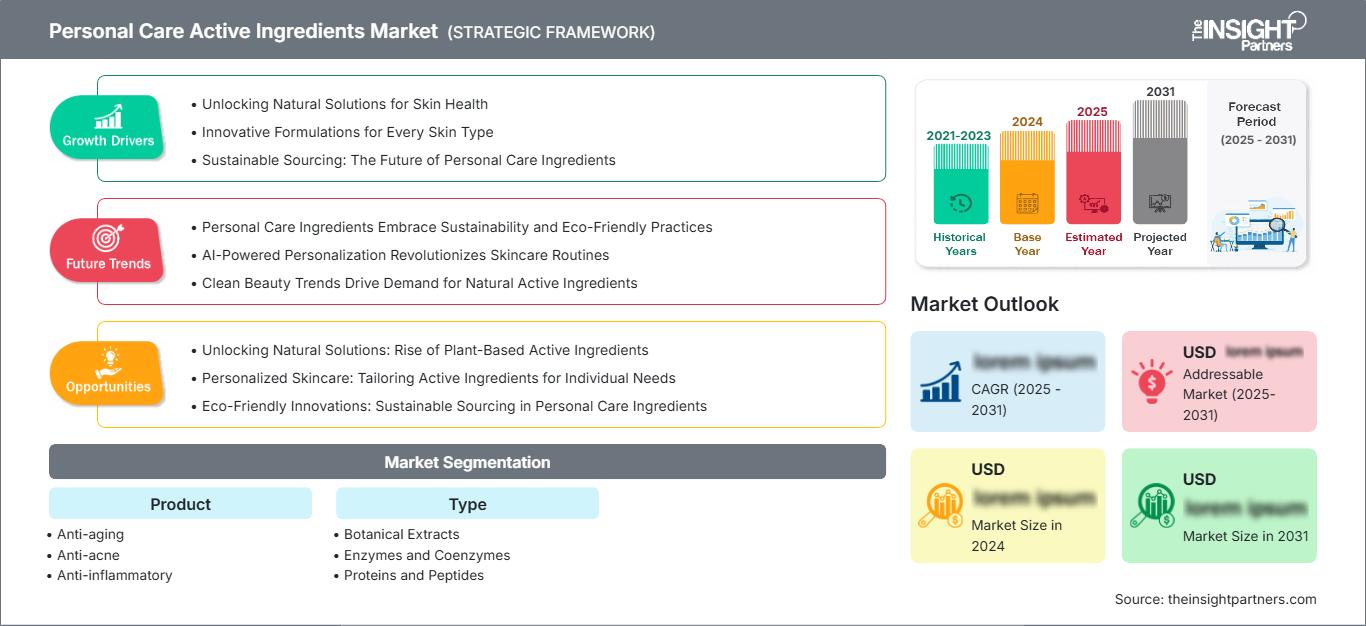
The Personal Care Active Ingredients Market is valued at US$ 10.8 billion in 2025 and is projected to reach US$ 15.93 billion by 2034, expanding at a CAGR of 4.42% during 2026–2034. Growth is being shaped by increasing consumer focus on scientifically validated skincare benefits, rising demand for multifunctional cosmetic formulations, and continuous innovation in bioactive compounds. Manufacturers are increasingly investing in efficacy-driven ingredients that address specific skin concerns, including aging, inflammation, acne, hydration, and barrier repair.
North America remains a major contributor to the Personal Care Active Ingredients Market and is anticipated to advance at an estimated CAGR of around 4.1% through 2034. The region benefits from strong consumer spending on premium skincare products and growing demand for dermatologist-supported formulations. Expanding adoption of clean-label beauty products, coupled with innovation in peptides, botanical extracts, and biotechnology-derived actives, continues to reinforce regional market expansion.
Personal Care Active Ingredients Market Assessment and Insights
- North America: North America accounted for 31–35% market share in 2025 and is projected to expand at a CAGR of 4.0%–4.5% during 2026–2034. Growth is driven by rising premium skincare adoption and continuous innovation in cosmetic ingredients, which collectively support steady regional market expansion.
- U.S.: The U.S. represented 81–85% of the North American market in 2025 and is anticipated to register a CAGR of 4.1%–4.6% during 2026–2034, supported by strong consumer demand for advanced skincare products, high penetration of premium cosmetics, and ongoing formulation innovation.
- Europe: Europe held 27–31% market share in 2025 and is expected to grow at a CAGR of 3.9%–4.4% during 2026–2034. France, Germany, and the United Kingdom lead regional demand, supported by advanced cosmetics manufacturing capabilities and strong research and development activities in cosmetic science.
- Asia Pacific: Asia Pacific accounted for 29–33% market share in 2025 and is forecast to expand at a CAGR of 5.0%–5.5% during 2026–2034. China, Japan, and South Korea drive regional growth through rapidly expanding beauty industries and increasing investment in ingredient innovation.
- Largest Segment – Synthetic Actives: Synthetic actives represented the largest market segment and are expected to grow at a CAGR of 4.5%–5.0% during 2026–2034, supported by their proven efficacy, formulation stability, and broad compatibility across cosmetic applications.
- High Growth Segment – Anti-aging: The anti-aging segment is projected to register the fastest growth with a CAGR of 5.3%–5.8% during 2026–2034, driven by rising demand for preventive skincare solutions and increasing adoption of premium cosmetic formulations.
- Key companies analyzed in detail: BASF SE; BERKEM; Clariant AG; Corum Inc.; Croda International Plc; DSM-Firmenich AG; Evonik Industries AG; Gattefossé; Givaudan SA; LipoTrue S.L.
Source: The Insight Partners' analysis based on proprietary research, government publications, company annual reports, investor presentations, industry databases, and expert interviews.
The Personal Care Active Ingredients market has transitioned from a supply-based industry to a science-based ecosystem that revolves around efficacy, safety, and sustainability. Scientific discoveries and advancements in fields such as skin science, microbiology, peptides, and botany have made it possible for suppliers to come up with ingredients that target specific needs.
In the coming years, product differentiation will rely more on innovations in ingredients as opposed to traditional branding techniques. It is expected that companies will focus on clinically proven active ingredients, sustainable extraction processes, and biotech technology that ensures quality in order to capitalize on premium skincare, hair, and wellness products.
Personal Care Active Ingredients Market Report Scope
| Report Attribute | Details |
|---|---|
| Market size in 2025 | US$ 10.8 Billion |
| Market Size by 2034 | US$ 15.93 Billion |
| Global CAGR (2026 - 2034) | 4.42% |
| Historical Data | 2021-2024 |
| Forecast period | 2026-2034 |
Personal Care Active Ingredients Market Analysis
Consumer awareness regarding ingredient functionality has transformed purchasing behavior across skincare and personal care categories. Demand for anti-aging, anti-acne, and anti-inflammatory ingredients continues to expand as consumers seek products addressing specific dermatological concerns rather than generalized cosmetic benefits. Social media influence, digital ingredient transparency, and professional skincare recommendations have accelerated this transition.
The value chain includes sourcing of raw materials, ingredient development, biotechnological processes, formulation development, regulatory compliance, and branding. Botanical providers, fermenters, peptide producers, contract manufacturers, and cosmetic brands are all involved in market growth. The personal care active ingredients market report suggests that increased focus on sustainable sourcing and traceability of ingredients is changing the sourcing strategy in the ecosystem.
The competition continues to revolve around innovation capacity, intellectual property holdings, clinical testing, and formulation support services. Major players such as BASF SE, Croda International Plc, Evonik Industries AG, DSM, Clariant AG, Givaudan, BERKEM, Corum, Gattefossé, and LipoTrue are still increasing their portfolios through biotechnology, peptides, and active natural ingredients.
Investment activity increasingly targets bio-based ingredients, microbiome-friendly compounds, and advanced extraction technologies. Strategic collaborations between ingredient manufacturers and cosmetic brands are enabling faster commercialization cycles. Companies capable of combining scientific evidence, sustainability credentials, and regulatory expertise are strengthening their personal care active ingredients market share across global personal care markets.
● REPORT CUSTOMIZATION
Tailor This Report To Align With Your Specific Business Requirements
This report can be customized to align precisely with your business objectives, scope, and target markets. Customization options include tailored segmentation, geography, competitive analysis, and strategic insights to support informed decision-making.
Customize This Report →WHAT YOU CAN ADJUST
- ● Segmentations
- ● Geography
- ● Competitive Analysis
- ● Language Preferences
Personal Care Active Ingredients Market: Strategic Insights
Regional Insights
North America Personal Care Active Ingredients Market
North America accounts for a significant share of global demand and is projected to grow at an estimated CAGR of approximately 4.1% through 2034. The region benefits from mature beauty and personal care industries, high consumer awareness, and widespread adoption of premium skincare products. Ingredient transparency and evidence-based marketing continue influencing purchasing decisions.
Increasing demands for anti-aging products, barrier repair products, and multifunctional ingredients are driving the growth in the market. Peptides, enzymes, and botanicals are more frequently being used as key ingredients in products. Increasing concerns for regulation and sustainability are prompting companies to use safer and more eco-friendly active ingredients.
U.S. Personal Care Active Ingredients Market
The U.S. represents the largest national market within North America and is anticipated to record a CAGR of around 4.2% through 2034. The country contributes an estimated 70–75% of regional demand, supporting the personal care active ingredients market size, and is backed by a large consumer base, premium skincare penetration, and strong innovation activity.
Key suppliers of ingredients have well-equipped research, development, and application labs spread throughout the country. There is a growing demand for peptides, extracts, microbiome ingredients, and ingredients for fighting acne. The growing popularity of dermatologist-tested skin care and customized beauty care solutions is adding to the attractiveness of the market.
Europe Personal Care Active Ingredients Market
The U.S. represents the largest national market within North America and is anticipated to record a CAGR of around 4.2% through 2034. The country contributes an estimated 70–75% of regional demand, supported by a large consumer base, premium skincare penetration, and strong innovation activity, as reflected in the personal care active ingredients market forecast.
The region's leadership in cosmetic science and ingredient development has encouraged significant investments in biotechnology, green chemistry, and natural active ingredients. Manufacturers increasingly focus on environmentally responsible sourcing and scientifically validated efficacy claims.
The United Kingdom demonstrates a strong demand for premium skincare and wellness-focused beauty products. Consumer preference for clean-label formulations, coupled with increasing adoption of anti-aging and anti-inflammatory ingredients, continues to support market expansion at a steady pace.
Germany remains the leading European country due to its advanced chemical industry, strong cosmetic manufacturing base, and emphasis on scientific innovation. Demand for sustainable peptides, botanical extracts, and fermentation-derived ingredients within the personal care active ingredients market continues to increase across skincare applications.
France, Italy, and Spain benefit from established beauty industries and growing interest in naturally derived active ingredients. Premium cosmetic formulations, luxury skincare products, and increasing investment in biotechnology-supported ingredient development contribute to regional market momentum.
APAC Personal Care Active Ingredients Market
Asia Pacific is projected to be the fastest-growing regional market, advancing at an estimated CAGR exceeding 5.5% through 2034. The region currently accounts for approximately 30–35% of global demand and benefits from rising disposable incomes, expanding beauty-conscious populations, and growing skincare sophistication.
China leads regional consumption due to its large consumer base and rapidly evolving skincare market. Domestic brands are increasingly adopting advanced active ingredients to compete in premium product categories. Regulatory modernization and investment in biotechnology capabilities continue to support market growth.
Japan, South Korea, India, and Australia contribute significantly through innovation, manufacturing expertise, and growing demand for science-backed skincare solutions. South Korea's influence on global beauty trends, India's expanding middle-class population, and Australia's preference for naturally derived formulations collectively strengthen opportunities within the personal care active ingredients market.
Middle East & Africa Personal Care Active Ingredients Market
The Middle East & Africa market is developing steadily and is anticipated to record a CAGR of approximately 4.6% through 2034. Rising urbanization, expanding retail networks, and increasing awareness of skincare benefits are contributing to demand growth across major economies.
Saudi Arabia remains the leading market due to growing beauty expenditure, premium skincare adoption, and expanding consumer interest in anti-aging and hydration-focused formulations. Government-led economic diversification initiatives continue to support broader consumer goods development.
The UAE serves as a regional hub for international beauty brands and advanced cosmetic products. South Africa contributes through a relatively mature personal care sector. At the same time, the broader MEA region benefits from expanding distribution channels and growing demand for products designed to address climate-related skin concerns.
Segmentation Analysis
Product
- Anti-aging: Dominates demand within the personal care active ingredients market due to growing consumer focus on wrinkle reduction, skin firmness enhancement, collagen stimulation, and preventative skincare solutions supported by peptides, enzymes, and advanced biotechnology-derived ingredients.
- Anti-acne: Benefits from the increasing prevalence of acne-related concerns across multiple age groups. Demand centers on targeted formulations containing antimicrobial, sebum-regulating, and skin-balancing active ingredients with proven efficacy.
- Anti-inflammatory: Gains traction through rising consumer awareness regarding skin sensitivity, redness, irritation, and barrier protection. Botanical extracts and biotechnology-derived compounds are increasingly incorporated into soothing skincare formulations.
Type
- Botanical Extracts: Widely utilized due to consumer preference for naturally sourced ingredients. Advanced extraction technologies are enhancing efficacy, consistency, and sustainability while supporting clean beauty positioning.
- Enzymes and Coenzymes: Growing adoption is linked to their role in cellular renewal, antioxidant activity, and skin metabolism support. These ingredients are increasingly integrated into premium skincare applications.
- Proteins and Peptides: Among the most innovative ingredient categories, offering targeted anti-aging and skin-repair benefits. Continuous research supports expanding applications across advanced cosmetic formulations.
- Synthetic Actives: Remain essential due to formulation stability, scalability, and predictable performance. Ongoing innovation is improving efficacy while aligning products with evolving safety and regulatory requirements.
Opportunity Snapshot
| Product | Revenue Contribution | Trend Tag | Adoption Stage |
| Anti-aging | High | Longevity Beauty | Mature |
| Anti-acne | Medium | Skin Clarity | Scaling |
| Anti-inflammatory | Medium | Barrier Repair | Scaling |
Personal Care Active Ingredients Market Growth Drivers and Impact Analysis
Rising Consumer Demand for Evidence-Based Skincare Solutions
Consumers increasingly evaluate personal care products based on ingredient performance rather than brand recognition alone within the personal care active ingredients market. This shift has accelerated demand for clinically supported active ingredients capable of delivering measurable benefits related to aging, acne management, hydration, and skin barrier protection. Digital access to ingredient information and dermatology-focused content has strengthened awareness regarding active compound functionality.
Manufacturers are responding by investing heavily in efficacy testing, scientific validation, and advanced formulation technologies. The resulting emphasis on measurable outcomes has elevated the strategic importance of active ingredients within cosmetic product development. As consumers continue prioritizing results-oriented skincare solutions, suppliers capable of demonstrating performance advantages gain stronger competitive positioning and greater influence across the value chain.
Expansion of Biotechnology and Precision Fermentation Platforms
Biotechnology is transforming ingredient development by enabling the production of highly consistent, sustainable, and targeted active compounds. Precision fermentation, cellular engineering, and bio-based manufacturing technologies are helping companies create innovative ingredients with enhanced purity and functionality.
These advancements reduce dependency on resource-intensive extraction methods while improving supply reliability. Biotechnology also enables the development of novel peptides, enzymes, and bioactive molecules that would be difficult to obtain through conventional sourcing approaches. Market participants increasingly view biotechnology as a strategic pathway toward innovation, sustainability, and long-term differentiation, encouraging greater investment throughout the industry.
Growing Preference for Natural and Sustainable Ingredients
Environmental consciousness and ingredient transparency are key elements that buyers are starting to take into consideration when making their purchases around the world. They prefer to purchase goods that contain environmentally friendly and sustainably extracted plant-based extracts and biodegradable materials.
These changes have affected approaches towards formulations, sources of ingredients, and suppliers. Ingredient companies are increasing their spending on green chemistry, regenerative farming, and sustainable extraction technologies. This has led to a significant shift not only in marketing but also in other areas of the Personal Care Active Ingredients Market.
Personal Care Active Ingredients Market Future Trends
Convergence of Longevity Science and Cosmetic Innovation
Longevity-based skincare appears to be one of the emerging trends shaping future ingredient development. Instead of merely targeting skin aging symptoms, the industry begins searching for active ingredients that will promote skin longevity at a cellular level. Current scientific advances related to epigenetics, oxidative stress control, and cell regeneration create novel opportunities for developing new ingredients.
Future ingredients within the personal care active ingredients market are likely to unite preventive and corrective effects due to the increased understanding of skin aging processes. Consumers who increasingly adopt a wellness-oriented approach to beauty will create strong demand for ingredient suppliers capable of translating longevity science into commercially successful products.
Rise of Multifunctional and Minimalist Formulations
Consumers tend to appreciate the ease of a routine involving fewer multi-purpose products. It is fostering the emergence of active compounds with the ability to tackle multiple skincare needs at once, such as hydrating, inflammation regulation, barrier function, and anti-aging.
The future ingredient lineup would focus on efficiency, simplicity in formulations, and greater convenience for users. The use of multifunctional active compounds could minimize formulation complexity while increasing product differentiation. Companies that manage to integrate efficiency, sustainability, and multifunctionality in one ingredient concept would gain more attention from cosmetic companies around the world.
Personal Care Active Ingredients Market Opportunities
Commercialization of Next-Generation Peptide Technologies
The use of peptides continues to attract considerable interest because of their potential to be used to target specific biological pathways responsible for skin aging, healing, and regeneration. Continued improvements in peptide technology will open up many chances for companies supplying ingredients to create highly specialized products with better characteristics.
Opportunities abound in terms of research collaborations, proprietary peptide technology, and improved formulations. Companies that can demonstrate superior efficacy through clinical evidence can command premium pricing and better customer relations. With the need for differentiation of cosmetic products becoming increasingly important, next-generation peptide technology should continue to offer considerable commercial possibilities.
Expansion into Emerging Premium Beauty Markets
The fast pace at which premium skincare adoption is growing in Asia, the Middle East, and selected Latin American markets presents significant opportunities within the personal care active ingredients market. Rising disposable incomes, the digitalization of beauty, and increasing consumer awareness regarding ingredient functionality are creating favorable conditions for market development.
Investment in manufacturing and formulation facilities and innovation in the region may provide better market access. The players that develop ingredients in accordance with consumer preferences in the region, but still meet global standards, may have an accelerated growth and diversification of customers in the forecast period.
Recent Developments
- June, 2026: CORUM has launched NeoC101, a next-generation vitamin C derivative derived from 100% plant-based sources. According to the company, NeoC101 is based on a patented molecular design and introduces a new approach to how vitamin C performs within the skin.
- October, 2025: BASF SE Personal Care introduced Ameriflor Calm, a botanical active ingredient developed for sensitive skin applications. The ingredient is sourced from regenerative organic farms and produced using renewable electricity, highlighting growing industry emphasis on sustainability, traceability, and efficacy in personal care ingredient development.
- March, 2025: Givaudan Active Beauty launched Evernityl, a marine-derived active ingredient designed to address newly identified skin-aging mechanisms linked to porphyrins produced by the skin microbiome. The ingredient utilizes upcycled macroalgae and targets both visible and underlying signs of aging, reflecting increasing industry focus on longevity-oriented skincare innovation.
Frequently Asked Questions

- Comprehensive Market Sizing and Forecast Analysis
- Detailed Segmentation Analysis
- In-Depth Market Dynamics Assessment
- Regional and Country-Level Insights
- Competitive Landscape and Company Benchmarking
- Strategic Business Intelligence
Recent Reports
Testimonials

The Insight Partners provided valuable market intelligence that supported our global go-to-market strategy. Their team was professional, responsive, and attentive to our feedback, providing thoughtful analysis and helpful methodological clarifications throughout the project.
Junmo Kim Chief Financial Officer (CFO), Enertech Co., Ltd.
The Insight Partners' SCADA System Market report is comprehensive, with valuable insights on current trends and future forecasts. The team was highly professional, responsive, and supportive throughout. We are very satisfied and highly recommend their services.
RAN KEDEM Partner, Reali Technologies LTDs
I requested a report on a very specific software market and the team produced the report in a few days. The information was very relevant and well presented. I then requested some changes and additions to the report. The team was again very responsive and I got the final report in less than a week.
JEAN-HERVE JENN Chairman, Future Analytica
We worked with The Insight Partners for an important market study and forecast. They gave us clear insights into opportunities and risks, which helped shape our plans. Their research was easy to use and based on solid data. It helped us make smart, confident decisions. We highly recommend them.
PIYUSH NAGPAL Sr. Vice President, High Beam Global
The Insight Partners delivered insightful, well-structured market research with strong domain expertise. Their team was professional and responsive throughout. The user-friendly website made accessing industry reports seamless. We highly recommend them for reliable, high-quality research services
YUKIHIKO ADACHI CEO, Deep Blue, LLC.
This is the first time I have purchased a market report from The Insight Partners.While I was unsure at first, I visited their web site and felt more comfortable to take the risk and purchase a market report.I am completely satisfied with the quality of the report and customer service. I had several questions and comments with the initial report, but after a couple of dialogs over email with their analyst I believe I have a report that I can use as input to our strategic planning process.Thank you so much for taking the extra time and making this a positive experience.I will definitely recommend your service to others and you will be my first call when we need further market data.
JOHN SUZUKI President and Chief Executive Officer, Board Director, BK Technologies
I wish to appreciate your support and the professionalism you displayed in the course of attending to my request for information regarding to infectious disease IVD market in Nigeria. I appreciate your patience, your guidance, and the fact that you were willing to offer a discount, which eventually made it possible for us to close a deal. I look forward to engaging The Insight Partners in the future, all thanks to the impression you have created in me as a result of this first encounter.
DR CHIJIOKE ONYIA MANAGING DIRECTOR, PineCrest Healthcare Ltd.Reason to Buy
- Informed Decision-Making
- Understanding Market Dynamics
- Competitive Analysis
- Identifying Emerging Markets
- Customer Insights
- Market Forecasts
- Risk Mitigation
- Boosting Operational Efficiency
- Strategic Planning
- Investment Justification
- Tracking Industry Innovations
- Aligning with Regulatory Trends





 Get Free Sample for