
Pigging Valves Market Growth, Trends & Forecast by 2034
Coverage: by Product Type (Bypass Pigging Valve, Shutoff Pigging Valve); Technology Type (Ultrasonic Pigging, Magnetic Flux Pigging); Industry Vertical (Oil and Gas, Pharmaceutical, Chemical, Petrochemicals, Power Generation, Others) , and Geography (North America, Europe, Asia Pacific, and South and Central America)
- Status : Data Released
- Report Code : TIPRE00005952
- Category : Manufacturing and Construction
- No. of Pages : 150
- Available Report Formats :


- Last update date : August 06, 2026


2025 Market Size
US$ 1.32 Bn
Base year value
2034 Forecast
US$ 1.89 Bn
Projected by 2034
CAGR 2026-2034
4.57 %
Growth rate
Addressable Market
US$ 14.95 Bn
(2026-2034)
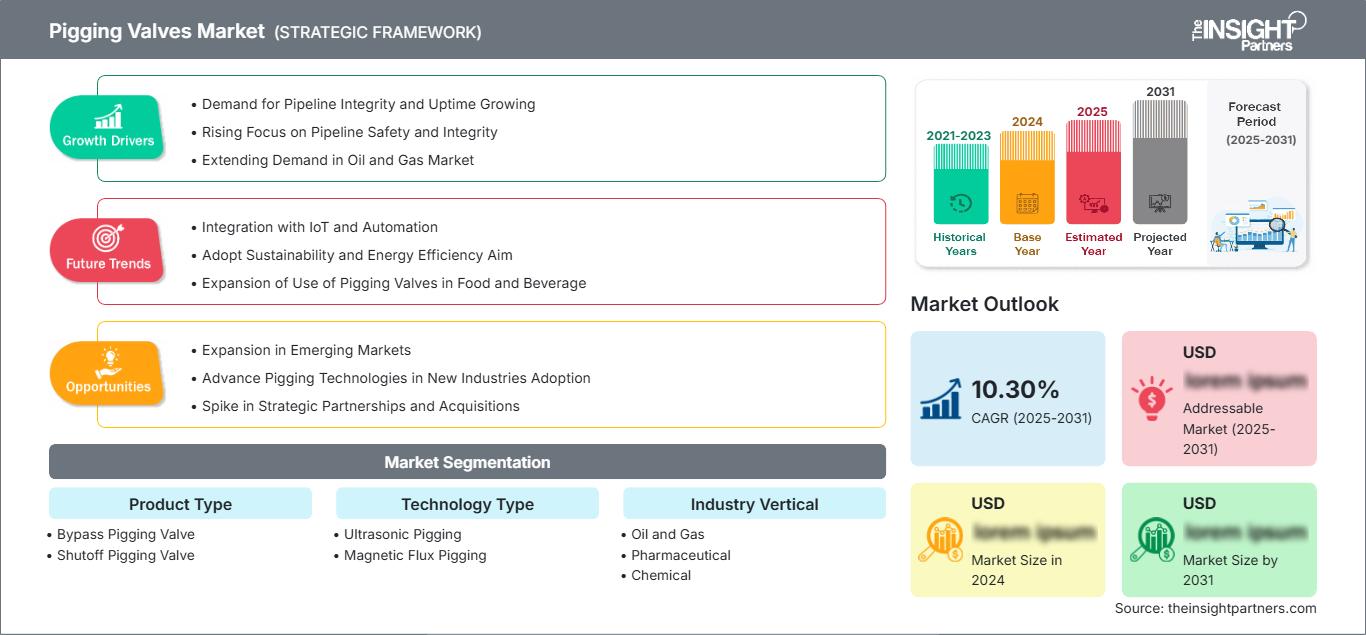
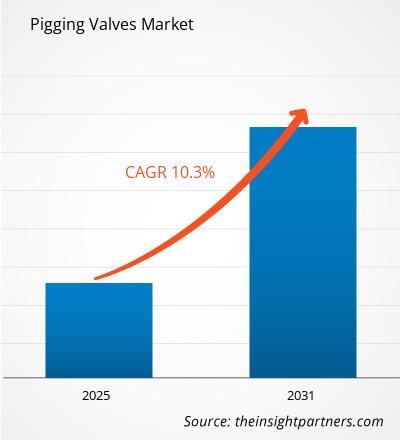
The Pigging Valves Market was valued at US$ 1.32 Billion in 2025 and is projected to reach US$ 1.89 Billion by 2034, expanding at a CAGR of 4.57% from 2026 to 2034. The market reflects steady demand for compact launcher-receiver valve systems used in pipeline cleaning, inspection, product recovery, and contamination control across energy, chemical, pharmaceutical, petrochemical, and power generation facilities.
North America remains a technically mature demand center, with regional CAGR estimated at 4.20–4.60% as pipeline operators replace barrel-style launchers with safer compact valve assemblies. The Pigging Valves Market size in the region is supported by midstream integrity spending, methane-emission reduction programs, API-aligned safety practices, and pharmaceutical-grade transfer lines requiring cleanable, low-dead-space components.
Pigging Valves Market Assessment and Insights
- North America held 34–36% share in 2025 and is expected to grow at 4.20–4.60% CAGR between 2026–2034, led by pipeline integrity, shale infrastructure, and emissions control upgrades.
- US accounted for 78–82% of North America in 2025 and is projected to expand at 4.10–4.50% CAGR between 2026–2034, supported by midstream modernization.
- Europe represented 23–25% share in 2025 and is forecast to grow at 3.90–4.30% CAGR between 2026–2034, led by Germany, the UK, France, Italy, and Spain.
- Asia Pacific captured 26–28% share in 2025 and is set to grow at 5.10–5.50% CAGR between 2026–2034, with China, India, Japan, South Korea, and Australia driving demand.
- Largest Segment Oil and Gas held 54–58% market share in 2025 and is expected to grow at 4.00–4.40% CAGR between 2026–2034 due to inspection intensity.
- High Growth Segment Pharmaceutical held 8–10% market share in 2025 and is projected to grow at 5.60–6.00% CAGR between 2026–2034 as hygienic product recovery expands.
- Key companies analyzed in detail: Argus Machine Co. Ltd., Frontier Valve International Ltd., Hartmann Valves GmbH, JAG Valve, Inc., PBM, Inc., Phoenix Specialty, Inc., Pigging Solutions Ltd., Pipetech Corporation, Sofis B.V., and Tiger Valve Company.
Source: The Insight Partners' analysis based on proprietary research, government publications, company annual reports, investor presentations, industry databases, and expert interviews.
Operators are transitioning from large launcher and receiver barrels to smaller pigging valves that help save space, reduce venting volumes, and require less maintenance. Innovations are increasingly becoming oriented towards double block-and-bleed configuration, automation, and preparation of valves for ultrasonic and magnetic flux inspection. Changes in production include increasing use of forgings, materials with improved resistance to corrosion, and modules in pipelines for sour gas, offshore operations, and processing facilities.
The future demand for pigging valves will be driven by new pipeline projects in the Asia-Pacific and the Middle East regions, renewal programs in North America and Europe, and regulatory pressures related to leakage prevention. Future investments will likely be made into valves that have access provisions, can be automated, and have product recovery functionality. The demand for pigging valves is likely to increase due to regulatory pressures to reduce methane emissions and prevent cross-contamination.
Pigging Valves Market Report Scope
| Report Attribute | Details |
|---|---|
| Market size in 2025 | US$ 1.32 Billion |
| Market Size by 2034 | US$ 1.89 Billion |
| Global CAGR (2026 - 2034) | 4.57% |
| Historical Data | 2021-2024 |
| Forecast period | 2026-2034 |
Pigging Valves Market Analysis
The Pigging Valves Market growth is linked to operators seeking lower downtime, safer pig launching, and better product recovery in pipelines handling hydrocarbons, chemicals, specialty fluids, and pharmaceutical media. High demand exists in regions that necessitate a higher degree of cleanliness or regions in which traditional launcher traps produce too much space, venting, and exposure risks. The ongoing investments in fossil fuels and power grid-linked infrastructure by the IEA energy indicators support the requirement for pipeline maintenance equipment.
The supply chain continues to be specialized due to the need for highly precise manufacturing, pressure class approval, actuation, and user certification. There are various players in the pipeline pigging valve industry including forgers of the steel, sealing components manufacturers, automation providers, pipeline integrity services, and engineering procurement companies. Lead time factors include the availability of alloys and API/ASME documentation.
Competitive positioning in the Pigging Valves Market analysis is shaped by application specialization rather than scale alone. Argus Machine Co. Ltd. and Tiger Valve Company have visibility in oilfield and midstream applications, while PBM, Inc. supports sanitary and industrial process lines. Hartmann Valves GmbH, Frontier Valve International Ltd., and JAG Valve, Inc. compete through pressure integrity, materials expertise, and engineered valve packages.
Trends in investments include automatic launchers, low-emission cavity designs, and mechanisms for easy and regular cleaning without halting production. Phoenix Specialty, Inc., Pigging Solutions Ltd., Pipetech Corporation, and Sofis B.V. improve the sector with their expertise on accessories, cleaning, pipelines and valve operation safety systems. Customers are paying more attention to lifecycle costs, operator involvement, and service accessibility.
● REPORT CUSTOMIZATION
Tailor This Report To Align With Your Specific Business Requirements
This report can be customized to align precisely with your business objectives, scope, and target markets. Customization options include tailored segmentation, geography, competitive analysis, and strategic insights to support informed decision-making.
Customize This Report →WHAT YOU CAN ADJUST
- ● Segmentations
- ● Geography
- ● Competitive Analysis
- ● Language Preferences
Pigging Valves Market: Strategic Insights
Regional Insights
North America Pigging Valves Market
North America accounted for 34–36% share in 2025 and is forecast to expand at 4.20–4.60% CAGR through 2034. The Pigging Valves Market share is supported by dense oil and gas gathering networks, aging midstream infrastructure, offshore maintenance needs, and methane-control programs that favor compact, lower-emission launching systems.
Regional buyers prioritize double-block-and-bleed isolation, API 6D compliance, automated actuation, and pressure-rated designs for sour gas and high-frequency pigging. Demand also comes from pharmaceutical and specialty chemical facilities using piggable transfer lines to recover product, limit effluent volumes, and improve batch-changeover discipline.
U.S. Pigging Valves Market
The U.S. Pigging Valves Market represented 78–82% of North America in 2025 and is projected to grow at a 4.10–4.50% CAGR between 2026–2034. Shale-linked liquids handling, gas transmission upgrades, and petrochemical corridor maintenance create recurring demand for pigging valves that reduce operator exposure during launch and receipt operations. Continued investment in pipeline integrity, flow assurance, and operational safety is further supporting adoption across energy and processing infrastructure.
The presence of the company is evident in the use of valves by suppliers in upstream, midstream, refinery, and sanitary processing applications. Users are incorporating valves for pigging in condensate piping, multi-product chemicals transferring, and utilities for increased cleaning, which helps save time, yields products, and creates maintenance records. There is also growing demand among organizations looking forward to reducing losses, minimizing human interaction, and ensuring efficient maintenance. Aging of pipelines and greater concern for safety and performance environmentally from regulators is prompting end-users to invest more in pigging solutions.
Europe Pigging Valves Market
Europe held 23–25% share in 2025 and is expected to post 3.90–4.30% CAGR. Germany leads on chemical, petrochemical, and industrial valve demand, while the UK supports offshore and gas infrastructure replacement. France adds pharmaceutical and refining applications, emphasizing hygienic transfer, emissions control, and traceable maintenance.
Italy and Spain contribute through refinery modernization, LNG-related infrastructure, and specialty chemical production. European buyers apply strict safety, pressure-equipment, and environmental standards, making engineered pigging valves attractive where smaller footprints, lower venting volumes, and repeatable pig launch sequences reduce compliance risk.
APAC Pigging Valves Market
APAC captured 26–28% share in 2025 and is forecast to grow at 5.10–5.50% CAGR, the fastest regional pace. China leads through petrochemical capacity, pipeline additions, and refinery integration, while India benefits from gas grid expansion and rising chemical processing investment.
Japan and South Korea support demand through high-specification process industries, LNG terminals, and power-linked fuel systems. Australia contributes through gas export infrastructure and remote pipeline maintenance, where compact pigging valves reduce service complexity and improve inspection readiness.
Middle East & Africa Pigging Valves Market
The Middle East & Africa is projected to expand at 4.40–4.80% CAGR, led by Saudi Arabia. National oil companies are investing in gathering, refining, petrochemical, and export pipeline reliability, creating demand for robust pigging valves suited to high-temperature, sour-service, and desert operating conditions.
The UAE adds LNG, storage, and downstream applications, while South Africa supports refinery, chemical, and power-generation maintenance. The rest of MEA demand remains project-led, linked to gas monetization, pipeline rehabilitation, and safer pigging procedures across remote infrastructure.
Segmentation Analysis
Product Type
Product Type is expected to record 4.30–4.70% CAGR from 2026–2034. The Pigging Valves Market scope within this segment is defined by operators choosing between continuous-flow bypass configurations and positive isolation shutoff designs. Selection depends on cleaning frequency, process criticality, pressure rating, and the need to launch or receive pigs without disrupting production.
- Bypass Pigging Valve demand is strongest in continuous processing, where flow diversion, product recovery, and line cleaning must occur with minimal interruption and reduced contamination risk.
- Shutoff Pigging Valve remains strategically important for higher-pressure oil, gas, and chemical lines requiring secure isolation, safe access, and reliable launch or receipt of cleaning devices.
Technology Type
Technology Type is projected to grow at 4.60–5.00% CAGR between 2026–2034. Adoption is driven by the need to align pigging valves with inspection methods that identify corrosion, wall loss, deposits, and deformation. Compatibility with intelligent tools is increasingly important as maintenance shifts from reactive cleaning to predictive integrity management.
- Ultrasonic Pigging supports wall-thickness measurement and corrosion mapping in liquid-coupled pipelines, making it valuable for operators prioritizing preventive maintenance and inspection accuracy.
- Magnetic Flux Pigging is favored in ferromagnetic pipelines where leakage-flux signals help detect metal loss, pitting, and integrity risks across long transmission systems.
Industry Vertical
Industry Vertical is forecast to expand at 4.50–4.90% CAGR from 2026–2034. Oil and gas remain the largest demand base, but pharmaceutical and chemical plants are raising adoption as product recovery, cleanability, and batch integrity become financial and regulatory priorities. Power generation and petrochemicals add steady replacement demand.
- Oil and gas dominate due to inspection intensity, aging pipeline networks, offshore constraints, and safety requirements for launching pigs in high-pressure hydrocarbon systems.
- Pharmaceutical demand is accelerating as manufacturers recover costly media, reduce cleaning validation burden, and limit cross-contamination in hygienic transfer systems.
- Chemical applications rely on pigging valves to separate batches, recover viscous or hazardous products, and reduce effluent treatment costs in multiproduct facilities.
- Petrochemicals use pigging valves to support feedstock transfer, product changeovers, and maintenance activities in plants where downtime has high opportunity cost.
- Power Generation adoption centers on fuel handling, water treatment, and auxiliary process lines where reliable cleaning supports uptime and asset integrity.
Opportunity Snapshot
| Industry Vertical | Revenue Contribution | Trend Tag | Adoption Stage |
| Oil and Gas | High | Integrity Upgrade | Mature |
| Pharmaceutical | Medium | Hygienic Recovery | Scaling |
| Chemical | Medium | Batch Recovery | Scaling |
| Petrochemicals | High | Feedstock Flexibility | Mature |
| Power Generation | Low | Fuel Reliability | Emerging |
Pigging Valves Market Growth Drivers and Impact Analysis
Pipeline Integrity Spending Moves Toward Preventive Maintenance
Operators are increasing preventive maintenance because leak events, corrosion failures, and unplanned shutdowns carry higher financial and regulatory consequences than scheduled pigging. Pigging Valves Market demand benefits when asset owners replace temporary launch arrangements with permanent valve-based access points that make cleaning and inspection faster. The impact is strongest in oil and gas, petrochemicals, and chemicals, where long pipeline runs handle corrosive, viscous, or multiphase media. Compact systems also reduce the land, scaffolding, and isolation complexity associated with barrel launchers, making them practical for brownfield upgrades. This driver improves recurring aftermarket demand for seals, actuators, pigging accessories, and maintenance services.
Product Recovery Economics Improve Adoption in Process Plants
Pigging valve manufacturers catering to fluid processes involving expensive products are now considering their pigging valves as a way to increase yields, not just as equipment that is used for maintenance purposes. For example, in the pharmaceutical industry, specialty chemicals, and petrochemical industries, recovered product is capable of minimizing waste, cleaning water, solvent use, and effluent treatment. The commercial significance of this process is visible in places where there is frequent changeover and where the value of the product left in the transferring pipelines is high.
Safety and Emission Controls Favor Compact Launching Systems
Traditional pig launchers may consist of larger volumes with pressurization, cap management by hand, and ventilation processes, all of which add danger to the process. Pigging valves offer an answer to all three issues by bringing together isolation, pressure monitoring, and controlled access in one compact device. With regard to methane reduction efforts and safety initiatives at facilities, it is driving midstream and upstream companies to find answers for reduced venting of gases and minimizing operator exposure. This trend is also true for lines containing hazardous chemicals, where prevention of spills and containing them is of utmost importance.
Pigging Valves Market Future Trends
Automation-Ready Pigging Valve Architectures
Pigging Valves Market trends point toward actuator-ready designs that can be integrated with plant control systems, remote stations, and safety interlocks. Future installations will prioritize valves that support defined operating sequences, pressure verification, and reduced manual intervention. This shift will be important in remote oil and gas assets, hazardous chemical units, and pharmaceutical plants where repeatable procedures lower training burden. Suppliers that package valves with sensors, interlocks, and digital maintenance records will gain differentiation as customers move from equipment procurement to lifecycle reliability management.
Inspection-Compatible Designs for Intelligent Pigging
The future design of products will see increased convergence between the design of pigging valves and intelligent tools based on ultrasonic and magnetic flux measurement. The importance of geometry design and valve bore transitions will increase as companies seek reliable information through shorter inspection times. This will present opportunities to producers who can demonstrate the compatibility of pigs in different pressure levels and fluids. At the same time, integrity contractors will guide specifications towards systems that reduce tool damage, delays, and unpredictable cleanings prior to inspection campaigns.
Pigging Valves Market Opportunities
Brownfield Retrofit Programs in Mature Pipeline Networks
Mature pipeline systems offer a practical opportunity because operators often need safer pigging access without major civil works. Pigging Valves Market Forecasts indicate that retrofit demand can be captured through compact assemblies, standardized pressure classes, and field support packages that reduce installation disruption. Suppliers should target midstream operators, refinery transfer lines, and offshore platforms where space constraints and shutdown costs are severe. Commercial success will depend on rapid engineering review, clear emissions and safety benefits, and compatibility with existing pig fleets.
Hygienic Pigging Expansion in High-Value Manufacturing
Pharmaceutical and Specialty Chemical Manufacturers provide more margin potential as their product recovery, cleaning validation, and waste minimization have immediate financial implications. Manufacturers of valves can compete on the basis of sanitary material, low dead space, documentation, and automation systems that are relevant in a validated manufacturing facility environment. Channel relationships with process engineers and hygienic system integrators would be key since the selection of valves is done early in line design. The biggest potential here lies in multi-product facilities where constant changeover results in recurring losses in residual media and cleaning times.
Recent Developments
- June 2026: Argus provides an automatic pig valve launchers (APVs) that offer a practical, low-complexity solution. APVs require no hydraulics or indexing mechanisms. A simple ball valve, vertical barrel, and follower weight allow operators to preload multiple pigs and launch them remotely at defined intervals, reducing site visits, venting events, and crew exposure.
- December 2024: NOV’s Subsea Production Systems business unit has been awarded the ANP Technological Innovation Award 2024 in the category of Research, Development & Innovation for our Subsea Automated Pig Launcher for Deepwater (SAPL), in collaboration with TotalEnergies and Equinor. This award honors projects that drive technological advancements and industry transformation within the oil and gas sector.
- August 2024: APV, a brand of SPX FLOW, has introduced the Ultra Clean Pigging System, an upgraded hygienic system that recovers valuable product before cleaning-in-place (CIP). This upgrade saves time and resources while reducing losses in dairy and plant-based food and beverage processing. The scraping system can be used on all lines that create fresh and fermented products, including yogurt, ice cream and desserts. The system’s modulating valve and pressure transmitter restrict product by-pass and allow for superior control of the scraper’s travel speed for sanitary performance.
Frequently Asked Questions

- Comprehensive Market Sizing and Forecast Analysis
- Detailed Segmentation Analysis
- In-Depth Market Dynamics Assessment
- Regional and Country-Level Insights
- Competitive Landscape and Company Benchmarking
- Strategic Business Intelligence
Recent Reports
Testimonials

The Insight Partners' SCADA System Market report is comprehensive, with valuable insights on current trends and future forecasts. The team was highly professional, responsive, and supportive throughout. We are very satisfied and highly recommend their services.
RAN KEDEM Partner, Reali Technologies LTDs
I requested a report on a very specific software market and the team produced the report in a few days. The information was very relevant and well presented. I then requested some changes and additions to the report. The team was again very responsive and I got the final report in less than a week.
JEAN-HERVE JENN Chairman, Future Analytica
We worked with The Insight Partners for an important market study and forecast. They gave us clear insights into opportunities and risks, which helped shape our plans. Their research was easy to use and based on solid data. It helped us make smart, confident decisions. We highly recommend them.
PIYUSH NAGPAL Sr. Vice President, High Beam Global
The Insight Partners delivered insightful, well-structured market research with strong domain expertise. Their team was professional and responsive throughout. The user-friendly website made accessing industry reports seamless. We highly recommend them for reliable, high-quality research services
YUKIHIKO ADACHI CEO, Deep Blue, LLC.
This is the first time I have purchased a market report from The Insight Partners.While I was unsure at first, I visited their web site and felt more comfortable to take the risk and purchase a market report.I am completely satisfied with the quality of the report and customer service. I had several questions and comments with the initial report, but after a couple of dialogs over email with their analyst I believe I have a report that I can use as input to our strategic planning process.Thank you so much for taking the extra time and making this a positive experience.I will definitely recommend your service to others and you will be my first call when we need further market data.
JOHN SUZUKI President and Chief Executive Officer, Board Director, BK Technologies
I wish to appreciate your support and the professionalism you displayed in the course of attending to my request for information regarding to infectious disease IVD market in Nigeria. I appreciate your patience, your guidance, and the fact that you were willing to offer a discount, which eventually made it possible for us to close a deal. I look forward to engaging The Insight Partners in the future, all thanks to the impression you have created in me as a result of this first encounter.
DR CHIJIOKE ONYIA MANAGING DIRECTOR, PineCrest Healthcare Ltd.Reason to Buy
- Informed Decision-Making
- Understanding Market Dynamics
- Competitive Analysis
- Identifying Emerging Markets
- Customer Insights
- Market Forecasts
- Risk Mitigation
- Boosting Operational Efficiency
- Strategic Planning
- Investment Justification
- Tracking Industry Innovations
- Aligning with Regulatory Trends





 Get Free Sample for