
Pigments and Dyes Market Share, Demand & Growth by 2034
Coverage: by Type of Dyes (Acid dyes, VAT dyes, Disperse dyes, Reactive dyes, Direct dyes); Pigments Type (Organic pigments, Inorganic pigments, Titanium dioxide pigments); End-user Industry (Automotive, Construction, Chemicals, Textile, Leather, Paper, Paints and Coatings) , and Geography (North America, Europe, Asia Pacific, and South and Central America)
- Status : Data Released
- Report Code : TIPRE00003689
- Category : Chemicals and Materials
- No. of Pages : 150
- Available Report Formats :


- Last update date : June 23, 2026


2025 Market Size
US$ 45.82 Bn
Base year value
2034 Forecast
US$ 69.53 Bn
Projected by 2034
CAGR 2026-2034
4.74 %
Growth rate
Addressable Market
US$ 523.55 Bn
(2026-2034)
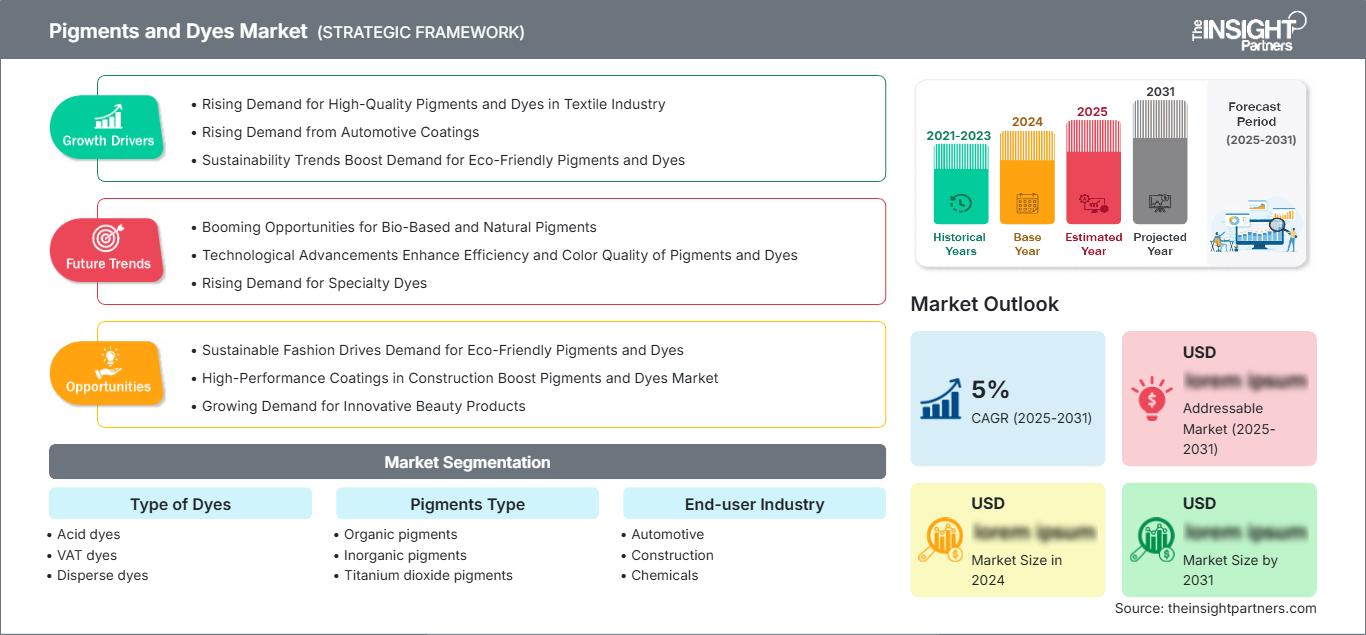
The pigments and dyes market was valued at US$ 45.82 billion in 2025 and is projected to reach US$ 69.53 billion by 2034, registering a CAGR of 4.74% during 2026–2034. Demand for pigments and dyes continues to expand as industries seek enhanced color performance, product differentiation, durability, and sustainability. Increasing consumption across paints and coatings, textiles, automotive manufacturing, packaging, and construction materials is supporting market expansion across both developed and emerging economies.
North America remains a significant market for pigments and dyes and is anticipated to achieve a CAGR of approximately 4.3% through 2034. Growth is being supported by rising construction activity, increasing demand for high-performance coatings, and expanding adoption of specialty colorants in packaging and consumer goods. Investments in sustainable formulations and environmentally compliant manufacturing technologies are also contributing to regional market development.
Pigments and Dyes Market Assessment and Insights
- Market Size (2025): US$ 45.82 Billion
- Market Size (2034): US$ 69.53 Billion
- CAGR (2026–2034): 4.74%
- Leading Region: Asia Pacific
- Fastest-Growing Region: Asia Pacific
- Leading Segment: Paints and Coatings
- Key Innovation / Competitive Trend: Sustainable and high-performance specialty colorant development
Source: The Insight Partners' analysis based on proprietary research, government publications, company annual reports, investor presentations, industry databases, and expert interviews.
The pigments and dyes market has evolved alongside changing industrial requirements for aesthetics, functionality, and environmental performance. Advances in chemical engineering have enabled the development of products with improved color strength, UV stability, heat resistance, and application versatility. Growing consumer preference for visually differentiated products has further increased demand across numerous end-use industries.
Market prospects remain supported by industrialization, urban development, and continued innovation in specialty materials. Manufacturers are increasingly focusing on sustainable production methods, bio-based alternatives, and regulatory-compliant formulations. Demand from construction, automotive, textile, and packaging sectors is expected to remain a major contributor to long-term market development, while technological advancements continue to expand application possibilities.
Pigments and Dyes Market Report Scope
| Report Attribute | Details |
|---|---|
| Market size in 2025 | US$ 45.82 Billion |
| Market Size by 2034 | US$ 69.53 Billion |
| Global CAGR (2026 - 2034) | 4.74% |
| Historical Data | 2021-2024 |
| Forecast period | 2026-2034 |
Pigments and Dyes Market Analysis
Demand for pigments and dyes is closely linked to manufacturing activity, infrastructure development, and consumer product production. Expanding urbanization is increasing the consumption of paints, coatings, plastics, and construction materials that require high-performance colorants. The textile industry's continuous need for diverse color solutions and the automotive sector's emphasis on premium finishes also contribute significantly to market growth.
The market ecosystem includes raw material suppliers, chemical manufacturers, pigment and dye producers, distributors, formulators, and end-use industries. Product performance is influenced by factors such as color consistency, chemical stability, environmental compliance, and application efficiency. Continuous research into sustainable chemistry and advanced processing technologies is helping improve product quality while addressing evolving regulatory requirements.
Competition is characterized by strong emphasis on innovation, product diversification, and sustainability initiatives. Companies including BASF SE, Clariant AG, DIC Corporation, ALTANA AG, Huntsman Corporation, Lanxess Aktiengesellschaft, and Sudarshan Chemical Industries Limited continue to invest in advanced formulations and specialty product portfolios. Differentiation increasingly depends on technical expertise, regulatory compliance, and customized solutions.
Investment activity is focused on expanding production capacity, strengthening specialty chemical capabilities, and developing environmentally responsible products. Strategic acquisitions, partnerships, and regional expansion initiatives remain common across the industry. Companies are positioning themselves to address growing demand from high-value applications such as automotive coatings, digital printing, advanced textiles, and sustainable packaging materials.
● REPORT CUSTOMIZATION
Tailor This Report To Align With Your Specific Business Requirements
This report can be customized to align precisely with your business objectives, scope, and target markets. Customization options include tailored segmentation, geography, competitive analysis, and strategic insights to support informed decision-making.
Customize This Report →WHAT YOU CAN ADJUST
- ● Segmentations
- ● Geography
- ● Competitive Analysis
- ● Language Preferences
Pigments and Dyes Market: Strategic Insights
Regional Insights
North America Pigments and Dyes Market
North America is projected to expand at a CAGR of approximately 4.3% during the forecast period. Demand is supported by construction activity, automotive production, packaging innovation, and continued growth in specialty coatings applications. The region's advanced manufacturing infrastructure and strong regulatory framework encourage adoption of high-performance and environmentally compliant pigment and dye products.
Increasing investment in sustainable coatings, industrial materials, and specialty chemicals is strengthening market opportunities. The growing use of advanced pigments in automotive finishes, architectural coatings, and packaging solutions reflects changing customer preferences for durability, aesthetics, and environmental performance. These factors continue to support stable regional market expansion.
U.S. Pigments and Dyes Market
The United States accounts for approximately 75–80% of the North American pigments and dyes market and is expected to register a CAGR of nearly 4.4% through 2034. Demand is driven by construction materials, industrial coatings, automotive applications, packaging products, and consumer goods manufacturing. The country's diversified industrial base supports consistent consumption across multiple sectors.
Major global chemical manufacturers maintain significant operations within the United States, supporting innovation and product development activities. Specialty pigments, performance dyes, and sustainable color solutions are gaining importance as customers seek enhanced functionality and regulatory compliance. Growing interest in environmentally responsible products continues to influence purchasing decisions and manufacturing strategies.
Europe Pigments and Dyes Market
Europe represents approximately 24–29% of global pigments and dyes consumption and is anticipated to achieve a CAGR of around 4.1% during the forecast period. Strong demand from automotive manufacturing, construction materials, industrial coatings, and specialty chemicals supports regional market performance. Regulatory emphasis on sustainability is encouraging the development of environmentally responsible pigment and dye technologies.
Germany remains the leading country market due to its extensive chemical manufacturing capabilities, automotive production base, and advanced industrial infrastructure. Demand for specialty pigments, industrial coatings, and high-performance colorants remains particularly strong. Continued investment in sustainable chemical solutions is reinforcing Germany's leadership position within the regional market.
The United Kingdom, France, Italy, and Spain contribute through demand from textiles, packaging, coatings, construction materials, and consumer products. The United Kingdom benefits from innovation in specialty chemicals, while France maintains significant demand from luxury goods and automotive applications. Italy and Spain continue to support growth through manufacturing activities and expanding construction-related consumption.
APAC Pigments and Dyes Market
Asia Pacific dominates the global pigments and dyes market with an estimated 42–47% market share and is projected to record a CAGR of approximately 5.3% through 2034. Rapid industrialization, expanding manufacturing activity, urban infrastructure development, and growing consumer goods production continue to support regional leadership. Government initiatives promoting domestic manufacturing and industrial modernization are further strengthening demand for pigments and dyes across multiple sectors.
China represents the largest country market due to its extensive chemical manufacturing industry, large-scale textile production, construction activity, and coatings consumption. Strong domestic demand and export-oriented manufacturing continue to generate substantial requirements for pigments, dyes, and specialty colorants. Ongoing investments in sustainable chemical production technologies are also influencing market development.
Japan, South Korea, India, and Australia contribute significantly to regional growth. Japan maintains strong demand for high-performance pigments used in automotive and electronics applications, while South Korea benefits from advanced coatings and industrial materials production. India is witnessing rising consumption driven by textiles, construction, and paints industries, while Australia supports demand through mining-related infrastructure and construction projects.
Middle East & Africa Pigments and Dyes Market
The Middle East & Africa pigments and dyes market is gradually expanding as infrastructure development, industrial diversification, and construction investments accelerate across the region. The market is anticipated to achieve a CAGR of approximately 4.2% through the forecast period. Growing demand for architectural coatings, industrial paints, plastics, and textile products is supporting market expansion.
Saudi Arabia remains the leading market in the region due to major infrastructure projects, urban development initiatives, and investments in downstream chemical manufacturing. Demand for pigments and dyes is increasing across construction materials, coatings, packaging, and industrial applications. Economic diversification programs continue to encourage local manufacturing and specialty chemical investments.
The United Arab Emirates is experiencing growing consumption through commercial construction, luxury real estate projects, and industrial coatings demand. South Africa remains an important market due to manufacturing, mining, and packaging industries, while the rest of the region benefits from expanding infrastructure and industrial development activities. Increasing urbanization is expected to support future consumption of colorants and specialty materials.
Segmentation Analysis
Type of Dyes
- Acid dyes: Acid dyes are widely used for coloring wool, silk, nylon, and specialty textiles due to their excellent color brightness, strong affinity for fibers, and ability to produce vibrant shades.
- VAT dyes: VAT dyes are valued for superior color fastness, durability, and resistance to washing, light, and chemicals, making them suitable for high-performance textile applications.
- Disperse dyes: Disperse dyes are primarily utilized for polyester and synthetic fibers, offering excellent penetration characteristics, color consistency, and suitability for modern textile manufacturing processes.
- Reactive dyes: Reactive dyes maintain strong demand because they form chemical bonds with fibers, delivering excellent wash fastness, color brilliance, and performance in textile applications.
- Direct dyes: Direct dyes are extensively used in paper, cotton, and cellulose-based materials due to their cost-effectiveness, ease of application, and broad color availability.
Pigments Type
- Organic pigments: Organic pigments offer vibrant colors, high tinting strength, and suitability for applications requiring aesthetic appeal, including coatings, plastics, inks, and consumer products.
- Inorganic pigments: Inorganic pigments provide excellent durability, weather resistance, thermal stability, and opacity, making them ideal for construction materials, coatings, and industrial applications.
- Titanium dioxide pigments: Titanium dioxide pigments remain a critical segment because of their exceptional opacity, brightness, UV resistance, and widespread use in paints, coatings, plastics, and paper products.
End-user Industry
- Automotive: The automotive industry utilizes pigments and dyes extensively in coatings, interior materials, plastics, and specialty finishes designed to enhance aesthetics, durability, and brand differentiation.
- Construction: Construction applications rely on pigments and dyes for architectural coatings, concrete coloring, roofing materials, flooring products, and decorative building solutions.
- Chemicals: The chemicals industry incorporates pigments and dyes into specialty formulations, industrial compounds, masterbatches, and performance materials requiring consistent coloration and functionality.
- Textile: Textile manufacturers represent a major consumer group, utilizing diverse dye technologies to achieve color consistency, design flexibility, and performance across natural and synthetic fibers.
- Leather: Leather processing applications depend on pigments and dyes to create premium finishes, improve product appearance, and meet evolving fashion and consumer preferences.
- Paper: Paper manufacturers use pigments and dyes to enhance visual appeal, printability, product differentiation, and branding across packaging, publishing, and specialty paper products.
Paints and Coatings: Paints and coatings represent the largest end-user segment, utilizing pigments for color, opacity, UV protection, corrosion resistance, and decorative performance.
Opportunity Snapshot
| End-user Industry | Revenue Contribution | Trend Tag | Adoption Stage |
| Automotive | High | Premium Finishes | Mature |
| Construction | High | Urban Projects | Mature |
| Chemicals | Medium | Specialty Formulations | Scaling |
| Textile | High | Sustainable Dyeing | Mature |
| Leather | Medium | Fashion Colors | Mature |
| Paper | Medium | Packaging Design | Mature |
| Paints and Coatings | High | Protective Coatings | Mature |
Pigments and Dyes Market Growth Drivers and Impact Analysis
Expanding Construction and Infrastructure Development Activities
Construction and infrastructure development remain among the most significant drivers of the pigments and dyes market. Rapid urbanization, population growth, and government investments in residential, commercial, and public infrastructure projects are increasing consumption of paints, coatings, concrete additives, roofing materials, and decorative products. These applications rely heavily on pigments to provide color consistency, durability, UV protection, and weather resistance.
Growing infrastructure modernization efforts across emerging economies are creating substantial demand for architectural coatings and construction materials that incorporate advanced pigment technologies. Commercial buildings, transportation infrastructure, industrial facilities, and residential developments all require high-performance coloring solutions capable of maintaining long-term aesthetic and functional performance.
The market impact extends throughout the value chain, encouraging pigment manufacturers to invest in improved durability, sustainability, and production efficiency. Companies capable of supplying innovative color solutions that meet evolving environmental and performance standards are positioned to benefit from continued construction sector expansion. Long-term urban development trends are expected to sustain demand across multiple product categories.
Rising Demand for High-Performance Paints and Coatings
The paints and coatings industry continues to represent a major source of demand for pigments and dyes. Industries including automotive, construction, marine, aerospace, and industrial manufacturing increasingly require coatings that provide both aesthetic appeal and functional protection. Advanced pigments contribute to corrosion resistance, UV stability, heat management, and enhanced visual characteristics.
Consumers and industrial buyers alike are placing greater emphasis on durability, product longevity, and appearance. This shift is encouraging coating manufacturers to adopt specialty pigments capable of delivering superior performance under demanding operating conditions. The increasing popularity of premium finishes, customized colors, and protective coatings further supports market demand.
The broader market impact includes greater investment in specialty pigment research, production capacity expansion, and sustainable coating technologies. Manufacturers are focusing on innovative formulations that balance regulatory compliance with performance requirements. Continued growth in global coatings consumption is expected to remain a major driver for pigment producers throughout the forecast period.
Growth of Textile Manufacturing and Fashion Industries
The textile industry remains one of the largest consumers of dyes worldwide, creating a strong foundation for market expansion. Rising apparel demand, increasing disposable incomes, evolving fashion trends, and growth in home furnishing products continue to support consumption of reactive, disperse, acid, and direct dyes. Emerging economies play a particularly important role due to their expanding textile manufacturing capacities.
Modern consumers increasingly seek product differentiation through color variety, design innovation, and personalization. Textile manufacturers are responding by adopting advanced dye technologies capable of producing vibrant shades while meeting environmental and quality requirements. Sustainable dyeing processes and water-efficient production methods are becoming increasingly important across the industry.
The market impact includes continuous innovation in dye chemistry, greater adoption of environmentally responsible manufacturing practices, and increased investment in specialty textile applications. As fashion cycles accelerate and textile production volumes remain substantial, demand for high-quality dyes is expected to maintain a positive growth trajectory.
Pigments and Dyes Market Future Trends
Sustainable and Bio-Based Colorant Development
Sustainability is becoming a central theme in the pigments and dyes market as manufacturers, regulators, and end users increasingly prioritize environmentally responsible products. Traditional dyeing and pigment production processes often involve significant energy consumption, water usage, and chemical inputs. As environmental regulations become stricter and corporate sustainability goals gain importance, producers are accelerating the development of bio-based, low-emission, and resource-efficient alternatives.
Advancements in green chemistry are enabling the production of pigments and dyes derived from renewable feedstocks while reducing environmental impact throughout the manufacturing process. Textile, packaging, and coatings industries are actively seeking solutions that support sustainability objectives without compromising color performance, durability, or product quality. Water-saving dyeing technologies and low-VOC pigment systems are gaining increasing commercial attention.
Looking ahead, sustainable colorants are expected to move beyond niche applications and become a mainstream market requirement. Companies investing in environmentally compliant product portfolios, circular economy initiatives, and cleaner manufacturing technologies may strengthen their competitive position. Sustainability credentials are increasingly influencing purchasing decisions across both industrial and consumer markets, creating long-term opportunities for innovation-focused manufacturers.
Growing Adoption of Specialty Pigments for Functional Applications
The role of pigments is expanding beyond coloration as industries increasingly demand multifunctional materials capable of delivering both aesthetic and performance benefits. Specialty pigments are being engineered to provide UV protection, heat management, infrared reflectivity, anti-corrosion properties, and enhanced durability. These advanced functionalities are becoming increasingly important across automotive, construction, packaging, and industrial applications.
Manufacturers are investing in research to develop pigments that contribute to product performance while maintaining visual appeal. Cool pigments used in energy-efficient buildings, effect pigments used in premium automotive finishes, and functional coatings designed for harsh environments are gaining wider adoption. This trend reflects growing demand for materials that create value beyond traditional coloration purposes.
Future market development is likely to be influenced by continued innovation in advanced materials and performance coatings. As industries seek products that improve energy efficiency, durability, and sustainability, specialty pigments are expected to capture a larger share of market value. Suppliers capable of delivering technically differentiated solutions may benefit from higher-margin opportunities and stronger customer relationships.
Pigments and Dyes Market Opportunities
Expansion of Sustainable Packaging and Printing Applications
The rapid growth of sustainable packaging solutions presents a significant opportunity for pigments and dyes manufacturers. Brand owners, packaging producers, and retailers are increasingly adopting recyclable, biodegradable, and environmentally friendly packaging materials to meet regulatory requirements and changing consumer preferences. These developments are creating demand for colorants that perform effectively within sustainable packaging systems.
Packaging formulations need pigments and dyes that give aesthetics, brand recognition, printability, and regulatory compliance. With the changes happening in packaging, new color systems that can work well with recyclable plastic, packaging made of paper, and compostable products are being developed.
There are business areas in specialty packaging ink, food-grade colorants, low migration pigments, and sustainable printing technology. Firms that develop products based on new packaging trends could tap into new market sectors that are fast-growing. There is an upside in this market from a regulatory point of view, and due to the importance of product differentiation through colors.
Increasing Demand from Emerging Automotive Coating Technologies
Automotive manufacturers are still heavily investing in advanced coating technologies that improve the aesthetics, durability, and performance of vehicles. The shift to electric vehicles, superior quality finishes, and custom colors is presenting new opportunities for pigment suppliers. Automotive coatings now need unique pigments that give unique visual effects, weather resistance, and durability.
The rise in popularity of electric vehicles is shaping the color trends and needs for coatings. Innovative finishes are being developed that help distinguish the electric vehicle models from others while providing energy efficiency and thermal management benefits. Effect pigments, metallic pigments, and functional color technologies have become increasingly relevant in today's automotive design strategy.
Strategic opportunities extend across both original equipment manufacturers and aftermarket applications. Suppliers capable of delivering innovative pigments that meet the stringent requirements of the automotive industry will benefit from long-lasting business relationships and premium positioning. Investment in advanced mobility solutions will ensure ongoing demand for functional color technologies during the forecast period.
Recent Developments
- March, 2025: Sudarshan Chemical Industries Limited completed the acquisition of Heubach Group’s global pigment business assets in a major transaction aimed at strengthening its position in the international pigments industry. The acquisition significantly expanded Sudarshan’s manufacturing footprint, technology portfolio, and customer reach across coatings, plastics, inks, and specialty applications.
- March, 2025: BASF SE announced capacity expansion initiatives for selected pigment and dispersions product lines to support growing demand from coatings, construction, and industrial applications. The investment reflects increasing industry focus on high-performance and sustainable color solutions designed to meet evolving customer and regulatory requirements.
- February, 2025: The Chemours Company highlighted continued innovation within its Ti-Pure titanium dioxide pigment portfolio, focusing on improved sustainability, production efficiency, and customer support across paints, coatings, plastics, and paper industries. The development underscores ongoing investment in advanced titanium dioxide technologies.
Frequently Asked Questions

- Comprehensive Market Sizing and Forecast Analysis
- Detailed Segmentation Analysis
- In-Depth Market Dynamics Assessment
- Regional and Country-Level Insights
- Competitive Landscape and Company Benchmarking
- Strategic Business Intelligence
Recent Reports
Testimonials

The Insight Partners' SCADA System Market report is comprehensive, with valuable insights on current trends and future forecasts. The team was highly professional, responsive, and supportive throughout. We are very satisfied and highly recommend their services.
RAN KEDEM Partner, Reali Technologies LTDs
I requested a report on a very specific software market and the team produced the report in a few days. The information was very relevant and well presented. I then requested some changes and additions to the report. The team was again very responsive and I got the final report in less than a week.
JEAN-HERVE JENN Chairman, Future Analytica
We worked with The Insight Partners for an important market study and forecast. They gave us clear insights into opportunities and risks, which helped shape our plans. Their research was easy to use and based on solid data. It helped us make smart, confident decisions. We highly recommend them.
PIYUSH NAGPAL Sr. Vice President, High Beam Global
The Insight Partners delivered insightful, well-structured market research with strong domain expertise. Their team was professional and responsive throughout. The user-friendly website made accessing industry reports seamless. We highly recommend them for reliable, high-quality research services
YUKIHIKO ADACHI CEO, Deep Blue, LLC.
This is the first time I have purchased a market report from The Insight Partners.While I was unsure at first, I visited their web site and felt more comfortable to take the risk and purchase a market report.I am completely satisfied with the quality of the report and customer service. I had several questions and comments with the initial report, but after a couple of dialogs over email with their analyst I believe I have a report that I can use as input to our strategic planning process.Thank you so much for taking the extra time and making this a positive experience.I will definitely recommend your service to others and you will be my first call when we need further market data.
JOHN SUZUKI President and Chief Executive Officer, Board Director, BK Technologies
I wish to appreciate your support and the professionalism you displayed in the course of attending to my request for information regarding to infectious disease IVD market in Nigeria. I appreciate your patience, your guidance, and the fact that you were willing to offer a discount, which eventually made it possible for us to close a deal. I look forward to engaging The Insight Partners in the future, all thanks to the impression you have created in me as a result of this first encounter.
DR CHIJIOKE ONYIA MANAGING DIRECTOR, PineCrest Healthcare Ltd.Reason to Buy
- Informed Decision-Making
- Understanding Market Dynamics
- Competitive Analysis
- Identifying Emerging Markets
- Customer Insights
- Market Forecasts
- Risk Mitigation
- Boosting Operational Efficiency
- Strategic Planning
- Investment Justification
- Tracking Industry Innovations
- Aligning with Regulatory Trends





 Get Free Sample for