
Encapsulation Market Size, Trends & Demand by 2034
Coverage: By Coating Material (Polymers, Gums and Resins, Lipids, Carbohydrates, and Proteins), Technology (Spray Technology, Emulsion Technology, Dripping Technology, and Others), and Application (Pharmaceuticals and Nutraceutical, Food and Beverages, Personal Care Products, Agrochemicals, and Others)
- Status : Data Released
- Report Code : TIPRE00024897
- Category : Chemicals and Materials
- No. of Pages : 150
- Available Report Formats :


- Last update date : February 11, 2026


2025 Market Size
US$ 55.25 Bn
Base year value
2034 Forecast
US$ 153.2 Bn
Projected by 2034
CAGR 2026-2034
12.0 %
Growth rate
Addressable Market
US$ 914.32 Bn
(2026-2034)
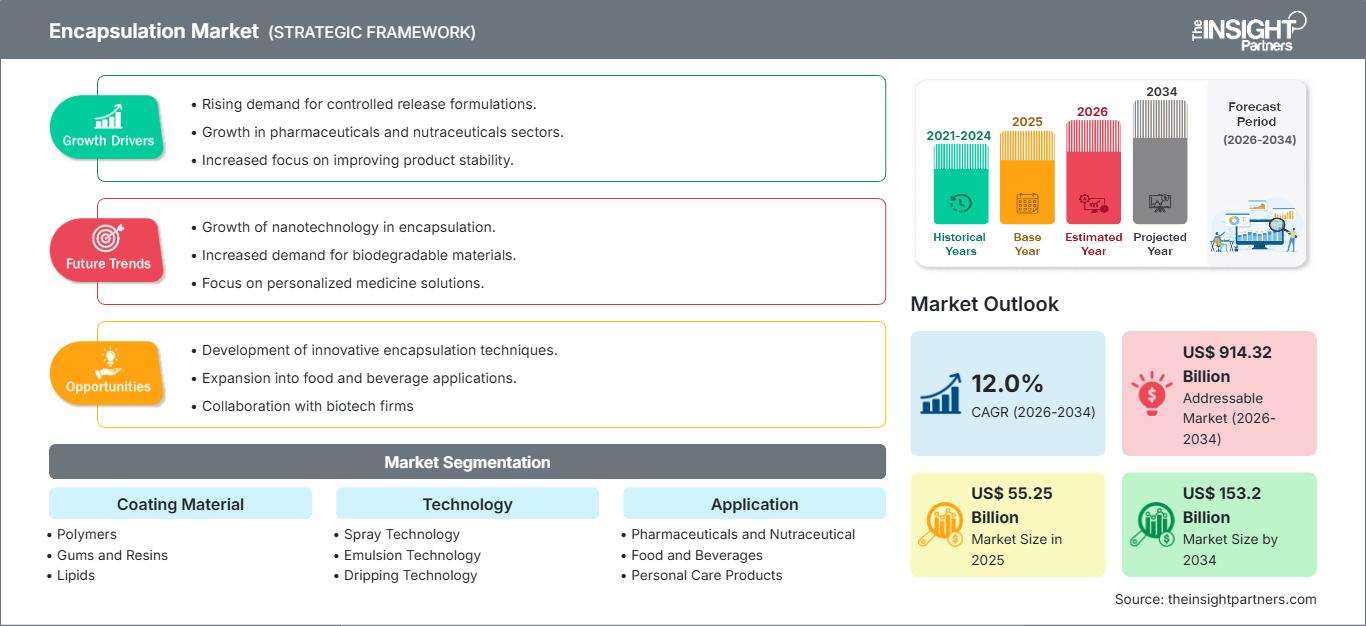
The global encapsulation market size is projected to reach US$ 153.2 billion by 2034 from US$ 55.25 billion in 2025. The market is anticipated to register a CAGR of 12.0% during the forecast period 2026–2034. Key market dynamics include a heightening global focus on controlled-release drug delivery systems, rising consumer demand for functional and fortified foods, and the increasing integration of encapsulated active ingredients in premium personal care products. Additionally, the market is expected to benefit from technological advancements in nanotechnology, a significant shift toward biodegradable and bio-based coating materials, and the expansion of the pharmaceutical sector in emerging economies.
Encapsulation Market Analysis
The encapsulation market analysis shows a shift toward precision delivery systems as industries prioritize ingredient stability and targeted release. Procurement trends indicate a growing preference for smart materials that respond to environmental triggers like pH and temperature, particularly in the healthcare and agrochemical sectors. Strategic opportunities are emerging in personalized nutrition and clinical therapeutics, where nanoencapsulation offers a clear competitive advantage by enhancing the bioavailability of sensitive compounds. The analysis also notes that market expansion depends on overcoming high manufacturing costs and maintaining structural integrity during advanced processing. Competitive differentiation now stands out through innovation in sustainable shell materials, such as plant-based proteins and polysaccharides, which help manufacturers align with clean-label consumer trends and stringent environmental regulations.
Encapsulation Market Overview
Encapsulation is shifting from a specialized industrial process to a critical enabler for high-value consumer goods. With the focus on protecting flavors in the food industry and active pharmaceutical ingredients (APIs), encapsulation is expanding into advanced fields like self-healing materials, thermal energy storage, and live cell therapy. Both global chemical giants and specialized biotech firms are part of this market, utilizing techniques such as spray drying, coacervation, and fluid-bed coating. Health-conscious consumers in North America and Europe are driving the demand for fortified beverages and gentle nutraceuticals, where encapsulation masks unpleasant tastes and odors. North America remains a leader in R&D and pharmaceutical applications, but the Asia-Pacific region is emerging as the fastest-growing hub, fueled by rapid industrialization and government support for high-tech manufacturing in China and India.
For instance, in the US, the market is primarily driven by a robust pharmaceutical sector and advanced processing capabilities. High demand for controlled-release drug delivery, fortified food products, and clean-label personal care ingredients fuels domestic innovation. Strong R&D initiatives and favorable regulatory environments further support the adoption of sophisticated microencapsulation technologies.
Market Research Highlights
- Global market for Encapsulation was valued at US$ 55.25 Billion in 2025
- Annual market size is expected to reach US$ 153.20 Billion by 2034
- Total addressable market (TAM) during 2026-2034 is projected to reach approximately US$ 914.32 Billion
- Market is anticipated to register a CAGR of 12% during the forecast period
- The United States represents a key market, supported by Rising demand for controlled release formulations., Growth in pharmaceuticals and nutraceuticals sectors., Increased focus on improving product stability., as well as evolving industry dynamics
- Market analysis covers North America, Europe, Asia-Pacific, South and Central America, Middle East and Africa, with growth evaluated across the forecast period
- Market opportunities such as Development of innovative encapsulation techniques., Expansion into food and beverage applications., Collaboration with biotech firms are expected to influence market dynamics and addressable market
- Report profiles industry participants, including Encapsys,LLC, Lycored, Tastetech, Givadan, Balchem, INC, FrieslandCampina, DSM, Microtek Laboratories, INC, Legris Industries Group, while analyzing competitive strategies and innovation developments
-
Source: The Insight Partners' analysis based on proprietary research, government publications, company annual reports, investor presentations, industry databases, and expert interviews.
● REPORT CUSTOMIZATION
Tailor This Report To Align With Your Specific Business Requirements
This report can be customized to align precisely with your business objectives, scope, and target markets. Customization options include tailored segmentation, geography, competitive analysis, and strategic insights to support informed decision-making.
Customize This Report →WHAT YOU CAN ADJUST
- ● Segmentations
- ● Geography
- ● Competitive Analysis
- ● Language Preferences
Encapsulation Market: Strategic Insights
-
Get Top Key Market Trends of this report.This FREE sample will include data analysis, ranging from market trends to estimates and forecasts.
Encapsulation Market Drivers and Opportunities
Market Drivers:
- Superior Targeted Delivery and Stability: Encapsulation protects sensitive compounds (vitamins, enzymes, or APIs) from environmental degradation (light, oxidation, pH), ensuring they reach the target site in the body or soil with maximum potency.
- Rapid Expansion of Functional Food and Beverages: The surge in global health consciousness has sustained high demand for fortified foods. Encapsulation allows for the seamless integration of omega-3s, minerals, and vitamins without altering the product's taste or texture.
- Technological Innovation in Micro and Nano-systems: Advancements in nanotechnology have enabled the creation of smaller, more efficient capsules that improve the solubility and bioavailability of poorly soluble active ingredients.
Market Opportunities:
- Growth in Precision Agriculture: Encapsulating fertilizers and pesticides offers significant opportunities to reduce chemical runoff and improve crop efficiency through time-released nutrient delivery.
- Expansion into Advanced Personal Care: Beyond basic fragrances, there is a growing opportunity for smart encapsulation in skincare that releases active anti-aging ingredients in response to skin temperature or moisture levels.
- Sustainable Material Development: Transitioning from synthetic polymers to natural, biodegradable coating materials like seaweed extracts and plant proteins offers a massive competitive edge in eco-conscious markets.
Encapsulation Market Report Segmentation Analysis
The Encapsulation Market share is analyzed across various segments to provide a clearer understanding of its structure, growth potential, and emerging trends. Below is the standard segmentation approach used in most industry reports:
By Coating Material:
- Polymers: The dominant segment due to their versatility and strength; includes synthetic (PLGA, PLA) and natural biopolymers extensively used in drug delivery.
- Gums and Resins: Preferred for their excellent film-forming properties and natural origin, widely utilized in the food and confectionery sectors.
- Lipids: A fast-growing niche, particularly for encapsulating fat-soluble vitamins and enhancing the bioavailability of nutraceuticals.
- Carbohydrates: Highly popular in the food industry for flavor masking and protection due to their low cost and high solubility (e.g., maltodextrins, starches).
- Proteins: Gaining traction as a clean-label shell material, offering high biocompatibility for pediatric and geriatric nutrition.
By Technology:
- Spray Technology: The primary volume driver, including spray drying and spray chilling, is valued for its high efficiency, cost-effectiveness, and scalability.
- Emulsion Technology: The fastest-rising method, especially for liquid-core materials; the pharmaceutical sector needs to improve the delivery of poorly soluble drugs.
- Dripping Technology: Used for the production of larger beads or specialized pharmaceutical formulations where precise size control and high loading capacity are required.
By Application:
- Pharmaceuticals and Nutraceuticals: The largest application segment, focusing on masking bitter tastes, protecting sensitive molecules, and enabling sustained drug release.
- Food and Beverages: Rapidly expanding through the fortification of snacks, dairy, and beverages with functional ingredients like probiotics and omega-3.
- Personal Care Products: Utilized to stabilize fragrances, UV filters, and active anti-aging compounds in luxury skincare and hair care products.
- Agrochemicals: A developing segment focused on the controlled release of pesticides and soil enhancers to support sustainable farming.
By Geography:
- North America
- Europe
- Asia Pacific
- South & Central America
- Middle East & Africa
Encapsulation Market Report Scope
| Report Attribute | Details |
|---|---|
| Market size in 2025 | US$ 55.25 Billion |
| Market Size by 2034 | US$ 153.2 Billion |
| Global CAGR (2026 - 2034) | 12.0% |
| Historical Data | 2021-2024 |
| Forecast period | 2026-2034 |
| Segments Covered |
By Coating Material
|
| Regions and Countries Covered |
North America
|
| Market leaders and key company profiles |
|
Encapsulation Market Players Density: Understanding Its Impact on Business Dynamics
The Encapsulation Market is growing rapidly, driven by increasing end-user demand due to factors such as evolving consumer preferences, technological advancements, and greater awareness of the product's benefits. As demand rises, businesses are expanding their offerings, innovating to meet consumer needs, and capitalizing on emerging trends, which further fuels market growth.
Encapsulation Market Share Analysis by Geography
Asia-Pacific is expected to grow fastest in the coming years. Emerging markets in South & Central America, the Middle East, and Africa also have many untapped opportunities for pharmaceutical innovators and functional food producers to expand.
The encapsulation market is undergoing a significant transformation, moving from a specialized industrial process to a global high-value technical commodity. Growth is driven by the rising demand for controlled-release pharmaceuticals, a surge in clean-label functional foods, and the expansion of luxury personal care sectors. Below is a summary of market share and trends by region:
North America
- Market Share: Holds the largest share globally, anchored by a robust pharmaceutical sector and high R&D spending in the US and Canada.
- Key Drivers:
- Rising consumer preference for personalized medicine and high-performance drug delivery systems.
- Mainstreaming of fortified smart foods and specialized nutraceuticals in high-end retail chains.
- Strong regulatory support from the FDA for advanced medical and food preservation technologies.
- Trends: Heavy focus on nanoencapsulation for clinical therapeutics and the successful adoption of biodegradable coating materials to meet sustainability goals.
Europe
- Market Share: A major regional player, driven by strict regulatory frameworks and a strong presence of global chemical giants in Germany, France, and the UK.
- Key Drivers:
- Strategic focus on Green Chemistry and 100% plastic-free encapsulation to comply with EU microplastic bans.
- High domestic demand for natural, clean-label food additives and premium fragrance stabilization.
- Established infrastructure for traditional small-molecule pharmaceutical manufacturing.
- Trends: A strategic shift toward prioritizing bio-based polymers and plant proteins for shell materials to appeal to eco-conscious European consumers.
Asia-Pacific
- Market Share: The fastest-growing region, with China and India acting as primary engines for pharmaceutical, agrochemical, and food processing.
- Key Drivers:
- Massive consumer base seeking affordable functional foods and premium infant nutrition.
- Government-supported agricultural initiatives focused on smart farming and high-yield crop protection.
- Rapid urbanization leading to increased demand for westernized luxury personal care and convenience foods.
- Trends: Heavy reliance on B2B contracts for high-end encapsulated ingredients used in the booming regional electronics and cosmetics industries.
South and Central America
- Market Share: Emerging market with a growing artisanal food sector and expanding pharmaceutical manufacturing in Brazil and Chile.
- Key Drivers:
- Increasing awareness of the nutritional benefits of encapsulated vitamins for child development and gut health.
- Modernization of local manufacturing lines to supply urban centers with high-quality processed foods.
- Trends: Growth of farm-to-shelf fortified products and the introduction of encapsulated soil enhancers to differentiate in the dominant agricultural market.
Middle East and Africa
- Market Share: Developing market with strategic investments in localized food security and specialized agricultural inputs for arid climates.
- Key Drivers:
- Strategic shift toward Smart Agriculture to improve local crop yields and reduce reliance on imported chemical fertilizers.
- High demand for shelf-stable functional foods and high-nutrient pediatric supplements.
- Trends: Implementation of modern microencapsulation technologies to formalize local markets, coupled with a focus on long-l asting fragrance delivery for regional luxury perfume sectors.
High Market Density and Competition
Competition is intensifying due to the presence of established leaders such as BASF SE, Cargill, and Kerry Group. The environment pushes vendors to differentiate through:
- Positioning encapsulation as a value-add that guarantees ingredient stability and superior delivery compared to non-encapsulated alternatives.
- Developing 100% biodegradable and plant-based shell materials to comply with global bans on microplastics.
- Managing the entire lifecycle from core material synthesis to final encapsulation to ensure quality and clean-label transparency.
Opportunities and Strategic Moves
- Incorporate sustainable and biodegradable shell materials, such as plant-based resins and proteins, to align with global environmental regulations and appeal to eco-conscious Gen Z consumers seeking ethical products.
- Invest in Precision Agrochemical Solutions by developing encapsulated fertilizers and pesticides that offer controlled release, helping farmers in the Asia-Pacific and Middle East regions improve efficiency and reduce environmental runoff.
- Leverage AI-driven Formulation Tools to optimize core-shell compatibility and predict release profiles, significantly reducing R&D cycles and operational costs for small and mid-sized manufacturers.
Major Companies operating in the Encapsulation Market are:
- Encapsys,LLC
- Lycored
- Tastetech
- Givadan
- Balchem, INC
- FrieslandCampina
- DSM
- Microtek Laboratories, INC
- Legris Industries Group
Disclaimer: The companies listed above are not ranked in any particular order.
Encapsulation Market News and Recent Developments
- In December 2025, Avant Technologies, Inc. highlighted the essential importance of cell encapsulation technology in enabling effective, long-term treatments for type 1 and insulin-dependent type 2 diabetes. By protecting genetically modified cells that produce and secrete insulin, this innovative approach addresses key barriers to cell-based therapies, offering hope for millions of patients worldwide who rely on daily insulin injections.
- In November 2025, Givaudan extended its PlanetCaps™ range with a new biodegradable fragrance encapsulation breakthrough for personal care. PlanetCaps™ is the perfect example of how encapsulation expertise transforms personal care.\
Encapsulation Market Report Coverage and Deliverables
The Encapsulation Market Size and Forecast (2021–2034) report provides a detailed analysis of the market covering below areas:
- Encapsulation Market size and forecast at global, regional, and country levels for all the key market segments covered under the scope
- Encapsulation Market trends, as well as market dynamics such as drivers, restraints, and key opportunities
- Detailed PEST and SWOT analysis
- Encapsulation Market analysis covering key market trends, global and regional framework, major players, regulations, and recent market developments
- Industry landscape and competition analysis covering market concentration, heat map analysis, prominent players, and recent developments in the Encapsulation Market.
- Detailed company profiles
Frequently Asked Questions

- Comprehensive Market Sizing and Forecast Analysis
- Detailed Segmentation Analysis
- In-Depth Market Dynamics Assessment
- Regional and Country-Level Insights
- Competitive Landscape and Company Benchmarking
- Strategic Business Intelligence
Recent Reports
Testimonials

The Insight Partners' SCADA System Market report is comprehensive, with valuable insights on current trends and future forecasts. The team was highly professional, responsive, and supportive throughout. We are very satisfied and highly recommend their services.
RAN KEDEM Partner, Reali Technologies LTDs
I requested a report on a very specific software market and the team produced the report in a few days. The information was very relevant and well presented. I then requested some changes and additions to the report. The team was again very responsive and I got the final report in less than a week.
JEAN-HERVE JENN Chairman, Future Analytica
We worked with The Insight Partners for an important market study and forecast. They gave us clear insights into opportunities and risks, which helped shape our plans. Their research was easy to use and based on solid data. It helped us make smart, confident decisions. We highly recommend them.
PIYUSH NAGPAL Sr. Vice President, High Beam Global
The Insight Partners delivered insightful, well-structured market research with strong domain expertise. Their team was professional and responsive throughout. The user-friendly website made accessing industry reports seamless. We highly recommend them for reliable, high-quality research services
YUKIHIKO ADACHI CEO, Deep Blue, LLC.
This is the first time I have purchased a market report from The Insight Partners.While I was unsure at first, I visited their web site and felt more comfortable to take the risk and purchase a market report.I am completely satisfied with the quality of the report and customer service. I had several questions and comments with the initial report, but after a couple of dialogs over email with their analyst I believe I have a report that I can use as input to our strategic planning process.Thank you so much for taking the extra time and making this a positive experience.I will definitely recommend your service to others and you will be my first call when we need further market data.
JOHN SUZUKI President and Chief Executive Officer, Board Director, BK Technologies
I wish to appreciate your support and the professionalism you displayed in the course of attending to my request for information regarding to infectious disease IVD market in Nigeria. I appreciate your patience, your guidance, and the fact that you were willing to offer a discount, which eventually made it possible for us to close a deal. I look forward to engaging The Insight Partners in the future, all thanks to the impression you have created in me as a result of this first encounter.
DR CHIJIOKE ONYIA MANAGING DIRECTOR, PineCrest Healthcare Ltd.Reason to Buy
- Informed Decision-Making
- Understanding Market Dynamics
- Competitive Analysis
- Identifying Emerging Markets
- Customer Insights
- Market Forecasts
- Risk Mitigation
- Boosting Operational Efficiency
- Strategic Planning
- Investment Justification
- Tracking Industry Innovations
- Aligning with Regulatory Trends





 Get Free Sample for