
Pipe and Tube Bending Machine Market Share, Size & Demand by 2034
Coverage: By Product Type (CNC Bending Machine, Hydraulic Pipe Bender); End-User (Power Construction, Public Railway Construction, Boilers, Bridge, Ships Furniture) , and Geography (North America, Europe, Asia Pacific, and South and Central America)
- Status : Data Released
- Report Code : TIPRE00019858
- Category : Manufacturing and Construction
- No. of Pages : 150
- Available Report Formats :


- Last update date : August 06, 2026


2025 Market Size
US$ 1.65 Bn
Base year value
2034 Forecast
US$ 3.05 Bn
Projected by 2034
CAGR 2026-2034
7.03 %
Growth rate
Addressable Market
US$ 21.18 Bn
(2026-2034)
The pipe and Tube Bending Machine Market was valued at US$ 1.65 Billion in 2025 and is projected to reach US$ 3.05 Billion by 2034, registering a CAGR of 7.03% during 2026–2034. Demand is being shaped by precision fabrication requirements across power construction, public railway construction, boilers, bridges, ships, and furniture, where repeatable bends reduce rework, support modular production, and improve throughput in metal forming operations.
North America remains a technology-led demand center, with an estimated regional CAGR in the 6.4–6.8% range as reshoring, infrastructure renewal, and fabrication automation reshape purchasing priorities. Pipe and Tube Bending Machine Market size in the region is supported by rail modernization, power plant maintenance, ship repair, and higher adoption of CNC workcells that improve consistency for short-batch and engineered-to-order tube assemblies.
Pipe and Tube Bending Machine Market Assessment and Insights
- North America accounted for 24–27% share in 2025 and is expected to grow at 6.4–6.8% CAGR during 2026–2034, supported by utility upgrades, fabrication reshoring, and rail investments.
- US represented 76–80% of North America in 2025 and is projected to expand at 6.5–6.9% CAGR during 2026–2034.
- Europe held 20–23% share in 2025 and is likely to grow at 5.8–6.3% CAGR, led by Germany, Italy, France, Spain, and the UK.
- Asia Pacific captured 38–42% share in 2025 and is forecast to grow at 7.6–8.1% CAGR, led by China, Japan, South Korea, India, and Australia.
- Largest Segment CNC Bending Machine held 58–62% market share in 2025, with 7.3–7.8% CAGR during 2026–2034 due to automation demand.
- High Growth Segment Public Railway Construction held 14–17% market share in 2025, with 8.0–8.6% CAGR during 2026–2034.
- Key companies analyzed in detail: Electropneumatics Pvt. Ltd., Wonsten Group, CML USA, Inc., Shuz Tung Machinery Industrial Co., Ltd., Tube & Pipe Bending Machines Ltd., Baileigh Industrial, Inc., SOCO Machinery Co., Ltd., Promau S.r.l., Van Sant Enterprises, Inc., and AMOB S.A.
Source: The Insight Partners' analysis based on proprietary research, government publications, company annual reports, investor presentations, industry databases, and expert interviews.
Technology migration is moving the Pipe and Tube Bending Machine Market from manually adjusted hydraulic equipment toward CNC, servo-electric, and hybrid systems with digital control, bend simulation, and repeatable tooling libraries. Current production conditions are more in favor of flexible cells that work with smaller batches without any lengthy setup. Machines for boilers, railroad constructions, ships, bridges, and furniture are being selected on the basis of precision, safety, and reduction of waste rather than the machine's performance only.
Future demand will be coming from new industrial regions where power projects, mass transit systems, and construction in modules are creating a continuous demand for bent tubes and pipes. Government-supported development of electrified railroad lines, power infrastructure, and the local manufacturing industry increases investments. At the same time, customers are taking into account such criteria as energy consumption and software availability in the process of machine selection.
Pipe and Tube Bending Machine Market Report Scope
| Report Attribute | Details |
|---|---|
| Market size in 2025 | US$ 1.65 Billion |
| Market Size by 2034 | US$ 3.05 Billion |
| Global CAGR (2026 - 2034) | 7.03% |
| Historical Data | 2021-2024 |
| Forecast period | 2026-2034 |
Pipe and Tube Bending Machine Market Analysis
Demand in the Pipe and tube-bending machine market growth cycle is being driven by infrastructure fabrication, heat-transfer equipment, shipbuilding, and precision assemblies for transport systems. Buyers require machines capable of maintaining bend integrity across stainless steel, carbon steel, copper, and aluminum profiles. This is raising demand for mandrel support, programmable axes, automated loading, and digital angle correction.
The value chain consists of steel and tube manufacturers, tooling providers, servo and hydraulic components manufacturers, machinery manufacturers, distributors, and field service companies. The supply situation still depends on the availability of controls, qualified commissioning staff, and customization time. Users tend to evaluate the total cost per bend and not just the cost of machinery.
Competitive positioning in the market analysis is defined by the degree of automation, engineering applications, geographical support, and successful experience in heavy-wall and/or complex radius bending. Electropneumatics Pvt. Ltd. and Shuz Tung Machinery Industrial Co., Ltd. cover general industrial fabrication, whereas SOCO Machinery Co., Ltd. and AMOB S.A. stress CNC and automated bending systems.
Investments are being made in the areas of electric axes, robotic manipulators, vision systems, and software to reduce setup time. Some companies operating in this segment include CML USA, Inc., Baileigh Industrial, Inc., Promau S.r.l., Van Sant Enterprises, Inc., Tube & Pipe Bending Machines Ltd., and Wonsten Group.
● REPORT CUSTOMIZATION
Tailor This Report To Align With Your Specific Business Requirements
This report can be customized to align precisely with your business objectives, scope, and target markets. Customization options include tailored segmentation, geography, competitive analysis, and strategic insights to support informed decision-making.
Customize This Report →WHAT YOU CAN ADJUST
- ● Segmentations
- ● Geography
- ● Competitive Analysis
- ● Language Preferences
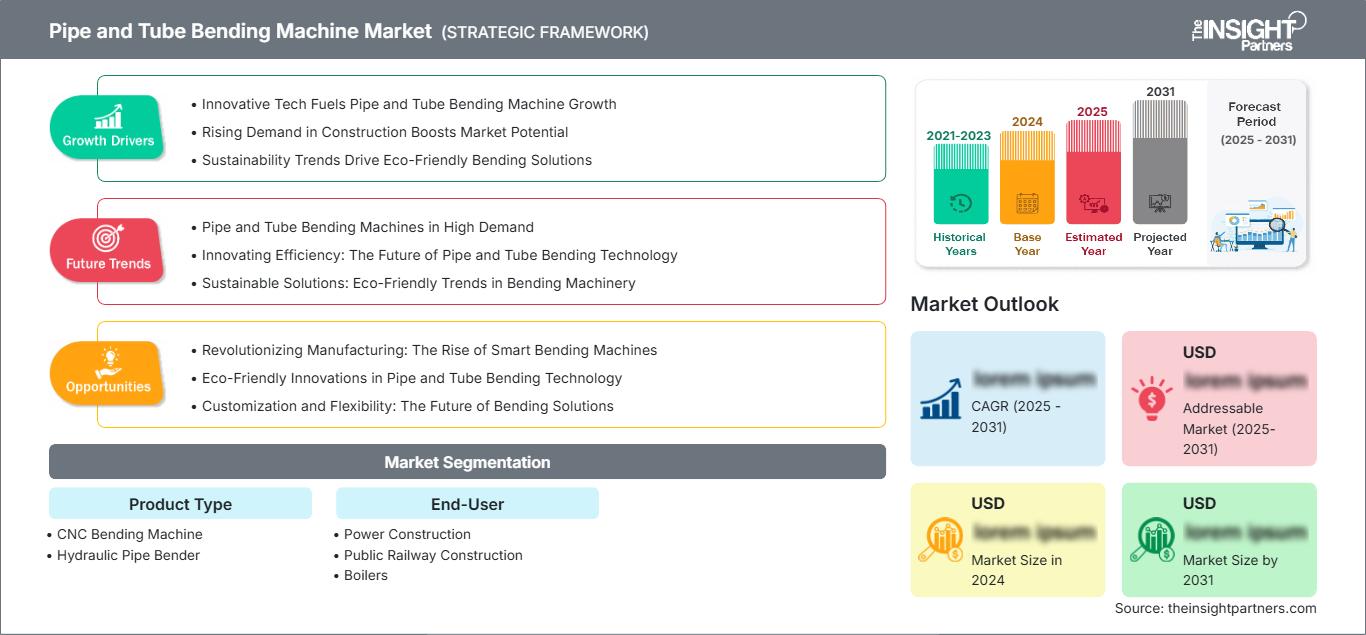
Pipe and Tube Bending Machine Market: Strategic Insights
Regional Insights
North America Pipe and Tube Bending Machine Market
North America held 24–27% Pipe and Tube Bending Machine Market share in 2025 and is projected to advance at 6.4–6.8% CAGR during 2026–2034. Demand is tied to utility refurbishment, LNG and power construction, bridge rehabilitation, and rail workshop modernization. Fabricators are investing in CNC cells to reduce skilled-labor dependence and improve repeatability across engineered tube assemblies.
Procurement patterns favor machines with stronger after-sales support, software compatibility, and tooling availability. The region also benefits from automotive lightweighting and ship repair activity, which require precise tubular structures. Buyers are replacing aging hydraulic benders where scrap reduction and shorter changeovers justify automation investment.
U.S. Pipe and Tube Bending Machine Market
The U.S. represented 76–80% of North American revenue in 2025 and is expected to grow at 6.5–6.9% CAGR. Demand is based on power plant repairs, railway rolling stock, defense ships, commercial furniture, and metal service centers. Businesses operating with distribution in the U.S., such as CML USA, Inc., Baileigh Industrial, Inc., and Van Sant Enterprises, Inc., are in favor of reduced lead times.
In terms of application trends, more manufacturers are using programmable rotary draw bending and measurements for repeat orders. Fabricators catering to customers in the energy sector and transport industry are moving away from manual bending to stored bending recipes.
Europe Pipe and Tube Bending Machine Market
Europe accounted for 20–23% share in 2025 and is forecast to expand at 5.8–6.3% CAGR. Germany leads through machinery, automotive, boiler, and rail fabrication, while Italy contributes strong metalworking equipment demand and supplier expertise. The UK market is supported by rail renewal, ship repair, and infrastructure maintenance, requiring accurate bent tube assemblies.
France, Spain, and Italy are reaping the rewards of improved transportation, energy efficiency initiatives, and factory automation. Buyers in Europe tend to prefer products that are energy efficient, safe, small in size, and of traceable quality. This means that the market is largely driven by specifications rather than price.
APAC Pipe and Tube Bending Machine Market
APAC held 38–42% share in 2025 and is projected to post 7.6–8.1% CAGR, the strongest regional pace. China remains the leading country due to construction machinery, rail, shipbuilding, boilers, and furniture manufacturing. Japan and South Korea support high-precision demand, while India and Australia add infrastructure-led opportunities.
Industrial policy, local equipment manufacturing, and expanding fabrication clusters are improving access to CNC bending technology. APAC buyers balance cost, productivity, and service responsiveness, creating room for both domestic suppliers and global specialists. Railway expansion and energy projects remain central to equipment replacement cycles.
Middle East & Africa Pipe and Tube Bending Machine Market
The Middle East & Africa is expected to grow at 6.2–6.7% CAGR during 2026–2034. Saudi Arabia leads regional demand, followed by the UAE, South Africa, and the rest of MEA. Energy infrastructure, district cooling, ship repair, and construction megaprojects create recurring requirements for durable bending equipment.
Local fabricators are adopting machines that can process heavier pipe diameters while maintaining accurate bend radii. Import dependence remains high, so supplier selection often depends on commissioning support, spare-part availability, and training. Utility, oil and gas, and transport projects anchor medium-term demand.
Segmentation Analysis
Product Type
Product Type is expected to register 6.9–7.4% CAGR during 2026–2034 as users shift toward automation, programmability, and lower scrap. The market scope across product types is defined by bend accuracy, tube diameter range, power source, tooling flexibility, and integration readiness for robotic or semi-automatic production lines.
- CNC Bending Machine holds the leading position as fabricators prioritize repeatability, stored bending programs, multi-axis control, and reduced operator dependence for complex geometries in rail, ship, boiler, and precision furniture applications.
- Hydraulic Pipe Bender remains strategically important for heavy-wall pipes, maintenance shops, and cost-sensitive users that require robust force output, simpler operation, and reliable bending for construction and industrial service environments.
End-User
By End-User, the Pipe and Tube Bending Machine Market forecast is projected to grow at a 7.1–7.6% CAGR during 2026–2034, reflecting diversified demand across infrastructure, energy, transportation, marine, and furniture manufacturing. Adoption is strongest where bent tube assemblies influence safety, installation speed, aesthetics, and repeatability. Buyers increasingly align machine selection with project pipeline visibility and internal fabrication strategy.
- Power Construction requires reliable bending for boiler piping, cable conduits, heat exchangers, and plant maintenance, making equipment durability, diameter capability, and repeatable angle control central purchasing criteria.
- Public Railway Construction is gaining strategic importance as stations, rolling stock, signaling structures, and maintenance depots use bent tubes for frames, handrails, conduits, and modular assemblies.
- Boilers depend on accurate tube shaping for heat-transfer efficiency, pressure integrity, and installation consistency, encouraging adoption of programmable systems that reduce deformation and improve production documentation.
- Bridge applications use bent tubes and pipes in railings, structural supports, drainage systems, and architectural elements, where repeatable geometry supports faster installation and lower onsite rework.
- Ships Furniture combines marine durability with compact interior design, creating demand for precise tube frames, railings, fixtures, and furniture components suitable for vessel cabins and public areas.
Opportunity Snapshot
| End-User | Revenue Contribution | Trend Tag | Adoption Stage |
| Power Construction | High | Grid Buildout | Scaling |
| Public Railway Construction | Medium | Rail Renewal | Scaling |
| Boilers | High | Heat Transfer | Mature |
| Bridge | Medium | Structural Retrofit | Scaling |
| Ships Furniture | Low | Marine Interiors | Emerging |
Pipe and Tube Bending Machine Market Growth Drivers and Impact Analysis
Infrastructure Prefabrication Raises Demand for Repeatable Bends
Infrastructure contractors are shifting more work from construction sites to controlled fabrication shops to improve safety, scheduling, and quality. This directly supports the Pipe and Tube Bending Machine Market because prefabricated pipe spools, rail station handrails, bridge drainage assemblies, and utility conduits require consistent bend angles across repeated batches. The process of automated bending is less labor-intensive than on-site cutting, welding, and adjusting processes, reducing risks for laborers and time delays. In terms of market effects, this is more pronounced when it comes to projects related to public railroads and power construction, where standardized structures can be manufactured prior to the installation periods. Firms with programmable controls and field service capabilities have an advantage.
Automation Shortens Setup Time in Mixed-Batch Fabrication
Fabrication is increasingly being done on customized work where the customer wants frames, pipe bends, structures for furniture or industries, among other such items. This requires manual setup, which leads to loss of time and quality becoming a function of the personal experience of each operator. CNC and servo-bending machines overcome this restriction. The effect is higher machine utilization, lower scrap, and faster quotation-to-delivery cycles. For the Pipe and Tube Bending Machine Market, automation becomes a purchasing justification rather than a premium feature. Companies that combine controls, simulation, and measurement feedback can serve buyers seeking consistent output without expanding labor headcount or floor space.
Energy and Transport Assets Need Durable Tube Fabrication
Generation facilities, railway systems, shipping operations, and bridges are all reliant on bent tubes and pipes, which must withstand vibrations, pressures, corrosion, and frequent maintenance. The replacement of outdated equipment provides ongoing needs for machinery that bends thick-walled material and ensures that the bends will not become oval and crack. The effect on the market is an increased desire for more durable hydraulic systems in heavy-duty applications and CNC machines, where documentation and consistency are important. Serviceability is another factor because downtime in the fabrication facility could lead to delays in infrastructure projects.
Pipe and Tube Bending Machine Market Future Trends
Electric and Hybrid Bending Platforms Gain Preference
Pipe and Tube Bending Machine Market trends are moving toward electric and hybrid platforms because manufacturers want lower energy use, cleaner operation, quieter workspaces, and tighter process control. Fully electric axes offer enhanced repeatability and may lower the maintenance needs associated with hydraulic fluid, whereas hybrid types maintain the ability to achieve high forces for difficult diameters. During the forecasted period, purchasing departments are likely to judge machines according to their cost of operation over the course of their lifecycle rather than just their initial cost. This development is likely to benefit those vendors that are able to prove savings in energy consumption, predictive maintenance, and integration with software.
Vision-Guided Cells Move from Premium to Practical
The vision system, weld seam location, robotized loading, and automated palletizing are getting increasingly feasible for mid-size users due to falling integration costs and labor shortage. These processes assist in orienting the tubes prior to the bending process, minimizing operator intervention and maintaining continuous manufacturing in repetitive processes. The greatest implementation will take place in the vicinity of automotive manufacturing, railway parts, boiler tube manufacturing, and maritime interior construction. The Pipe and Tube Bending Machine Market will gradually shift from standalone equipment toward connected cells that combine feeding, bending, measuring, unloading, and production data capture in one workflow.
Pipe and Tube Bending Machine Market Opportunities
Railway Fabrication Hubs Offer Scalable Equipment Demand
Modernization of rail systems provides a niche opportunity for vendors who can bundle bending machines along with tooling, training, and application services for on-site manufacturing at the depot level and at the contractor level. Bends in pipes are needed for the manufacture of handrails, conduit systems, interior fittings of the train coaches, maintenance equipment, and station structures. Vendors can offer industry-specific setups with pre-programmed templates and enhanced safety features to match project requirements. Such an opportunity is best suited for the APAC region, North America, and some parts of Europe, where there are ongoing projects related to rail renovation and electrification.
Aftermarket Services Can Stabilize Supplier Revenue
As installed bases expand, aftermarket services can become a recurring revenue stream for machine builders and distributors. Preventive maintenance contracts, tooling refurbishment, software upgrades, operator training, and remote diagnostics help customers keep bending accuracy within tolerance. This is particularly valuable for shops serving boilers, ships, bridges, and power construction, where machine downtime can disrupt broader project schedules. Suppliers that build service networks near industrial clusters can differentiate beyond machine specifications. The opportunity also supports data-driven offerings, including utilization monitoring and bend-quality reporting, which strengthen customer retention and create upsell pathways for automation accessories.
Recent Developments
- March 2026: AMOB UK, on behalf of the AMOB Group, will present a fully integrated tube bending and inspection workflow at MACH 2026, taking place from 20–24 April at the NEC, Birmingham. Located at Stand 6-170, directly at the entrance to Hall 6 opposite the registration area, the AMOB exhibit will feature two all-electric CNC tube bending machines operating live throughout the show, alongside on-stand tube measurement and inspection using Hexagon systems.
- March 2026: YLM Group cordially invites businesses across the globe to visit TMTS 2026 (Booth G1022). The company showcases its latest innovations in tube bending, laser tube cutting, and precision machining, and support businesses in advancing toward smart manufacturing.
- January 2026: SLTL Group showcasing a live Cut-Bend-Weld ecosystem at IMTEX Forming 2026 in Bangalore International Exhibition Centre (BIEC). For SLTL Group (Sahajanand Laser Technology Ltd.), the event was a watershed moment that moved beyond traditional equipment displays to demonstrate the rapid evolution from machine-centric tasks to intelligent, connected, and outcome-driven production ecosystems.
Frequently Asked Questions

- Comprehensive Market Sizing and Forecast Analysis
- Detailed Segmentation Analysis
- In-Depth Market Dynamics Assessment
- Regional and Country-Level Insights
- Competitive Landscape and Company Benchmarking
- Strategic Business Intelligence
Recent Reports
Testimonials

The Insight Partners' SCADA System Market report is comprehensive, with valuable insights on current trends and future forecasts. The team was highly professional, responsive, and supportive throughout. We are very satisfied and highly recommend their services.
RAN KEDEM Partner, Reali Technologies LTDs
I requested a report on a very specific software market and the team produced the report in a few days. The information was very relevant and well presented. I then requested some changes and additions to the report. The team was again very responsive and I got the final report in less than a week.
JEAN-HERVE JENN Chairman, Future Analytica
We worked with The Insight Partners for an important market study and forecast. They gave us clear insights into opportunities and risks, which helped shape our plans. Their research was easy to use and based on solid data. It helped us make smart, confident decisions. We highly recommend them.
PIYUSH NAGPAL Sr. Vice President, High Beam Global
The Insight Partners delivered insightful, well-structured market research with strong domain expertise. Their team was professional and responsive throughout. The user-friendly website made accessing industry reports seamless. We highly recommend them for reliable, high-quality research services
YUKIHIKO ADACHI CEO, Deep Blue, LLC.
This is the first time I have purchased a market report from The Insight Partners.While I was unsure at first, I visited their web site and felt more comfortable to take the risk and purchase a market report.I am completely satisfied with the quality of the report and customer service. I had several questions and comments with the initial report, but after a couple of dialogs over email with their analyst I believe I have a report that I can use as input to our strategic planning process.Thank you so much for taking the extra time and making this a positive experience.I will definitely recommend your service to others and you will be my first call when we need further market data.
JOHN SUZUKI President and Chief Executive Officer, Board Director, BK Technologies
I wish to appreciate your support and the professionalism you displayed in the course of attending to my request for information regarding to infectious disease IVD market in Nigeria. I appreciate your patience, your guidance, and the fact that you were willing to offer a discount, which eventually made it possible for us to close a deal. I look forward to engaging The Insight Partners in the future, all thanks to the impression you have created in me as a result of this first encounter.
DR CHIJIOKE ONYIA MANAGING DIRECTOR, PineCrest Healthcare Ltd.Reason to Buy
- Informed Decision-Making
- Understanding Market Dynamics
- Competitive Analysis
- Identifying Emerging Markets
- Customer Insights
- Market Forecasts
- Risk Mitigation
- Boosting Operational Efficiency
- Strategic Planning
- Investment Justification
- Tracking Industry Innovations
- Aligning with Regulatory Trends





 Get Free Sample for