
Pipe and Tube Cutters Market Share, Demand & Growth by 2034
Coverage: By Type (Manual, Battery); Application (Residential, Commercial) , and Geography (North America, Europe, Asia Pacific, and South and Central America)
- Status : Data Released
- Report Code : TIPRE00018402
- Category : Manufacturing and Construction
- No. of Pages : 150
- Available Report Formats :


- Last update date : August 06, 2026


2025 Market Size
US$ 1.57 Bn
Base year value
2034 Forecast
US$ 2.87 Bn
Projected by 2034
CAGR 2026-2034
6.91 %
Growth rate
Addressable Market
US$ 20.03 Bn
(2026-2034)
The Pipe and Tube Cutters Market was valued at US$ 1.57 Billion in 2025 and is projected to reach US$ 2.87 Billion by 2034; it is expected to register a CAGR of 6.91% during 2026–2034. Demand is supported by replacement plumbing, commercial fit-outs, HVAC installation, water infrastructure maintenance, and wider use of compact cutting tools that improve cut accuracy in confined spaces.
North America remains a high-value demand center, with an estimated CAGR range of 6.5–7.1% through 2034, driven by skilled-trade tool replacement, remodeling activity, and stricter expectations for burr-free pipe preparation. The Pipe and Tube Cutters Market size in the region is also supported by professional-grade retail channels and continued investment in water, gas, and mechanical contracting workflows.
Pipe and Tube Cutters Market Assessment and Insights
- North America accounted for 35–38% share in 2025 and is expected to grow at a CAGR of 6.5–7.1% between 2026–2034, supported by plumbing replacement, commercial renovation, and professional tool upgrades.
- US represented 78–82% of North America in 2025 and is projected to grow at 6.4–7.0%, led by contractor demand and residential service work.
- Europe held 22–25% share in 2025 and is expected to expand at 5.8–6.4%, with Germany, the UK, France, Italy, and Spain leading replacement and renovation-linked demand.
- Asia Pacific represented 27–30% share in 2025 and is forecast to grow at 7.3–8.0%, led by China, India, Japan, South Korea, and Australia.
- Largest Segment Manual cutters held 61–65% market share in 2025 and are expected to grow at 5.8–6.4%, due to affordability and wide residential usage.
- High Growth Segment Battery cutters held 35–39% share in 2025 and are projected to grow at 8.1–8.8%, supported by productivity and labor-saving benefits.
- Key companies analyzed in detail: Apollo Valves, Klein Tools, Inc., Husky Tools, Imperial Tools, JSC, MISUMI India Pvt. Ltd., Milwaukee Tool, RIDGID, The Plumber's Choice, and The Eraser Company, Inc.
Source: The Insight Partners' analysis based on proprietary research, government publications, company annual reports, investor presentations, industry databases, and expert interviews.
The design of the tools has changed from revolving wheels and ratchets to more ergonomic handles, quick blade change, and battery-powered technology for frequent cutting. Tool manufacturers have become efficient at producing large quantities and durable products, while distributors distinguish their products based on the type of pipe, pipe diameter, clearances required, and users. The evolution of the Pipe and Tube Cutters Market follows other trade tool trends that are focusing on precision and portability.
Up until 2034, the focus of investments would be on cordless machines, compact cutters for retrofits, and special cutters for stainless steel, copper, PVC and flexible pipes. The emerging demand for the cutters in India, Southeast Asia and the Gulf would be driven by the plumbing upgrades, commercial construction and infrastructure for energy, while North America and Europe would be the replacement market driven by safety standards and labor productivity.
Pipe and Tube Cutters Market Report Scope
| Report Attribute | Details |
|---|---|
| Market size in 2025 | US$ 1.57 Billion |
| Market Size by 2034 | US$ 2.87 Billion |
| Global CAGR (2026 - 2034) | 6.91% |
| Historical Data | 2021-2024 |
| Forecast period | 2026-2034 |
Pipe and Tube Cutters Market Analysis
Pipe and Tube Cutters Market growth is being shaped by building services work, aging water networks, HVAC retrofits, and faster installation cycles in commercial projects. Contractors increasingly prefer tools that reduce burrs, limit pipe deformation, and shorten connection preparation. Demand is also reinforced by do-it-yourself repair activity in residential plumbing, where manual cutters remain cost-effective and easy to store.
The ecosystem includes blade suppliers, forged and cast component manufacturers, tool brands, distributors, home improvement retailers, and professional trade channels. Supply dynamics depend on steel quality, carbide blade availability, battery platform compatibility, and private-label sourcing. The market favors companies that can maintain consistent cutting performance across copper, plastic, steel, stainless steel, and flexible tubing while controlling replacement blade costs.
The competitive positioning is scattered amongst premium professional tools, retailer-branded tools, and industrial automation companies. The market analysis reveals that Milwaukee Tool and RIDGID have robust positions in professional plumbing, whereas Klein Tools, Inc. is extending its plumbing range of offerings. Plumber’s Choice and Husky Tools help in enhancing retail availability of tools, while The Eraser Company, Inc., caters to automated tube processing segments.
Investments are being made in cordless cutters, specialty blades, workstations, and channels to increase availability to contractors and maintenance purchasers. Apollo Valves, Imperial Tools, JSC, and MISUMI India Pvt. Ltd. further expand the reach of the offering in plumbing, industrial supplies, and components. Application-specific tooling and serviceability are the strategic differentiators in today's business environment.
● REPORT CUSTOMIZATION
Tailor This Report To Align With Your Specific Business Requirements
This report can be customized to align precisely with your business objectives, scope, and target markets. Customization options include tailored segmentation, geography, competitive analysis, and strategic insights to support informed decision-making.
Customize This Report →WHAT YOU CAN ADJUST
- ● Segmentations
- ● Geography
- ● Competitive Analysis
- ● Language Preferences
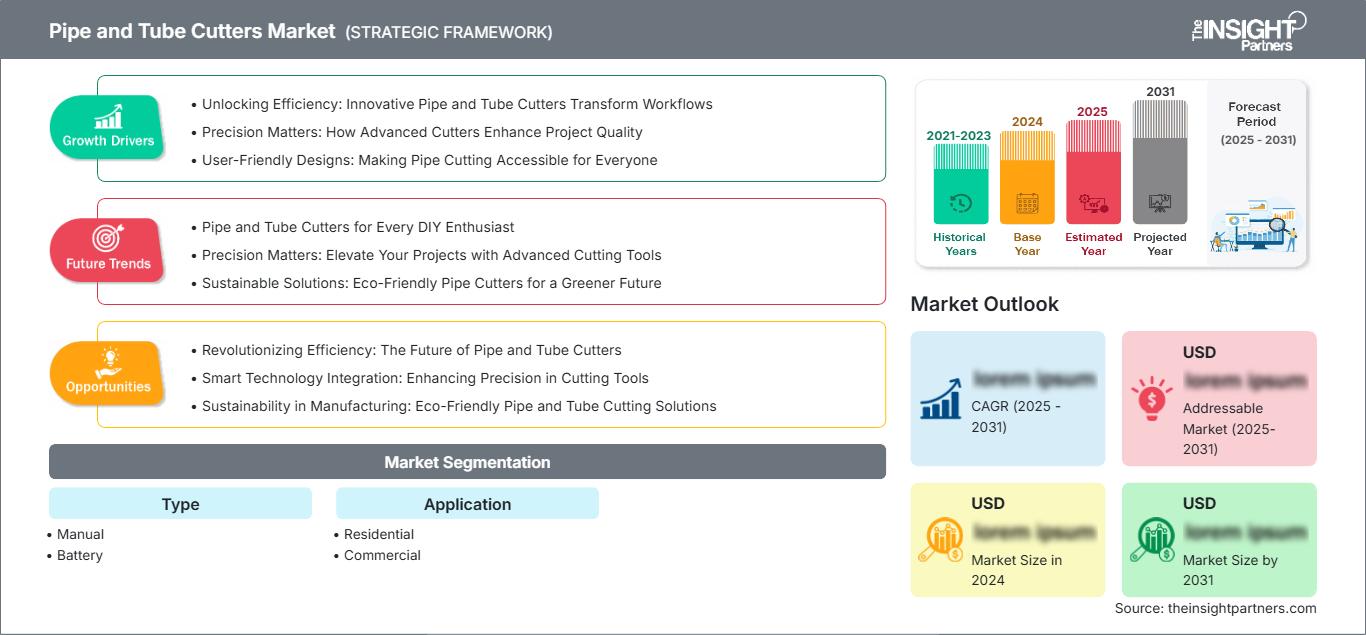
Pipe and Tube Cutters Market: Strategic Insights
Regional Insights
North America Pipe and Tube Cutters Market
North America accounted for 35–38% of global revenue in 2025 and is projected to grow at a 6.5–7.1% CAGR between 2026–2034. The Pipe and Tube Cutters Market share is supported by professional plumbing replacement cycles, commercial maintenance spending, and demand for compact tools that work around installed pipe runs in older buildings.
U.S. and Canadian contractors are shifting toward cordless and specialty cutters where labor savings justify a higher upfront cost. Retailers also sustain manual cutter volumes through residential repair demand. Product differentiation is linked to blade life, clearance access, deburring efficiency, and compatibility with copper, PVC, steel, stainless steel, and flexible tubing.
U.S. Pipe and Tube Cutters Market
The U.S. Pipe and Tube Cutters Market represented 78–82% of North America in 2025 and is expected to grow at a 6.4–7.0% CAGR. Demand is anchored in plumbing service, mechanical contracting, HVAC replacement, and home improvement retail. Contractors value cutters that reduce preparation time before press-fit, threaded, soldered, or solvent-welded connections. Ongoing renovation activity, aging building infrastructure, and increasing adoption of modern piping systems continue to support steady demand across residential and commercial applications.
The Milwaukee Tool, RIDGID, Klein Tools, Inc., Husky Tools, and The Plumber's Choice brands enjoy high visibility within both professional and retail channels. Current application trends suggest the preference of using battery-powered cutters in commercial settings requiring high levels of repeatability, where efficiency, consistent results, and minimal physical strain of workers matter, whereas manual cutters continue to be preferred in residential settings owing to their compactness, affordability, and convenience of use. There is a heightened interest in productivity, high-quality cuts, and efficient installation, which drives users to buy better-performing cutters.
Europe Pipe and Tube Cutters Market
Europe held 22–25% of the Pipe and Tube Cutters Market share in 2025 and is projected to grow at a 5.8–6.4% CAGR, with Germany leading demand. The UK market is supported by renovation activity, heating system upgrades, and installer preference for compact cutters that handle copper and plastic pipe in constrained residential and commercial settings. Growing emphasis on energy efficiency and building modernization is also supporting replacement and maintenance-related tool demand across the region.
Germany enjoys the advantage of mechanical cutting, fabrication and maintenance, and high standards for consistent cutting quality in HVAC systems and process piping. Building restoration work in France, Italy, and Spain is a significant source of demand for the market. The use of batteries is increasing due to an increased preference for mobility and efficiency in field conditions among contractors, but manual cutters will continue to be used where various types of pipes are handled by different trades.
APAC Pipe and Tube Cutters Market
APAC represented 27–30% share in 2025 and is expected to grow at a 7.3–8.0% CAGR, making it the fastest regional cluster. China leads volume, while India adds strong incremental demand from housing, commercial plumbing, and water infrastructure programs.
Japan and South Korea emphasize precision tools for industrial maintenance, HVAC, and manufacturing applications, whereas Australia shows steady demand from construction and facility upkeep. Policy support for urban infrastructure, manufacturing localization, and building modernization strengthens the market across multiple price tiers.
Middle East & Africa Pipe and Tube Cutters Market
The Middle East & Africa Pipe and Tube Cutters Market is projected to grow at a 6.2–6.8% CAGR, led by Saudi Arabia and the UAE. Energy facilities, district cooling networks, commercial construction projects, and utility upgrades generate demand for cutters that can perform reliably in field maintenance and installation settings. Ongoing investments in infrastructure modernization and industrial development are increasing the need for efficient pipe installation and repair tools across the region.
South Africa and the Rest of MEA add demand through water network repair, mining support services, and industrial facility maintenance. Manual cutters remain important because of their affordability, simplicity, and widespread availability, while battery-powered tools gain traction where contractors handle repetitive cutting tasks in large projects or long-term service contracts. Demand is also being supported by growing emphasis on worker productivity, reduced installation time, and improved cutting precision in challenging field environments.

Segmentation Analysis
Type
Type is expected to grow at a 6.4–7.0% CAGR between 2026–2034. The market scope across types is defined by the trade-off between affordability and productivity. Manual tools dominate daily residential work, while battery cutters gain share in commercial projects where repetitive cuts, consistent square edges, and lower operator fatigue improve jobsite throughput.
- Manual cutters retain the largest installed base because they are inexpensive, durable, and suitable for copper, PVC, and smaller-diameter metal pipe used in residential repair and light commercial service.
- Battery cutters are gaining acceptance among contractors handling repeated cuts, tight spaces, and harder materials, especially where clean edges reduce deburring, rework, and connection preparation time.
Application
By Application, the Pipe and Tube Cutters Market forecast is projected to grow at a 6.6–7.2% CAGR between 2026–2034. Residential demand is volume-oriented and replacement-led, whereas commercial applications require higher productivity, durability, and tool specialization. The segment benefits from plumbing upgrades, HVAC retrofits, mechanical rooms, retail fit-outs, and maintenance work across offices, hospitality, healthcare, and industrial facilities.
- Residential applications generate steady demand through bathroom repairs, kitchen renovations, small-diameter pipe replacement, and DIY plumbing activity where manual cutters are preferred for simplicity and low ownership cost.
- Commercial applications prioritize productivity, repeatability, and durability as contractors manage larger pipe runs, HVAC installations, tenant improvements, and facility maintenance with tighter completion schedules.
Opportunity Snapshot
| Application | Revenue Contribution | Trend Tag | Adoption Stage |
| Residential | High | Repair Kits | Mature |
| Commercial | Medium | Jobsite Speed | Scaling |
Pipe and Tube Cutters Market Growth Drivers and Impact Analysis
Renovation and Repair Work Expands Tool Replacement Cycles
The need for renovation and repairs creates a repeat business opportunity since cutting tools are employed in periodic cycles that involve working with copper pipes, PVC, steel, and flexible tubes. Old properties need pipe replacements, fixture replacements, HVAC services, and the maintenance of water supply lines. The implications for manufacturers are that they have a consistent sales avenue that does not rely heavily on new construction. Retailers will enjoy periodic purchases of smaller value, whereas professional distributors will enjoy higher value purchases for durable tools such as the cutters, wheels, and deburring accessories.
Cordless Platforms Improve Productivity in Repetitive Cutting
Changes in purchasing criteria have been seen through battery cutters’ focus on the cost of labor and not the cost of the tools, the quality of the cut, and fatigue reduction. In commercial sites, preparation of the pipes may take up considerable time, especially in cases of deburring and recutting. Cordless tools solve this problem through the provision of square cuts, control, and portability in the absence of stationary power sources. Market effects include increased average selling price and customer loyalty in case cutters use batteries common to contractors’ tool systems.
Infrastructure Modernization Raises Demand for Precise Cutting
Adequate pipe preparation is essential for water supply, gas, cooling, and building services networks to prevent leakage, failed connections, and installation delays. The advancement of infrastructure ensures a greater need for tools among public works contractors, facilities managers, and mechanical service contractors. In situations where cuts need to be made before press fitting, soldering, compression coupling, or thread fitting, accurate cuts become crucial. This trend helps increase the demand for premium pipe cutters with low deformation capacity and uniform cuts, irrespective of the material. From the manufacturer’s point of view, it will increase the demand for application-specific cutters and training-oriented products.
Pipe and Tube Cutters Market Future Trends
Connected Tool Platforms and Usage-Based Maintenance
Pipe and Tube Cutters Market trends will increasingly include connected tool management for contractors that operate large fleets. Although cutters are simpler than many power tools, battery platforms can support usage tracking, maintenance reminders, and inventory visibility. This is relevant for commercial plumbing and mechanical contractors that need to reduce lost tools, schedule blade replacement, and maintain consistent productivity across crews. Manufacturers can use connectivity to differentiate premium cordless models and support service programs. Over time, tool data may also help buyers compare actual cutting productivity, not just catalog specifications, which could reshape procurement decisions in larger contracting organizations.
Material-Specific Cutters for Specialty Installations
Product development in the future will focus on designing cutters suitable for stainless steel, multi-ply plastic, flexible medical tubing, and small mechanical room installations. The more diverse the materials used in construction, the less likely universal cutters are to provide high-quality cuts and efficient work. Specialty cutters can enhance the quality of cut surfaces, minimize burrs and crushing of tubing materials in cases where tolerances are critical. This is good news for manufacturers with engineering and accessories experience. In addition, it will increase their margins since customers are ready to invest in tools that prevent leaks and do not damage costly materials.
Pipe and Tube Cutters Market Opportunities
Battery Tool Expansion in Commercial Contracting
Commercial contracting offers a clear investment opportunity because repetitive pipe cutting magnifies the value of speed, ergonomics, and consistent cut quality. Vendors can expand through bundled kits that include cutters, batteries, chargers, blades, and deburring accessories. Distributor training and demonstration programs can convert contractors who currently rely on manual tools or general-purpose saws. The opportunity is strongest where plumbing, fire protection, HVAC, and mechanical trades already use the same cordless ecosystem. Manufacturers that prove lower rework and faster cut-to-connection times can defend premium pricing and improve account penetration across multi-crew contractors.
Emerging-Market Distribution and Private-Label Programs
Emerging markets present an opportunity for brands that combine affordable manual cutters with selective premium offerings. Urban housing, water infrastructure, and commercial construction in India, Southeast Asia, and the Gulf create demand across price bands. Local distributors can use private-label or co-branded programs to address cost-sensitive buyers while reserving premium products for contractors handling higher-specification work. Success depends on inventory availability, blade replacement access, and tool education at retail and trade counters. Companies that build dependable channel partnerships can capture recurring demand without relying solely on large project cycles.
Recent Developments
- April 2026: TRUMPF is introducing a new, even more productive TruLaser Tube 7000 laser tube cutting machine for the North American market. This enables companies to increase throughput and reduce costs per part. The solution also gives users significantly more flexibility in laser tube processing, enabling them to cut greater wall thicknesses.
- February 2026: Longxin Laser is proud to introduce the revolutionary 5th Generation Intelligent Pipe Cutting Expert—a state-of-the-art solution powered by advanced AI that is set to redefine manufacturing precision, efficiency, and adaptability.
- July 2025: Milwaukee Tool introduces the M18 FUEL™ ½”-1” Steel Pipe Cutter and ½” – 1” Steel Pipe Cutting Blade, the first solution truly optimized for cutting steel pipe on the job. Optimized for residential service plumbing and mechanical contractors, this Steel Pipe Cutter delivers unmatched productivity by providing the easiest, consistent, clean cuts, the fastest cut-to-connection process, and controlled cuts on both installed and new pipes.
Frequently Asked Questions

- Comprehensive Market Sizing and Forecast Analysis
- Detailed Segmentation Analysis
- In-Depth Market Dynamics Assessment
- Regional and Country-Level Insights
- Competitive Landscape and Company Benchmarking
- Strategic Business Intelligence
Recent Reports
Testimonials

The Insight Partners provided valuable market intelligence that supported our global go-to-market strategy. Their team was professional, responsive, and attentive to our feedback, providing thoughtful analysis and helpful methodological clarifications throughout the project.
Junmo Kim Chief Financial Officer (CFO), Enertech Co., Ltd.
The Insight Partners' SCADA System Market report is comprehensive, with valuable insights on current trends and future forecasts. The team was highly professional, responsive, and supportive throughout. We are very satisfied and highly recommend their services.
RAN KEDEM Partner, Reali Technologies LTDs
I requested a report on a very specific software market and the team produced the report in a few days. The information was very relevant and well presented. I then requested some changes and additions to the report. The team was again very responsive and I got the final report in less than a week.
JEAN-HERVE JENN Chairman, Future Analytica
We worked with The Insight Partners for an important market study and forecast. They gave us clear insights into opportunities and risks, which helped shape our plans. Their research was easy to use and based on solid data. It helped us make smart, confident decisions. We highly recommend them.
PIYUSH NAGPAL Sr. Vice President, High Beam Global
The Insight Partners delivered insightful, well-structured market research with strong domain expertise. Their team was professional and responsive throughout. The user-friendly website made accessing industry reports seamless. We highly recommend them for reliable, high-quality research services
YUKIHIKO ADACHI CEO, Deep Blue, LLC.
This is the first time I have purchased a market report from The Insight Partners.While I was unsure at first, I visited their web site and felt more comfortable to take the risk and purchase a market report.I am completely satisfied with the quality of the report and customer service. I had several questions and comments with the initial report, but after a couple of dialogs over email with their analyst I believe I have a report that I can use as input to our strategic planning process.Thank you so much for taking the extra time and making this a positive experience.I will definitely recommend your service to others and you will be my first call when we need further market data.
JOHN SUZUKI President and Chief Executive Officer, Board Director, BK Technologies
I wish to appreciate your support and the professionalism you displayed in the course of attending to my request for information regarding to infectious disease IVD market in Nigeria. I appreciate your patience, your guidance, and the fact that you were willing to offer a discount, which eventually made it possible for us to close a deal. I look forward to engaging The Insight Partners in the future, all thanks to the impression you have created in me as a result of this first encounter.
DR CHIJIOKE ONYIA MANAGING DIRECTOR, PineCrest Healthcare Ltd.Reason to Buy
- Informed Decision-Making
- Understanding Market Dynamics
- Competitive Analysis
- Identifying Emerging Markets
- Customer Insights
- Market Forecasts
- Risk Mitigation
- Boosting Operational Efficiency
- Strategic Planning
- Investment Justification
- Tracking Industry Innovations
- Aligning with Regulatory Trends





 Get Free Sample for