
PLGA Market Size, Share & Forecast by 2034
PLGA Market Size and Forecasts (2021 - 2034), Global and Regional Share, Trends, and Growth Opportunity Analysis Report Coverage : by Processibility (Extrusion and Injection Molding); Application (Medical and Non-Medical Applications); End-Use Industry (Healthcare, Biotech Firms, Medical Institutions, Packaging, Textile, Agriculture); and Geography (North America, Europe, Asia Pacific, and South and Central America)
- Status : Data Released
- Report Code : TIPRE00040204
- Category : Chemicals and Materials
- No. of Pages : 150
- Available Report Formats :


- Last update date : July 03, 2026


2025 Market Size
US$ 91.80 Mn
Base year value
2034 Forecast
US$ 264.60 Mn
Projected by 2034
CAGR 2026-2034
12.48 %
Growth rate
Addressable Market
US$ 1,557.03 Mn
(2026-2034)
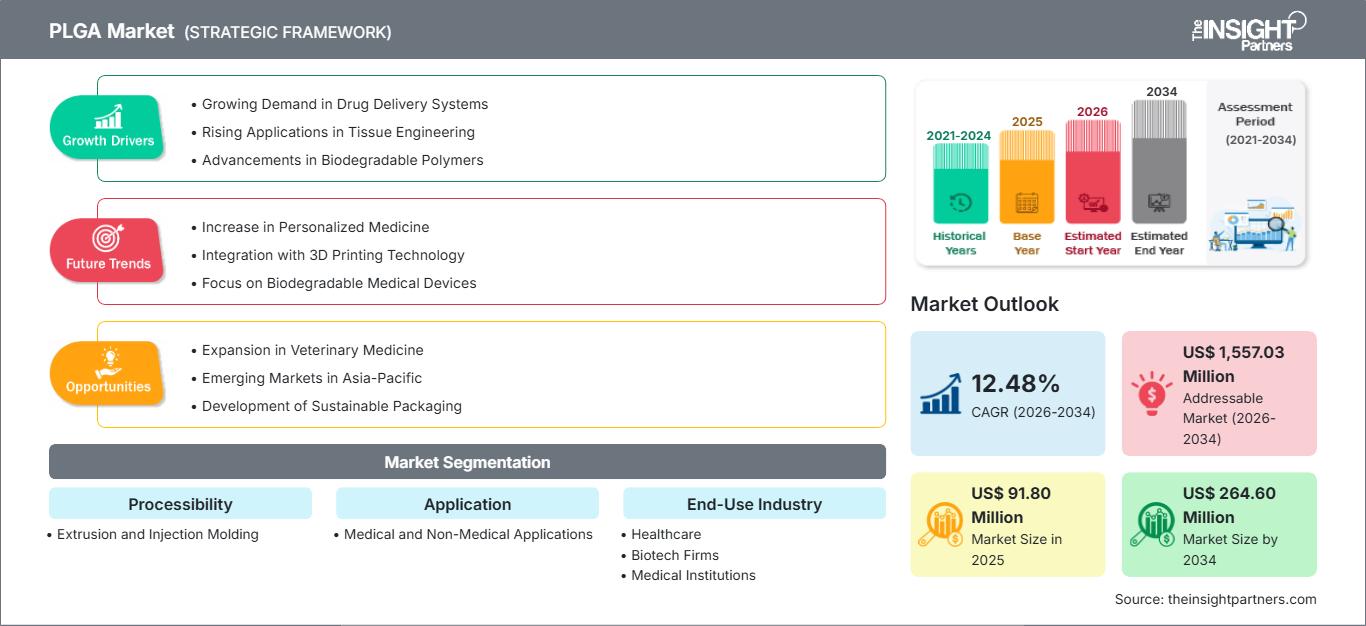
The PLGA Market is gaining strategic importance across advanced drug delivery, regenerative medicine, and bioresorbable medical device applications due to the polymer’s established biocompatibility and controlled degradation characteristics. Valued at US$ 91.80 Million in 2025, the PLGA market is projected to reach US$ 264.60 Million by 2034, expanding at a CAGR of 12.48% during 2026–2034. Growing utilization of poly(lactic-co-glycolic acid) in long-acting therapeutics, tissue engineering, and implantable devices continues to strengthen its commercial relevance. The PLGA Market report provides detailed insights into industry dynamics, competitive developments, and emerging opportunities. The PLGA Market size reflects the growing adoption of biodegradable polymers across pharmaceutical and medical applications.
North America remains a pivotal center for PLGA innovation and commercialization, supported by a strong pharmaceutical ecosystem and substantial biomedical research spending. The regional PLGA market is anticipated to advance at an estimated 12.1% CAGR through 2034. Increased adoption of sustained-release drug formulations and growing investments in biodegradable medical technologies are creating favorable conditions for broader PLGA deployment across healthcare and biotechnology applications. The PLGA Market forecast indicates continued expansion throughout the assessment period, while PLGA Market trends are being shaped by advancements in drug delivery technologies and biomaterials research. North America continues to account for a significant PLGA Market share due to its strong innovation ecosystem and expanding biomedical manufacturing capabilities.
PLGA Market Assessment and Insights
- North America: North America accounted for 34–38% of the PLGA market share in 2025 and is anticipated to expand at a CAGR of 11–13% during 2026–2034. Biomedical research, pharmaceutical innovation, and increasing adoption of advanced healthcare technologies continue to drive strong regional market growth.
- U.S.: The U.S. represented 78–82% of the North American PLGA market in 2025 and is projected to register a CAGR of 11–13% during 2026–2034, supported by expanding biopharmaceutical research, growing investments in advanced drug delivery technologies, and increasing demand for innovative biomaterials.
- Europe: Europe held 27–31% PLGA market share in 2025 and is expected to grow at a CAGR of 10–12% during 2026–2034. Germany, the United Kingdom, and France remain leading markets, supported by established pharmaceutical manufacturing, strong research capabilities, and continuous innovation in biomedical materials.
- Asia Pacific: Asia Pacific accounted for 25–29% market share in 2025 and is forecast to expand at a CAGR of 14–16% during 2026–2034. China, Japan, and South Korea continue to lead regional demand, driven by rapid biotechnology expansion, increasing healthcare investments, and growing adoption of advanced medical materials.
- Largest Segment: Medical Applications represented the largest market segment and is expected to record a CAGR of 12–14% during 2026–2034, reflecting increasing use in drug delivery systems, implants, and controlled-release technologies.
- High Growth Segment: Biotechnology Firms are projected to grow at a CAGR of 14–16% during 2026–2034, driven by expanding research activities, increasing biopharmaceutical development, and rising demand for advanced biomaterials.
- Key companies analyzed in detail: Evonik Industries AG; Corbion N.V.; Ashland Global Holdings Inc.; Mitsui Chemicals, Inc.; Jinan Digang Bioengineering Co., Ltd.; Merck KGaA; Akina, Inc.; Nomisma Healthcare Pvt. Ltd.; Bezwada Biomedical, LLC; CD Bioparticles.
Source: The Insight Partners' analysis based on proprietary research, government publications, company annual reports, investor presentations, industry databases, and expert interviews.
PLGA has evolved from a specialized biomedical material into a foundational polymer platform supporting multiple high-value healthcare applications. Advances in polymer engineering have enabled greater control over degradation rates, drug-release kinetics, and mechanical performance, making PLGA increasingly suitable for sophisticated therapeutic and regenerative medicine solutions.
The market outlook remains favorable as pharmaceutical manufacturers pursue long-acting formulations and medical device developers seek biodegradable alternatives to permanent implants. Continuous innovation in polymer customization, particle engineering, and precision manufacturing is expected to create new commercialization pathways while reinforcing the role of PLGA in next-generation healthcare technologies.
PLGA Market Report Scope
| Report Attribute | Details |
|---|---|
| Market size in 2025 | US$ 91.80 Million |
| Market Size by 2034 | US$ 264.60 Million |
| Global CAGR (2026 - 2034) | 12.48% |
| Historical Data | 2021-2024 |
| Forecast period | 2026-2034 |
PLGA Market Analysis
PLGA demand is directly correlated with increased interest in drug discovery, biologics delivery, tissue regeneration, and minimally invasive treatments. The polymer's ability to decompose into metabolically safe compounds adds significant value in cases where temporary structural support is required or when the release of a specific substance in the body needs to be regulated. Greater acceptance by regulatory bodies of bioresorbable materials will contribute to widespread use across a number of healthcare industries.
The value chain includes raw material suppliers, producers of polymers, formulators, developers of medical devices, pharmaceutical companies, contract manufacturing organizations, and healthcare providers. Collaboration between these stakeholders leads to faster development of innovative products.
Competition within the PLGA market is shaped by technological capabilities, regulatory expertise, manufacturing quality, and customization services. Companies such as Evonik, Corbion NV, Ashland, Mitsui Chemicals, Merck, Akina, Inc., and Bezwada Biomedical, LLC continue to expand their biomaterials portfolios to address evolving pharmaceutical and medical device requirements.
Increasing investments are being made in advanced drug delivery systems, personalized medicine solutions, and regenerative therapy products. Positioning is determined by the supplier's capability to provide custom polymer formulations, scale up production, and provide technical assistance during product development. The more healthcare evolves, the greater the opportunities for suppliers of customized PLGA products.
● REPORT CUSTOMIZATION
Tailor This Report To Align With Your Specific Business Requirements
This report can be customized to align precisely with your business objectives, scope, and target markets. Customization options include tailored segmentation, geography, competitive analysis, and strategic insights to support informed decision-making.
Customize This Report →WHAT YOU CAN ADJUST
- ● Segmentations
- ● Geography
- ● Competitive Analysis
- ● Language Preferences
PLGA Market: Strategic Insights
Regional Insights
North America PLGA Market
North America represents the largest regional market for PLGA and is projected to register a CAGR of approximately 12.1% through 2034. Strong pharmaceutical research infrastructure, extensive clinical development activity, and high adoption of advanced medical technologies continue to support market expansion. The region also benefits from established regulatory pathways for biodegradable medical materials.
Growing demand for sustained-release injectables, orthopedic implants, tissue scaffolds, and bioresorbable surgical products is creating consistent consumption opportunities. Collaboration between biotechnology firms, academic research institutions, and medical device manufacturers is fostering innovation while strengthening regional leadership in PLGA commercialization.
U.S. PLGA Market
The U.S. accounts for an estimated 75–80% share of the North American PLGA market and is anticipated to expand at roughly 12.3% CAGR through 2034. Strong funding for pharmaceutical research, extensive clinical trial activity, and the presence of leading biomaterials suppliers contribute significantly to market development.
Medical applications remain the primary demand center, particularly in long-acting injectable drugs, implantable devices, and regenerative medicine solutions. Companies, including Evonik, Merck, Akina, Inc., and Bezwada Biomedical, LLC, maintain active participation across product development and commercialization activities. The increasing focus on personalized therapeutics and precision drug delivery technologies is expected to sustain long-term demand.
Europe PLGA Market
Europe accounts for approximately 25–30% of global PLGA market revenue and is expected to grow at nearly 11.8% CAGR during the forecast period. Strong biomedical research capabilities, established pharmaceutical manufacturing networks, and increasing adoption of sustainable medical materials support regional market expansion.
The UK has a thriving biotechnology industry and is seeing rising investment in the development of new therapies. The growing research in regenerative medicine and drug delivery systems is driving consistent demand for high-quality PLGA.
Germany has a robust medical devices manufacturing industry and expertise in biomaterials. Innovation in bioresorbable implants and healthcare systems ensures that the country maintains its strong position in the regional market.
France, Italy, and Spain are promising growth areas due to increasing healthcare investments and the uptake of new treatments. Academic research programs and collaborations among biotechnology companies have enabled the greater use of PLGA in new applications.
APAC PLGA Market
Asia Pacific is expected to be the fastest-growing regional market, advancing at approximately 13.8% CAGR through 2034 while accounting for nearly 20–25% of global revenue. Rapid healthcare modernization, expanding pharmaceutical production capacity, and increasing government support for biotechnology innovation are driving regional growth.
China leads because of its capabilities in manufacturing a wide range of pharmaceutical products and its increased investment in producing highly sophisticated biomaterials. The national initiatives geared towards the development of biotechnology are playing a significant role in driving innovation and commercialization processes.
Japan and South Korea have strong healthcare infrastructure and are proficient in medical device innovation. There is a growing demand for highly effective biodegradable materials for use in regenerative medicine and therapeutics.
India and Australia are emerging as potential areas for future growth, given increased clinical research, increased healthcare spending, and growing interest in pharmaceutical manufacturing.
Middle East & Africa PLGA Market
The Middle East & Africa market is developing steadily, supported by healthcare modernization programs and increasing investment in advanced medical technologies. The region is anticipated to register a CAGR of approximately 10.9% through 2034, creating opportunities for specialized biomaterial suppliers.
Saudi Arabia sets the pace in regional implementation through healthcare transformation programs and investments in biotechnology infrastructure. The demand for cutting-edge therapeutic technologies is fueling the interest in biodegradable medical materials.
The UAE is becoming the healthcare innovation leader in the region, with its robust investment in specialty medical facilities and treatment capacities. The increased focus on high-value healthcare solutions creates an environment conducive to PLGA use.
South Africa and the Rest of MEA are witnessing gradual growth driven by improving healthcare access and infrastructure development. While adoption remains at an earlier stage than developed markets, expanding pharmaceutical and medical technology investments are expected to support future demand.
Segmentation Analysis
Processibility
- Extrusion: Widely utilized for manufacturing bioresorbable implants, tubing, and specialized medical components. Consistent processing performance and adaptability for customized formulations support its importance in high-precision healthcare applications.
- Injection Molding: Enables production of complex PLGA-based medical devices with precise dimensional control. Increasing demand for minimally invasive implants and disposable healthcare products continues to support segment growth.
Application
- Medical Applications: Dominates market demand due to extensive use in controlled drug delivery systems, tissue engineering scaffolds, orthopedic implants, wound management products, and regenerative medicine technologies.
- Non-Medical Applications: Expanding gradually through specialty packaging, sustainable materials research, agricultural solutions, and advanced industrial products requiring biodegradable performance characteristics.
End-Use Industry
- Healthcare: Represents the largest consumption base, driven by pharmaceutical innovation, implantable devices, and advanced therapeutic development requiring biocompatible biodegradable materials.
- Biotech Firms: Increasingly utilize PLGA for novel drug delivery platforms, biologics formulation, cell therapies, and translational research activities focused on next-generation healthcare solutions.
- Medical Institutions: Adoption is supported by clinical research programs, regenerative medicine initiatives, and the growing implementation of advanced biomedical technologies within healthcare facilities.
- Packaging: Emerging demand stems from sustainability objectives and interest in biodegradable materials capable of reducing long-term environmental impact across selected packaging applications.
- Textile: Research into biodegradable fibers and specialty functional materials is creating niche opportunities for PLGA integration within advanced textile development programs.
- Agriculture: Growing exploration of controlled-release delivery systems for agricultural inputs supports incremental adoption within specialized farming and crop management applications.
Opportunity Snapshot
| End-Use Industry | Revenue Contribution | Trend Tag | Adoption Stage |
| Healthcare | High | Drug Delivery | Mature |
| Biotech Firms | Medium | Biologics Research | Scaling |
| Medical Institutions | Medium | Regenerative Care | Scaling |
| Packaging | Low | Eco Materials | Emerging |
| Textile | Low | Bio Fibers | Emerging |
| Agriculture | Low | Controlled Release | Emerging |
PLGA Market Growth Drivers and Impact Analysis
Expansion of Long-Acting Drug Delivery Technologies
PLGA has become one of the most common polymers used in controlled-release pharmaceutical formulations due to its ability to ensure predictable drug release while also providing a good level of biocompatibility. Pharmaceutical companies are actively searching for long-acting injectables, which will improve patient compliance and the effectiveness of drugs.
The increasing incidence of chronic diseases also fuels the need for sustained-release preparations. The scope of applications in the areas of oncology, endocrinology, pain management, and infectious disease treatment is continuously increasing, among other things, because pharmaceutical companies search for novel products with a prolonged effect.
Growing Adoption of Bioresorbable Medical Devices
Device manufacturers are gradually adopting biodegradable materials that can eliminate the need for removal surgeries. PLGA provides an excellent combination of physical properties, biological compatibility, and controlled degradation; hence, it can be used in orthopedic fixation devices, tissue engineering scaffolds, surgical meshes, and wound care products.
The healthcare sector is shifting its focus to patient-centered care and improved efficiency in procedure execution; therefore, the adoption of bioresorbable technology is becoming favorable. With the increasing use of regenerative medicine and minimally invasive treatments, the application of PLGA-based devices is becoming more popular. This has contributed to increased demand for such materials and encouraged suppliers to create specific polymer grades for various medical applications.
Advancements in Regenerative Medicine and Tissue Engineering
Regenerative medicine is continuously moving from being research-related to becoming a more clinically oriented industry. PLGA is an important part of this trend due to the potential of the material as a scaffold that facilitates cell growth and tissue repair. The adjustable degradation time allows tailoring the material according to particular biological processes.
The development of stem cell research, tissue engineering, and personalized treatments opens up new channels for PLGA demand. The commercial effect goes far beyond the selling of materials and affects the cooperation of material producers, biotech firms, and research institutes. Future developments in regenerative medicine will provide many opportunities for PLGA.
PLGA Market Future Trends
Precision-Engineered Polymer Platforms for Personalized Therapies
Innovations in healthcare are progressively concentrating on individualized therapies, leading to a need for biomaterials that are highly customized. PLGA producers are coming up with novel polymer structures that have specific molecular weights, degradation rates, and release mechanisms that can be used for individualized therapies.
Future innovations will concentrate on the precise control of the release rate of drugs from implants. With the increasing personalization of medicines, the need for biomaterial producers who can facilitate individualized therapies will increase in the future. This may lead to increased collaboration among polymer producers, pharmaceutical developers, and clinicians.
Integration of PLGA with Advanced Manufacturing Technologies
The technologies of additive manufacturing, microfabrication, and particle engineering are opening up opportunities for PLGA products. Using these manufacturing methods, developers can create complex structures with improved properties, thus helping in innovations in the design of implants and drug delivery.
Over the coming decade, broader adoption of digital manufacturing technology will increase the level of customization while saving time on the product development process. The fusion of biomaterials technology with manufacturing methods will definitely bring more variety of PLGA products available in the market in the healthcare systems.
PLGA Market Opportunities
Emerging Potential in Biodegradable Specialty Packaging
While healthcare continues to be the key demand generator, sustainability efforts are making people look into the potential of PLGA for applications in premium packaging. Regulatory efforts at reducing the amount of long-lasting plastic waste are pushing companies to explore biodegradable solutions that can satisfy specific performance criteria.
Opportunities for investment in packaging products lie in specialized packaging segments where biodegradability, safety, and performance of the material justify higher costs. Firms involved in developing affordable manufacturing processes and formulations for specific applications will stand to gain from an early start in the market.
Expansion Across Agricultural Controlled-Release Systems
Agriculture could be considered a potential long-term opportunity for the PLGA producers who wish to diversify their markets. The controlled-release delivery systems for fertilizers, pesticides, and other agricultural chemicals correspond well to the degradation properties of the polymer.
The growing attention to energy-efficient and sustainable agriculture leads to the development of techniques that ensure precise application and minimize adverse effects on the environment. Such companies that have invested in collaboration in the agricultural sector and in scalable production could benefit from additional sources of income in the future.
Recent Developments
- July, 2025: Evonik Industries AG announced that IMCD would become the exclusive European distributor for its RESOMER bioresorbable polymers used in implantable medical devices. The agreement expands customer access across Europe and supports applications including orthopedic devices, tissue reconstruction products, dental meshes, and 3D-printed implants, strengthening the commercial ecosystem surrounding PLGA-based biomaterials.
- November, 2024: Avantium N.V., a leading company in renewable and circular polymer materials, announced the strengthening of its partnership with SCG Chemicals Public Company Limited (“SCGC”), a leading chemical player in Asia and an innovator of chemical innovations and solutions. The companies have signed a multi-year collaboration to pilot the production of PLGA (polylactic-co-glycolic acid). This partnership marks a significant milestone in the development and commercialization of sustainable materials.
- April, 2024: Evonik Industries AG expanded capacity for customized RESOMER powder biomaterials at its Darmstadt facility through advanced solvent-free micronization technology. The investment enables production of specialized bioresorbable powders with tailored particle sizes and material properties for implantable medical devices, aesthetic applications, and precision medical manufacturing.
Frequently Asked Questions

- Comprehensive Market Sizing and Forecast Analysis
- Detailed Segmentation Analysis
- In-Depth Market Dynamics Assessment
- Regional and Country-Level Insights
- Competitive Landscape and Company Benchmarking
- Strategic Business Intelligence
Recent Reports
Testimonials

The Insight Partners' SCADA System Market report is comprehensive, with valuable insights on current trends and future forecasts. The team was highly professional, responsive, and supportive throughout. We are very satisfied and highly recommend their services.
RAN KEDEM Partner, Reali Technologies LTDs
I requested a report on a very specific software market and the team produced the report in a few days. The information was very relevant and well presented. I then requested some changes and additions to the report. The team was again very responsive and I got the final report in less than a week.
JEAN-HERVE JENN Chairman, Future Analytica
We worked with The Insight Partners for an important market study and forecast. They gave us clear insights into opportunities and risks, which helped shape our plans. Their research was easy to use and based on solid data. It helped us make smart, confident decisions. We highly recommend them.
PIYUSH NAGPAL Sr. Vice President, High Beam Global
The Insight Partners delivered insightful, well-structured market research with strong domain expertise. Their team was professional and responsive throughout. The user-friendly website made accessing industry reports seamless. We highly recommend them for reliable, high-quality research services
YUKIHIKO ADACHI CEO, Deep Blue, LLC.
This is the first time I have purchased a market report from The Insight Partners.While I was unsure at first, I visited their web site and felt more comfortable to take the risk and purchase a market report.I am completely satisfied with the quality of the report and customer service. I had several questions and comments with the initial report, but after a couple of dialogs over email with their analyst I believe I have a report that I can use as input to our strategic planning process.Thank you so much for taking the extra time and making this a positive experience.I will definitely recommend your service to others and you will be my first call when we need further market data.
JOHN SUZUKI President and Chief Executive Officer, Board Director, BK Technologies
I wish to appreciate your support and the professionalism you displayed in the course of attending to my request for information regarding to infectious disease IVD market in Nigeria. I appreciate your patience, your guidance, and the fact that you were willing to offer a discount, which eventually made it possible for us to close a deal. I look forward to engaging The Insight Partners in the future, all thanks to the impression you have created in me as a result of this first encounter.
DR CHIJIOKE ONYIA MANAGING DIRECTOR, PineCrest Healthcare Ltd.Reason to Buy
- Informed Decision-Making
- Understanding Market Dynamics
- Competitive Analysis
- Identifying Emerging Markets
- Customer Insights
- Market Forecasts
- Risk Mitigation
- Boosting Operational Efficiency
- Strategic Planning
- Investment Justification
- Tracking Industry Innovations
- Aligning with Regulatory Trends





 Get Free Sample for