
Pneumatic Conveying Systems Market Share, Growth & Demand by 2034
Coverage: by Operation (Dilute Phase Conveying, Dense Phase Conveying); Technology (Positive Pressure Systems, Vacuum Systems, Combination Systems); End-user (Pharmaceuticals, Food and Beverages, Chemicals, Mineral and Ceramics, Power Generation, Plastics and Polymer, Others) , and Geography (North America, Europe, Asia Pacific, and South and Central America)
- Status : Data Released
- Report Code : TIPRE00008371
- Category : Manufacturing and Construction
- No. of Pages : 150
- Available Report Formats :


- Last update date : September 08, 2026


2025 Market Size
US$ 33.83 Bn
Base year value
2034 Forecast
US$ 59.30 Bn
Projected by 2034
CAGR 2026-2034
6.43 %
Growth rate
Addressable Market
US$ 421.18 Bn
(2026-2034)
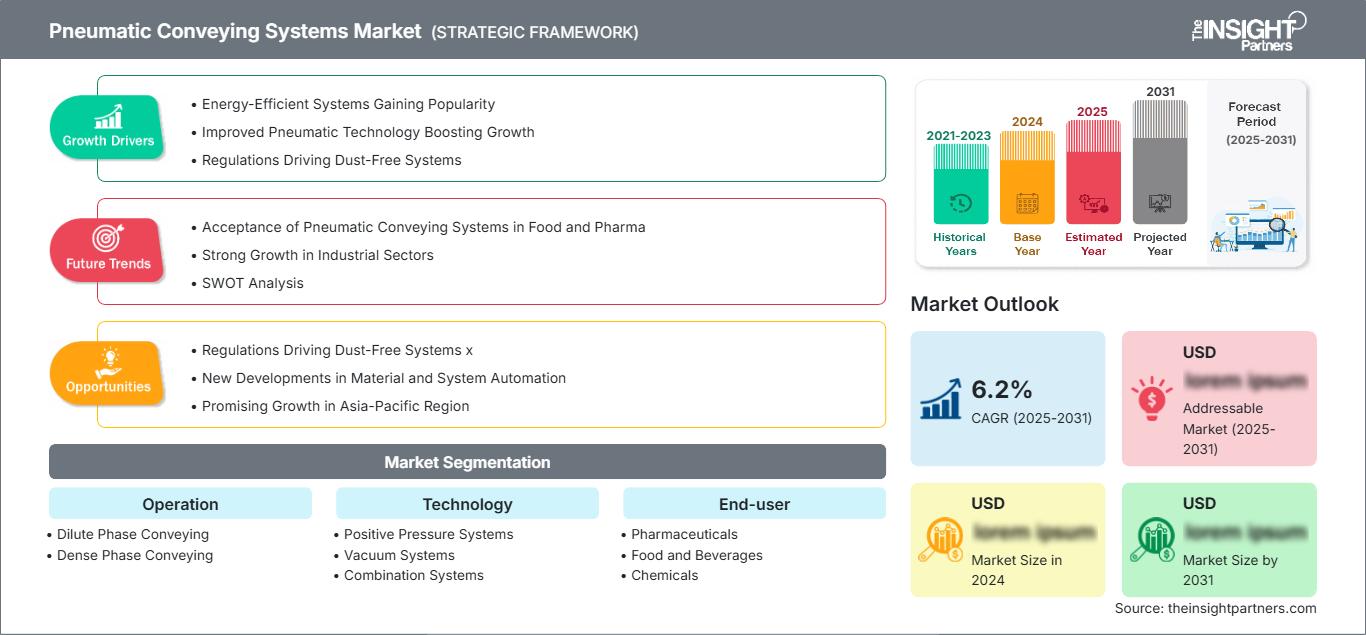
The pneumatic conveying systems market was valued at US$ 33.83 billion in 2025 and is projected to reach US$ 59.30 billion by 2034, registering a CAGR of 6.43% during 2026–2034. Demand is supported by rising automation in bulk material handling, stricter hygiene expectations in food and pharmaceutical processing, and wider adoption of enclosed dust-controlled transfer systems for powders, granules, pellets, minerals, and polymers.
North America remains a structurally important region because manufacturers prioritize contamination control, worker safety, and automated movement of dry bulk materials. The pneumatic conveying systems market size in the region is supported by food processing upgrades, pharmaceutical capacity expansion, and the replacement of mechanical conveyors with enclosed pressure and vacuum-based transfer equipment.
Pneumatic Conveying Systems Market Assessment and Insights
- North America: The region accounted for an estimated 33–36% share in 2025 and is expected to grow at a CAGR of 5.8–6.4% during 2026–2034, driven by hygienic processing, automation, and retrofit demand.
- US: The US represented nearly 72–76% of North America in 2025, supported by strong food, pharmaceutical, plastics, and chemical processing bases, with a CAGR range of 5.9–6.5%.
- Europe: Europe held an estimated 25–28% share in 2025 and is projected to grow at 5.4–6.0%, led by Germany, the UK, France, Italy, and Spain.
- Asia Pacific: Asia Pacific accounted for 24–27% share in 2025 and is expected to grow at 6.8–7.5%, supported by China, India, Japan, South Korea, and Southeast Asia manufacturing expansion.
- Largest Segment: Dilute phase conveying held 56–60% market share in 2025 and is projected to grow at 5.7–6.3% due to broad use in high-volume powder and granule transfer.
- High Growth Segment: Pharmaceuticals held 12–15% share in 2025 and is expected to grow at 7.2–8.0% as manufacturers prioritize validated, enclosed, and contamination-controlled material movement.
- Key companies analyzed in detail: AZO GmbH + Co. KG, Cyclonaire Corporation, Dynamic Air Inc., Flexicon Corporation, Gericke AG, Nilfisk Group, Nol-Tec Systems Inc., Schenck Process LLC, VAC-U-MAX, and Zeppelin Systems GmbH.
Source: The Insight Partners' analysis based on proprietary research, government publications, company annual reports, investor presentations, industry databases, and expert interviews.
Industrial users have moved from simple air-assisted transfer toward engineered systems that balance material integrity, energy use, dust containment, and layout flexibility. Technology shifts are visible in dense phase conveying for fragile powders, low-velocity transfer for pharmaceutical ingredients, and automated monitoring of pressure, velocity, and blockage risks. These changes support pneumatic conveying systems market growth across process industries.
Future demand will be influenced by new centers of production, localization of processes of chemical and food manufacturing, and regulations concerning dust explosion prevention and hygienic manufacturing processes. Investments are expected to focus on systems that are capable of expansion throughout facilities, integration with the plant control system, and optimization of compressed air usage.
Pneumatic Conveying Systems Market Report Scope
| Report Attribute | Details |
|---|---|
| Market size in 2025 | US$ 33.83 Billion |
| Market Size by 2034 | US$ 59.30 Billion |
| Global CAGR (2026 - 2034) | 6.43% |
| Historical Data | 2021-2024 |
| Forecast period | 2026-2034 |
Pneumatic Conveying Systems Market Analysis
The demand for such machinery is high in industries where there is a need for sealed, repeatable and clean transfer of large quantities of solid materials. In the food and beverages industry, machines are used to transfer such materials as flour, sugar, starch, coffee, spices, among others, without spilling and contamination.
Supply dynamics are shaped by system integrators, component manufacturers, and automation providers. Blowers, rotary valves, filters, separators, tubing, controls, and sensors form the core ecosystem. The pneumatic conveying systems market analysis shows that buyers increasingly compare lifecycle cost, energy demand, maintenance access, and validation support rather than purchase price alone.
The positioning of companies is impacted by the installed base, engineering skills, piloting, and servicing range. In their competitive positionings, AZO GmbH + Co. KG, Gericke AG, Zeppelin Systems GmbH, Flexicon Corporation, and VAC-U-MAX rely on their application skills, whereas Cyclonaire Corporation, Dynamic Air Inc., Nol-Tec Systems Inc., Nilfisk Group, and Schenck Process LLC focus on reliable systems, dust management, and customization according to industries.
Current investment patterns suggest that there is an increased need for dense phase systems, vacuum conveying systems, and combo systems used in locations that process multiple materials with varying flow characteristics. The ability to provide digital monitoring and recipe-controlled systems is one of the main distinguishing factors in high-output operations due to potential material blockage or deterioration issues.
● REPORT CUSTOMIZATION
Tailor This Report To Align With Your Specific Business Requirements
This report can be customized to align precisely with your business objectives, scope, and target markets. Customization options include tailored segmentation, geography, competitive analysis, and strategic insights to support informed decision-making.
Customize This Report →WHAT YOU CAN ADJUST
- ● Segmentations
- ● Geography
- ● Competitive Analysis
- ● Language Preferences
Pneumatic Conveying Systems Market: Strategic Insights
Regional Insights
North America pneumatic conveying systems market
North America maintained a 33–36% pneumatic conveying systems market share in 2025, supported by mature food processing, pharmaceuticals, chemicals, plastics, and mineral handling industries. The region is projected to expand at a CAGR of 5.8–6.4% during 2026–2034 as manufacturers replace open mechanical conveyors with enclosed systems that reduce dust, contamination, and manual handling.
The need for automation in processes where it can boost capacity and compliance is greatest. Vacuum and pressure systems that interface with dryers, mixers, silos, packers, and cleanroom-adjacent conveyance systems are being considered by companies in food ingredients production, pharmaceutical production, battery material processing, and resin management.
U.S. pneumatic conveying systems Market
The U.S. accounted for approximately 72–76% of North America in 2025 and is expected to grow at 5.9–6.5% during the forecast period. Growth is anchored by large-scale food processing, polymer manufacturing, pharmaceutical production, and advanced material handling needs in chemicals and battery-related facilities.
Companies that manufacture air conveyors have a wide reach, including companies in the country such as Dynamic Air Inc., Flexicon Corporation, VAC-U-MAX, Cyclonaire Corporation, and Nol-Tec Systems Inc. The need for these air conveyors is also driven by the fact that existing facilities require upgrades to newer conveyor systems.
Europe pneumatic conveying systems Market
Europe represented an estimated 25–28% share in 2025 and is forecast to grow at 5.4–6.0%. Demand is driven by Germany because of its robust market ecosystem in chemicals, plastics, food machinery, and pharma equipment applications. The UK, France, Italy, and Spain provide a solid replacement and modernization base.
Dust, hygiene, and worker safety regulations improve the market uptake. Suppliers in Europe like AZO GmbH + Co. KG, Gericke AG, Zeppelin Systems GmbH, and Nilfisk Group, have the advantage of excellent engineering and custom pneumatic transport systems.
APAC pneumatic conveying systems Market
Asia Pacific held 24–27% share in 2025 and is projected to record a CAGR of 6.8–7.5%, making it the fastest-expanding region. China is the biggest supplier, while the rest of the region, including India, Japan, South Korea, and Australia, provides demand through the manufacturing of food products, medicines, chemical products, minerals, and polymers.
Growth in capacity, favorable policies for the development of local manufacturing and automation are promoting the adoption. Regional consumers tend to prefer flexible systems capable of processing larger amounts of material in the future.
Middle East & Africa pneumatic conveying systems Market
The Middle East and Africa are expected to grow at a CAGR of 5.6–6.3%, supported by petrochemicals, cement, minerals, food processing, and infrastructure-related material handling. Saudi Arabia and the UAE are key demand centers, while South Africa contributes through mining, minerals, and industrial processing applications.
Energy-linked investment and industrial diversification are encouraging the adoption of enclosed conveying systems for powders, additives, catalysts, cementitious materials, and polymers. Demand remains project-driven but is gaining depth as end users seek safer, cleaner, and more automated transfer methods.
Segmentation Analysis
Operation
Operation is expected to grow at a CAGR of 6.0–6.7% during 2026–2034. The pneumatic conveying systems market report indicates that the market scope by operation reflects the balance between dilute phase systems for high-volume, lower-pressure movement and dense phase systems for fragile, abrasive, or segregation-sensitive materials.
- Dilute Phase Conveying: This sub-segment remains widely adopted because it suits continuous movement of powders, granules, and pellets over moderate distances in food, plastics, chemicals, and mineral processing plants.
- Dense Phase Conveying: Dense phase conveying is strategically important for fragile powders, abrasive materials, and applications where lower velocity reduces degradation, dust generation, and material separation.
Technology
Technology is projected to grow at a CAGR of 6.1–6.8% during 2026–2034. Positive pressure, vacuum, and combination systems are selected based on distance, material properties, pickup points, discharge points, sanitation needs, and plant layout complexity.
- Positive Pressure Systems: These systems are preferred for longer conveying distances, multiple discharge points, and higher-capacity transfer from silos, bulk bags, or process equipment into downstream production lines.
- Vacuum Systems: Vacuum systems support cleaner pickup from drums, bins, bags, or process areas, making them useful in food, pharmaceuticals, and chemical facilities requiring contained transfer.
- Combination Systems: Combination systems address complex layouts where multiple feed and discharge points require flexible pressure and vacuum movement across integrated production or packaging operations.
End-user
End-user demand is projected to grow at a CAGR of 6.2–7.0% during 2026–2034. Pharmaceuticals, food and beverages, chemicals, minerals and ceramics, power generation, and plastics and polymer applications represent major adoption pathways, each with distinct contamination, capacity, and material behavior requirements.
- Pharmaceuticals: Pharmaceutical manufacturers require closed transfer, cleanability, validation readiness, and reduced operator exposure when moving excipients, active ingredients, blends, and powders between process stages.
- Food and Beverages: Food processors use pneumatic conveying to move ingredients hygienically, reduce dust and spillage, and improve automation in milling, mixing, storage, and packaging operations.
- Chemicals: Chemical producers adopt conveying systems for powders, additives, catalysts, and resins where containment, reliability, and compatibility with varied material characteristics are critical.
- Mineral and Ceramics: Mineral and ceramics users require robust systems capable of handling abrasive powders, fillers, cementitious materials, and fine particles while reducing manual movement.
- Power Generation: Power plants and related facilities use pneumatic transfer for fly ash, sorbents, lime, and other dry bulk materials where dust containment and dependable discharge are important.
- Plastics and Polymer: Plastics and polymer processors rely on conveying for pellets, regrind, powders, and additives that must move cleanly from storage to dryers, blenders, extruders, and molding equipment.
Opportunity Snapshot
| End-user | Revenue Contribution | Trend Tag | Adoption Stage |
| Pharmaceuticals | Medium | Validated Transfer | Scaling |
| Food and Beverages | High | Hygienic Handling | Mature |
| Chemicals | High | Contained Powders | Mature |
| Mineral and Ceramics | Medium | Abrasive Transfer | Scaling |
| Power Generation | Medium | Ash Handling | Mature |
| Plastics and Polymer | High | Resin Automation | Scaling |
Pneumatic Conveying Systems Market Growth Drivers and Impact Analysis
Rising Automation in Bulk Material Handling
One of the key factors behind the growth is automation, as there is a need for repeated and efficient movement of powders and granules with minimal human involvement. Automation of the transfer process can be achieved through pneumatic conveying from one point to another, such as storage, batching, mixing, processing, and packaging. This becomes very important in industries that are labor-constrained, have quality considerations, and require higher throughput.
Demand for Hygienic and Dust-free Processing
Food and pharmaceutical companies are spending on enclosed conveying systems in order to minimize contamination, dust, allergens and cross-contact problems. In contrast to the open conveyors, pneumatic conveying has the advantage of making clean facilities easier, reducing the number of transfer points and providing better integration with filtration and containment systems. This will enhance compliance and quality of products while making housekeeping easier. The factor has a big business implication since consumers are now seeing hygienic transfer as essential to production continuity.
Expansion of Chemicals, Plastics, and Advanced Materials
Producers of chemicals, plastics, and high-performance materials need to be able to convey particles with great flexibility. Pneumatic conveying allows for multi-line operation, feed control, and transfer within even complex manufacturing plants. Since production continues to grow in such sectors as polymers, battery materials, specialty chemicals, and construction additives, there is an increasing need for conveying systems that can cope with various flow behaviors without much degradation.
Pneumatic Conveying Systems Market Future Trends
Energy-optimized Conveying Architectures
Future pneumatic conveying systems market trends will focus on lowering compressed air consumption without sacrificing throughput. Supplier emphasis should be on pressure optimization, sizing of blowers, intelligent valves, pipe routing, and velocity/material loading control. Energy efficiency is set to be a major factor as plants compare pneumatic and mechanical options in terms of lifecycle costs. Energy-efficient systems will probably become the choice in high-throughput food, chemical, plastics, and mineral handling applications.
Digital Monitoring and Predictive Maintenance
The use of digital monitoring shall be common in medium and high-value equipment. Sensors such as those for pressure, air flow, blockage, filter state and material flow will ensure that predictive maintenance is possible as well as easy problem solving. In plants operating continuously, this shall be used to prevent line blocks, minimize downtime and perfect recipes for different material types. This is set to boost the value of control systems and supplier service agreements within the forecast period.
Pneumatic Conveying Systems Market Opportunities
Pharmaceutical Capacity Expansion
Pharmaceutical manufacturing creates a high-value opportunity because powders and blends require enclosed, validated, and cleanable transfer. Producers need conveying systems that reduce operator exposure, support containment, integrate with weighing and batching, and maintain product integrity. The pneumatic conveying systems market Forecasts indicate that suppliers offering documentation support, sanitary design, modularity, and flexible changeover capability can win projects in oral solid dosage, biologics support operations, nutraceuticals, and contract manufacturing facilities.
Retrofit of Legacy Mechanical Conveyors
There are still many old plants that depend on screw conveyors, bucket elevators, manual feeding, or transfer under the open sky. Retrofitting such facilities with pneumatic conveying offers possibilities for increasing cleanliness, reducing spillage, freeing floor space and automating the feeding process. The potential is greatest where the quality of the product, dust control and labor efficiency are important. The suppliers should exploit the demand by providing phasing of the retrofit, pilot studies, energy audits and suitable configurations for existing installations.
Frequently Asked Questions

- Comprehensive Market Sizing and Forecast Analysis
- Detailed Segmentation Analysis
- In-Depth Market Dynamics Assessment
- Regional and Country-Level Insights
- Competitive Landscape and Company Benchmarking
- Strategic Business Intelligence
Recent Reports
Testimonials

The Insight Partners' SCADA System Market report is comprehensive, with valuable insights on current trends and future forecasts. The team was highly professional, responsive, and supportive throughout. We are very satisfied and highly recommend their services.
RAN KEDEM Partner, Reali Technologies LTDs
I requested a report on a very specific software market and the team produced the report in a few days. The information was very relevant and well presented. I then requested some changes and additions to the report. The team was again very responsive and I got the final report in less than a week.
JEAN-HERVE JENN Chairman, Future Analytica
We worked with The Insight Partners for an important market study and forecast. They gave us clear insights into opportunities and risks, which helped shape our plans. Their research was easy to use and based on solid data. It helped us make smart, confident decisions. We highly recommend them.
PIYUSH NAGPAL Sr. Vice President, High Beam Global
The Insight Partners delivered insightful, well-structured market research with strong domain expertise. Their team was professional and responsive throughout. The user-friendly website made accessing industry reports seamless. We highly recommend them for reliable, high-quality research services
YUKIHIKO ADACHI CEO, Deep Blue, LLC.
This is the first time I have purchased a market report from The Insight Partners.While I was unsure at first, I visited their web site and felt more comfortable to take the risk and purchase a market report.I am completely satisfied with the quality of the report and customer service. I had several questions and comments with the initial report, but after a couple of dialogs over email with their analyst I believe I have a report that I can use as input to our strategic planning process.Thank you so much for taking the extra time and making this a positive experience.I will definitely recommend your service to others and you will be my first call when we need further market data.
JOHN SUZUKI President and Chief Executive Officer, Board Director, BK Technologies
I wish to appreciate your support and the professionalism you displayed in the course of attending to my request for information regarding to infectious disease IVD market in Nigeria. I appreciate your patience, your guidance, and the fact that you were willing to offer a discount, which eventually made it possible for us to close a deal. I look forward to engaging The Insight Partners in the future, all thanks to the impression you have created in me as a result of this first encounter.
DR CHIJIOKE ONYIA MANAGING DIRECTOR, PineCrest Healthcare Ltd.Reason to Buy
- Informed Decision-Making
- Understanding Market Dynamics
- Competitive Analysis
- Identifying Emerging Markets
- Customer Insights
- Market Forecasts
- Risk Mitigation
- Boosting Operational Efficiency
- Strategic Planning
- Investment Justification
- Tracking Industry Innovations
- Aligning with Regulatory Trends





 Get Free Sample for