
Poly Aluminum Chloride Market Growth, Share & Trends by 2034
Coverage: By Form (Solid and Liquid), and End-Use Industry (Water Treatment, Paper Industry, Cosmetics & Personal Care, Oil & Gas, and Others)
- Status : Data Released
- Report Code : TIPRE00003598
- Category : Chemicals and Materials
- No. of Pages : 150
- Available Report Formats :


- Last update date : July 03, 2026


2025 Market Size
US$ 1.65 Bn
Base year value
2034 Forecast
US$ 2.67 Bn
Projected by 2034
CAGR 2026-2034
6.20 %
Growth rate
Addressable Market
US$ 20.30 Bn
(2026-2034)
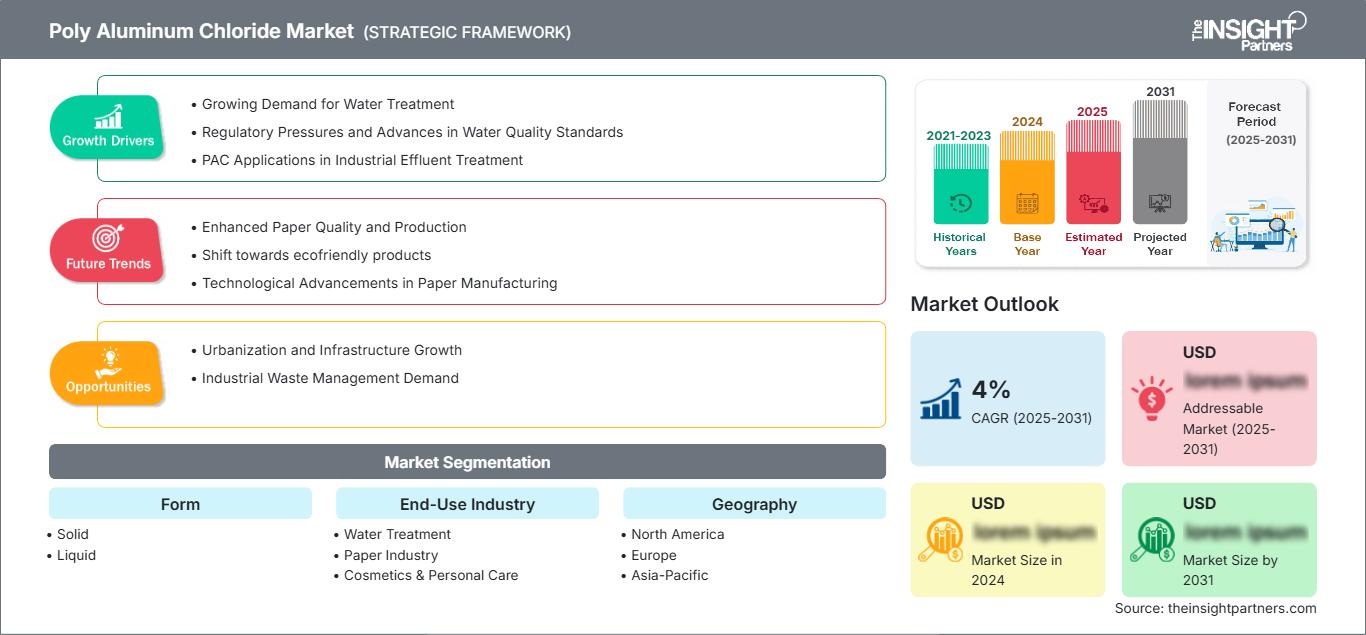
The poly aluminum chloride market is positioned for sustained expansion as industries intensify investments in water purification, wastewater management, and process optimization, reflecting a steadily expanding poly aluminum chloride market size. Valued at US$ 1.65 billion in 2025, the market is projected to reach US$ 2.67 billion by 2034, advancing at a CAGR of 6.20% during 2026–2034, underscoring strong poly aluminum chloride market growth dynamics driven by tightening regulatory frameworks and infrastructure upgrades. Rising regulatory scrutiny over water quality, increasing municipal treatment capacity, and growing industrial discharge management requirements continue to strengthen demand for poly aluminum chloride across developed and emerging economies, as highlighted in the evolving poly aluminum chloride market report.
North America remains a strategically important market, expected to register a CAGR of approximately 5.8% through 2034. Demand is supported by aging water infrastructure, stricter wastewater treatment standards, and growing investment in industrial water reuse systems, shaping a favorable poly aluminum chloride market forecast for the region. Municipal utilities and industrial operators are increasingly adopting high-performance coagulants to improve treatment efficiency while reducing sludge generation, creating favorable conditions for long-term poly aluminum chloride market trends and sustained market expansion.
Poly Aluminum Chloride Market Assessment and Insights
- North America: North America accounted for 28–32% of the poly aluminum chloride market share in 2025 and is anticipated to expand at a CAGR of 5.5–6.5% during 2026–2034. Stringent wastewater treatment regulations, ongoing infrastructure renewal projects, and increasing investments in water treatment facilities continue to support regional market growth.
- U.S.: The U.S. represented 70–75% of the North American market in 2025 and is projected to register a CAGR of 5.6–6.6% during 2026–2034, driven by expanding municipal water treatment infrastructure, stricter environmental compliance requirements, and rising industrial water treatment demand.
- Europe: Europe held 22–26% market share in 2025 and is expected to grow at a CAGR of 5.0–6.0% during 2026–2034. Germany, the United Kingdom, and France remain leading markets, supported by widespread adoption of industrial water treatment technologies and stringent regulatory compliance requirements.
- Asia Pacific: Asia Pacific accounted for 35–40% market share in 2025 and is forecast to expand at a CAGR of 7.0–8.0% during 2026–2034. China, India, and Japan continue to lead regional demand, driven by rapid urbanization, industrial expansion, and increasing investments in water management infrastructure.
- Largest Segment: Liquid Form represented the largest market segment and is expected to record a CAGR of 6.0–7.0% during 2026–2034, reflecting its ease of handling, faster dosing, and compatibility with automated water treatment systems.
- High Growth Segment: Cosmetics & Personal Care End-Use Industry is projected to grow at a CAGR of 7.0–8.0% during 2026–2034, driven by rising formulation requirements, higher product quality standards, and increasing demand for specialty chemical ingredients.
- Key companies analyzed in detail: Aditya Birla Chemicals; Airedale Chemical; AKW Group Enterprise; Feralco AB; GEO Specialty Chemicals; Gujarat Alkalies and Chemical Limited; Holland Company; Kemira; Synergy Multichem Pvt. Ltd.; USALCO.
Source: The Insight Partners' analysis based on proprietary research, government publications, company annual reports, investor presentations, industry databases, and expert interviews.
The Poly Aluminum Chloride Market has transitioned from a commoditized chemicals market to one driven by performance in water treatment processes. Improved coagulant efficiency, regulatory focus on post-treatment water quality, and increased use for municipal and industrial purposes have heightened the importance of PAC in treatment processes. Manufacturers of PAC need to focus on customization, efficiency, and application-specific formulations to meet the varied demands of customers.
Future market development will be shaped by urbanization, industrial water reuse initiatives, and expanding investments in environmental infrastructure. Demand is expected to strengthen across emerging economies where water scarcity and wastewater management challenges require advanced treatment technologies. Producers capable of ensuring supply reliability, regulatory compliance, and process optimization support are likely to strengthen their competitive positions over the coming decade.
Poly Aluminum Chloride Market Report Scope
| Report Attribute | Details |
|---|---|
| Market size in 2025 | US$ 1.65 Billion |
| Market Size by 2034 | US$ 2.67 Billion |
| Global CAGR (2026 - 2034) | 6.20% |
| Historical Data | 2021-2024 |
| Forecast period | 2026-2034 |
Poly Aluminum Chloride Market Analysis
Due to increased pressure on water resources, demand for effective coagulants has risen in municipal and industrial water treatment plants. Some of the features of poly aluminum chloride include rapid floc development, low sludge production, and enhanced efficiency in reducing turbidity compared to conventional products. These features have made poly aluminum chloride applicable in water treatment processes, industrial water treatment, and specialized high-purification applications.
The market ecosystem includes raw material suppliers, PAC producers, distributors, water treatment solution providers, engineering contractors, and the end users. Collaboration between chemical producers and treatment service providers is becoming increasingly critical, as consumers demand integrated solutions rather than just chemicals.
Competition remains characterized by a mix of multinational chemical companies and regional producers. Companies, including Aditya Birla Chemicals, Kemira, Feralco AB, Gujarat Alkalies and Chemical Limited, GEO, AKW Group Enterprise, Synergy Multichem Pvt Ltd, Airedale Chemical, and HOLLAND COMPANY, continue to focus on product quality, supply reliability, and application expertise to differentiate themselves in a competitive environment.
Investments have become highly focused on capacity expansion, coagulant technology, and sustainability projects. Manufacturers are focusing on reducing production costs, enhancing their environmental profile, and developing logistics channels. Collaborations with water utility companies and industrial organizations are emerging as a key strategy to increase market reach and meet changing treatment needs.
● REPORT CUSTOMIZATION
Tailor This Report To Align With Your Specific Business Requirements
This report can be customized to align precisely with your business objectives, scope, and target markets. Customization options include tailored segmentation, geography, competitive analysis, and strategic insights to support informed decision-making.
Customize This Report →WHAT YOU CAN ADJUST
- ● Segmentations
- ● Geography
- ● Competitive Analysis
- ● Language Preferences
Poly Aluminum Chloride Market: Strategic Insights
Regional Insights
North America Poly Aluminum Chloride Market
North America is expected to maintain steady growth at approximately 5.8% CAGR through 2034. Water infrastructure modernization programs across the United States and Canada continue to support demand for advanced coagulants capable of improving treatment efficiency and regulatory compliance. Municipal utilities are prioritizing solutions that enhance water quality while controlling operational costs.
Industrial sectors, including power generation, manufacturing, and food processing, are also contributing to demand growth. Increased emphasis on wastewater reuse, discharge compliance, and sustainability targets has encouraged wider adoption of PAC-based treatment systems. The region's mature regulatory framework and continued investment in environmental infrastructure provide a stable foundation for market expansion.
U.S. Poly Aluminum Chloride Market
The U.S. accounts for approximately 70–75% of the North American market and is projected to grow at a CAGR of around 5.9% during the forecast period. Federal and state-level investments in drinking water systems, wastewater facilities, and industrial treatment infrastructure remain important growth catalysts.
The availability of large suppliers and technology providers is an indicator of market maturity. Drinking water treatment in municipalities remains a major application area, whereas industries rely more on PAC for improved performance and efficiency. An increasing emphasis on water recycling and tighter environmental standards is strengthening the need for PAC across various industries.
Europe Poly Aluminum Chloride Market
Europe represents approximately 25–30% of global market revenue and is anticipated to expand at a CAGR of nearly 5.7% through 2034. Environmental regulations governing water quality and industrial discharge remain key drivers. The region's commitment to circular economy initiatives and sustainable resource management continues to support the adoption of advanced treatment chemicals.
The United Kingdom has seen increased demand for municipal water utilities' services, requiring greater efficiency in treatment processes. Investments in improving wastewater treatment facilities are driving the adoption of PAC technology across the country’s public utilities.
Germany leads with a highly developed industry sector and stringent environmental regulations. Industrial applications of wastewater treatment in the manufacturing and chemical industries account for a significant share of regional demand.
France, Italy, and Spain collectively represent an important growth cluster. Rising infrastructure investment, stricter environmental monitoring, and expanding industrial treatment requirements are increasing the consumption of PAC products across municipal and industrial facilities.
APAC Poly Aluminum Chloride Market
Asia Pacific accounts for approximately 40–45% of global revenue, making it the largest regional market. The region is projected to grow at a CAGR exceeding 6.8% through 2034. Rapid urbanization, industrialization, and government investment in water treatment infrastructure are driving strong demand across multiple countries.
China leads in the poly aluminum chloride market due to extensive municipal treatment projects, industrial wastewater management initiatives, and large-scale manufacturing activity. Government policies focused on environmental protection continue to encourage the adoption of advanced treatment chemicals.
Japan and South Korea focus on water treatment systems that are efficient in their operation. India is coming up as an important market owing to its urban water management projects, industrial growth, and compliance with environmental regulations. Australia contributes through investments in water recycling, desalination, and sustainable resource management initiatives.
Middle East & Africa Poly Aluminum Chloride Market
The Middle East & Africa poly aluminum chloride market is expected to register the fastest regional growth at approximately 7.1% CAGR during the forecast period. Water scarcity challenges, population growth, and infrastructure development projects are creating favorable conditions for PAC adoption across municipal and industrial sectors.
Saudi Arabia is focused on its desalination and wastewater treatment projects and the development of its industrial sector. Water security is a critical issue for the UAE and will thus drive further investment in the development and deployment of water treatment technologies. South Africa remains the largest African market due to the growing need for water and industrial wastewater treatment. MEA is gradually developing its capacity for water treatment due to increased environmental regulation and urbanization. Together, these factors contribute to the poly aluminum chloride demand in this region.
Segmentation Analysis
Form
- Solid: Solid PAC offers easier transportation, longer shelf life, and lower storage costs. It is widely utilized where centralized dilution systems exist and is preferred in regions requiring bulk chemical distribution efficiency.
- Liquid: Liquid PAC provides operational convenience, faster dosing, and reduced preparation requirements. Municipal utilities and industrial treatment facilities increasingly favor liquid formulations for continuous treatment processes and process automation compatibility.
End-Use Industry
- Water Treatment: The largest application segment, driven by municipal drinking water purification, wastewater treatment, industrial effluent management, and growing investment in water reuse infrastructure worldwide.
- Paper Industry: PAC improves retention efficiency, drainage performance, and wastewater treatment outcomes in paper manufacturing operations, supporting process optimization and environmental compliance objectives.
- Cosmetics & Personal Care: Specialty-grade PAC finds selective applications in formulation processes requiring controlled chemical performance, purity standards, and process stability within regulated manufacturing environments.
- Oil & Gas: PAC supports produced water treatment, wastewater management, and operational water quality control across upstream and downstream oil and gas activities.
Opportunity Snapshot
| End-Use Industry | Revenue Contribution | Trend Tag | Adoption Stage |
| Water Treatment | High | Water Reuse | Mature |
| Paper Industry | Medium | Process Efficiency | Scaling |
| Cosmetics & Personal Care | Low | Specialty Formulation | Emerging |
| Oil & Gas | Medium | Produced Water | Scaling |
Poly Aluminum Chloride Market Growth Drivers and Impact Analysis
Expanding Global Investment in Water Treatment Infrastructure
The increasing need for reliable drinking water supplies and effective wastewater management systems is a primary driver of the Poly Aluminum Chloride Market. Governments and utilities worldwide are investing in treatment plant construction, network upgrades, and water quality improvement programs. Rapid urbanization is placing additional pressure on existing infrastructure, particularly in developing economies where treatment capacity often lags demand. PAC has gained preference because of its ability to improve coagulation performance, reduce treatment costs, and enhance contaminant removal efficiency.
The impact extends across municipal and industrial sectors. Treatment operators benefit from improved process reliability and reduced sludge generation, while regulators increasingly encourage technologies capable of meeting stringent water quality standards. As infrastructure spending continues to rise globally, PAC consumption is expected to expand in parallel, strengthening long-term prospects in the poly aluminum chloride market.
Industrial Wastewater Compliance Requirements
Industries have come under increasing pressure for proper management of wastewater and stringent adherence to environmental policies. Many manufacturing companies, power generation companies, refineries, and other processing industries are installing sophisticated treatment processes to avoid any kind of pollution. PAC is essential in ensuring the removal of suspended particles, organic material, and other pollutants in industrial wastewater.
The regulatory environment has elevated the process of wastewater treatment into a key business strategy for organizations. Businesses are now on the lookout for treatment chemicals that increase efficiency and decrease treatment costs. The fact that PAC is an effective chemical agent in many industries is an important factor driving the growth in demand for PAC.
Rising Demand for Water Reuse and Resource Efficiency
The problem of water scarcity has been a driver of increased demand for recycling and reusing recycled water. Many municipalities and industries have started adopting the water reuse concept as a way of reducing fresh water use and improving resource security. Efficient coagulation is a critical step in the treatment process and has created the need for PACs.
Other poly aluminum chloride market trends include increased investments in technology for better treatment processes. As more companies aim at achieving sustainability and avoiding problems that come along with water shortages, there will be a higher demand for effective treatment chemicals. PAC suppliers capable of supporting reuse applications are positioned to benefit from this structural market trend.
Poly Aluminum Chloride Market Future Trends
Transition Toward High-Performance and Customized PAC Formulations
There is an increasing need for customized treatment chemicals that cater to unique water properties, regulations, and operational circumstances. Such trends have been driving the producers to produce specialized formulations of PAC with diverse degrees of basicity and improved efficiency in contaminant removal. These products can help maximize performance and minimize the use of chemicals and waste production.
Product differentiation may become one of the key factors in competition in the future. Those suppliers who can offer customized solutions with technical support may gain an advantage and influence in the poly aluminum chloride market. Performance optimization will be increasingly important with more demanding treatment needs.
Integration of Digital Water Management and Chemical Optimization
The use of digital solutions in water treatment processes is increasing. Water treatment facilities are increasingly relying on systems for monitoring, automation, and control through process data in order to enhance the effectiveness of water treatment. This increases accuracy in chemical dosing and process control and affects PAC usage directly.
Future growth in the poly aluminum chloride market will see increased collaboration between suppliers of chemicals and service providers of digital solutions. Real-time monitoring and predictive analysis will allow the enhancement of water treatment performance and cost savings at the same time. Companies providing digital water management solutions will benefit by taking advantage of intelligent water treatment systems.
Poly Aluminum Chloride Market Opportunities
Growth Potential in Emerging Municipal Water Projects
The growth of water treatment facilities in developing nations persists in response to rising population levels, urbanization, and environmental factors. Water treatment initiatives related to the purification of drinking water, wastewater treatment, and water recycling offer considerable business prospects for PAC manufacturers. Countries are investing greater amounts of money and encouraging private participation in order to fast-track the development of infrastructure.
Companies that establish local manufacturing capacities, distribution channels, and technical expertise can gain easier access to high-growth markets. Engaging in such initiatives at an early stage can bring about significant business benefits. Thus, strategic investments in such emerging regions should lead to strong growth prospects in the forecast period.
Expansion of Industrial Water Recycling Solutions
The industrial companies are increasingly using the practice of water recycling to cut costs, enhance sustainable performance, and minimize water availability risks. Industrial sectors, including chemicals, energy production, mining, and manufacturing companies, have started using advanced wastewater treatment technologies, allowing process water reuse.
There is a chance for PAC manufacturers to create special products meeting the needs of complex industrial applications. Companies able to offer knowledge in the area, performance optimization services, and comprehensive wastewater treatment technologies might benefit from their position in the market. Investment in application development and customer collaboration can help capture value from the expanding industrial water recycling segment.
Recent Developments
- September 2025: Kemira announced the acquisition of Water Engineering, Inc. to expand its industrial water treatment services portfolio in the United States. The transaction strengthens Kemira’s Water Solutions business by adding expertise in industrial wastewater, boiler, and cooling tower treatment applications, supporting broader growth across the water treatment value chain.
- July 2025: Kemira approved an investment of nearly €20 million in Tarragona, Spain, to build a new Aluminium Chloro Hydrate (ACH) production line. ACH is a high-basicity polyaluminium chloride used extensively in drinking water treatment, and the expansion is intended to strengthen supply capabilities for advanced coagulant solutions.
- February 2025: Gujarat Alkalies and Chemicals Limited (GACL), one of India’s leading industrial chemical manufacturers, announced the dispatch of the first consignment of Poly Aluminium Chloride (PAC) – 30 (Powder) from its newly commissioned plant at the Coelho Complex, Vadodara, with an installed capacity of 9,900 metric tonnes per annum (MTPA).
Frequently Asked Questions

- Comprehensive Market Sizing and Forecast Analysis
- Detailed Segmentation Analysis
- In-Depth Market Dynamics Assessment
- Regional and Country-Level Insights
- Competitive Landscape and Company Benchmarking
- Strategic Business Intelligence
Recent Reports
Testimonials

The Insight Partners' SCADA System Market report is comprehensive, with valuable insights on current trends and future forecasts. The team was highly professional, responsive, and supportive throughout. We are very satisfied and highly recommend their services.
RAN KEDEM Partner, Reali Technologies LTDs
I requested a report on a very specific software market and the team produced the report in a few days. The information was very relevant and well presented. I then requested some changes and additions to the report. The team was again very responsive and I got the final report in less than a week.
JEAN-HERVE JENN Chairman, Future Analytica
We worked with The Insight Partners for an important market study and forecast. They gave us clear insights into opportunities and risks, which helped shape our plans. Their research was easy to use and based on solid data. It helped us make smart, confident decisions. We highly recommend them.
PIYUSH NAGPAL Sr. Vice President, High Beam Global
The Insight Partners delivered insightful, well-structured market research with strong domain expertise. Their team was professional and responsive throughout. The user-friendly website made accessing industry reports seamless. We highly recommend them for reliable, high-quality research services
YUKIHIKO ADACHI CEO, Deep Blue, LLC.
This is the first time I have purchased a market report from The Insight Partners.While I was unsure at first, I visited their web site and felt more comfortable to take the risk and purchase a market report.I am completely satisfied with the quality of the report and customer service. I had several questions and comments with the initial report, but after a couple of dialogs over email with their analyst I believe I have a report that I can use as input to our strategic planning process.Thank you so much for taking the extra time and making this a positive experience.I will definitely recommend your service to others and you will be my first call when we need further market data.
JOHN SUZUKI President and Chief Executive Officer, Board Director, BK Technologies
I wish to appreciate your support and the professionalism you displayed in the course of attending to my request for information regarding to infectious disease IVD market in Nigeria. I appreciate your patience, your guidance, and the fact that you were willing to offer a discount, which eventually made it possible for us to close a deal. I look forward to engaging The Insight Partners in the future, all thanks to the impression you have created in me as a result of this first encounter.
DR CHIJIOKE ONYIA MANAGING DIRECTOR, PineCrest Healthcare Ltd.Reason to Buy
- Informed Decision-Making
- Understanding Market Dynamics
- Competitive Analysis
- Identifying Emerging Markets
- Customer Insights
- Market Forecasts
- Risk Mitigation
- Boosting Operational Efficiency
- Strategic Planning
- Investment Justification
- Tracking Industry Innovations
- Aligning with Regulatory Trends





 Get Free Sample for