
Polyester Fibers Market Size, Trends & Growth by 2034
Coverage: By Product (Polyester Staple Fiber (PSF), Polyester Filament Yarn (PFY), Others); Application (Carpets and Rugs, Non-Woven Fabrics, Apparels, Home Textiles, Others) , and Geography (North America, Europe, Asia Pacific, and South and Central America)
- Status : Data Released
- Report Code : TIPRE00023808
- Category : Chemicals and Materials
- No. of Pages : 150
- Available Report Formats :


- Last update date : July 15, 2026


2025 Market Size
US$ 83.82 Bn
Base year value
2034 Forecast
US$ 139.54 Bn
Projected by 2034
CAGR 2026-2034
6.58 %
Growth rate
Addressable Market
US$ 1,051.55 Bn
(2026-2034)
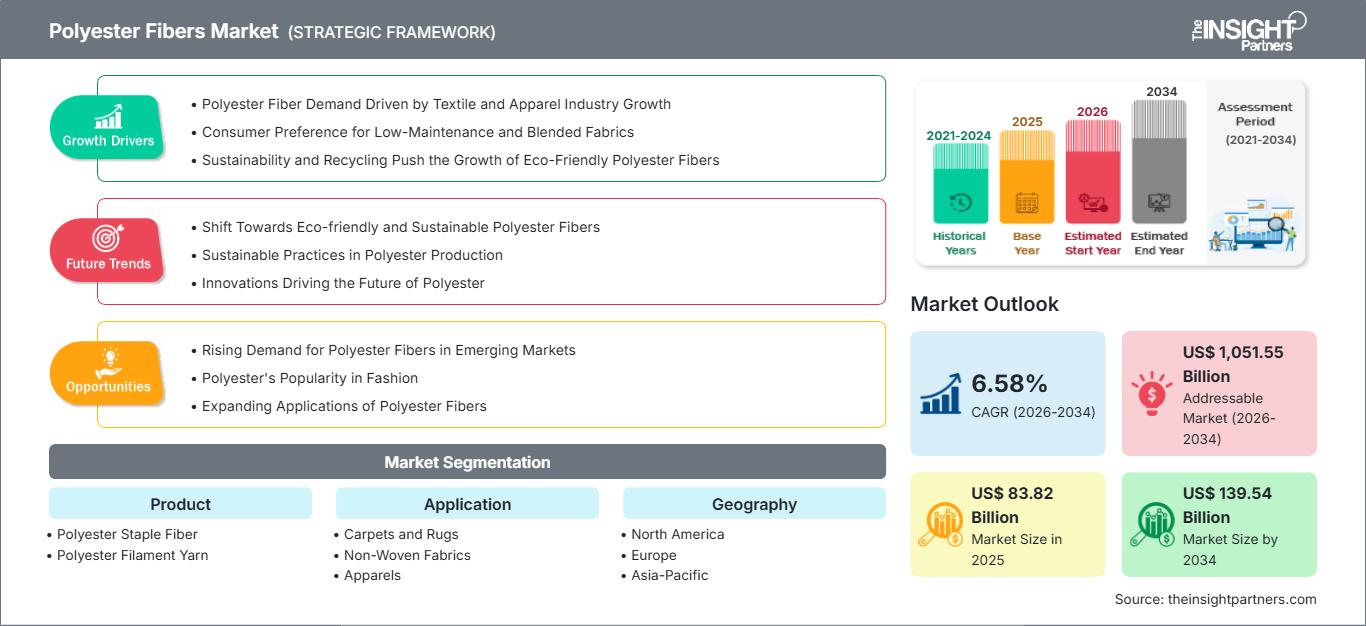
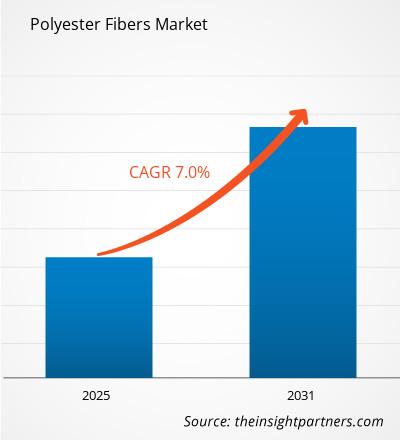
The polyester fibers market continues to play a central role in the global textile and industrial materials industry due to its versatility, affordability, and durability. The market is estimated at approximately US$ 83.82 billion in 2025 and is projected to reach nearly US$ 139.54 billion by 2034, advancing at a compound annual growth rate of around 6.58% from 2026 to 2034. Rising consumption of apparel, home furnishings, technical textiles, and nonwoven products is supporting sustained market expansion across both developed and emerging economies.
North America remains a significant contributor to the market, supported by growing demand for performance textiles, nonwoven fabrics, and sustainable fiber solutions. The regional market is anticipated to expand at an estimated CAGR of 5.9% throughout the Polyester Fibers market forecast period, driven by increasing investments in advanced textile manufacturing and rising adoption of recycled polyester materials. Expanding applications in automotive interiors and industrial fabrics further strengthen regional demand prospects.
Polyester Fibers Market Assessment and Insights
- North America: North America accounted for 21–25% market share in 2025 and is projected to expand at a CAGR of 5.9%–6.3% during 2026–2034. Growth is driven by expanding textile recycling capacity, increasing automotive applications, and rising demand for technical textile manufacturing.
- U.S.: The U.S. represented 82–86% of the North American market in 2025 and is anticipated to register a CAGR of 6.0%–6.4% during 2026–2034, supported by growing investments in textile recycling infrastructure, expanding industrial applications, and increasing production of technical textiles.
- Europe: Europe held 23–27% market share in 2025 and is expected to grow at a CAGR of 6.0%–6.4% during 2026–2034. Germany, Italy, and France remain the leading regional markets, supported by advanced textile manufacturing, sustainable fiber production, and increasing adoption of recycled polyester.
- Asia Pacific: Asia Pacific accounted for 42–46% market share in 2025 and is forecast to expand at a CAGR of 7.0%–7.4% during 2026–2034. China, India, and Japan drive regional growth through large-scale textile manufacturing, expanding apparel exports, and increasing investments in fiber production capacity.
- Largest Segment – Apparels: The apparels segment represented the largest market segment and is expected to grow at a CAGR of 6.5%–6.9% during 2026–2034, driven by increasing global clothing production, affordability, durability, and rising consumption of blended fabrics.
- High Growth Segment – Non-Woven Fabrics: The non-woven fabrics segment is projected to register the fastest growth with a CAGR of 7.4%–7.8% during 2026–2034, supported by expanding demand from hygiene products, filtration media, geotextiles, automotive interiors, and healthcare applications.
- Key companies analyzed in detail: Stein Fibers, Ltd.; Reliance Industries Limited; Toray Industries, Inc.; Nirmal Fibres Private Limited; Tongkun Group Co., Ltd.; Indorama Ventures Public Company Limited; Jiangsu Shenghong Co., Ltd.; Green Group S.A.; Märkische Faser GmbH; ESTAL Packaging, S.A.
Source: The Insight Partners' analysis based on proprietary research, government publications, company annual reports, investor presentations, industry databases, and expert interviews.
The polyester fibers market has transformed significantly with the evolution of global textile supply chains and advancements in synthetic fiber technologies. Manufacturers have enhanced fiber quality, durability, moisture management, and processing efficiency, enabling polyester fibers to serve a broad range of applications. The material’s cost-effectiveness and adaptability have helped maintain its position as one of the most widely used textile fibers worldwide.
Future development of the market will be shaped by growing demand for sustainable textiles, increasing urbanization, and expanding industrial applications. Technological improvements in recycling processes and fiber engineering are expected to create new opportunities for producers. As consumers and manufacturers increasingly prioritize performance and environmental considerations, polyester fibers are likely to remain a cornerstone of the global textile industry.
Polyester Fibers Market Report Scope
| Report Attribute | Details |
|---|---|
| Market size in 2025 | US$ 83.82 Billion |
| Market Size by 2034 | US$ 139.54 Billion |
| Global CAGR (2026 - 2034) | 6.58% |
| Historical Data | 2021-2024 |
| Forecast period | 2026-2034 |
Polyester Fibers Market Analysis
Demand for polyester fibers continues to rise due to their widespread utilization in apparel, home textiles, industrial fabrics, carpets, and nonwoven materials. Polyester offers several advantages, including durability, wrinkle resistance, lightweight properties, and compatibility with various manufacturing processes. These characteristics have contributed to strong demand from both consumer and industrial sectors. Expanding middle-class populations and increasing textile consumption in emerging economies are further strengthening market growth.
The market ecosystem encompasses petrochemical feedstock suppliers, polymer manufacturers, fiber producers, textile processors, apparel manufacturers, and retail distribution networks. Continuous collaboration across this value chain is supporting innovation in fiber production, product performance, and recycling technologies. The increasing integration of recycled feedstocks is also reshaping supply chain strategies and influencing investment decisions throughout the industry.
Competition remains intense among global producers seeking to strengthen market share through capacity expansion, sustainability initiatives, and product differentiation. Companies such as Reliance Industries Limited, Toray Industries, Inc., Tongkun Group Co., Ltd., Indorama Ventures Public Company Limited, and Jiangsu Shenghong Co., Ltd. continue investing in advanced production capabilities and recycled polyester technologies. Competitive positioning increasingly depends on operational efficiency, product quality, and environmental performance.
Investment activity is focused on modernizing manufacturing facilities, improving recycling infrastructure, and expanding specialty fiber portfolios, reinforcing long-term Polyester Fibers market size expansion. Market participants are also pursuing strategic partnerships to secure raw material supply and enhance circular economy capabilities. These investments are expected to support long-term competitiveness while addressing evolving customer expectations related to sustainability and performance.
● REPORT CUSTOMIZATION
Tailor This Report To Align With Your Specific Business Requirements
This report can be customized to align precisely with your business objectives, scope, and target markets. Customization options include tailored segmentation, geography, competitive analysis, and strategic insights to support informed decision-making.
Customize This Report →WHAT YOU CAN ADJUST
- ● Segmentations
- ● Geography
- ● Competitive Analysis
- ● Language Preferences
Polyester Fibers Market: Strategic Insights
Regional Insights
North America Polyester Fibers Market
North America represents a mature but steadily growing polyester fibers market and is expected to register a CAGR of approximately 5.9% through 2034. Demand is supported by robust consumption of home textiles, technical textiles, nonwoven fabrics, and performance apparel. The region also benefits from growing interest in sustainable textile solutions and increasing adoption of recycled polyester fibers by leading consumer brands.
Manufacturers are investing in advanced fiber processing technologies and recycling capabilities to meet environmental objectives and changing consumer preferences. Demand from automotive interiors, filtration systems, industrial fabrics, and hygiene products continues to create additional opportunities. These structural factors are expected to sustain stable market growth throughout the forecast period.
U.S. Polyester Fibers Market
The United States remains the largest polyester fibers market within North America and is projected to expand at a CAGR of approximately 6.0% during the forecast period. The country accounts for an estimated 72–77% share of regional demand, supported by strong consumption across apparel, home furnishings, nonwoven products, and industrial textiles. Growing adoption of recycled fibers is influencing purchasing decisions across multiple end-use industries.
The presence of advanced textile manufacturers, established retail brands, and expanding sustainability initiatives contributes to the country's market leadership. Application trends increasingly emphasize high-performance fabrics, eco-friendly textile materials, and innovative nonwoven products. Continued investments in domestic textile production and recycling infrastructure are expected to reinforce market growth over the coming years.
Europe Polyester Fibers Market
Europe accounts for approximately 22–27% Polyester Fibers market share and is anticipated to expand at a CAGR of around 5.6% through 2034. Market demand is supported by strong textile manufacturing capabilities, growing adoption of sustainable fibers, and increasing regulatory focus on circular economy initiatives. The region is also witnessing rising demand for technical textiles used in automotive, healthcare, and industrial applications.
Germany leads the European market due to its advanced industrial base and significant presence in technical textiles, automotive fabrics, and engineered materials. Investments in sustainable textile innovation and recycling technologies continue to strengthen the country's position within the regional polyester fibers industry.
The United Kingdom, France, Italy, and Spain contribute substantial demand through apparel manufacturing, home textile production, and consumer goods applications. Growing interest in recycled polyester products and environmentally responsible sourcing practices is encouraging manufacturers to adopt circular production models. These developments are expected to support long-term market stability and innovation across Europe.
APAC Polyester Fibers Market
Asia Pacific remains the dominant regional market, accounting for approximately 48–53% of global demand, while also representing the fastest-growing region. The Polyester Fibers market is projected to advance at a CAGR approaching 7.2% through 2034, supported by extensive textile manufacturing infrastructure, rising consumer spending, and expanding industrial activity. The region serves as a major production and consumption hub for polyester fibers worldwide.
China leads the regional market due to its large-scale fiber production capacity, integrated supply chains, and strong export-oriented textile industry. Government support for manufacturing modernization and recycling initiatives continues to encourage investment in advanced fiber technologies and sustainable production practices.
India, Japan, South Korea, and Australia contribute to regional growth through expanding apparel production, industrial textile demand, and technological innovation. India, in particular, is emerging as a major growth engine supported by rising domestic consumption and increasing textile exports. Collectively, these factors position Asia Pacific as the primary driver of future market expansion.
Middle East & Africa Polyester Fibers Market
The Middle East & Africa polyester fibers market is gradually expanding as investments in textile manufacturing, infrastructure development, and consumer goods production continue to increase. The region is expected to register a CAGR of approximately 5.5% through 2034. Growing urbanization and rising demand for affordable textile products are creating favorable market conditions.
Saudi Arabia represents the leading market within the region, supported by petrochemical integration, industrial diversification initiatives, and investments in downstream manufacturing industries. The United Arab Emirates is also strengthening its position through textile trade activities, logistics infrastructure, and expanding consumer markets.
South Africa contributes through apparel manufacturing, industrial textile applications, and retail demand, while other regional markets are gradually increasing fiber consumption as industrial capabilities expand. Rising infrastructure development and economic diversification efforts are expected to create additional opportunities for polyester fiber manufacturers throughout the region.
Segmentation Analysis
Product
- Polyester Staple Fiber: Polyester staple fiber is extensively used in spinning applications for apparel, home furnishings, nonwoven products, and filling materials. Its versatility, cost efficiency, recyclability, and compatibility with natural fibers make it a preferred material for blended yarn production and textile manufacturing. Growing demand for sustainable textile products and recycled polyester content is further strengthening the segment’s market position across global apparel and industrial sectors.
- Polyester Filament Yarn: Polyester filament yarn represents the leading product segment due to its superior strength, uniformity, durability, and suitability for high-speed textile processing. It is widely utilized in apparel, sportswear, automotive fabrics, industrial textiles, home furnishings, and technical applications. The segment benefits from rising demand for performance textiles, moisture-management fabrics, and engineered textile solutions that require enhanced mechanical and aesthetic properties.
Application
- Carpets and Rugs: Polyester fibers are widely utilized in carpets and rugs because of their durability, stain resistance, color retention, and affordability. Growing residential construction activity, commercial infrastructure development, and consumer demand for attractive flooring solutions continue to support adoption. Manufacturers are also increasing the use of recycled polyester fibers in carpet production to align with sustainability objectives and environmental regulations.
- Non-Woven Fabrics: Non-woven fabrics represent a major application segment due to widespread use in hygiene products, medical textiles, filtration systems, geotextiles, and industrial materials. Polyester fibers provide strength, flexibility, and processing efficiency, making them suitable for diverse nonwoven manufacturing processes. Expanding healthcare services, hygiene awareness, and infrastructure investments are contributing to sustained demand growth across this segment.
- Apparels: Apparel remains one of the most significant applications for polyester fibers, driven by increasing global clothing consumption, fast-fashion trends, and demand for performance garments. Polyester offers durability, wrinkle resistance, moisture management, and affordability, making it suitable for a broad range of clothing categories. Growing demand for sportswear, athleisure products, and blended textile fabrics further supports Polyester Fibers market expansion.
- Home Textiles: Home textile applications include bedding, curtains, upholstery, furnishings, and decorative products. Polyester fibers are valued for their durability, ease of maintenance, and aesthetic versatility. Rising residential construction, growing consumer spending on interior décor, and increasing demand for premium home furnishing products continue to create favorable growth opportunities within this segment.
Application
- Others: Additional applications include industrial textiles, automotive fabrics, packaging materials, agricultural textiles, and specialty engineered products. These niche segments continue to expand as manufacturers develop advanced polyester fiber solutions tailored to specific performance requirements and industrial operating environments.
Opportunity Snapshot
| Application | Revenue Contribution | Trend Tag | Adoption Stage |
| Carpets and Rugs | Medium | Flooring Renovation | Mature |
| Non-Woven Fabrics | High | Hygiene Products | Scaling |
| Apparels | High | Athleisure Wear | Mature |
| Home Textiles | High | Interior Décor | Scaling |
| Others | Medium | Technical Textiles | Emerging |
Polyester Fibers Market Growth Drivers and Impact Analysis
Expanding Global Demand for Affordable and Durable Textile Products
Polyester fibers continue to benefit from strong global demand for cost-effective textile materials that deliver durability, flexibility, and consistent performance. Consumers increasingly seek apparel, home furnishing products, and everyday textile solutions that offer long service life while remaining affordable. Polyester fibers satisfy these requirements by providing wrinkle resistance, color retention, dimensional stability, and easy maintenance characteristics. These advantages have contributed to their widespread adoption across mass-market and premium textile categories alike.
Rapid urbanization, rising disposable incomes, and expanding middle-class populations in emerging economies are further strengthening textile consumption. Growth in organized retail channels and e-commerce platforms has also increased accessibility to polyester-based products across global markets. Manufacturers continue to incorporate polyester fibers into diverse product categories to balance performance and production efficiency.
The impact of this trend extends throughout the textile value chain, supporting investments in fiber manufacturing, yarn production, fabric processing, and apparel manufacturing. As textile demand continues expanding globally, polyester fibers are expected to maintain a central role in meeting volume and performance requirements across multiple end-use industries.
Growth of Nonwoven Applications in Hygiene and Healthcare Sectors
The increasing use of polyester fibers in nonwoven products represents a significant growth driver for the Polyester Fibers market. Nonwoven fabrics are widely used in hygiene products, medical supplies, filtration systems, protective apparel, and industrial applications. Polyester fibers provide essential performance characteristics such as strength, durability, flexibility, and process compatibility, making them suitable for a wide range of nonwoven manufacturing technologies.
Rising healthcare expenditures, expanding access to medical services, and growing awareness of hygiene standards are contributing to increased consumption of nonwoven products worldwide. Demand for disposable medical products, personal hygiene materials, and advanced filtration systems continues to rise across both developed and developing economies. These factors are creating substantial opportunities for polyester fiber manufacturers.
The market impact includes increasing investments in nonwoven production capacity, product innovation, and specialty fiber development. Suppliers capable of meeting evolving performance requirements in healthcare and hygiene applications are well-positioned to benefit from long-term demand growth and enhanced value-creation opportunities.
Acceleration of Recycled Polyester and Circular Textile Initiatives
Sustainability is emerging as a key driver of buying behavior across the entire textile industry. More and more brands, retailers, and manufacturers are incorporating recycled polyester fibers into their supply chains to minimize environmental impact and align with circular economy goals. Recycled polyester, which can be sourced from post-consumer plastics and used textiles, helps businesses meet their sustainability goals while preserving product functionality.
Government regulations, companies' commitment to sustainability goals, and rising consumer awareness are driving increased investment in recycling facilities and fiber recovery. Improvements in systems for collecting and processing materials, and in the quality of materials, have resulted in greater availability of recycled polyester products.
Market implications are not solely environmental. Businesses that incorporate recycled products into their portfolios gain an edge and can enhance their branding and supply chain resilience. The shift is expected to present many opportunities for innovation and market differentiation in the polyester fibers industry.
Polyester Fibers Market Future Trends
Acceleration of Textile-to-Textile Recycling and Circular Fiber Production
The polyester fibers market is entering a phase in which circular production models are becoming increasingly important for manufacturers, apparel brands, and regulatory authorities. While recycled polyester derived from PET bottles has gained widespread adoption, industry participants are now investing in textile-to-textile recycling technologies that convert discarded garments and textile waste into new polyester fibers. Growing concerns about textile waste generation, resource efficiency, and long-term sustainability targets across global fashion and textile supply chains are driving this transition.
Major polyester producers are expanding partnerships with recycling technology providers to improve feedstock availability and reduce dependence on virgin petrochemical inputs. The emergence of advanced chemical recycling technologies is enabling manufacturers to recover polyester materials of sufficient quality for demanding textile applications. These developments are encouraging broader adoption of circular production practices throughout the industry.
Future growth will depend increasingly on manufacturers' capacity to implement closed-loop systems capable of handling vast amounts of post-consumer textile waste. Businesses that have successfully incorporated recycling technology into their systems will be able to secure their supply, enhance sustainability, and even generate revenue. Circularity will become a key differentiator in the polyester fibers market during the coming decade.
Development of High-Performance and Functional Polyester Fibers
Demand for specialized polyester fibers is expanding beyond conventional textile applications as manufacturers seek materials with enhanced performance characteristics. Contemporary polyester fibers have incorporated features such as moisture management, UV protection, temperature control, flame retardancy, and increased durability. Such advances will ensure that polyester fibers satisfy current demands in sports, technical textiles, and automotive fabrics.
Advancements in fiber engineering and spinning technologies are supporting the development of products that combine functionality with sustainability. Manufacturers are focusing on creating fibers that deliver improved comfort, aesthetics, and performance while maintaining cost competitiveness. The growing popularity of athleisure apparel and performance-oriented consumer products is accelerating investment in specialized polyester technologies.
In the coming years, the emphasis will be on developing multifunctional fibers that meet multiple performance requirements simultaneously. Companies that invest in advanced fiber technologies and unique product lines would enjoy better positioning in the future. The trend towards valuable textile applications would benefit companies that want to shift from basic fiber manufacturing and target the premium markets.
Polyester Fibers Market Opportunities
Expansion of Sustainable Apparel and Consumer Textile Markets
The move towards sustainability in the apparel industry presents a significant opportunity for polyester fiber makers. The industry now requires fashion companies, retailers, and end users to be more environmentally friendly. There is, therefore, a high demand for recycled, low-carbon-footprint polyester fibers to meet sustainability requirements.
Emerging Polyester Fibers market trends indicate that rising incomes and expanding urban populations are creating additional opportunities through increased apparel consumption. Polyester fibers remain popular for their combination of cost-effectiveness, durability, and performance. Companies that combine the above benefits with the added benefit of sustainability will gain an edge. The increased use of recycled polyester in athletic wear, clothing, and household products is making it increasingly lucrative.
Proper investments in establishing recycling infrastructure, certification systems, and brand partnerships can enable companies to build market access and improve their bottom line. Companies that can offer high-quality, sustainable fibers at scale will be well-positioned to capitalize on shifting consumer demands and expectations.
Increasing Utilization in Technical and Industrial Textile Applications
Technical textiles are emerging as an important growth avenue for polyester fiber manufacturers. Applications such as geotextiles, filtration materials, automotive fabrics, protective textiles, construction materials, and industrial reinforcement products require fibers that deliver consistent performance under demanding conditions. Polyester's strength, durability, chemical resistance, and processing flexibility make it highly suitable for these specialized uses.
Infrastructure development, industrialization, and increased investment in transportation facilities are creating conducive market conditions for technical textiles globally. There has been increased use of polyester fibers in applications that support environmental protection, construction, and productivity. With more governments and industries investing in infrastructure development, the demand for technical textiles is likely to continue to rise.
Companies that improve their offerings will have more diverse income sources and minimize the risk associated with changes in traditional fashion markets. Product development investment, fiber innovation tailored to specific applications, and cooperation with customers can yield competitive advantages. The growing significance of industrial textile applications is expected to create numerous business opportunities during the forecast period.
Recent Developments
- March, 2026: Reliance Industries Limited announced expansion of its recycled polyester fiber (rPET) production capacity to support growing demand for sustainable textiles, strengthening its position in circular polyester value chains and enabling a large-scale supply of eco-friendly fibers for apparel and industrial applications.
- November, 2025: Indorama Ventures Public Company Limited announced a joint venture between its Fibers business and Jiaren Chemical Recycling to accelerate textile circularity. The partnership aims to unlock up to 100,000 tonnes of textile-recycled PET spinning capacity annually, strengthening global recycled polyester fiber supply chains and supporting large-scale textile-to-textile recycling initiatives.
- September, 2025: Indorama Ventures Public Company Limited expanded its Deja Bio portfolio by advancing certified low-carbon PET fibers and yarns for textile applications. The initiative focuses on scalable bio-based polyester production and demonstrates growing industry investment in lower-carbon alternatives for apparel and technical textile markets.
Frequently Asked Questions

- Comprehensive Market Sizing and Forecast Analysis
- Detailed Segmentation Analysis
- In-Depth Market Dynamics Assessment
- Regional and Country-Level Insights
- Competitive Landscape and Company Benchmarking
- Strategic Business Intelligence
Recent Reports
Testimonials

The Insight Partners' SCADA System Market report is comprehensive, with valuable insights on current trends and future forecasts. The team was highly professional, responsive, and supportive throughout. We are very satisfied and highly recommend their services.
RAN KEDEM Partner, Reali Technologies LTDs
I requested a report on a very specific software market and the team produced the report in a few days. The information was very relevant and well presented. I then requested some changes and additions to the report. The team was again very responsive and I got the final report in less than a week.
JEAN-HERVE JENN Chairman, Future Analytica
We worked with The Insight Partners for an important market study and forecast. They gave us clear insights into opportunities and risks, which helped shape our plans. Their research was easy to use and based on solid data. It helped us make smart, confident decisions. We highly recommend them.
PIYUSH NAGPAL Sr. Vice President, High Beam Global
The Insight Partners delivered insightful, well-structured market research with strong domain expertise. Their team was professional and responsive throughout. The user-friendly website made accessing industry reports seamless. We highly recommend them for reliable, high-quality research services
YUKIHIKO ADACHI CEO, Deep Blue, LLC.
This is the first time I have purchased a market report from The Insight Partners.While I was unsure at first, I visited their web site and felt more comfortable to take the risk and purchase a market report.I am completely satisfied with the quality of the report and customer service. I had several questions and comments with the initial report, but after a couple of dialogs over email with their analyst I believe I have a report that I can use as input to our strategic planning process.Thank you so much for taking the extra time and making this a positive experience.I will definitely recommend your service to others and you will be my first call when we need further market data.
JOHN SUZUKI President and Chief Executive Officer, Board Director, BK Technologies
I wish to appreciate your support and the professionalism you displayed in the course of attending to my request for information regarding to infectious disease IVD market in Nigeria. I appreciate your patience, your guidance, and the fact that you were willing to offer a discount, which eventually made it possible for us to close a deal. I look forward to engaging The Insight Partners in the future, all thanks to the impression you have created in me as a result of this first encounter.
DR CHIJIOKE ONYIA MANAGING DIRECTOR, PineCrest Healthcare Ltd.Reason to Buy
- Informed Decision-Making
- Understanding Market Dynamics
- Competitive Analysis
- Identifying Emerging Markets
- Customer Insights
- Market Forecasts
- Risk Mitigation
- Boosting Operational Efficiency
- Strategic Planning
- Investment Justification
- Tracking Industry Innovations
- Aligning with Regulatory Trends





 Get Free Sample for