
Port Equipment Market Share, Demand & Growth by 2034
Coverage: by Equipment Type (Tug Boats, Cranes, Shiploaders, Reach Stackers, Mooring Systems, Automated Guided Vehicles (AGVS), Forklift Trucks, Container Lift Trucks, Terminal Tractors, Straddle Carriers, Others); Application (Container Handling, Bulk Handling, Ship Handling, Others); Type (Diesel, Electric, Hybrid) , and Geography (North America, Europe, Asia Pacific, and South and Central America)
- Status : Data Released
- Report Code : TIPRE00004781
- Category : Manufacturing and Construction
- No. of Pages : 150
- Available Report Formats :


- Last update date : September 08, 2026


2025 Market Size
US$ 15.93 Bn
Base year value
2034 Forecast
US$ 22.24 Bn
Projected by 2034
CAGR 2026-2034
3.78 %
Growth rate
Addressable Market
US$ 173.39 Bn
(2026-2034)
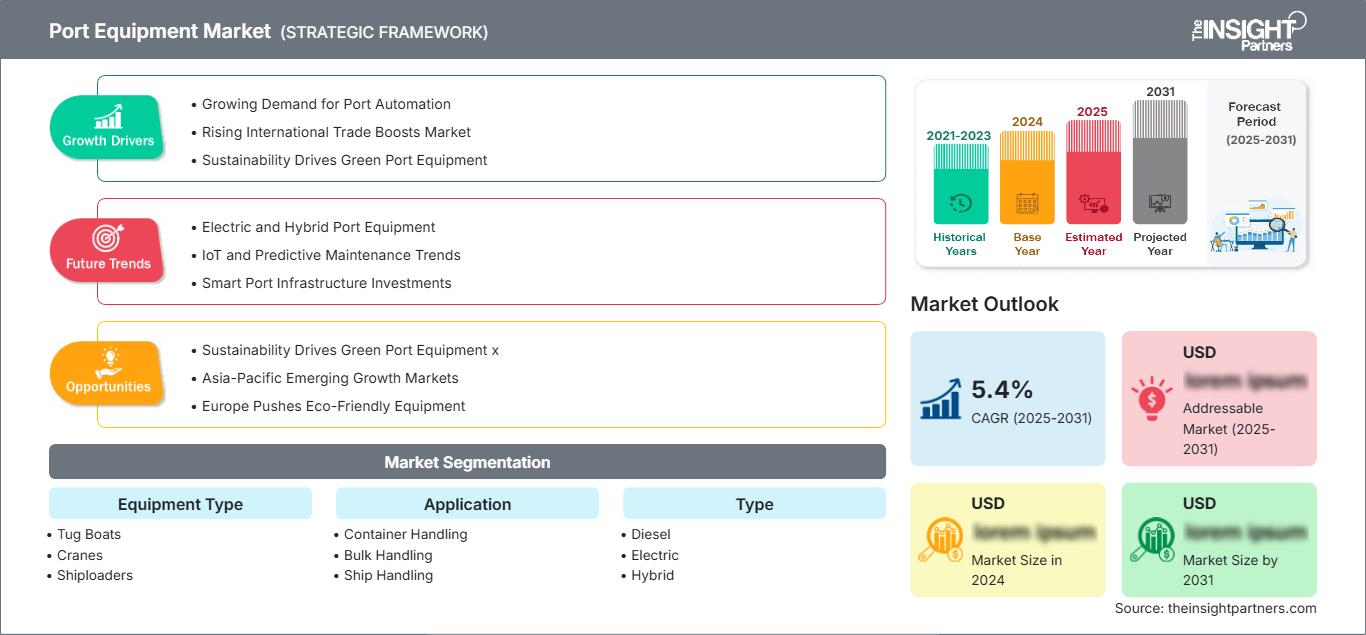
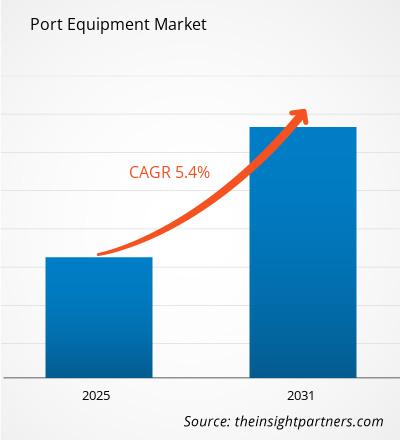
The port equipment market was valued at US$ 15.93 Billion in 2025 and is projected to reach US$ 22.24 Billion by 2034, registering a CAGR of 3.78% during 2026–2034. Demand is supported by container throughput growth, port modernization, equipment electrification, automation pilots, and the need to reduce vessel turnaround time across container, bulk, and general cargo terminals.
North America remains an important replacement and modernization market as terminals upgrade cranes, tractors, reach stackers, and shore-side systems. The port equipment market size in the region is supported by port congestion management, federal infrastructure funding, zero-emission equipment mandates in selected coastal states, and rising investment in electric yard tractors, automated stacking systems, and resilient cargo-handling fleets.
Port Equipment Market Assessment and Insights
- North America: North America accounted for 24–27% share in 2025 and is expected to grow at a CAGR of 3.2–3.8% during 2026–2034, supported by terminal upgrades and electrification.
- US: The US represented 78–82% of North America in 2025 and is projected to grow at 3.3–3.9%, led by port infrastructure renewal and container terminal automation.
- Europe: Europe held 22–25% share in 2025 and is forecast to grow at 3.0–3.6%, with Germany, the UK, France, Italy, Spain, and the Netherlands leading port modernization.
- Asia Pacific: Asia Pacific accounted for 38–42% share in 2025 and is projected to grow at 4.1–4.8%, led by China, Japan, South Korea, India, Singapore, and Australia.
- Largest Segment: Cranes held 28–32% market share in 2025 and are expected to grow at 3.4–4.0% during 2026–2034 because quay and yard lifting capacity remains central to terminal productivity.
- High Growth Segment: Electric equipment held 17–21% share in 2025 and is projected to grow at 5.8–6.6% as ports reduce emissions and transition from diesel fleets.
- Key companies analyzed in detail: ABB Ltd, Anhui Heli Co., Ltd., Cavotec SA, CVS Ferrari S.p.A., Hyster-Yale Materials Handling, Inc., Kalmar Corporation, Konecranes Plc, Liebherr-International Deutschland GmbH, SANY Group Co., Ltd., and TTS Group ASA.
Source: The Insight Partners' analysis based on proprietary research, government publications, company annual reports, investor presentations, industry databases, and expert interviews.
The port equipment market has shifted from capacity-led procurement toward technology-enabled asset renewal. Container terminals are embracing remote control, energy management, battery-powered tractors, automated guided vehicles, and software-controlled cranes in order to improve equipment efficiency. In addition, there is a transformation of production dynamics due to the procurement of steel construction, power electronics, software for automation, batteries, charging stations, and after-sales services as one package by the OEMs.
The investment is projected to take place in Asia Pacific greenfield terminals, European shore-side decarbonization, and brownfield projects in North America. The drive for cleaner port emissions, increasing vessel sizes, and labor availability will make automation and electrification possible. Suppliers who have the capabilities of offering after-sales service, retrofits, integration of charging and spare parts are more likely to get a larger market share.
Port Equipment Market Report Scope
| Report Attribute | Details |
|---|---|
| Market size in 2025 | US$ 15.93 Billion |
| Market Size by 2034 | US$ 22.24 Billion |
| Global CAGR (2026 - 2034) | 3.78% |
| Historical Data | 2021-2024 |
| Forecast period | 2026-2034 |
Port Equipment Market Analysis
Containerized trade, bulk commodity movements, and demand for faster berth productivity are supporting port equipment market growth across marine terminals. Ports require tug boats, cranes, shiploaders, reach stackers, terminal tractors, straddle carriers, container lift trucks, and mooring systems to handle larger vessels and compressed schedules. Equipment purchases are linked to berth depth, yard layout, TEU density, energy infrastructure, and the need to reduce truck waiting time.
The value chain includes steel fabricators, hydraulic suppliers, powertrain companies, battery providers, automation vendors, OEMs, dealers, terminal operators, and port authorities. The port equipment market analysis shows that buyers increasingly assess the total cost of ownership, emissions compliance, service response, operator safety, uptime, and integration with terminal operating systems. This shifts supplier competition from equipment delivery toward performance assurance.
Competitiveness is strong since the worldwide suppliers cater to varying operational levels. Kalmar Corporation and Konecranes Plc are highly competitive with regard to container handling and horizontal transport, whereas Liebherr-International Deutschland GmbH and SANY Group Co., Ltd. cater to the demand for cranes and port machinery. ABB Ltd and Cavotec SA help in the improvement of electrification and shore connections.
CVS Ferrari S.p.A., Hyster-Yale Materials Handling, Inc., Anhui Heli Co., Ltd., and TTS Group ASA provide special handling systems, lift trucks, ship solutions, and terminal equipment. Strategic positioning is based on such factors as electrified portfolio, diagnostics, financing, and retrofits. Terminal management requires that the vendors possess skills to minimize downtime when upgrading terminals and manage diesel, hybrid, and electrical fleets.
● REPORT CUSTOMIZATION
Tailor This Report To Align With Your Specific Business Requirements
This report can be customized to align precisely with your business objectives, scope, and target markets. Customization options include tailored segmentation, geography, competitive analysis, and strategic insights to support informed decision-making.
Customize This Report →WHAT YOU CAN ADJUST
- ● Segmentations
- ● Geography
- ● Competitive Analysis
- ● Language Preferences
Port Equipment Market: Strategic Insights
Regional Insights
North America port equipment market
North America held 24–27% port equipment market share in 2025 and is projected to grow at 3.2–3.8% during 2026–2034. The demand is influenced by container throughput fluctuations, port congestion learnings, zero-emission equipment goals, and growth in inland transport linkages.
Large terminals are switching from existing diesel trucks, cranes, and lifts to electric and hybrid equipment when the logistics are appropriate for such technology. While automation continues to be cautious, remote crane operation, yard efficiency, and electric terminal trucks have gone past trials at large coastal terminals.
U.S. port equipment Market
The U.S. represented 78–82% of North America in 2025 and is forecast to grow at 3.3–3.9% during 2026–2034. The demand is focused on the areas of container ports, bulk terminals of the Gulf, intermodal terminals inland, and automotive ports. Financial support from both the government and private companies will help improve cranes, electric tractors, and cybersecurity-enabled operational systems.
Companies such as Kalmar Corporation, Konecranes Plc, ABB Ltd, Hyster-Yale Materials Handling Inc, Cavotec SA, and Liebherr-International Deutschland GmbH have established their business in the U.S. through equipment sales and port electrification projects.
Europe port equipment Market
Europe accounted for 22–25% share in 2025 and is expected to expand at 3.0–3.6%. The UK and Germany generate replacement demand due to container terminal automation, inland transport, and crane renewal. Shore power, ferry terminals, Mediterranean cargo traffic, and investments associated with decarbonization of the port infrastructure become drivers of demand for France, Italy, Spain, and the Netherlands.
Electric RTGs, automated mooring systems, and shore power systems become early adopters by European terminals. ABB Ltd, Cavotec SA, Konecranes Plc, Kalmar Corporation, CVS Ferrari S.p.A. and Liebherr-International Deutschland GmbH can take advantage of pressure in terms of port emissions and quieter berthing.
APAC port equipment Market
Asia Pacific held 38–42% share in 2025 and is projected to grow at 4.1–4.8%. China dominates the demand for containers due to its large number of terminals, production of machinery, and port automation. The other major players, such as Japan and South Korea, have high-efficiency terminals, and India and Australia contribute to the demand because of port expansions, coal, iron ore, LNG, and containers.
Trade corridors, manufacturing products, smart-port projects, and deep-water terminals drive the regional growth. The competitors of the company include SANY Group Co., Ltd., Anhui Heli Co., Ltd., Kalmar Corporation, Konecranes Plc, and ABB Ltd.
Middle East & Africa port equipment Market
The Middle East and Africa are projected to grow at 3.6–4.3% during 2026–2034. Saudi Arabia and the UAE lead investment through logistics hubs, container terminals, and port-led industrial zones. South Africa supports demand through container, automotive, and mineral terminals, while the rest of MEA's growth remains project-driven.
Energy exports, free-zone development, and transshipment strategies create demand for cranes, shiploaders, terminal tractors, mooring systems, and heavy forklifts. Suppliers with hot-climate service capability and financing support are better positioned.
Segmentation Analysis
Equipment Type
Equipment Type is expected to grow at a CAGR of 3.6–4.3% during 2026–2034. The port equipment market scope by equipment type reflects terminal specialization, vessel size, berth design, cargo mix, and automation readiness. Cranes remain capital-intensive assets, while terminal tractors, reach stackers, straddle carriers, AGVs, shiploaders, forklifts, and mooring systems address yard productivity, safety, and berth reliability.
- Tug Boats: Tug boats support vessel maneuvering in congested harbors, making them essential where larger ships, crosswinds, tidal variation, and berth safety increase harbor assistance requirements.
- Cranes: Cranes remain the productivity backbone of container and bulk terminals because ship-to-shore, mobile harbor, gantry, and yard cranes determine berth output and cargo flow.
- Shiploaders: Shiploaders serve bulk terminals handling coal, grain, minerals, cement, and fertilizers, where high loading rates and dust control influence terminal economics.
- Reach Stackers: Reach stackers are valued in flexible yards because they handle containers, intermodal moves, and medium-volume terminals without fixed rail or gantry infrastructure.
- Mooring Systems: Mooring systems improve vessel stability, berth safety, and turnaround time, especially in ferry, container, and high-frequency terminals seeking lower manual handling risk.
- Automated Guided Vehicles: Automated guided vehicles support repeatable container movement between quay cranes and stacks, improving safety and predictability in highly automated terminals.
- Forklift Trucks: Forklift trucks handle breakbulk, palletized cargo, warehouse operations, and maintenance tasks, remaining vital across smaller ports and multipurpose terminals.
- Container Lift Trucks: Container lift trucks provide heavy lifting flexibility for loaded and empty boxes, supporting depots, inland terminals, and lower-density container yards.
- Terminal Tractors: Terminal tractors move trailers, chassis, and containers across terminals, distribution hubs, and ro-ro facilities, with electric models gaining traction in closed routes.
- Straddle Carriers: Straddle carriers combine lifting and horizontal transport, making them important for dense container yards and terminals seeking flexible stacking without separate tractor fleets.
Application
Application is projected to grow at a CAGR of 3.5–4.1% during 2026–2034. Application demand depends on cargo flow, vessel mix, product density, and berth configuration. Container handling dominates investment because TEU throughput and vessel call efficiency directly influence port competitiveness. Bulk handling remains important for energy, mining, agriculture, and construction supply chains.
- Container Handling: Container handling requires high-capacity cranes, yard tractors, AGVs, reach stackers, straddle carriers, and lift trucks to reduce dwell time and improve berth productivity.
- Bulk Handling: Bulk handling uses shiploaders, grabs, conveyors, mobile harbor cranes, and dust-control systems to move minerals, grain, cement, coal, and fertilizers efficiently.
- Ship Handling: Ship handling depends on tug boats, mooring systems, fenders, gangway interfaces, and berth equipment that improve safety, stability, and vessel turnaround.
Type
Type is forecast to grow at a CAGR of 3.7–4.4% during 2026–2034. Diesel equipment remains widely deployed because port machines require high torque, long duty cycles, and established service networks. Electric and hybrid types are gaining faster adoption as ports align with emissions rules, energy transition plans, and lower maintenance objectives.
- Diesel: Diesel equipment remains common in heavy-duty port applications where high utilization, fuel availability, and existing maintenance skills support reliable operation.
- Electric: Electric equipment is expanding in terminal tractors, RTGs, straddle carriers, and shore-side systems, where controlled routes and charging windows improve feasibility.
- Hybrid: Hybrid equipment provides a transition pathway for terminals that need lower fuel use and emissions without relying fully on charging infrastructure.
Opportunity Snapshot
| Application | Revenue Contribution | Trend Tag | Adoption Stage |
| Container Handling | High | Berth Productivity | Mature |
| Bulk Handling | Medium | Commodity Flow | Mature |
| Ship Handling | Medium | Safe Berthing | Scaling |
Port Equipment Market Growth Drivers and Impact Analysis
Container Throughput Pressure and Larger Vessel Calls
The port has to deal with increased traffic due to increased ship size, as well as predictable supply chain logistics and has to increase the throughput capacity from its limited berth and yard space. The larger ships increase the peak handling capacity, requiring the ports to use larger quay cranes, larger yards, faster tractors, and sturdier stacking equipment. This factor influences the equipment replacement directly since an older fleet slows down the cycle times and results in congestion.
Decarbonization Mandates and Electrified Terminal Fleets
The environmental trend in policy is driving ports toward equipment with fewer emissions, particularly those located in urban coastlines, where air pollution due to diesel exhausts, noise pollution and poor air quality can become visible concerns. Examples of low-emission equipment include battery electric terminal tractor, electric RTG, shore power, automatic mooring, and hybrid equipment. This trend will be felt the most in locations where there is a combination of incentives, grid capability and a reliable duty cycle. The change in procurement is due to the electrification of equipment.
Automation Adoption to Improve Safety and Utilization
Automation is increasingly becoming a reality as ports require safety, efficiency, and effective utilization of skilled labor. Automated guided vehicles, remote-controlled cranes, automated RTGs, and yard planning through digitization minimize human presence in risky areas and enhance the efficiency of equipment coordination. This driver does not remove manual processes from the process instantly, but it increases the need for automated equipment and retrofitting kits. Its impact on the business can be seen in brownfield ports looking to automate in steps.
Port Equipment Market Future Trends
Fleet-level Electrification Planning
One of the most significant port equipment market trends is the shift from isolated electric pilots to fleet-level planning. Terminals are evaluating duty cycles, charging windows, grid connections, battery capacity, and backup strategies before replacing diesel machinery. This will increase demand for integrated packages that combine equipment, chargers, energy software, and maintenance support. Suppliers that can model operational impact and support staged conversion will gain an advantage as ports move from demonstration purchases toward high-volume electric fleets.
Remote Operations and Brownfield Automation
Remote control operations are bound to become more common as a result of productivity requirements at a number of terminals that do not require a complete overhaul of the whole yard. Automated RTGs, crane assistance, remote control consoles, and sensor-based safety systems will help port managers bring about automation on an incremental basis by upgrading the facilities in place. Going forward, automated equipment should have features of future-proofing and software integration capabilities.
Port Equipment Market Opportunities
Retrofit Services for Diesel-to-Electric Transition
Port equipment market Forecasts indicate a growing opportunity in retrofitting existing fleets rather than replacing all equipment at once. Terminals need practical pathways to reduce emissions while maintaining service continuity. Retrofit work can include hybridization, battery conversion, charger installation, control upgrades, remote monitoring, and component replacement. This opportunity benefits OEMs and engineering providers that understand operating constraints, safety certification, and spare parts logistics. It is especially attractive in North America and Europe, where installed equipment bases are large and emissions targets are tightening.
Automation-ready Equipment for Emerging Ports
The new ports in Asia Pacific, the Middle East, Africa, and Latin America are growing capacity without falling into a future technology trap. They can buy cranes, tractors, AGVs, and yards working in normal fashion, but with the potential to automate later on. There is a scope for vendors selling equipment that is scalable and automated at different stages in the future, with proper software.
Frequently Asked Questions

- Comprehensive Market Sizing and Forecast Analysis
- Detailed Segmentation Analysis
- In-Depth Market Dynamics Assessment
- Regional and Country-Level Insights
- Competitive Landscape and Company Benchmarking
- Strategic Business Intelligence
Recent Reports
Testimonials

The Insight Partners' SCADA System Market report is comprehensive, with valuable insights on current trends and future forecasts. The team was highly professional, responsive, and supportive throughout. We are very satisfied and highly recommend their services.
RAN KEDEM Partner, Reali Technologies LTDs
I requested a report on a very specific software market and the team produced the report in a few days. The information was very relevant and well presented. I then requested some changes and additions to the report. The team was again very responsive and I got the final report in less than a week.
JEAN-HERVE JENN Chairman, Future Analytica
We worked with The Insight Partners for an important market study and forecast. They gave us clear insights into opportunities and risks, which helped shape our plans. Their research was easy to use and based on solid data. It helped us make smart, confident decisions. We highly recommend them.
PIYUSH NAGPAL Sr. Vice President, High Beam Global
The Insight Partners delivered insightful, well-structured market research with strong domain expertise. Their team was professional and responsive throughout. The user-friendly website made accessing industry reports seamless. We highly recommend them for reliable, high-quality research services
YUKIHIKO ADACHI CEO, Deep Blue, LLC.
This is the first time I have purchased a market report from The Insight Partners.While I was unsure at first, I visited their web site and felt more comfortable to take the risk and purchase a market report.I am completely satisfied with the quality of the report and customer service. I had several questions and comments with the initial report, but after a couple of dialogs over email with their analyst I believe I have a report that I can use as input to our strategic planning process.Thank you so much for taking the extra time and making this a positive experience.I will definitely recommend your service to others and you will be my first call when we need further market data.
JOHN SUZUKI President and Chief Executive Officer, Board Director, BK Technologies
I wish to appreciate your support and the professionalism you displayed in the course of attending to my request for information regarding to infectious disease IVD market in Nigeria. I appreciate your patience, your guidance, and the fact that you were willing to offer a discount, which eventually made it possible for us to close a deal. I look forward to engaging The Insight Partners in the future, all thanks to the impression you have created in me as a result of this first encounter.
DR CHIJIOKE ONYIA MANAGING DIRECTOR, PineCrest Healthcare Ltd.Reason to Buy
- Informed Decision-Making
- Understanding Market Dynamics
- Competitive Analysis
- Identifying Emerging Markets
- Customer Insights
- Market Forecasts
- Risk Mitigation
- Boosting Operational Efficiency
- Strategic Planning
- Investment Justification
- Tracking Industry Innovations
- Aligning with Regulatory Trends





 Get Free Sample for