
Port Infrastructure Market Share, Size & Demand by 2034
Coverage: By Product Type (Sea Port, Inland Port, Warm Water Port, Dry Port, Others); Application (Passenger Application, Cargo Application)) , and Geography (North America, Europe, Asia Pacific, and South and Central America)
- Status : Data Released
- Report Code : TIPRE00021537
- Category : Manufacturing and Construction
- No. of Pages : 150
- Available Report Formats :


- Last update date : September 08, 2026


2025 Market Size
US$ 178.47 Bn
Base year value
2034 Forecast
US$ 269.62 Bn
Projected by 2034
CAGR 2026-2034
4.69 %
Growth rate
Addressable Market
US$ 2,034.09 Bn
(2026-2034)
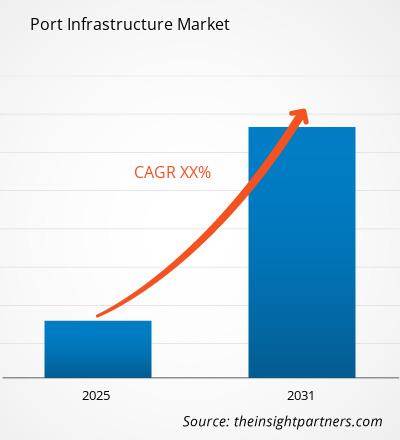
The port infrastructure market is projected to grow from US$ 178.47 Billion in 2025 to US$ 269.62 Billion by 2034, registering a CAGR of 4.69% during 2026–2034. The market covers sea ports, inland ports, warm water ports, and dry ports serving passenger and cargo applications across maritime trade corridors, logistics parks, terminal concessions, industrial gateways, and multimodal freight networks.
Across North America, port infrastructure market size expansion is linked to federal funding, terminal modernization, rail connectivity, container yard expansion, and emission-control investments. The region is expected to grow at a CAGR range of 4.0–4.5% during 2026–2034 as port authorities and private terminal operators deepen channels, add berth capacity, and deploy data-led cargo management platforms.
Port Infrastructure Market Assessment and Insights
- North America: The region accounted for 28–31% share in 2025 and is expected to grow at a CAGR range of 4.0–4.5% during 2026–2034, supported by container berth expansion and intermodal rail upgrades.
- US: The U.S. represented 76–80% of North America demand in 2025 and is projected to grow at a CAGR range of 4.1–4.6% through 2034.
- Europe: Europe held 22–25% share in 2025 and is likely to expand at a CAGR range of 3.7–4.2%, led by the UK, Germany, France, Spain, and Italy.
- Asia Pacific: Asia Pacific accounted for 36–40% share in 2025 and is forecast to grow at 5.0–5.6% CAGR, with China, India, Japan, South Korea, and Australia leading capacity development.
- Largest Segment: Sea ports held 58–62% market share in 2025 and are expected to grow at a 4.5–5.0% CAGR because deepwater terminals dominate international trade flows.
- High Growth Segment: Dry ports held 9–12% share in 2025 and are projected to grow at 5.4–6.0% CAGR as inland logistics hubs absorb pressure from coastal gateways.
- Key companies analyzed in detail: A.P. Moller-Maersk A/S, Adani Ports and Special Economic Zone Limited, APM Terminals, COLAS SA, Essar Ports Limited, IL&FS Engineering and Construction Company Limited, IQPC Worldwide Pte Ltd, Larsen & Toubro Limited, Man Infraconstruction Limited, and The Shipping Corporation of India Limited.
Source: The Insight Partners' analysis based on proprietary research, government publications, company annual reports, investor presentations, industry databases, and expert interviews.
Port infrastructure market evolution is moving from basic capacity addition toward integrated gateway development. Modern terminals have evolved to incorporate berth deepening, cargo yards, scheduling systems, customs handling capabilities, and road/rail transportation. The demand by customers for dependability, resilience, and multimodal transport facilities has made port investments increasingly interlinked with national logistics policies rather than just being marine infrastructure construction.
The long-term perspective is favorable to those countries that integrate their ports with industry areas, export areas, and land-based logistics networks. The emerging Asian nations and Gulf trading centers are developing new capacities, whereas the developed nations are concerned about carbon-neutral operations, shore power and decongestion. Emissions regulations and the need for resilience in logistics chains will maintain investments throughout the forecast period.
Port Infrastructure Market Report Scope
| Report Attribute | Details |
|---|---|
| Market size in 2025 | US$ 178.47 Billion |
| Market Size by 2034 | US$ 269.62 Billion |
| Global CAGR (2026 - 2034) | 4.69% |
| Historical Data | 2021-2024 |
| Forecast period | 2026-2034 |
Port Infrastructure Market Analysis
Market expansion will be driven through containerized cargo shipping, increased vessel size calls, energy cargo movements, and diversification of manufacturing supply chains. Increased cargo handling will require ports to have larger turning basins, deeper draughts, stronger quay walls, automated gateways, durable storage facilities, and IT-based traffic management systems. Increased multimodal transport and cargo processing needs will lead to brownfield and greenfield investments. Value chain players include engineering companies, terminal operators, dredging companies, equipment providers, digital logistics companies, and government port authorities.
Suppliers still exhibit capital intensity owing to the need for availability of land, environmental clearance, structure of concessions, availability of finance, and lengthy construction processes. The findings from the market analysis suggest that private investments are common in areas where there is certainty of returns due to cargo visibility, tariffs, and hinterlands. Financing by the government is crucial in cases of dredging, navigational channels, breakwaters, security systems, rail services, and intermodal infrastructures.
Competitors can be differentiated into three groups of developers, contractors, and terminal operators. Adani Ports and Special Economic Zone Limited and APM Terminals are competing in the sphere of port operation and capacity enhancement, while Larsen & Toubro Limited, COLAS SA, and Man Infraconstruction Limited contribute to the market through the application of engineering, construction, and civil infrastructure services. Competitive advantage now relies on efficient operation, technological innovations, successful execution of projects, and the capability to carry out large-scale modernization programs in various cargo types and markets.
Positioning now relies on integrated solutions. A.P. Moller-Maersk A/S combines the role of port operator with shipping and logistics companies, while Essar Ports Limited specializes in the development of industrial cargo corridors and The Shipping Corporation of India Limited provides for maritime connectivity. IQPC Worldwide Pte Ltd competes in the sector of intelligence gathering and industry forums, but not as a port operator. The participants of the market are now investing in automation, intelligent ports, predictive maintenance systems, digital cargo monitoring, and sustainability programs.
● REPORT CUSTOMIZATION
Tailor This Report To Align With Your Specific Business Requirements
This report can be customized to align precisely with your business objectives, scope, and target markets. Customization options include tailored segmentation, geography, competitive analysis, and strategic insights to support informed decision-making.
Customize This Report →WHAT YOU CAN ADJUST
- ● Segmentations
- ● Geography
- ● Competitive Analysis
- ● Language Preferences
Port Infrastructure Market: Strategic Insights
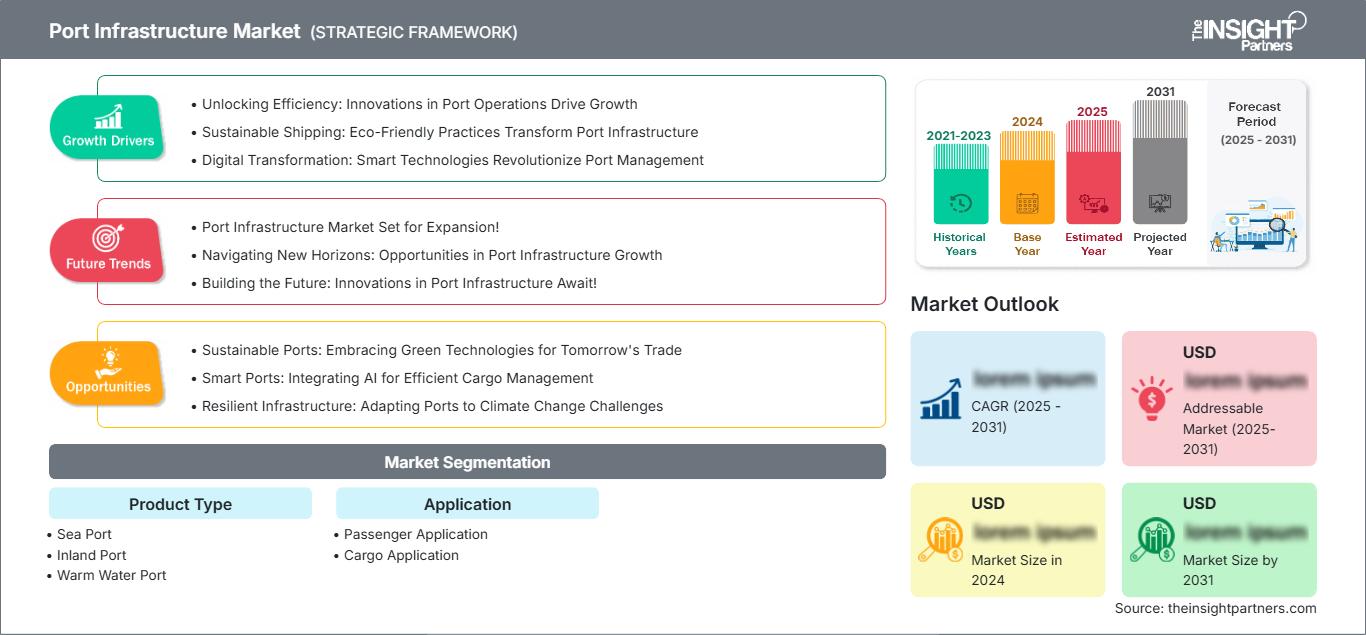
Regional Insights
North America port infrastructure market
North America accounted for 28–31% share in 2025 and is projected to expand at a CAGR range of 4.0–4.5% during 2026–2034. The region is investing in channel deepening, container berth expansion, rail yards, and digital freight corridors to reduce congestion and improve vessel turnaround.
Port infrastructure market share in North America is supported by U.S. gateway ports and cross-border trade links with Canada and Mexico. Funding programs, public-private partnerships, and terminal concessions are accelerating upgrades in cold-chain areas, inland connectors, and low-emission cargo-handling zones.
U.S. port infrastructure Market
The U.S. represented 76–80% of North America demand in 2025 and is expected to grow at a CAGR range of 4.1–4.6% during the forecast period. Container terminals on the Gulf Coast, East Coast, and West Coast are adding berth capacity, rail access, and yard density.
Recent investments reflect a stronger focus on resilient import gateways, export agriculture flows, and domestic manufacturing supply chains. APM Terminals, A.P. Moller-Maersk A/S, and engineering contractors are active in terminal modernization, while port authorities coordinate federal grants and private capital for channel, rail, and berth projects.
Europe port infrastructure Market
Europe held 22–25% share in 2025 and is forecast to grow at a CAGR range of 3.7–4.2%. Germany is at the forefront of container and industrial ports, with high-volume operations that use waterways and rail links to connect industries to gateways to the North Sea and the Baltic.
In the United Kingdom, port capacity improvements for container, wind, and Ro-Ro traffic are underway. In France, Spain, and Italy, there are continued efforts to improve Mediterranean gateways, transshipment, energy terminals, and intermodal facilities. There is considerable European demand for shore power, decarbonization, and digital port communities.
APAC port infrastructure Market
APAC accounted for 36–40% share in 2025 and is projected to grow at a CAGR range of 5.0–5.6%. China remains the leading country because of massive container throughput, industrial exports, and continued investment in smart and automated terminals.
India is accelerating port-led development through coastal economic zones, transshipment hubs, and inland logistics networks, while Japan, South Korea, and Australia focus on modernization, energy exports, and resilient maritime supply chains. Port infrastructure market trends in the region include larger terminals, digital customs interfaces, and stronger dry port integration.
Middle East & Africa port infrastructure Market
The Middle East and Africa are expected to grow at a CAGR range of 4.3–4.9% during 2026–2034. Saudi Arabia and the UAE lead regional investment through logistics diversification, free zones, and container transshipment capacity linked to global trade corridors.
South Africa and other African markets are upgrading bulk, container, and industrial port assets to reduce bottlenecks and support trade corridors. Growth is project-led, with demand tied to energy exports, mining logistics, food imports, and infrastructure concessions.
Segmentation Analysis
Product Type
Product Type is expected to grow at a CAGR range of 4.4–5.0% during 2026–2034. The port infrastructure market report indicates that the market scope includes coastal gateways, inland terminals, climate-resilient warm water ports, and dry ports that extend cargo processing beyond seacoasts. Product type demand depends on vessel access, cargo mix, hinterland connectivity, and national logistics priorities.
- Sea Port: Sea ports dominate investment because they handle international container, bulk, and energy flows requiring deepwater berths, quay cranes, breakwaters, storage yards, and customs-secure operating areas.
- Inland Port: Inland ports improve trade efficiency by shifting customs, storage, consolidation, and intermodal operations closer to manufacturing clusters and consumption centers.
- Warm Water Port: Warm water ports provide year-round navigability, supporting strategic shipping continuity in regions where seasonal ice or climate disruption could affect freight reliability.
- Dry Port: Dry ports reduce coastal congestion by moving container clearance, warehousing, and rail-linked consolidation inland, strengthening multimodal logistics and regional distribution networks.
Application
Application is expected to grow at a CAGR range of 4.5–5.1%. Cargo application dominates because ports primarily support container, bulk, liquid, energy, and industrial goods movement. Passenger application remains important for cruise terminals, ferry systems, and coastal mobility, but revenue intensity is generally lower than cargo-linked infrastructure.
- Passenger Application: Passenger infrastructure demand is linked to cruise tourism, ferry connectivity, coastal mobility, and safety upgrades in terminals serving mixed commercial and public transport functions.
- Cargo Application: Cargo infrastructure requires berths, yards, storage, customs zones, rail spurs, road links, and digital systems that improve throughput, security, and supply chain reliability.
Opportunity Snapshot
| Application | Revenue Contribution | Trend Tag | Adoption Stage |
| Passenger Application | Medium | Cruise Recovery | Scaling |
| Cargo Application | High | Freight Corridors | Mature |
Port Infrastructure Market Growth Drivers and Impact Analysis
Expansion of Containerized Trade Corridors
The pressure for container trades to deepen berths, extend crane reach, densify yards, and enhance gates persists. Increased vessel sizes lead to increased variability in call size, hence necessitating more containers handled in less time. This factor directly promotes investments in seaports, inland ports, and dry ports due to the growing fluidity of cargo within the entire corridor as opposed to the marine port alone. Failure to match the efficiency of handling operations at the berth level with the evacuation capabilities by rail and road leads to increased dwell times.
Public-Private Investment in Multimodal Connectivity
Concessionary arrangements, government funding, and private finance are now more common among port authorities to modernize rail terminals, road links, inland facilities, and logistics zones. Multimodality ensures decreased truck traffic, wider coverage areas for ports, and increased certainty of the supply chain process for importers/exporters. The importance of this factor is especially relevant in North America and the Asia Pacific regions, where container gateway ports have to service faraway inland locations. It also makes business cases for dry ports and inland ports more attractive.
Decarbonization and Smart Port Modernization
Emission targets and operational resilience are pushing ports to invest in shore power, electrified cargo equipment interfaces, digital berth planning, and port community systems. These upgrades change port infrastructure from static civil assets into connected operating platforms. Smart systems improve cargo visibility, vessel scheduling, customs coordination, and asset utilization, while clean-energy infrastructure helps terminals meet regulatory expectations. The driver creates opportunities for engineering firms, technology providers, and terminal operators that can combine construction capability with sustainability and data integration.
Port Infrastructure Market Future Trends
Dry Port Networks Supporting Coastal Gateways
Port infrastructure market trends will increasingly favor inland nodes that absorb storage, customs, and consolidation work from congested seaports. Dry port networks can reduce terminal dwell time, improve rail utilization, and extend port competition into manufacturing regions far from coastlines. Governments will use these assets to lower logistics costs and strengthen export readiness. For operators, inland cargo hubs create new revenue streams through warehousing, value-added services, and intermodal handling.
Climate-Resilient and Energy-Ready Terminals
Future terminals will be designed for rising weather volatility, stricter environmental requirements, and changing energy cargo flows. Ports will invest in flood protection, stronger quay structures, shore power, renewable integration, and safer handling of fuels such as LNG, hydrogen derivatives, and ammonia. These requirements will raise upfront project complexity but reduce long-term operational risk. Engineering and concession models will increasingly factor resilience, carbon performance, and energy flexibility into project selection.
Port Infrastructure Market Opportunities
Brownfield Modernization of Legacy Gateways
Port infrastructure market Forecasts indicate a strong opportunity in brownfield upgrades because many established gateways operate with constrained land, aging berths, and limited rail capacity. Modernization can deliver capacity gains through yard redesign, berth strengthening, deeper channels, automated gates, and digital scheduling without requiring full greenfield development. Contractors and terminal operators can target phased projects that reduce disruption while improving throughput, safety, and emissions performance. This opportunity is attractive in North America and Europe, where ports need productivity gains from existing assets.
Greenfield Port Development in Emerging Corridors
Emerging trade corridors in India, Southeast Asia, Africa, and the Gulf create opportunities for new ports linked to industrial zones, energy terminals, and logistics parks. Greenfield projects allow developers to design efficient layouts, direct rail or road connections, resilient utilities, and digital systems from the outset. Financing remains complex, but long concession periods and national trade strategies can support viable returns. Operators with engineering, capital, and cargo relationships are positioned to secure high-value projects.
Frequently Asked Questions

- Comprehensive Market Sizing and Forecast Analysis
- Detailed Segmentation Analysis
- In-Depth Market Dynamics Assessment
- Regional and Country-Level Insights
- Competitive Landscape and Company Benchmarking
- Strategic Business Intelligence
Recent Reports
Testimonials

The Insight Partners provided valuable market intelligence that supported our global go-to-market strategy. Their team was professional, responsive, and attentive to our feedback, providing thoughtful analysis and helpful methodological clarifications throughout the project.
Junmo Kim Chief Financial Officer (CFO), Enertech Co., Ltd.
The Insight Partners' SCADA System Market report is comprehensive, with valuable insights on current trends and future forecasts. The team was highly professional, responsive, and supportive throughout. We are very satisfied and highly recommend their services.
RAN KEDEM Partner, Reali Technologies LTDs
I requested a report on a very specific software market and the team produced the report in a few days. The information was very relevant and well presented. I then requested some changes and additions to the report. The team was again very responsive and I got the final report in less than a week.
JEAN-HERVE JENN Chairman, Future Analytica
We worked with The Insight Partners for an important market study and forecast. They gave us clear insights into opportunities and risks, which helped shape our plans. Their research was easy to use and based on solid data. It helped us make smart, confident decisions. We highly recommend them.
PIYUSH NAGPAL Sr. Vice President, High Beam Global
The Insight Partners delivered insightful, well-structured market research with strong domain expertise. Their team was professional and responsive throughout. The user-friendly website made accessing industry reports seamless. We highly recommend them for reliable, high-quality research services
YUKIHIKO ADACHI CEO, Deep Blue, LLC.
This is the first time I have purchased a market report from The Insight Partners.While I was unsure at first, I visited their web site and felt more comfortable to take the risk and purchase a market report.I am completely satisfied with the quality of the report and customer service. I had several questions and comments with the initial report, but after a couple of dialogs over email with their analyst I believe I have a report that I can use as input to our strategic planning process.Thank you so much for taking the extra time and making this a positive experience.I will definitely recommend your service to others and you will be my first call when we need further market data.
JOHN SUZUKI President and Chief Executive Officer, Board Director, BK Technologies
I wish to appreciate your support and the professionalism you displayed in the course of attending to my request for information regarding to infectious disease IVD market in Nigeria. I appreciate your patience, your guidance, and the fact that you were willing to offer a discount, which eventually made it possible for us to close a deal. I look forward to engaging The Insight Partners in the future, all thanks to the impression you have created in me as a result of this first encounter.
DR CHIJIOKE ONYIA MANAGING DIRECTOR, PineCrest Healthcare Ltd.Reason to Buy
- Informed Decision-Making
- Understanding Market Dynamics
- Competitive Analysis
- Identifying Emerging Markets
- Customer Insights
- Market Forecasts
- Risk Mitigation
- Boosting Operational Efficiency
- Strategic Planning
- Investment Justification
- Tracking Industry Innovations
- Aligning with Regulatory Trends





 Get Free Sample for