
Power Tools Market Trends, Demand & Growth by 2034
Coverage: By Mode (Electric, Pneumatic, Others); Type (Drilling and Fastening, Sawing, Demolition, Material Removal); End-user (Residential, Commercial , Industrial) , and Geography (North America, Europe, Asia Pacific, and South and Central America)
- Status : Data Released
- Report Code : TIPTE100000479
- Category : Manufacturing and Construction
- No. of Pages : 150
- Available Report Formats :


- Last update date : September 07, 2026


2025 Market Size
US$ 34.19 Bn
Base year value
2034 Forecast
US$ 81.19 Bn
Projected by 2034
CAGR 2026-2034
10.09 %
Growth rate
Addressable Market
US$ 513.07 Bn
(2026-2034)
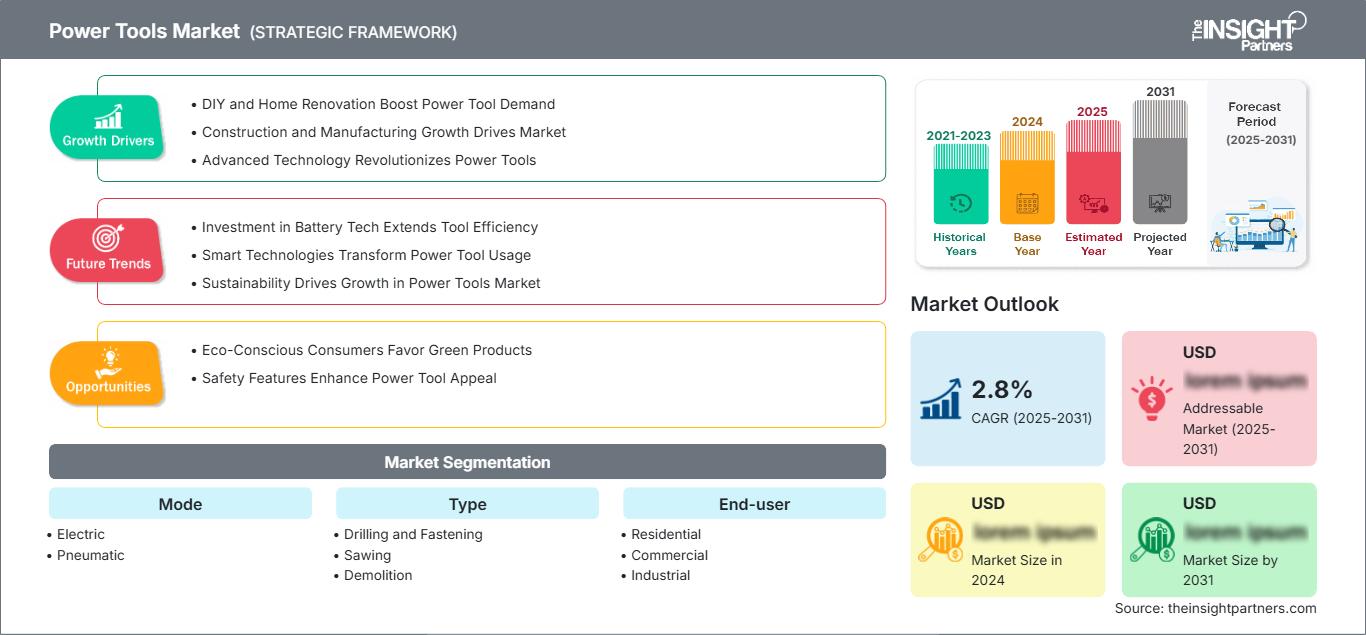
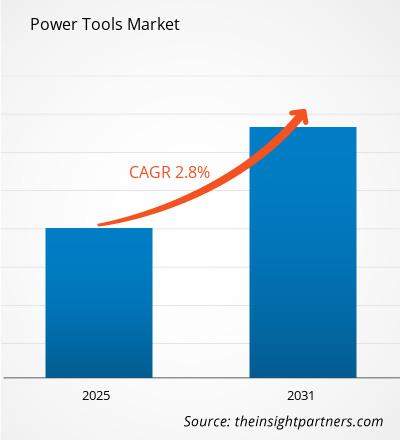
The power tools market was valued at US$ 34.19 billion in 2025 and is projected to reach US$ 81.19 Billion by 2034, expanding at a CAGR of 10.09% during 2026–2034. The market encompasses electric and pneumatic equipment used for drilling, fastening, sawing, demolition, and material removal across residential, commercial, and industrial applications. Product innovation increasingly centers on cordless platforms, brushless motors, battery efficiency, ergonomics, and digitally enabled jobsite productivity.
North America is expected to remain a significant market through 2034, supported by construction activity, industrial automation, renovation spending, and replacement demand. The regional market is also benefiting from professional adoption of cordless equipment, battery platform standardization, and demand for tools that reduce operator fatigue. Infrastructure modernization and skilled-labor constraints should encourage further investment in higher-productivity equipment, supporting long-term growth in the power tools market size.
Power Tools Market Assessment and Insights
- North America: North America is estimated to hold a 29–33% share in 2025 and grow at a CAGR of 8.8–9.6% during 2026–2034, supported by construction, industrial replacement demand, professional cordless adoption, and renovation activity.
- US: The US represents approximately 79–83% of North America's 2025 market and is projected to expand at a CAGR of 8.7–9.5%, supported by construction modernization and professional tool replacement.
- Europe: Europe is estimated to account for a 24–28% share in 2025 and expand at a CAGR of 8.6–9.4%, with Germany, the UK, France, Italy, and Spain supporting demand through manufacturing, construction, and renovation.
- Asia Pacific: Asia Pacific is estimated to hold a 31–35% share in 2025 and expand at a CAGR of 11.8–12.8%, led by China, Japan, South Korea, and India as industrialization and construction capacity increase.
- Largest Segment: Electric mode is estimated to hold a 78–82% market share in 2025 and expand at a CAGR of 10.4–11.2%, supported by cordless technology and broad application coverage.
- High Growth Segment: Residential end users are estimated to hold a 25–29% market share in 2025 and grow at a CAGR of 11.8–12.6%, supported by DIY renovation and home improvement.
- Key companies analyzed in detail: AIMCO; Atlas Copco AB; Hilti Corporation; KYOCERA Industrial Tools Corporation; Makita U.S.A., Inc.; Panasonic Life Solutions India Pvt. Ltd.; Robert Bosch Tool Corporation; Snap-on Incorporated; Stanley Black & Decker, Inc.; Techtronic Industries Company Limited.
Source: The Insight Partners' analysis based on proprietary research, government publications, company annual reports, investor presentations, industry databases, and expert interviews.
The power tools market has shifted from predominantly corded and mechanically driven equipment toward cordless platforms, brushless motors, lithium-ion batteries, electronic controls, and connected accessories. The development of tools based on battery ecosystems has enabled end-users to use various products through the same battery and charger. The platform-based approach has influenced purchase patterns, improved customer retention, and forced manufacturers to develop tool lines in drills, fastening tools, cutters, grinders, demolition tools, and outdoor tools.
In the forecast period, investments are expected to be more inclined towards higher-capacity batteries, small brushless motors, connectivity, and trade-specific tool lines. Rapid capacity growth can be expected from the Asia Pacific region due to growing manufacturing and construction activity, whereas North America and Europe would focus on professional replacements and productivity. Increasing safety norms, ergonomics requirements, emission reductions, and labor shortages would drive the demand for better productivity in minimum operator effort.
Power Tools Market Report Scope
| Report Attribute | Details |
|---|---|
| Market size in 2025 | US$ 34.19 Billion |
| Market Size by 2034 | US$ 81.19 Billion |
| Global CAGR (2026 - 2034) | 10.09% |
| Historical Data | 2021-2024 |
| Forecast period | 2026-2034 |
Power Tools Market Analysis
Demand for power tools is supported by construction, manufacturing, automotive assembly, infrastructure development, maintenance, renovation, and household improvement. The power tools market growth increasingly depends on cordless penetration because battery-powered products provide mobility where electrical access is limited. There are manufacturers of tools, battery makers, component makers, distributors, retailers, equipment renters, contractors, industrial users, and consumers, with accessories forming part of the recurrent elements in the ecosystem.
The supply chain is affected by batteries, motors, electronics, gears, housings, chargers, and precision parts. More manufacturers are developing integrated systems than individual tools, which makes it possible to use a common battery and charger on various types. The distribution system has changed through professional dealerships, home improvement stores, Internet sales, and direct consumer channels.
Competition in the power tools market analysis is concentrated among diversified manufacturers with broad product portfolios, proprietary battery systems, strong distribution, and established professional relationships. Techtronic Industries Company Limited has expanded the MILWAUKEE and RYOBI cordless ecosystems, while Stanley Black & Decker, Inc. maintains significant exposure through DEWALT and CRAFTSMAN. Robert Bosch Tool Corporation and Makita U.S.A., Inc. continue to compete through cordless platforms and trade-specific tools.
Atlas Copco AB and Hilti Corporation have stronger industrial and professional orientations, while AIMCO and Snap-on Incorporated serve specialized fastening and maintenance applications. As noted in the power tools market report, KYOCERA Industrial Tools Corporation and Panasonic Life Solutions India Pvt. Ltd. add technology and regional capabilities. Strategic investment is increasingly directed toward batteries, brushless motors, automation, connected tools, accessories, and professional ecosystems that increase lifetime value rather than relying solely on individual tool sales.
● REPORT CUSTOMIZATION
Tailor This Report To Align With Your Specific Business Requirements
This report can be customized to align precisely with your business objectives, scope, and target markets. Customization options include tailored segmentation, geography, competitive analysis, and strategic insights to support informed decision-making.
Customize This Report →WHAT YOU CAN ADJUST
- ● Segmentations
- ● Geography
- ● Competitive Analysis
- ● Language Preferences
Power Tools Market: Strategic Insights
Regional Insights
North America power tools market
North America is estimated to represent 29–33% of the global power tools market in 2025 and is projected to expand at a CAGR of 8.8–9.6% through 2034. The United States is a dominant region for demand, whereas Canada and Mexico also participate in demand through construction, industrial manufacturing, automotive production, development of infrastructure, and renovation. Professional cordless adoption is an important reason for replacement.
Modernization of construction, renovations of housing, industrial maintenance, and the limitation of skilled labor are contributing factors that are driving the need for productivity of equipment. Battery technology plays an important role due to the fact that toolsets can be standardized by contractors on job sites. There is an expansion of brushless and connected technologies by manufacturers, whereas distribution and rentals offer professional equipment.
U.S. power tools Market
The US accounts for approximately 79–83% of North America's 2025 power tools market and is projected to grow at a CAGR of 8.7–9.5%. Demand spans residential renovation, commercial construction, automotive repair, manufacturing, and professional maintenance. DEWALT, Milwaukee, Bosch, Makita, Hilti, Snap-on, and other established brands maintain extensive distribution and service networks.
Cordless drilling, fastening, sawing, grinding, and demolition products are increasingly favored by professional users because they combine mobility with improved power output. Commercial and industrial buyers also evaluate tool durability, battery interchangeability, runtime, connected diagnostics, and total ownership costs. Residential demand is influenced by DIY activity, home remodeling, and the increasing availability of compact battery-powered tools.
Europe power tools market
Europe is estimated to hold a 24–28% of the power tools market share in 2025 and is expected to grow at a CAGR of 8.6–9.4%. Germany is a major consumer country due to manufacturing, demand for construction equipment, automobile manufacturing, and engineering-driven applications. Other countries such as the UK, France, Italy, and Spain generate demand through renovations, infrastructural construction, industrial maintenance, and housing construction.
In the UK, the customer base is varied, both professionals and DIY customers, with cordless drilling, fastening, cutting, and garden tools becoming increasingly important. Germany exhibits good industrial consumption, together with tool engineering skills. France, Italy, and Spain take advantage of the modernization of construction and renovations, while safety and product durability issues in Europe result in replacing the existing tools.
APAC power tools market
APAC is estimated to represent 31–35% of the global power tools market in 2025 and is projected to grow at a CAGR of 11.8–12.8%. China is the leading regional market, followed by Japan, South Korea, India, and Australia. Manufacturing expansion, construction activity, automotive production, and infrastructure investment support consumption.
China combines large industrial capacity with extensive tool manufacturing, while Japan and South Korea emphasize precision and advanced electronics. India is benefiting from manufacturing and infrastructure expansion, and Australia contributes through construction and resource-related applications. Government-led industrialization, local manufacturing initiatives, and infrastructure programs should support continued tool adoption across professional and industrial applications.
Middle East & Africa power tools Market
The Middle East and Africa power tools market is projected to grow at a CAGR of 9.8–10.8% through 2034. Saudi Arabia is expected to lead regional demand, supported by infrastructure development, construction, industrial diversification, and large-scale development projects. The UAE follows through with commercial construction, logistics, hospitality, and industrial investment.
South Africa provides an established base in mining, construction, manufacturing, and maintenance, while the rest of MEA offers opportunities linked to infrastructure and energy projects. Tool selection increasingly emphasizes durability, portability, battery runtime, and service availability. Construction and energy investment should support professional equipment demand as new projects require efficient fastening, drilling, cutting, and material-removal operations.
Segmentation Analysis
Mode
Mode is projected to expand at a CAGR of 10.4–11.2% during 2026–2034. Electric equipment dominates because it spans residential, commercial, and industrial applications and increasingly incorporates cordless battery platforms. Pneumatic tools remain important where high duty cycles, low tool weight, and industrial compressed-air infrastructure provide operational advantages.
- Electric: Electric tools represent the principal technology base, with cordless products increasingly replacing corded equipment in mobile applications. Shared battery platforms strengthen ecosystem value across professional and residential users.
- Pneumatic: Pneumatic tools remain important in automotive assembly, industrial fastening, and heavy-duty applications where compressed-air infrastructure supports continuous operation, controlled torque, and lightweight tool designs.
Type
Type is expected to grow at a CAGR of 9.7–10.5% during 2026–2034. Drilling and fastening maintain broad demand across virtually all end users, while sawing, demolition, and material removal benefit from construction, infrastructure, industrial maintenance, and specialized trade applications.
- Drilling and Fastening: Drilling and Fastening represents a core power-tool category because it is required across construction, assembly, maintenance, woodworking, and home improvement, creating broad replacement and accessory demand.
- Sawing: Sawing equipment supports construction, woodworking, metalworking, remodeling, and installation applications, with cordless designs improving portability and enabling greater use outside fixed workshop environments.
- Demolition: Demolition tools serve renovation, construction, infrastructure, and maintenance activities, with users prioritizing impact energy, vibration control, durability, and battery performance in demanding environments.
- Material Removal: Material Removal includes grinding and related applications requiring controlled abrasion, surface preparation, finishing, and cutting, with professional users emphasizing power density, safety, and accessory compatibility.
End-user
End-user demand is projected to grow at a CAGR of 10.2–11.0% during 2026–2034. Industrial users remain strategically important because of high utilization, while commercial demand follows construction and maintenance activity. Residential adoption is expanding as cordless platforms make professional-grade functionality more accessible to DIY consumers.
- Residential: Residential users increasingly adopt cordless drills, drivers, saws, sanders, and compact equipment for renovation, maintenance, woodworking, and DIY projects, supported by simplified battery ecosystems.
- Commercial: Commercial users include contractors, installers, maintenance providers, and service businesses that prioritize portability, runtime, durability, productivity, and dependable access to replacement batteries and accessories.
- Industrial: Industrial users require high-duty-cycle tools for assembly, production, maintenance, automotive, aerospace, and heavy equipment applications, emphasizing torque control, reliability, ergonomics, and service support.
Opportunity Snapshot
| End-user | Revenue Contribution (High/Medium/Low) | Trend Tag | Adoption Stage |
| Residential | Medium | DIY Cordless | Scaling |
| Commercial | High | Jobsite Cordless | Scaling |
| Industrial | High | Smart Assembly | Mature |
Power Tools Market Growth Drivers and Impact Analysis
Rapid adoption of cordless battery platforms
Cordless innovation is revolutionizing purchasing habits through freedom from dependency on fixed electrical outlets and compressed air infrastructures in a variety of settings. Advances in lithium-ion cells, brushless motors, electronics, and battery charging systems have resulted in increased run times, higher power density, and smaller tools. Common battery platforms make it easy for users to acquire new tools using the same platform since the batteries and chargers are already compatible with each other. This provides a multiplier effect on both manufacturers and distributors, especially when users shift from using tools in one segment to using several segments. Professional contractors are enabled to move around easily with minimal time required for setup, and residential consumers are able to use highly effective tools.
Construction and infrastructure modernization
The construction and infrastructure projects require drilling, fastening, cutting, demolition, grinding, and material removal equipment at different stages of the process. The expansion of the infrastructure of transport, commercial buildings, industry, utility services, and homes will directly lead to the need for equipment. Modern contractors are looking for tools that increase their productivity as the scheduling, manpower, and costs of operations have an impact on the project economy. The high-productivity cordless equipment can ease the limitation of mobility and make work easier in places that lack convenient access to electricity. Professional users are paying more attention to ergonomics and vibration control since the tools are used for prolonged periods. Infrastructure investment, therefore, affects both the first purchase and the replacement of the tools.
Industrial automation and precision fastening requirements
Manufacturing settings are becoming increasingly dependent on controlled fastening, torque control, traceability, and ergonomic tools, especially in the automotive, aerospace, electronics, machinery, and assembly sectors. This is driving the need for tools capable of providing repeatable torque and connecting with manufacturing systems. Industrial buyers look at equipment from a different perspective compared to casual buyers, putting more value on uptime, calibration, maintenance, connectivity, and total cost of ownership. While pneumatic tools still find use in mass production, sophisticated electric tools are increasingly becoming important due to the benefits of programmable controls and data acquisition. The effect of this market trend goes beyond tool numbers because industrial buyers are likely to buy chargers, batteries, controllers, accessories, maintenance agreements, and replacement parts.
Power Tools Market Future Trends
Connected tools and digital jobsite ecosystems
The power tools market trends are increasingly moving toward connected equipment that communicates with smartphones, controllers, fleet platforms, and jobsite management systems. Future professional devices will be able to offer more detailed information on their runtime, battery status, location, maintenance needs, and usage patterns. This information will enable fleet management to identify idle devices, set up maintenance schedules, minimize losses, and optimize the allocation of devices for various projects. Industrial users will be able to integrate connected fastening devices with manufacturing operations to demonstrate torque compliance. The economic benefit from connectivity will rely on the practical application of connectivity in workflow, not the connectivity itself. Manufacturers that will integrate hardware, software, batteries, storage, and services will raise switching costs and develop digital relationships with professionals.
Higher energy density and modular battery architectures
Battery technology advancement is still going to be one of the key differentiation points for future manufacturers aiming to boost power generation, while controlling their weight, heating, charging duration, and operational costs. For future platforms, better cell technology, thermal control technologies, smart battery systems, and efficient motors will help cope with high demands. Also, modular design may let the user choose batteries based on their runtime, weight, or necessary power. Compatibility is still an essential commercial point since pre-installed battery packs affect future purchases. Therefore, manufacturers have to balance their introduction of new capabilities with their investments in the ecosystem. Since cordless devices penetrate into heavy-duty industries like demolition, cutting, concrete and industrial maintenance, battery technology becomes decisive for electric tools replacing pneumatic or corded.
Power Tools Market Opportunities
Professional cordless expansion in emerging construction markets
The power tools market Forecasts indicate substantial opportunities for suppliers that adapt professional cordless portfolios to rapidly developing construction markets. India, Southeast Asia, Latin America, and selected Middle Eastern economies are expanding construction and industrial capacity while professional users increasingly seek portable equipment. Suppliers can target these markets through localized distribution, financing, rental partnerships, service networks, and trade-specific product bundles. Battery compatibility can simplify portfolio expansion where customers initially purchase only a small number of tools. Manufacturers should also consider regional voltage requirements, climate conditions, repair infrastructure, and accessory availability. Establishing dependable after-sales support can differentiate premium products from lower-cost alternatives and improve customer retention. The most attractive opportunities are likely to combine affordable entry products with upgrade pathways into broader professional battery ecosystems.
Industrial fastening and fleet-management solutions
Industrial customers offer opportunities beyond conventional tool sales because connected fastening and tool-management systems can address productivity, quality, and asset-utilization requirements simultaneously. Automotive assembly, machinery production, electronics manufacturing, and maintenance operations can benefit from torque-controlled tools linked to digital production records. Suppliers can develop integrated offerings combining electric fastening tools, controllers, software, batteries, calibration, and maintenance. Fleet-management capabilities can further provide visibility into utilization, service intervals, and tool location. This model changes the commercial relationship from periodic equipment replacement toward lifecycle management. Manufacturers with strong application engineering and service capabilities can target production-line modernization projects where customers evaluate total process economics rather than individual tool prices. Integration with industrial automation systems should broaden the addressable opportunity over time.
Frequently Asked Questions

- Comprehensive Market Sizing and Forecast Analysis
- Detailed Segmentation Analysis
- In-Depth Market Dynamics Assessment
- Regional and Country-Level Insights
- Competitive Landscape and Company Benchmarking
- Strategic Business Intelligence
Recent Reports
Testimonials

The Insight Partners' SCADA System Market report is comprehensive, with valuable insights on current trends and future forecasts. The team was highly professional, responsive, and supportive throughout. We are very satisfied and highly recommend their services.
RAN KEDEM Partner, Reali Technologies LTDs
I requested a report on a very specific software market and the team produced the report in a few days. The information was very relevant and well presented. I then requested some changes and additions to the report. The team was again very responsive and I got the final report in less than a week.
JEAN-HERVE JENN Chairman, Future Analytica
We worked with The Insight Partners for an important market study and forecast. They gave us clear insights into opportunities and risks, which helped shape our plans. Their research was easy to use and based on solid data. It helped us make smart, confident decisions. We highly recommend them.
PIYUSH NAGPAL Sr. Vice President, High Beam Global
The Insight Partners delivered insightful, well-structured market research with strong domain expertise. Their team was professional and responsive throughout. The user-friendly website made accessing industry reports seamless. We highly recommend them for reliable, high-quality research services
YUKIHIKO ADACHI CEO, Deep Blue, LLC.
This is the first time I have purchased a market report from The Insight Partners.While I was unsure at first, I visited their web site and felt more comfortable to take the risk and purchase a market report.I am completely satisfied with the quality of the report and customer service. I had several questions and comments with the initial report, but after a couple of dialogs over email with their analyst I believe I have a report that I can use as input to our strategic planning process.Thank you so much for taking the extra time and making this a positive experience.I will definitely recommend your service to others and you will be my first call when we need further market data.
JOHN SUZUKI President and Chief Executive Officer, Board Director, BK Technologies
I wish to appreciate your support and the professionalism you displayed in the course of attending to my request for information regarding to infectious disease IVD market in Nigeria. I appreciate your patience, your guidance, and the fact that you were willing to offer a discount, which eventually made it possible for us to close a deal. I look forward to engaging The Insight Partners in the future, all thanks to the impression you have created in me as a result of this first encounter.
DR CHIJIOKE ONYIA MANAGING DIRECTOR, PineCrest Healthcare Ltd.Reason to Buy
- Informed Decision-Making
- Understanding Market Dynamics
- Competitive Analysis
- Identifying Emerging Markets
- Customer Insights
- Market Forecasts
- Risk Mitigation
- Boosting Operational Efficiency
- Strategic Planning
- Investment Justification
- Tracking Industry Innovations
- Aligning with Regulatory Trends





 Get Free Sample for