
Precision Ball Screw Market Growth, Size & Forecast by 2034
Coverage: by Type (Ground Type, Rolled Type); End-user (Medical, Laboratory, Semiconductor, Others) , and Geography (North America, Europe, Asia Pacific, and South and Central America)
- Status : Data Released
- Report Code : TIPRE00008041
- Category : Manufacturing and Construction
- No. of Pages : 150
- Available Report Formats :


- Last update date : September 07, 2026


2025 Market Size
US$ 1.72 Bn
Base year value
2034 Forecast
US$ 2.47 Bn
Projected by 2034
CAGR 2026-2034
4.15 %
Growth rate
Addressable Market
US$ 19.07 Bn
(2026-2034)
The precision ball screw market was valued at US$ 1.72 Billion in 2025 and is projected to reach US$ 2.47 Billion by 2034, expanding at a CAGR of 4.15% from 2026 to 2034. Demand is shaped by increasingly precise motion requirements in semiconductor equipment, medical systems, and laboratory automation. Product differentiation centers on lead accuracy, rigidity, thermal behavior, contamination control, preload stability, and service life.
North American demand is supported by semiconductor equipment investment, advanced medical-device manufacturing, laboratory automation, and modernization of high-precision production assets. The regional outlook indicates a 3.8–4.8% CAGR from 2026–2034. The precision ball screw market size is also influenced by the reshoring of critical manufacturing, tighter equipment-performance requirements, and the adoption of automated positioning systems requiring repeatable micron-level motion.
Precision Ball Screw Market Assessment and Insights
- North America: The region is expected to represent a 24–28% share in 2025 and expand at a 3.8–4.8% CAGR between 2026–2034, supported by semiconductor manufacturing, medical equipment, laboratory automation, and advanced machinery replacement cycles.
- US: The US is estimated to account for 72–76% of North American revenue in 2025, advancing at a 3.9–4.9% CAGR between 2026–2034 as semiconductor and medical equipment production expands.
- Europe: Europe is estimated at a 21–25% share in 2025, with a 3.4–4.4% CAGR between 2026–2034. Germany, Italy, France, and the UK remain important because of machine-tool engineering, medical technology, automation, and precision manufacturing.
- Asia Pacific: Asia Pacific is estimated at a 38–42% share in 2025, growing at a 4.6–5.6% CAGR between 2026–2034. China, Japan, South Korea, Taiwan, and India benefit from semiconductor, electronics, automation, and precision machinery investments.
- Largest Segment: Ground Type is estimated to hold a 61–65% market share in 2025, with a 4.0–4.7% CAGR from 2026–2034, reflecting stringent accuracy requirements in high-value equipment.
- High Growth Segment: Semiconductor is estimated to hold a 34–38% share in 2025, with a 5.0–5.9% CAGR from 2026–2034, supported by advanced-node equipment and contamination-sensitive motion systems.
- Key companies analyzed in detail: Barnes Industries, Inc.; Bosch Rexroth Corporation; Hiwin Corporation; KSS Co., Ltd.; KURODA Precision Industries Ltd.; NSK Ltd.; PMI GROUP; Schaeffler Technologies AG & Co. KG; TBI MOTION Technology Co., Ltd.; THK CO., LTD.
Source: The Insight Partners' analysis based on proprietary research, government publications, company annual reports, investor presentations, industry databases, and expert interviews.
Technological advancements in production have led to dimensional control, better preload management, reduction of friction variations, and customized shafts and nuts. Ground screws play an integral role in accurate production, while rolled products cater to those applications that are concerned with costs, speed, and adequate positional accuracy. Optimization of heat generation, lubrication, sealing, and contaminant resistance is now increasingly considered to sustain accuracy in continuous operations of equipment.
The forecasted investment will increasingly focus on specialized products for use in clean room environments in the semiconductor industry, medical imaging, laboratory automation, and high-speed positioning machines. The region of Asia Pacific is expected to continue as one of the primary centers for manufacturing and consumption of the products under study. Regions of North America and Europe will focus on localized supply chain resilience.
Precision Ball Screw Market Report Scope
| Report Attribute | Details |
|---|---|
| Market size in 2025 | US$ 1.72 Billion |
| Market Size by 2034 | US$ 2.47 Billion |
| Global CAGR (2026 - 2034) | 4.15% |
| Historical Data | 2021-2024 |
| Forecast period | 2026-2034 |
Precision Ball Screw Market Analysis
Demand for the precision ball screw market growth is closely connected with automation intensity and the increasing requirement for controlled linear positioning. The semiconductor production machines need repeatable performance in cleanrooms and under vacuum, and medical machines require vibration-free performance, repeatable motion, and small mechanical architecture. Lab automation requires repeatable dispensing, sample handling, and positioning. An ecosystem consists of steel producers, heat treatment specialists, grinding and rolling companies, bearings and nuts suppliers, motion control integration firms, equipment makers, and distribution channels.
The supply chain depends on the capability of precision grinding, quality of materials, heat treatment, metrology, and controlled assembly. Grinded products demand an even more rigorous finishing and inspection process, making the manufacturing process more complex compared to rolled products. In addition, long qualification cycles in the semiconductor and medical equipment industries make customers inclined to work with their approved suppliers. This allows suppliers with engineering services, customization, application testing, and quality management systems to compete.
The positioning within competitions is becoming largely dependent upon application engineering and not just the availability of products. The Bosch Rexroth Corporation utilizes ball-screw assemblies together with custom configurations in order to cope with tough applications. Meanwhile, THK CO., LTD concentrates on compact, fast, and accurate configurations. The NSK Ltd. concentrates on low-friction and heat-controlled applications with high precision. Hiwin Corporation is characterized by comprehensive positioning capabilities covering everything from medical devices to automation.
The competitive landscape also includes specialized manufacturers such as Barnes Industries, Inc., KSS Co., Ltd., KURODA Precision Industries Ltd., PMI GROUP, and TBI MOTION Technology Co., Ltd. Investment is increasingly directed toward product variants, cleanroom suitability, low-friction designs, and digital condition monitoring. The precision ball screw market analysis, therefore, indicates that suppliers can strengthen positioning through customized engineering, shorter delivery cycles, qualification support, and lifecycle service rather than relying solely on standardized products.
● REPORT CUSTOMIZATION
Tailor This Report To Align With Your Specific Business Requirements
This report can be customized to align precisely with your business objectives, scope, and target markets. Customization options include tailored segmentation, geography, competitive analysis, and strategic insights to support informed decision-making.
Customize This Report →WHAT YOU CAN ADJUST
- ● Segmentations
- ● Geography
- ● Competitive Analysis
- ● Language Preferences
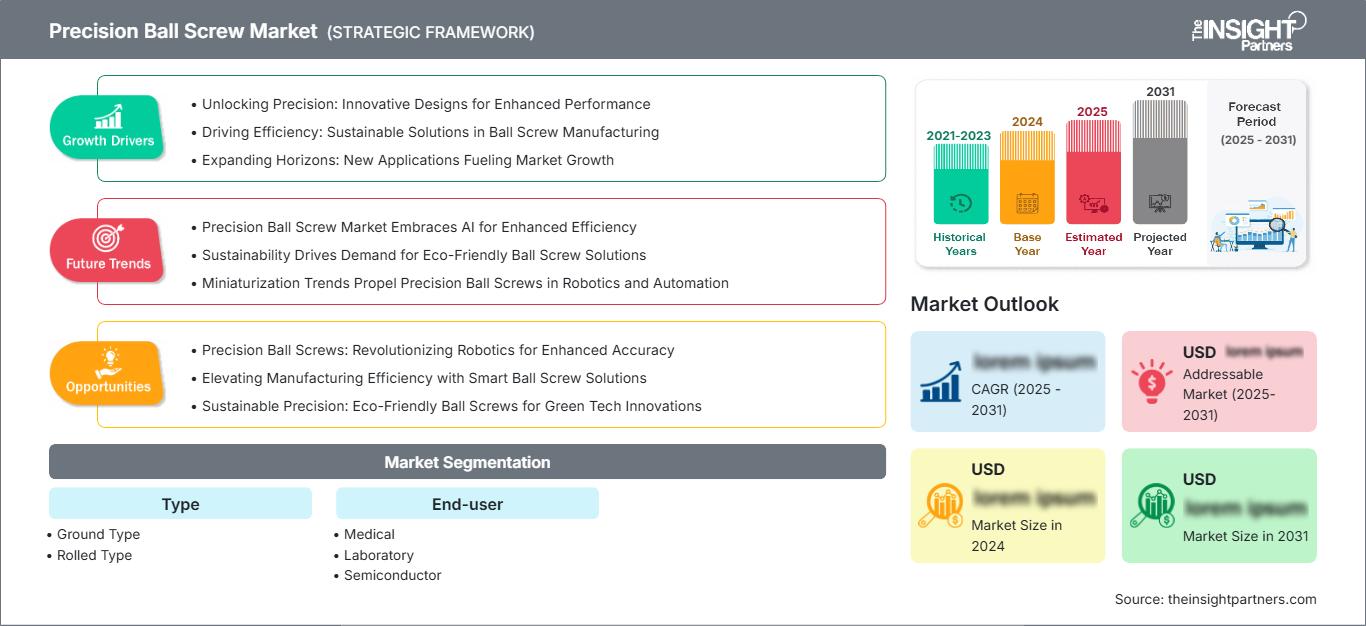
Precision Ball Screw Market: Strategic Insights
Regional Insights
North America precision ball screw market
North America is estimated to represent 24–28% of the global precision ball screw market revenue in 2025 and is projected to expand at a 3.8–4.8% CAGR from 2026–2034. US dominates regional demand due to increased linear motion control needs for semiconductor equipment, medical device manufacturing, aerospace-precision machining and lab automation. Canada makes contributions in terms of advanced manufacturing, research facilities and specialty industrial machinery.
Another factor contributing to regional demand is manufacturing localization and investment in high-value production equipment. For semiconductor equipment, there is a need for low-particle motion, thermally stable and repeatable vacuum-compatible motion. For medical equipment manufacturers, there is a preference for silent operation and precise positioning. This creates a need for precision-ground components and custom assembly solutions.
U.S. precision ball screw Market
The US is estimated to account for 72–76% of the North American precision ball screw market revenue in 2025, with a 3.9–4.9% CAGR from 2026–2034. Semiconductor equipment, medical imaging, laboratory robotics, and automated inspection are important applications. Domestic manufacturing investment supports demand for high-accuracy motion components and replacement systems.
Large vendors such as Bosch Rexroth Corporation, Hiwin Corporation, NSK Ltd., and THK CO., LTD. cater to US customers via their well-structured application and industrial networks. The demand pattern is moving towards smaller components, high repeatability, less heating, and a clean environment. Medical applications demand quiet operations and control of movements, while semiconductor equipment demands contamination control and stable positioning.
Europe precision ball screw Market
Europe is estimated at a 21–25% of the precision ball screw market share in 2025 and is expected to grow at a 3.4–4.4% CAGR from 2026–2034. Germany leads regional demand through machine tools, industrial automation, semiconductor equipment, and precision engineering. The UK maintains demand through laboratory technology, medical systems, and advanced manufacturing.
Germany's equipment base supports high-value ground products requiring repeatability, rigidity, and thermal consistency. France contributes through aerospace, medical equipment, and industrial automation, while Italy's machine-tool ecosystem supports precision motion demand. Spain also contributes through industrial machinery and automated production systems. European buyers increasingly consider energy efficiency, component durability, serviceability, and supply continuity when selecting motion components.
APAC precision ball screw Market
Asia Pacific is estimated to hold a 38–42% share of the precision ball screw market in 2025, expanding at a 4.6–5.6% CAGR from 2026–2034. China is the leading market, followed by Japan, South Korea, Taiwan, India, and Australia. Semiconductor investment, electronics manufacturing, machine tools, and industrial automation underpin regional demand.
China's equipment localization and Japan's precision manufacturing capabilities create substantial application opportunities. South Korea and Taiwan benefit from semiconductor production, while India is increasing its industrial automation and electronics manufacturing capacity. Australia remains smaller but supports laboratory, medical, and specialized industrial applications. Regional policies promoting advanced manufacturing and semiconductor ecosystems should favor precision motion components.
Middle East & Africa precision ball screw Market
The Middle East and Africa precision ball screw market represents a smaller demand base, with regional growth estimated at 3.0–4.0% CAGR from 2026–2034. Saudi Arabia and the UAE lead regional activity through industrial diversification, automation, healthcare infrastructure, and advanced manufacturing initiatives. South Africa remains important for industrial equipment and laboratory applications.
Energy-sector diversification and infrastructure development encourage investment in automated production systems, inspection equipment, and specialized machinery. Saudi Arabia's industrial localization agenda and the UAE's advanced manufacturing initiatives create opportunities for precision motion suppliers. The broader region remains dependent on imported components, making technical distribution, local inventory, and application support important competitive factors.
Segmentation Analysis
Type
Type segmentation is defined by Ground Type and Rolled Type. As highlighted in the precision ball screw market report, the segment is projected to expand at a 4.0–4.6% CAGR from 2026–2034. Ground products retain an advantage in terms of lead accuracy,
- Ground Type: Ground screws remain strategically important for semiconductor, medical, and laboratory systems requiring high positional accuracy, low error, and stable preload. Demand is concentrated in high-value equipment where component performance directly affects system precision.
- Rolled Type: Rolled screws provide a cost-efficient option for applications requiring dependable linear motion with less stringent accuracy requirements. Their manufacturing efficiency supports broader automation adoption and standardized equipment designs.
End-user
End-user segmentation covers Medical, Laboratory, and Semiconductor applications. The segment is projected to expand at a 4.5–5.4% CAGR from 2026–2034. Semiconductor equipment represents the strongest growth opportunity because advanced manufacturing requires contamination-sensitive, repeatable, and highly controlled positioning.
- Medical: Medical equipment uses precision motion for imaging tables, positioning systems, surgical platforms, and automated diagnostic equipment where smooth movement, low vibration, and repeatability are essential.
- Laboratory: Laboratory automation increasingly relies on compact motion systems for sample handling, dispensing, preparation, and analysis. Precision screws support repeatable positioning in equipment where dimensional consistency affects test reliability.
- Semiconductor: Semiconductor applications require precision motion under cleanroom, vacuum, and particle-sensitive conditions. Equipment developers prioritize low particle generation, thermal stability, rapid settling, and sub-micron positioning for advanced process architectures.
Opportunity Snapshot
| End-user | Revenue Contribution Trend | Tag Adoption Stage |
|---|---|---|
| Medical | Medium Imaging Motion | Mature |
| Laboratory | Medium Robotic Handling | Scaling |
| Semiconductor | High Cleanroom Motion | Scaling |
Precision Ball Screw Market Growth Drivers and Impact Analysis
Expansion of semiconductor manufacturing and advanced equipment
The demand for semiconductor manufacturing has resulted in an increased technical burden being imposed on the motion control components due to the necessity for very repeatable positioning of the wafers, stages, and process assemblies. The trend towards small process geometries results in increased sensitivity to vibration, heat dissipation, contamination, and positioning accuracy. Thus, screws for cleanroom and vacuum environment applications become eligible to compete in more valuable application areas compared to the regular industrial components. The equipment vendors more often take into account the particle generation, thermal performance, lubrication, and lifetime when qualifying their components. This trend poses a challenge for suppliers through increasing the need to invest in special material processing, sealing, and metrology technologies. It increases the qualification time, which favors experienced manufacturers.
Medical equipment automation and precision positioning requirements
Motion control without vibration or mechanical lag is important for medical imaging applications, diagnostic automation, robotic assistance, and patient positioning systems. Precision screws allow for linear positioning in imaging tables, examination tables, and automatic laboratory-medical interface systems. In order to achieve a smaller size and advanced features from equipment makers, motion system manufacturers need to design motion systems that have high repeatability in a limited mechanical space. This creates opportunities for the development of compact nuts, optimized preloading conditions, noiseless motions, and support hardware. This trend also applies not only to new systems but also to existing systems since they need replacement parts with the same specifications as the originals. The requirement for qualified suppliers with quality systems and application engineering skills benefits medical devices. It creates a less price-sensitive demand profile than industrial automation equipment.
Industrial automation and higher machine utilization
Higher automation intensity is increasing the operating hours and duty cycles of precision motion systems across semiconductor support equipment, laboratories, and medical manufacturing. Continuous operation exposes ball screws to friction, heat, contamination, and wear, making lifecycle performance increasingly important. Customers are consequently evaluating mean operating life, lubrication intervals, maintenance requirements, and thermal stability alongside purchase price. Manufacturers respond through improved internal geometries, specialized steels, surface treatments, sealing, and condition-monitoring capabilities. This changes purchasing decisions from component replacement toward total equipment performance. For suppliers, the opportunity lies in combining precision components with diagnostic services, application-specific lubrication, and predictive maintenance support. Such offerings can improve customer retention while creating recurring service opportunities. The driver is particularly relevant for automated facilities where unexpected motion-system failure can interrupt expensive production processes.
Precision Ball Screw Market Future Trends
Application-specific cleanroom and vacuum motion systems
The Precision ball screw market trends are increasingly influenced by semiconductor and advanced laboratory equipment that operates under controlled atmospheric conditions. Future designs are likely to place greater emphasis on ultra-low particle generation, low outgassing lubrication, thermal stability, compact dimensions, and repeatable motion under vacuum. Suppliers will increasingly engineer the screw, nut, lubrication system, sealing arrangement, and support structure as an integrated motion package rather than as isolated components. Qualification data for particle emissions and thermal behavior should become more important during equipment design reviews. This trend can also encourage greater use of application-specific materials and surface treatments. Manufacturers that establish validated performance under cleanroom and vacuum conditions can differentiate their products from conventional industrial screws and participate more directly in high-value semiconductor equipment programs.
Digital condition monitoring and lifecycle optimization
Future precision motion platforms are expected to incorporate more sensing and analytical capabilities around ball-screw assemblies. Condition monitoring can track temperature, vibration, friction changes, operating cycles, and other indicators associated with wear or abnormal loading. For medical and semiconductor equipment, predictive maintenance can reduce unplanned downtime and protect expensive production assets. Suppliers may increasingly provide diagnostic algorithms alongside mechanical products, allowing OEMs to monitor component condition through machine-control systems. This development should shift competition toward measurable lifecycle performance rather than dimensional specifications alone. Digital records can also support maintenance scheduling, warranty assessment, and replacement planning. As equipment becomes more connected, manufacturers that combine precision motion hardware with monitoring interfaces and service analytics could create differentiated lifecycle propositions while improving reliability for customers operating high-utilization systems.
Precision Ball Screw Market Opportunities
Localized supply chains for high-precision motion components
Investment in regional semiconductor, medical-device, and advanced manufacturing capacity creates opportunities for suppliers to establish localized production, finishing, inventory, and engineering capabilities. Customers increasingly value shorter lead times and reduced exposure to international logistics disruptions, especially when components are subject to qualification requirements. Localized facilities can support customized shaft lengths, end machining, preload selection, inspection, and replacement availability without requiring every requirement to be handled centrally. The precision ball screw market forecasts indicate that regional diversification should create opportunities in North America, Europe, and the Asia Pacific, although supplier economics will depend on achieving sufficient utilization. Partnerships with equipment OEMs, automation integrators, and specialized distributors can accelerate market entry while reducing the cost of building a standalone service infrastructure.
Specialized miniature and compact screw assemblies
Miniaturization offers a distinct investment opportunity as medical devices, laboratory automation platforms, optical equipment, and semiconductor modules require smaller motion architectures. Compact ball screws can help equipment designers reduce envelope size while retaining controlled positioning and mechanical stiffness. Opportunities extend beyond smaller diameters to integrated nuts, support bearings, optimized lubrication, and pre-machined shaft ends. Suppliers can target original equipment manufacturers during early mechanical design stages, when component selection has a stronger influence on system architecture. Engineering collaboration can also create customized products with application-specific preload, travel, speed, and environmental specifications. Manufacturers that develop scalable miniature product families may capture multiple applications from a single engineering platform, improving production efficiency while serving specialized equipment markets where standard industrial components are unsuitable.
Frequently Asked Questions

- Comprehensive Market Sizing and Forecast Analysis
- Detailed Segmentation Analysis
- In-Depth Market Dynamics Assessment
- Regional and Country-Level Insights
- Competitive Landscape and Company Benchmarking
- Strategic Business Intelligence
Recent Reports
Testimonials

The Insight Partners' SCADA System Market report is comprehensive, with valuable insights on current trends and future forecasts. The team was highly professional, responsive, and supportive throughout. We are very satisfied and highly recommend their services.
RAN KEDEM Partner, Reali Technologies LTDs
I requested a report on a very specific software market and the team produced the report in a few days. The information was very relevant and well presented. I then requested some changes and additions to the report. The team was again very responsive and I got the final report in less than a week.
JEAN-HERVE JENN Chairman, Future Analytica
We worked with The Insight Partners for an important market study and forecast. They gave us clear insights into opportunities and risks, which helped shape our plans. Their research was easy to use and based on solid data. It helped us make smart, confident decisions. We highly recommend them.
PIYUSH NAGPAL Sr. Vice President, High Beam Global
The Insight Partners delivered insightful, well-structured market research with strong domain expertise. Their team was professional and responsive throughout. The user-friendly website made accessing industry reports seamless. We highly recommend them for reliable, high-quality research services
YUKIHIKO ADACHI CEO, Deep Blue, LLC.
This is the first time I have purchased a market report from The Insight Partners.While I was unsure at first, I visited their web site and felt more comfortable to take the risk and purchase a market report.I am completely satisfied with the quality of the report and customer service. I had several questions and comments with the initial report, but after a couple of dialogs over email with their analyst I believe I have a report that I can use as input to our strategic planning process.Thank you so much for taking the extra time and making this a positive experience.I will definitely recommend your service to others and you will be my first call when we need further market data.
JOHN SUZUKI President and Chief Executive Officer, Board Director, BK Technologies
I wish to appreciate your support and the professionalism you displayed in the course of attending to my request for information regarding to infectious disease IVD market in Nigeria. I appreciate your patience, your guidance, and the fact that you were willing to offer a discount, which eventually made it possible for us to close a deal. I look forward to engaging The Insight Partners in the future, all thanks to the impression you have created in me as a result of this first encounter.
DR CHIJIOKE ONYIA MANAGING DIRECTOR, PineCrest Healthcare Ltd.Reason to Buy
- Informed Decision-Making
- Understanding Market Dynamics
- Competitive Analysis
- Identifying Emerging Markets
- Customer Insights
- Market Forecasts
- Risk Mitigation
- Boosting Operational Efficiency
- Strategic Planning
- Investment Justification
- Tracking Industry Innovations
- Aligning with Regulatory Trends





 Get Free Sample for