
Pulsation Dampeners Market Size, Growth & Demand by 2034
Coverage: by Type (Diaphragm Type, Bladder Type); End-user (Oil and Gas, Marine, Power Generation, Chemical and Petrochemical, Water and Wastewater, Others) , and Geography (North America, Europe, Asia Pacific, and South and Central America)
- Status : Data Released
- Report Code : TIPRE00010628
- Category : Manufacturing and Construction
- No. of Pages : 150
- Available Report Formats :


- Last update date : September 01, 2026


2025 Market Size
US$ 2.95 Bn
Base year value
2034 Forecast
US$ 4.31 Bn
Projected by 2034
CAGR 2026-2034
4.29 %
Growth rate
Addressable Market
US$ 32.95 Bn
(2026-2034)
The pulsation dampeners market is valued at US$ 2.95 Billion in 2025 and is projected to reach US$ 4.31 Billion by 2034, registering a CAGR of 4.29% during 2026–2034. Demand is supported by the need to stabilize positive displacement pumping systems, protect downstream equipment, and maintain controlled pressure profiles across demanding industrial fluid-handling applications. The market spans pressure-management equipment used across process and utility services.
Across North America, the pulsation dampeners market size is shaped by replacement demand, process modernization, and stringent reliability expectations in oil and gas, chemical processing, power generation, and water infrastructure. The region is estimated to expand at a 4.0–4.8% CAGR, supported by brownfield upgrades. Higher maintenance discipline, extensive installed pumping assets, and established distribution networks further sustain regional purchasing activity.
Pulsation Dampeners Market Assessment and Insights
- North America: The region is estimated to hold a 30–34% share in 2025 and expand at a 4.0–4.8% CAGR between 2026–2034, supported by mature process industries, equipment replacement, and fluid-system reliability programs.
- US: The US is estimated to represent 74–78% of North American demand in 2025 and grow at a 4.0–4.7% CAGR between 2026–2034, led by oil and gas and chemical applications.
- Europe: Europe is estimated at a 24–28% share in 2025 and a 3.7–4.5% CAGR between 2026–2034, with Germany, the UK, France, Italy, and Spain supporting demand through process modernization and energy-transition infrastructure.
- Asia Pacific: Asia Pacific is estimated at a 25–29% share in 2025 and a 5.0–5.8% CAGR between 2026–2034, led by China, India, Japan, South Korea, and Australia across expanding industrial fluid-handling systems.
- Largest Segment: Diaphragm Type is estimated at a 58–63% market share in 2025 and a 4.4–5.1% CAGR between 2026–2034, reflecting broad compatibility with reciprocating pumping systems.
- High Growth Segment: Water and Wastewater is estimated to expand at a 5.2–6.0% CAGR between 2026–2034, with a 17–21% market share in 2025 as treatment capacity and reliability requirements increase.
- Key companies analyzed in detail: Ashcroft Inc.; Cat Pumps; Flo-Dyne Controls Ltd.; FOX s.r.l.; IMI plc; Ingersoll Rand Inc.; LEWA GmbH; NUCCORP, Inc.; Parker-Hannifin Corporation; Tapflo Group.
Source: The Insight Partners' analysis based on proprietary research, government publications, company annual reports, investor presentations, industry databases, and expert interviews.
Technology development is moving dampening from basic pressure-volume control toward application-specific systems using diaphragm or bladder elements, optimized precharge, improved wetted materials, and compact installation. Positive displacement pumps remain a principal pulsation source, while instrumentation sensitivity, vibration, cavitation risk, and process consistency increasingly influence specifications. Manufacturers differentiate through pressure ratings, corrosion resistance, hygienic configurations, and easier servicing.
Over the forecast period, investment should favor retrofit-ready dampeners, monitored pumping assets, and designs suited to water treatment, chemicals, marine systems, and energy infrastructure. Asia Pacific and selected Middle Eastern markets should broaden demand, while pressure-equipment compliance and hazardous-area requirements favor documented engineering and certification.
Pulsation Dampeners Market Report Scope
| Report Attribute | Details |
|---|---|
| Market size in 2025 | US$ 2.95 Billion |
| Market Size by 2034 | US$ 4.31 Billion |
| Global CAGR (2026 - 2034) | 4.29% |
| Historical Data | 2021-2024 |
| Forecast period | 2026-2034 |
Pulsation Dampeners Market Analysis
Demand growth is closely linked to the installed base of reciprocating and diaphragm pumps, because pulsation dampeners stabilize discharge flow, reduce vibration, and protect valves, instruments, piping, and downstream equipment. This pulsation dampeners market growth is tied to maintenance and project requirements. Supply chains include pump OEMs, dampener manufacturers, pressure-vessel and elastomer suppliers, contractors, distributors, and maintenance providers.
Supply dynamics are shaped by pressure rating, material selection, connection standards, precharge requirements, and fluid compatibility. Stainless steel and specialized elastomers are important for corrosive or hygienic services, while engineered carbon-steel configurations remain relevant for general industrial duties. Procurement increasingly weighs lifecycle cost, replacement intervals, commissioning support, and compatibility with existing pumps rather than purchase price alone.
Competitive positioning in this pulsation dampeners market analysis combines standalone dampeners with broader pump, compressor, instrumentation, and fluid-control portfolios. Parker-Hannifin Corporation benefits from deep elastomer and oilfield product capabilities, while IMI plc emphasizes engineered flow-control solutions. Ingersoll Rand Inc. extends its ARO fluid-handling portfolio, and Tapflo Group focuses on integrated dampening for diaphragm and hose-pump systems. LEWA GmbH differentiates through pump synchronization and system-level pulsation engineering.
Specialists, including Ashcroft Inc., Cat Pumps, Flo-Dyne Controls Ltd., FOX s.r.l., and NUCCORP, Inc., compete through application knowledge, pressure-management components, and customized configurations. Investment favors compact designs, automated adjustment, corrosion-resistant materials, and modular installation, strengthening suppliers with engineering support and aftermarket reach.
● REPORT CUSTOMIZATION
Tailor This Report To Align With Your Specific Business Requirements
This report can be customized to align precisely with your business objectives, scope, and target markets. Customization options include tailored segmentation, geography, competitive analysis, and strategic insights to support informed decision-making.
Customize This Report →WHAT YOU CAN ADJUST
- ● Segmentations
- ● Geography
- ● Competitive Analysis
- ● Language Preferences
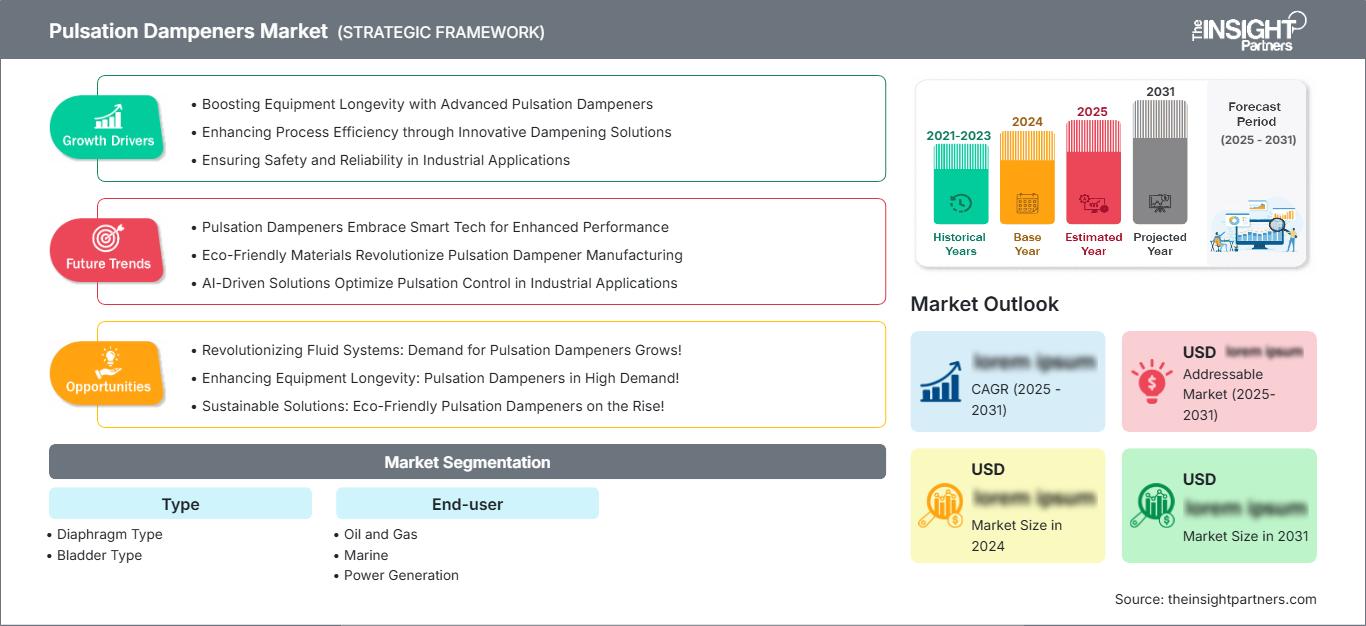
Pulsation Dampeners Market: Strategic Insights
Regional Insights
North America pulsation dampeners market
North America is estimated to account for a 30–34% pulsation dampeners market share in 2025 and grow at a 4.0–4.8% CAGR through 2034. The United States leads in regional consumption, backed by mature oil and gas, refineries, petrochemicals, power generation, and municipal water supply networks. Replacements for old pumps and maintenance programs driven by reliability offer a consistent installed-base opportunity.
Oil production in Canada, mining, water, and industrial processing contribute from Canada and Mexico, providing manufacturing, energy, and municipal needs. Buyers identify dampeners by pressure class, chemical composition, temperature, and instrument protection. Modernization of brownfields is key, as the small configuration of retrofits can help to mitigate pulsations without redesigning pipelines.
U.S. Pulsation Dampeners Market
The United States represents an estimated 74–78% of North American demand in 2025 and is projected to grow at a 4.0–4.7% CAGR. Oil & gas, refining, chemicals, water treatment, and industrial processes make up the primary end-user base where equipment protection and pressure management become vital criteria in purchasing decisions.
The local market consists of Ashcroft Inc., Cat Pumps, Parker-Hannifin Corporation, and Ingersoll Rand Inc. Applications in oilfield and chemical dosing prefer equipment that is designed to function at high pressure with corrosion resistance, while the municipal and industrial water applications require reliability and easy maintenance.
Europe Pulsation Dampeners Market
Europe is estimated to hold a 24–28% share of the pulsation dampeners market in 2025 and expand at a 3.7–4.5% CAGR, with Germany the leading country. Oil & gas, refining, chemicals, water treatment, and industrial processes make up the primary end-user base where equipment protection and pressure management become vital criteria in purchasing decisions.
The local market consists of Ashcroft Inc., Cat Pumps, Parker-Hannifin Corporation, and Ingersoll Rand Inc. Applications in oilfield and chemical dosing prefer equipment that is designed to function at high pressure with corrosion resistance, while the municipal and industrial water applications require reliability and easy maintenance.
APAC Pulsation Dampeners Market
APAC is estimated at a 25–29% share of the pulsation dampeners market in 2025 and is projected to expand at a 5.0–5.8% CAGR, making it a leading growth region. China leads regional demand, followed by Japan, South Korea, India, and Australia, supported by industrial production, energy, chemicals, and water infrastructure.
Industrial expansion and public investment in water treatment are broadening the addressable base. China benefits from large process industries, India from manufacturing and utility development, and Japan and South Korea from advanced industrial systems. Australia adds mining and water applications. Policy support for infrastructure modernization reinforces demand for pressure-management equipment.
Middle East & Africa Pulsation Dampeners Market
The Middle East and Africa pulsation dampeners market is expected to expand at a 4.2–5.0% CAGR, with Saudi Arabia leading regional demand, followed by the UAE and South Africa. Energy production, desalination, water reuse, and industrial infrastructure create recurring requirements for reliable pressure control.
Saudi Arabia and the UAE support demand through hydrocarbon processing, water projects, and industrial diversification, while South Africa contributes through mining and utilities. The rest of MEA remains project-driven, with procurement influenced by harsh conditions, service access, corrosion exposure, and energy infrastructure. Robust materials and local technical support improve supplier positioning.
Segmentation Analysis
Power Rating
Power Rating segmentation defines the pulsation dampeners market scope by pump capacity and duty profile served by each dampener configuration. Demand is associated with equipment supporting common industrial pumping loads, while high-power installations require stronger pressure containment, larger effective volumes, and carefully engineered connections. This segment is expected to expand at a 4.1–4.9% CAGR between 2026–2034.
- Up to 50 HP: Serves compact pumping systems where installation simplicity, cost control, and easy replacement matter. Demand spans water, light industrial, chemical, and smaller process installations.
- 51 HP-150 HP: Addresses mid-range industrial pumping duties, balancing capacity and equipment complexity. It is strategically relevant for chemical, water, food, and general process applications.
- Above 150 HP: Targets high-flow and high-pressure systems, including energy and heavy industrial services. Selection emphasizes pressure containment, connection integrity, and long operating life.
End-user
End-user segmentation captures differences in fluid characteristics, operating pressure, duty cycle, regulatory expectations, and asset criticality. Water and wastewater projects favor reliability and serviceability, while oil and gas and petrochemical installations emphasize pressure containment and material compatibility. The segment is expected to grow at a 4.5–5.3% CAGR between 2026–2034, with industrial diversification supporting adoption.
- Oil and Gas: Requires robust pressure-management components for production, transfer, refining, and related process systems. Buyers prioritize high-pressure performance, corrosion resistance, hazardous-area suitability, and dependable aftermarket support.
- Marine: Uses dampening solutions to control pressure fluctuations in compact fluid systems where vibration, space constraints, and reliability are critical. Corrosion-resistant materials and maintainable designs are strategically important.
- Power Generation: Supports stable operation of feedwater, chemical dosing, cooling, and auxiliary pumping systems. Equipment selection emphasizes predictable pressure behavior, long service intervals, and compatibility with demanding plant conditions.
- Chemical and Petrochemical: Demands materials and configurations suited to aggressive, hazardous, or viscous fluids. Engineered sealing, process compatibility, and pressure stability strongly influence procurement and replacement decisions.
- Water and Wastewater: Benefits from stable flow and reduced mechanical stress across treatment and distribution systems. Municipal upgrades, industrial reuse, and decentralized treatment support recurring demand for reliable dampening components.
Opportunity Snapshot
| Industry | End-user Revenue Contribution | Trend Tag | Adoption Stage |
|---|---|---|---|
| Oil and Gas | High | High Pressure | Mature |
| Marine | Low | Corrosion Control | Scaling |
| Power Generation | Medium | Flow Stability | Mature |
| Chemical and Petrochemical | High | Chemical Compatibility | Mature |
| Water and Wastewater | High | Water Reuse | Scaling |
Pulsation Dampeners Market Growth Drivers and Impact Analysis
Expansion of municipal and industrial water treatment
Water shortage, discharge specifications, and system replacement are driving up pumping resources at treatment plants and reuse facilities. Pulsation reduction is necessary when positive displacement pumps are used for dosing, sludge management, filtration, or chemical transport, as fluctuating discharge patterns increase wear and interfere with instrumentation. Such a purchase is not confined only to new installations. Older facilities need to buy retrofit products that would stabilize hydraulics without a complete replacement of the pumping system. This results in an ongoing after-market for dampeners and their suppliers. Manufacturers that offer compact design, compatibility with various elastomers, resistance to corrosion of the wetted parts, and ease of installation meet the demands of both the municipal and industrial sectors.
Higher reliability requirements in oil and gas pumping
Oil and gas equipment runs on high-pressure applications, using difficult fluids, and with significant consequences of system failure. Pressure dampening may therefore be an important factor in engineering. Pumps such as reciprocating and diaphragm are used for production, chemical injection, metering, and processes, which have the potential to produce pulsations that pass through pipes and instrumentation. Dampeners may therefore be an important protective element instead of being an additional accessory to protect against equipment problems caused by dynamic systems. This investment is especially significant in brownfield assets, since companies will always be interested in upgrading their pumps selectively rather than fully replacing them. This includes vessels, elastomers, seals, and services. Companies with proven materials, pressure ratings, and field service have a better chance of winning their specifications.
Greater adoption of integrated pressure-management packages
The increasing trend among purchasers of equipment is to assess pumps, dampeners, instrumentation, controls, and piping as systems, not individual pieces. This method of thinking has an added advantage in reducing commissioning risk because pulsation is determined by pump frequency, discharged quantity, precharge, pipe configuration, fluid characteristics, and other operational factors. A combined system approach helps simplify the process of responsibility in terms of both performance and maintenance. Suppliers with a more extensive product range can take advantage of this trend by packaging dampeners with pumps, pressure instrumentation, control systems, or service agreements. End users can benefit from a simpler engineering interface and less risk in terms of total lifecycle. The effect is particularly pertinent to skid-mounted equipment, chemical feed systems, and smaller-scale treatment facilities.
Pulsation Dampeners Market Future Trends
Self-regulating dampening architectures
Future designs are likely to place greater emphasis on dampeners that automatically adapt to changing pump conditions rather than relying entirely on fixed precharge or manual adjustment. Active diaphragm architectures already demonstrate how compressed air and process pressure can be managed dynamically to stabilize discharge flow. The next development stage should combine pressure sensing, adaptive control logic, and condition monitoring to maintain damping performance across variable pump speeds and process loads. Such systems can help where production recipes change frequently, or pumps operate across wide duty envelopes. Integration with plant controls may identify membrane deterioration, abnormal pressure behavior, or charging problems before failure. The pulsation dampeners market trends will shift purchasing criteria toward controllability, diagnostics, compatibility, and measurable performance.
Material engineering for aggressive and hygienic fluids
The choice of material is likely to be more of a distinguishing factor as dampeners become used increasingly in specialized chemical, food, pharmaceutical, and water applications. Producers can increase the size of the target market by designing dampeners with corrosion-resistant cases and an optimal design of the diaphragms, bladders, seals, and hygienic connection systems. More advanced elastomer compounds can enhance compatibility with solvents, acids, cleaning chemicals, and thermal cycling, while stainless steel construction is ideal for challenging process conditions. In addition, the hygienic applications will require cleanable designs and materials that would work in contact with fluids. The suppliers can design modular wet ends in order to adapt the same platform to different fluids.
Pulsation Dampeners Market Opportunities
Retrofit packages for aging pumping assets
A substantial opportunity exists for pulsation dampeners market Forecasts focused on retrofit packages designed for installed positive displacement pumps where pressure pulsation, vibration, or instrument instability has emerged after years of operation. Instead of replacing complete pump assemblies, operators can add correctly sized dampeners, upgraded connections, pressure gauges, and compatible elastomer components. Vendors can develop application kits organized by pump model, pressure range, and process fluid, reducing engineering effort for maintenance teams. Distributor stock programs could shorten downtime by holding common replacement units and service parts. Digital sizing tools may improve selection by incorporating flow rate, stroke frequency, pressure, fluid properties, and pipe characteristics. The opportunity extends beyond equipment sales into membranes, inspection, and commissioning. Suppliers combining retrofit products with field engineering can capture this aftermarket.
Application-specific solutions for emerging process industries
Further investment possibilities are also emerging in areas where process stability through pressure regulation is becoming increasingly critical as processes become miniaturized, automated, and chemically demanding. Processes like water recycling, specialist chemicals production, battery material processing, and high-tech manufacturing may demand precision in liquid movement under fluctuating operating conditions. This can be done by manufacturers designing customized dampening systems based on the type of liquid, temperature range, connection specifications, and sanitary considerations. Manufacturing or assembling of dampeners in local regions can help reduce delays in meeting project needs. The strongest possibility lies in companies adapting dampening technologies to different processes. Pump OEMs, skid manufacturers, and engineering firms will make this easy for them.
Frequently Asked Questions

- Comprehensive Market Sizing and Forecast Analysis
- Detailed Segmentation Analysis
- In-Depth Market Dynamics Assessment
- Regional and Country-Level Insights
- Competitive Landscape and Company Benchmarking
- Strategic Business Intelligence
Recent Reports
Testimonials

The Insight Partners provided valuable market intelligence that supported our global go-to-market strategy. Their team was professional, responsive, and attentive to our feedback, providing thoughtful analysis and helpful methodological clarifications throughout the project.
Junmo Kim Chief Financial Officer (CFO), Enertech Co., Ltd.
The Insight Partners' SCADA System Market report is comprehensive, with valuable insights on current trends and future forecasts. The team was highly professional, responsive, and supportive throughout. We are very satisfied and highly recommend their services.
RAN KEDEM Partner, Reali Technologies LTDs
I requested a report on a very specific software market and the team produced the report in a few days. The information was very relevant and well presented. I then requested some changes and additions to the report. The team was again very responsive and I got the final report in less than a week.
JEAN-HERVE JENN Chairman, Future Analytica
We worked with The Insight Partners for an important market study and forecast. They gave us clear insights into opportunities and risks, which helped shape our plans. Their research was easy to use and based on solid data. It helped us make smart, confident decisions. We highly recommend them.
PIYUSH NAGPAL Sr. Vice President, High Beam Global
The Insight Partners delivered insightful, well-structured market research with strong domain expertise. Their team was professional and responsive throughout. The user-friendly website made accessing industry reports seamless. We highly recommend them for reliable, high-quality research services
YUKIHIKO ADACHI CEO, Deep Blue, LLC.
This is the first time I have purchased a market report from The Insight Partners.While I was unsure at first, I visited their web site and felt more comfortable to take the risk and purchase a market report.I am completely satisfied with the quality of the report and customer service. I had several questions and comments with the initial report, but after a couple of dialogs over email with their analyst I believe I have a report that I can use as input to our strategic planning process.Thank you so much for taking the extra time and making this a positive experience.I will definitely recommend your service to others and you will be my first call when we need further market data.
JOHN SUZUKI President and Chief Executive Officer, Board Director, BK Technologies
I wish to appreciate your support and the professionalism you displayed in the course of attending to my request for information regarding to infectious disease IVD market in Nigeria. I appreciate your patience, your guidance, and the fact that you were willing to offer a discount, which eventually made it possible for us to close a deal. I look forward to engaging The Insight Partners in the future, all thanks to the impression you have created in me as a result of this first encounter.
DR CHIJIOKE ONYIA MANAGING DIRECTOR, PineCrest Healthcare Ltd.Reason to Buy
- Informed Decision-Making
- Understanding Market Dynamics
- Competitive Analysis
- Identifying Emerging Markets
- Customer Insights
- Market Forecasts
- Risk Mitigation
- Boosting Operational Efficiency
- Strategic Planning
- Investment Justification
- Tracking Industry Innovations
- Aligning with Regulatory Trends





 Get Free Sample for