
PVC Window Market Size, Share & Demand by 2034
Coverage: By Type (Turn and Tilt Window, Sliding Window, Casement Window, Others); Application (Residential, Commercial) , and Geography (North America, Europe, Asia Pacific, and South and Central America)
- Status : Data Released
- Report Code : TIPRE00020889
- Category : Manufacturing and Construction
- No. of Pages : 150
- Available Report Formats :


- Last update date : September 01, 2026


2025 Market Size
US$ 26.02 Bn
Base year value
2034 Forecast
US$ 33.56 Bn
Projected by 2034
CAGR 2026-2034
2.87 %
Growth rate
Addressable Market
US$ 270.49 Bn
(2026-2034)
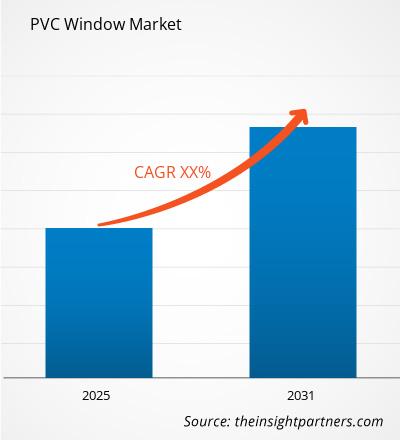
The pvc window market is entering a phase of measured expansion as energy-efficiency requirements, replacement activity, and durable building-material preferences influence product selection. The market is valued at US$ 26.02 Billion in 2025 and is projected to reach US$ 33.56 Billion by 2034, registering a CAGR of 2.87% from 2026 to 2034. Growth is supported by renovation demand, improving thermal-performance standards, and continued adoption across residential and commercial construction.
North American demand is expected to expand at an estimated 3.6–4.2% CAGR between 2026 and 2034, supported by the replacement of aging fenestration, stricter building-performance requirements, and consumer preference for low-maintenance frames. The pvc window market size in the region benefits particularly from remodeling expenditure, climate-related insulation requirements, and established vinyl fabrication networks serving suburban housing markets.
PVC Window Market Assessment and Insights
- North America: North America is estimated to represent 28–32% share in 2025 and grow at a 3.6–4.2% CAGR between 2026–2034, supported by replacement activity, energy-efficiency upgrades, and established vinyl window fabrication infrastructure.
- US: The US represents approximately 24–27% share in 2025 of the global market and is projected to grow at 3.5–4.1% CAGR between 2026–2034, led by remodeling and replacement demand.
- Europe: Europe holds an estimated 39–43% share in 2025 and is expected to grow at 2.4–3.0% CAGR between 2026–2034, with Germany, the UK, France, Italy, and Poland remaining important markets for renovation-led demand.
- Asia Pacific: Asia Pacific accounts for approximately 17–21% share in 2025 and is projected to expand at 3.8–4.6% CAGR between 2026–2034, with China, India, Japan, South Korea, and Australia supporting demand.
- Largest Segment: Casement Window is estimated to hold 42–46% market share in 2025, with a 2.7–3.2% CAGR between 2026–2034, reflecting broad residential applicability and established fabrication practices.
- High Growth Segment: Commercial application represents the high-growth segment, with an estimated 2.9–3.5% CAGR between 2026–2034, driven by energy-performance requirements and institutional renovation.
- Key companies analyzed in detail: Deceuninck NV, Epwin Group Plc, Eurocell Plc, Fortune Brands Innovations, Inc., LIXIL Corporation, Masco Corporation, PGT Innovations, Inc., Ply Gem Residential Solutions, VEKA AG, and REHAU Industries SE & Co. KG.
Source: The Insight Partners' analysis based on proprietary research, government publications, company annual reports, investor presentations, industry databases, and expert interviews.
The pvc window market has evolved through improvements in multi-chamber profiles, reinforcement systems, glazing compatibility, surface finishing, and automated fabrication. Manufacturers are using greater proportions of recycled PVC in profile cores without losing dimensional stability and insulation qualities. Deceuninck states that its Belgian recycling plants produced over 22,000 tons of input material in 2025. This is an example of how circular raw materials are becoming part of the economic equation rather than being a side sustainability program.
In terms of future investments, there would be an emphasis on high-insulation profiles, recyclable formulas, digital manufacturing processes, and regional production capacity. Renovation legislation in Europe will support the market for replacements, but urban construction and rising middle-class housing in India and Southeast Asia present opportunities. In North America, there would be an emphasis on replacement programs and customization, while in Europe, there would be differentiation based on certified environmental performance and insulation.
PVC Window Market Report Scope
| Report Attribute | Details |
|---|---|
| Market size in 2025 | US$ 26.02 Billion |
| Market Size by 2034 | US$ 33.56 Billion |
| Global CAGR (2026 - 2034) | 2.87% |
| Historical Data | 2021-2024 |
| Forecast period | 2026-2034 |
PVC Window Market Analysis
Demand across the pvc window market growth ecosystem is shaped by housing construction, replacement cycles, profile extrusion, glazing supply, hardware integration, fabrication, distribution, and installation. PVC resin together with additives, represents the upstream foundation, whereas processors turn these raw materials into systems suited for specific applications. In addition to rising energy expenses, building-envelope regulations impact specification considerations, which means that factors such as thermal transmittance, air tightness, durability, and glazing compatibility play roles in decision-making processes.
Market dynamics differ by region due to the fact that profile extrusion is relatively regional compared to PVC resin manufacturing. Big companies enjoy economies of scale in terms of tooling, compounding, recycling, and distribution, whereas small fabricators strive for customization and installation flexibility. Closed-loop recycling is gaining significance in Europe. Recycling of profiles cuts down demand for new materials. North American companies still enjoy competitive benefits from the long-term development of the vinyl material supply chain, whereas Asian manufacturers start to leverage local production along with technology alliances and premium hardware imports.
The pvc window market analysis indicates a fragmented competitive structure in which profile technology, fabrication efficiency, product breadth, geographic reach, and channel relationships determine positioning. Deceuninck NV and Eurocell Plc have substantial exposure in European systems, while Epwin Group Plc offers profile manufacturing along with distribution facilities. LIXIL Corporation and Masco Corporation have a comprehensive range of building products that facilitate cross-selling for renovations as well as new constructions.
Investment competition now lies in areas such as recycling, automation in extrusion, energy-efficient profile designs, and local geography. VEKA AG has been increasing its position in India through its ownership in NCL VEKA, while REHAU Industries SE & Co. KG has polymer system capabilities. PGT Innovations, Inc., Ply Gem Residential Solutions, and Fortune Brands Innovations, Inc. offer North American exposure, while regional competitors compete using their custom systems and fast manufacturing.
● REPORT CUSTOMIZATION
Tailor This Report To Align With Your Specific Business Requirements
This report can be customized to align precisely with your business objectives, scope, and target markets. Customization options include tailored segmentation, geography, competitive analysis, and strategic insights to support informed decision-making.
Customize This Report →WHAT YOU CAN ADJUST
- ● Segmentations
- ● Geography
- ● Competitive Analysis
- ● Language Preferences
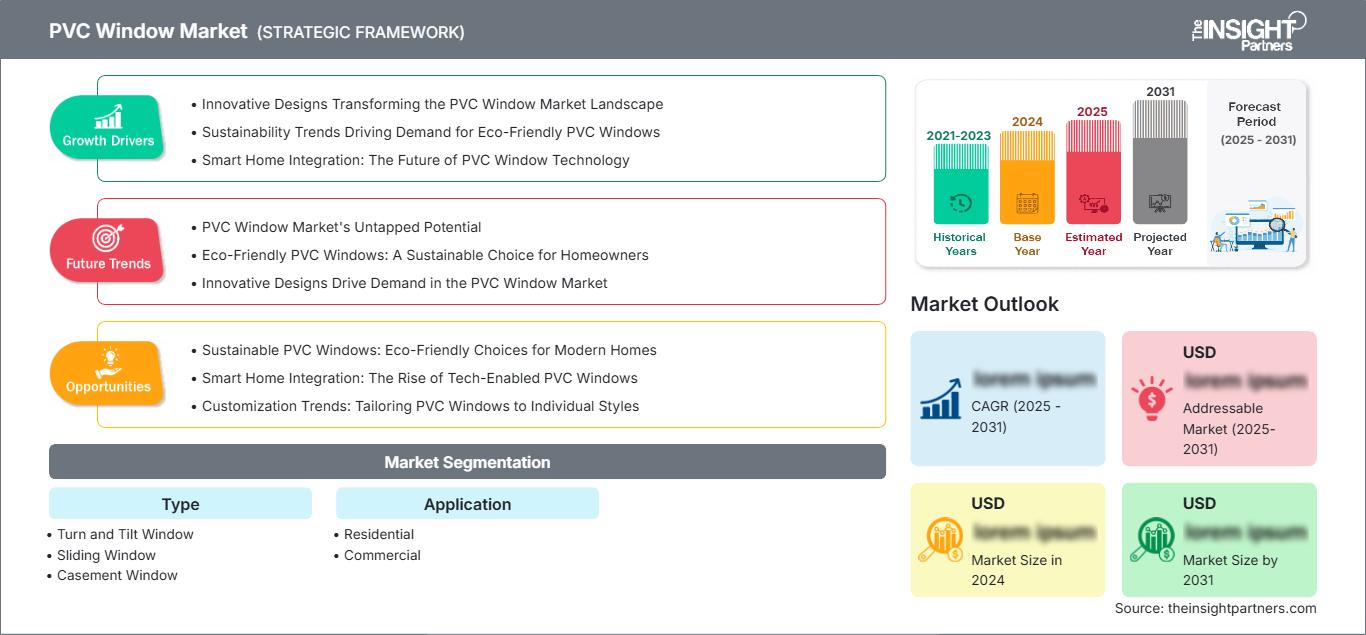
PVC Window Market: Strategic Insights
Regional Insights
North America pvc window market
North America is estimated at 28–32% of the pvc window market share in 2025, with a 3.6–4.2% CAGR through 2034. The United States dominates regional consumption because replacement windows are widely used in residential remodeling, multifamily renovation, and weatherization projects. Canada adds value to the market through energy-efficient construction and cold-weather performance requirements. There are existing distribution and installation channels for vinyl profile production.
The regional demand is further aided by the requirement of enhanced envelope efficiency, moisture resistance, and lower maintenance. Large producers are adding glazing, hardware, installation, and warranty services along with profiles. The United States is still the largest producer, and Canada is good for cold weather conditions and renovations. Growth will be steady due to mature markets, which limit volume growth but support replacement demand.
U.S. pvc window Market
The US accounts for approximately 76–84% of North American pvc window market share in 2025 and is expected to grow at 3.5–4.1% CAGR through 2034. Demand is concentrated in residential replacement, suburban remodeling, multifamily properties, and selected commercial projects requiring cost-efficient thermal performance.
Firms such as Masco Corporation, PGT Innovations, Inc., Ply Gem Residential Solutions, Fortune Brands Innovations, Inc., and Deceuninck NV are involved in various stages of the value chain. The choice of application is determined by climate conditions, architectural style, and cost-effectiveness of replacement, while casement and sliding window styles retain their relevance. Improvements in energy efficiency become especially important in cases where there is a loss of heating/cooling due to outdated single-pane windows.
Europe pvc window Market
Europe represents approximately 39–43% share of the pvc window market in 2025 and is projected to expand at 2.4–3.0% CAGR through 2034, remaining the leading regional market. Germany is the largest country market, supported by replacement demand and mature profile-system manufacturing. The UK, France, Italy, Spain, and Poland also provide substantial renovation opportunities.
There are three primary factors that affect the UK market, such as aged housing stock, energy efficiency and replacement works. The PVC is relevant due to its combination of low maintenance requirements, insulation properties and installer familiarity with the material. The demand for it highly depends on homeowners' renovation budget, financial conditions and legislation changes.
In Germany, there is an established window manufacturing industry, which has good profile systems knowledge and recycling facilities. Thermal insulation, airtightness, soundproofing, and recycling properties become more and more relevant for replacement jobs. Therefore, manufacturers compete in terms of these aspects.
France, Italy, and Spain present different opportunities. France is favored by the aspect of renovation and environmental construction, while Italy by residential refurbishment and replacement. Spain presents a combination of housing construction and renovation. Germany continues to be the number one nation due to its strong manufacturing capability, replacement capacity, and presence of a PVC profile infrastructure.
APAC pvc window Market
APAC holds approximately 17–21% share in 2025 and is forecast to grow at 3.8–4.6% CAGR through 2034, with China leading regional demand. India is emerging as a region of strategic significance due to the growth of organized window fabrication, whereas Japan, South Korea, and Australia favor high-performance-based uses of windows.
Factors such as industrialization, urban housing, climate-conscious construction, and policy attention towards energy-efficient buildings are helping in promoting the use of windows. China helps in this regard through manufacturing, India through construction, Japan and South Korea through product performance, and Australia through building specifications for energy.
Middle East & Africa pvc window Market
The Middle East and Africa pvc window market demand is developing from a smaller base, with growth expected at approximately 3.1–3.8% CAGR through 2034. Saudi Arabia and the UAE lead regional activity, supported by large construction programs, while South Africa remains important for established building-material distribution and residential applications.
Insulated windows become an important practical consideration due to the energy-consuming nature of cooling. Urban infrastructure development in Saudi Arabia is a major advantage for insulated windows, whereas the UAE focuses on quality construction and high-performing buildings. There are existing replacement channels in South Africa. Other MEA is fragmented, but there are possibilities around urban housing and commercial buildings.
Segmentation Analysis
Type
Type remains a key determinant of product positioning, fabrication requirements, and end-user suitability in the PVC Window Market Report. The segment is expected to register a 2.6–3.1% CAGR from 2026–2034. Automatic systems support standardized production and higher throughput, while semi-automatic and manual configurations remain relevant among smaller fabricators and specialized manufacturers.
- Automatic: Automatic systems serve high-volume manufacturers requiring consistent welding, cutting, routing, and assembly. Their strategic importance increases where labor costs, quality control, production repeatability, and shorter manufacturing cycles influence profitability.
- Semi-Automatic: Semi-automatic equipment balances operator involvement with process consistency, making it suitable for mid-sized fabricators handling varied orders. Its flexibility supports manufacturers managing multiple window configurations without fully automated capital expenditure.
- Manual: Manual production remains relevant for small workshops, customized installations, and low-volume regional demand. Its lower entry cost supports fragmented fabrication markets, although productivity and repeatability can constrain competitiveness at larger scales.
Application
Application determines purchasing specifications, order volumes, and installation economics. The segment is projected to grow at 2.8–3.4% CAGR from 2026–2034. Residential projects provide broad recurring demand, while commercial construction increasingly requires documented thermal and acoustic performance, lifecycle durability, and compliance with building-envelope standards.
- Residential: Residential applications represent the core demand base because replacement and new-home construction require affordable, durable, and low-maintenance window systems. Consumer priorities increasingly combine insulation, appearance, ventilation, security, and lifecycle value.
- Commercial: Commercial applications require stronger specification discipline around thermal performance, durability, acoustic control, fire considerations, and installation scheduling. Institutional and office renovation projects can favor standardized systems that simplify procurement and maintenance.
Opportunity Snapshot
| Application | Revenue Contribution | Trend Tag | Adoption Stage |
| Residential | High | Home Retrofit | Mature |
| Commercial | Medium | Envelope Efficiency | Scaling |
PVC Window Market Growth Drivers and Impact Analysis
Energy-performance requirements accelerating replacement decisions
The efficiency of building envelopes is now becoming a consideration during procurement as governments and building owners try to cut down the need for heating and cooling. Multi-chamber construction design, better sealing, compatible low-emissivity glass, as well as reinforcement, will improve the thermal properties of PVC windows without the manufacturers having to sacrifice their existing production technology. The biggest effect will be seen in the countries that have a significant number of renovations going on and thus, the older windows are inefficient. The commercial buildings also present an additional consideration because cutting down on operating costs can make a difference when making investment decisions over longer time spans.
Renovation activity sustaining replacement-oriented demand
Renovation represents an example of a structural driver of demand, since windows may be replaced without the need to renovate the entire building. Owners can update their living conditions, minimize the effects of draft, and make the appearance of their homes more modern by making specific improvements to their windows. It means that this feature makes it possible for such a kind of demand to persist even if there are no new houses built. At the same time, it becomes profitable to offer standard sizes and domestically manufactured products due to logistics, installation, and after-sales services associated with the cost of the entire project. It helps replace demand in the mature markets of Europe and North America to stabilize demand related to construction cycles.
Circular-material adoption reshaping profile manufacturing
The use of recycled PVC is becoming more of a part of operations than just an environmental factor. According to Deceuninck, recycled PVC needs less energy than new material, and 95% of the waste generated in its manufacture is reused. This kind of scenario encourages manufacturers to be able to collect, sort, clean, compound, and co-extrude recycled PVC. The implications of this are not only felt in procurement, since using recycled material may mean having less exposure to virgin material requirements and environmental documentation at the same time. Manufacturers with an already set-up recycling system can differentiate their products by using this as an advantage. In the future, the trend is expected to increase demands for extrusion technology, quality control, and recycling partnerships.
PVC Window Market Future Trends
Recycled-content profiles moving toward mainstream specifications
Future developments in product design will likely focus on profile designs based on recycled materials under controlled conditions, such as designs in which the recycled core material is separated from the high-performance surface. In this way, manufacturers can increase the amount of circular materials used without affecting the look and dimensions of the profile. Product specifications may include environmental information, certification of recycled content and end-of-life recovery for future procurement departments. European manufacturers are ready to play this role since recycling infrastructures and expectations in this respect have reached a certain level of maturity. North American and Asian manufacturers are expected to follow suit once there are enough recycled materials and circular building products have become familiar to the customer.
Digital fabrication improving customization economics
Digital production technologies are expected to influence how fabricators manage increasingly varied window configurations. Automated cutting optimization, barcode-based production tracking, digital measurement, and connected machinery can reduce material waste while improving order traceability. Such capabilities are particularly relevant for replacement projects, where dimensions vary substantially and installation schedules can be difficult to coordinate. Smaller fabricators may adopt modular automation rather than complete production lines, allowing them to improve productivity incrementally. Larger manufacturers can integrate design, production planning, inventory, and logistics systems to shorten lead times. As customization becomes more common, digital workflows may become an important competitive differentiator because they allow manufacturers to maintain product variety without proportionally increasing labor requirements, rework, inventory, or administrative complexity.
PVC Window Market Opportunities
Localized premium systems in high-growth construction economies
Manufacturers can pursue attractive opportunities by adapting established PVC profile technologies to rapidly urbanizing markets where climate conditions, architectural preferences, and construction practices differ from European standards. India, Southeast Asia, and selected Middle Eastern markets offer room for localized systems combining insulation, solar control, ventilation, durability, and cost efficiency. Successful investment requires more than exporting standard profiles because local fabricator capability, hardware availability, installation quality, and after-sales support influence adoption. Establishing regional extrusion, fabrication, or technical partnerships can reduce logistics exposure while improving customization. The opportunity is particularly relevant for suppliers with proven system platforms that can be modified for local building codes and climatic requirements without creating entirely new tooling ecosystems.
Closed-loop replacement networks for recovered window materials
The growing replacement cycle creates an opportunity to develop collection networks connecting installers, demolition contractors, recyclers, profile manufacturers, and fabricators. Recovered PVC from old windows can become a feedstock source when sorting and processing systems preserve material quality. A coordinated model can reduce disposal requirements while creating a more predictable recycled-material supply for extrusion operations. Manufacturers could strengthen participation through installer incentives, collection partnerships, dedicated recovery logistics, and product designs optimized for dismantling. The pvc window market Forecasts increasingly favor suppliers able to connect product sales with lifecycle management because circularity can influence procurement decisions, regulatory compliance, and material security. Investment in regional recycling hubs could therefore complement conventional profile manufacturing capacity.
Frequently Asked Questions

- Comprehensive Market Sizing and Forecast Analysis
- Detailed Segmentation Analysis
- In-Depth Market Dynamics Assessment
- Regional and Country-Level Insights
- Competitive Landscape and Company Benchmarking
- Strategic Business Intelligence
Recent Reports
Testimonials

The Insight Partners provided valuable market intelligence that supported our global go-to-market strategy. Their team was professional, responsive, and attentive to our feedback, providing thoughtful analysis and helpful methodological clarifications throughout the project.
Junmo Kim Chief Financial Officer (CFO), Enertech Co., Ltd.
The Insight Partners' SCADA System Market report is comprehensive, with valuable insights on current trends and future forecasts. The team was highly professional, responsive, and supportive throughout. We are very satisfied and highly recommend their services.
RAN KEDEM Partner, Reali Technologies LTDs
I requested a report on a very specific software market and the team produced the report in a few days. The information was very relevant and well presented. I then requested some changes and additions to the report. The team was again very responsive and I got the final report in less than a week.
JEAN-HERVE JENN Chairman, Future Analytica
We worked with The Insight Partners for an important market study and forecast. They gave us clear insights into opportunities and risks, which helped shape our plans. Their research was easy to use and based on solid data. It helped us make smart, confident decisions. We highly recommend them.
PIYUSH NAGPAL Sr. Vice President, High Beam Global
The Insight Partners delivered insightful, well-structured market research with strong domain expertise. Their team was professional and responsive throughout. The user-friendly website made accessing industry reports seamless. We highly recommend them for reliable, high-quality research services
YUKIHIKO ADACHI CEO, Deep Blue, LLC.
This is the first time I have purchased a market report from The Insight Partners.While I was unsure at first, I visited their web site and felt more comfortable to take the risk and purchase a market report.I am completely satisfied with the quality of the report and customer service. I had several questions and comments with the initial report, but after a couple of dialogs over email with their analyst I believe I have a report that I can use as input to our strategic planning process.Thank you so much for taking the extra time and making this a positive experience.I will definitely recommend your service to others and you will be my first call when we need further market data.
JOHN SUZUKI President and Chief Executive Officer, Board Director, BK Technologies
I wish to appreciate your support and the professionalism you displayed in the course of attending to my request for information regarding to infectious disease IVD market in Nigeria. I appreciate your patience, your guidance, and the fact that you were willing to offer a discount, which eventually made it possible for us to close a deal. I look forward to engaging The Insight Partners in the future, all thanks to the impression you have created in me as a result of this first encounter.
DR CHIJIOKE ONYIA MANAGING DIRECTOR, PineCrest Healthcare Ltd.Reason to Buy
- Informed Decision-Making
- Understanding Market Dynamics
- Competitive Analysis
- Identifying Emerging Markets
- Customer Insights
- Market Forecasts
- Risk Mitigation
- Boosting Operational Efficiency
- Strategic Planning
- Investment Justification
- Tracking Industry Innovations
- Aligning with Regulatory Trends





 Get Free Sample for