
Radial Drilling Machine Market Growth, Share & Trends by 2034
Coverage: by Type (Manual Clamping, Electrical Clamping, Hydraulic Clamping); Application (Construction, Metal Working, Wood Working, Others) , and Geography (North America, Europe, Asia Pacific, and South and Central America)
- Status : Data Released
- Report Code : TIPRE00010328
- Category : Manufacturing and Construction
- No. of Pages : 150
- Available Report Formats :


- Last update date : September 02, 2026


2025 Market Size
US$ 2.0 Bn
Base year value
2034 Forecast
US$ 2.83 Bn
Projected by 2034
CAGR 2026-2034
3.95 %
Growth rate
Addressable Market
US$ 21.96 Bn
(2026-2034)
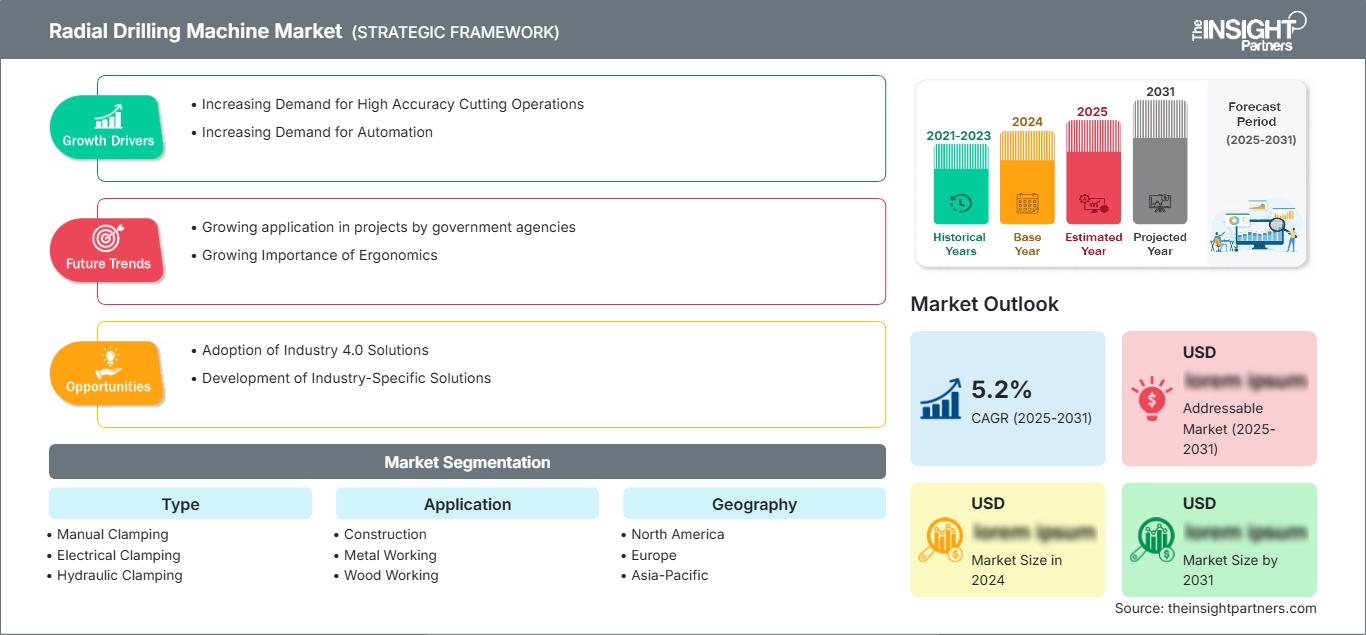
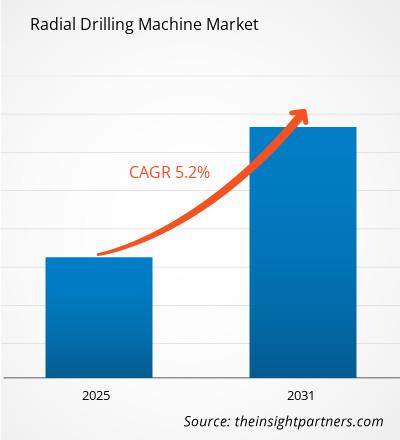
The radial drilling machine market is valued at US$ 2.0 Billion in 2025 and is projected to reach US$ 2.83 Billion by 2034, registering a CAGR of 3.95% from 2026 to 2034. Demand is supported by the need for versatile drilling of large and heavy workpieces across fabrication, construction, and industrial machining environments, while manufacturers continue refining clamping systems, spindle configurations, and machine rigidity.
North American procurement is expected to remain steady, with the radial drilling machine market size supported by replacement demand, infrastructure refurbishment, and metal fabrication activity. The region is estimated to expand at a 3.4–4.2% CAGR between 2026 and 2034, as manufacturers prioritize durable equipment, reduced setup time, and electronically controlled operations for high-mix production environments.
Radial Drilling Machine Market Assessment and Insights
- North America: North America is expected to represent 21–25% share in 2025 and grow at a 3.4–4.2% CAGR between 2026–2034, supported by fabrication, infrastructure maintenance, aerospace machining, and replacement of aging workshop equipment.
- US: The US is estimated to account for 68–72% of North America's 2025 share and expand at a 3.5–4.3% CAGR between 2026–2034, led by industrial fabrication and machinery modernization.
- Europe: Europe is projected to hold 24–28% share in 2025 and register a 3.1–3.9% CAGR between 2026–2034, with Germany, Italy, France, and the UK benefiting from established engineering and metalworking ecosystems.
- Asia Pacific: Asia Pacific is expected to command 39–43% share in 2025 and advance at a 4.2–5.0% CAGR between 2026–2034, with China, Japan, India, and South Korea supported by manufacturing expansion.
- Largest Segment: Metal Working is estimated to hold a 32–36% market share in 2025, supported by broad utilization in heavy fabrication and component machining, with a 3.8–4.5% CAGR between 2026–2034.
- High Growth Segment: Electrical Clamping is estimated at 18–22% market share in 2025, while automated positioning requirements support a 4.8–5.6% CAGR between 2026–2034.
- Key companies analyzed in detail: Eastar Machine Tools Corps, Esskay International Machine Tools, GILLARDON GmbH and Co. KG, HMT Machine Tools Limited, Kanematsu KGK Corp, Ohtori-kiko Co., Ltd., Shenyang Haitong International Machinery and Equipment Co., Ltd., Taian Hiscience Machinery Co., Ltd., Tailift Co., Ltd., and WGM Maschinen.
Source: The Insight Partners' analysis based on proprietary research, government publications, company annual reports, investor presentations, industry databases, and expert interviews.
The radial drilling machine market has evolved from predominantly manually operated equipment toward configurations offering electrical or hydraulic clamping, improved spindle control, and more repeatable positioning. Increasingly, machines are being differentiated by column rigidity, travel distance of radial arm, drilling capability, flexibility of work envelope, and operator comfort. The trend is due to a need for fewer workpiece repositioning operations in machining larger parts. Heavy fabrication will continue to be important as radial machines allow drilling through larger parts without repositioning them.
In the coming years, the focus of investments will likely shift towards electronically aided machines, energy-saving drive systems, and equipment capable of integration into larger factory upgrades. New manufacturing centers that may emerge in India and Southeast Asia could become candidates for capacity investments from suppliers looking for competitively priced and customer-proximate locations. There should be replacement demand from Europe and opportunities for fresh purchases of machinery in selected Asian economies.
Radial Drilling Machine Market Report Scope
| Report Attribute | Details |
|---|---|
| Market size in 2025 | US$ 2.0 Billion |
| Market Size by 2034 | US$ 2.83 Billion |
| Global CAGR (2026 - 2034) | 3.95% |
| Historical Data | 2021-2024 |
| Forecast period | 2026-2034 |
Radial Drilling Machine Market Analysis
Demand for radial drilling machine market products is closely linked to the fabrication of large metal structures, machinery components, plates, flanges, and heavy industrial assemblies. Radial drilling machine market growth, therefore, depends on capital expenditure in construction equipment, general manufacturing, structural fabrication, and maintenance workshops. These comprise machine makers, casting and steel makers, spindle and drive makers, electric components providers, distributors, service firms, and industrial clients.
The mobility of the drilling head by means of the radial arm makes the equipment suitable where pieces cannot be handled by regular drill presses. Competing in terms of drilling diameter, reach of arm, spindle speed, size of the table, reliability of clamping, and serviceability, equipment makers use hydraulic and electric means to limit manual actions, whereas manual machines are still useful where procurement is determined by their purchase cost and simplicity.
Competitive positioning varies substantially by machine configuration, customer geography, and application specialization. Radial drilling machine analysis indicates that established manufacturers compete through engineering reliability, customization, installed-service capability, and distributor coverage rather than through a single technology proposition. Tailift Co., Ltd. offers manual, electric, and hydraulic radial drilling configurations, while HMT Machine Tools Limited maintains relevance through its established industrial machinery portfolio. GILLARDON GmbH and Co. KG, Eastar Machine Tools Corps, and Taian Hiscience Machinery Co., Ltd. address different segments of industrial drilling demand.
Investment decisions increasingly emphasize lifecycle economics rather than acquisition price alone, as highlighted in the Radial Drilling Machine Market Report. Kanematsu KGK Corp and Ohtori-kiko Co., Ltd. benefit from Japan's established machinery distribution ecosystem, while Shenyang Haitong International Machinery and Equipment Co., Ltd. and Esskay International Machine Tools provide access to Asian industrial procurement channels. WGM Maschinen, along with HMT Machine Tools Limited and Tailift Co., Ltd., can differentiate through machine configuration, application support, and aftermarket service. This competitive structure favors suppliers able to combine robust equipment with responsive technical support.
● REPORT CUSTOMIZATION
Tailor This Report To Align With Your Specific Business Requirements
This report can be customized to align precisely with your business objectives, scope, and target markets. Customization options include tailored segmentation, geography, competitive analysis, and strategic insights to support informed decision-making.
Customize This Report →WHAT YOU CAN ADJUST
- ● Segmentations
- ● Geography
- ● Competitive Analysis
- ● Language Preferences
Radial Drilling Machine Market: Strategic Insights
Regional Insights
North America radial drilling machine market
North America is estimated to account for 21–25% of the radial drilling machine market share in 2025, with a projected 3.4–4.2% CAGR through 2034. There is demand for this equipment in the United States, Canada, and Mexico, since there is a need for drilling large-sized metal parts in metal fabricating, machine repair operations, infrastructural projects, and manufacturing of components of aircraft. There is now increasing emphasis on having sturdy machines, efficient spindle performance, and easy positioning.
The local purchasing trend revolves around the replacement of old machines as well as the purchase of electronically assisted versions. The workshop that deals with the manufacture of structural steel, transportation, and industrial machinery needs wide work areas as well as accurate drilling operations. Having local availability of service is now a factor in the purchasing process.
U.S. radial drilling machine Market
The US represents approximately 68–72% of North America's 2025 radial drilling machine market share and is expected to expand at a 3.5–4.3% CAGR through 2034. Industrial machinery, structural fabrication, aerospace manufacturing, and maintenance operations generate sustained requirements for radial drilling equipment, particularly where large components cannot be efficiently repositioned.
More stress is now being put on application requirements, which focus on the machine’s flexibility of manufacturing operations rather than merely on the ability to drill a hole. Machine builders need machines that will be able to deal with different sizes of workpieces and will keep the spindle steady at the same time. This can be achieved by suppliers like HMT Machine Tools Limited, Tailift Co., Ltd. and Eastar Machine Tools Corps.
Europe radial drilling machine Market
Europe is estimated to hold 24–28% share in 2025 and register a 3.1–3.9% CAGR through 2034, with Germany leading regional demand. There is the presence of engineering, metalworking, machinery, and industrial maintenance bases in the UK, Germany, France, Italy, and Spain, which helps in not only replacements but also capacity additions.
There is the UK, with demands being made from the fabrication and machinery services industry, where the versatility of the machinery and ease of maintenance become important. Germany continues to be the dominant market due to its engineering base, which needs dependable drillers in machinery, tooling, automotive suppliers, and heavy fabrication. France, Italy, and Spain add value by way of industrial manufacturing and construction equipment ecosystems, although purchasing cycles vary based on the investment climate.
APAC radial drilling machine Market
Asia Pacific is projected to represent 39–43% share of the radial drilling machine market in 2025 and achieve a 4.2–5.0% CAGR through 2034. China accounts for most of the demand in the region, followed by Japan, India, South Korea, and Australia. The growth in industry, production of machinery, industrialization capabilities, and infrastructure development drives the need for equipment.
China has its advantage in its manufacturing prowess, while Japan excels in precision and reliability in its machinery. India stands to benefit from the increase in demand due to increased industry and infrastructure activities, while South Korea promotes applications via engineering and manufacturing capabilities. Australia, on the other hand, helps with mining-related fabrication and maintenance and industrial workshops.
Middle East & Africa radial drilling machine Market
The Middle East and Africa radial drilling machine market demand is supported by energy infrastructure, fabrication workshops, construction equipment, and industrial maintenance. Saudi Arabia is the leading market, followed by the UAE and South Africa, while the remainder of the region contributes through smaller industrial and infrastructure applications. The region is expected to expand at a 3.0–3.8% CAGR through 2034.
Saudi Arabia's industrial diversification supports machinery requirements beyond conventional energy operations. The UAE provides demand through construction, fabrication, logistics, and industrial services, while South Africa contributes through mining and engineering workshops. Across the rest of MEA, procurement remains project-driven, making equipment durability, straightforward maintenance, and distributor availability particularly important for buyers operating in demanding environments.
Segmentation Analysis
Type
The Type segment is differentiated by manual, electrical, and hydraulic clamping architectures. Manual Clamping remains relevant where low acquisition cost and mechanical simplicity matter, while electrically and hydraulically assisted systems address higher productivity requirements. The segment is projected to grow at a 3.5–4.6% CAGR from 2026–2034 as users balance automation benefits against equipment complexity. For buyers evaluating radial drilling machine market scope, clamping selection directly affects setup time, operator workload, and repeatability.
- Manual Clamping: Manual systems remain widely applicable in general workshops because operators can configure workpieces without complex controls. Their straightforward construction supports economical procurement and accessible maintenance.
- Electrical Clamping: Electrical clamping supports quicker positioning and repeatable workholding, making it strategically relevant for workshops seeking greater consistency across recurring drilling operations and varied production batches.
- Hydraulic Clamping: Hydraulic systems provide strong workholding for heavier components and demanding fabrication applications. Their value increases where secure positioning and reduced manual intervention are priorities.
Application
The Application segment of the radial drilling machine market encompasses construction, metal working, wood working, and other industrial uses. Metalworking represents the principal demand center because radial machines accommodate large fabricated components and heavy workpieces. The application segment is estimated to advance at a 3.7–4.5% CAGR during 2026–2034, with equipment selection influenced by workpiece dimensions, drilling frequency, material properties, and workshop throughput requirements.
- Construction: Construction-related workshops use radial drilling equipment for structural components, plates, frames, and machinery parts. Flexibility is important where component dimensions vary between projects.
- Metal Working: Metal working represents the central application base because large fabricated components benefit from radial-arm movement, minimizing workpiece repositioning and supporting versatile drilling operations.
- Wood Working: Woodworking applications favor adaptable drilling arrangements for oversized assemblies and specialized fabrication. Equipment requirements differ from metalworking because spindle conditions and tooling priorities are application-specific.
Geography
The Geography segment of the radial drilling machine market reflects North America, Europe, Asia-Pacific, South and Central America, and the Middle East and Africa. Asia-Pacific holds the strongest position because of its manufacturing scale and machinery demand. The geography segment is expected to record a 4.0–4.8% CAGR during 2026–2034, while procurement conditions differ according to industrialization, machine-tool infrastructure, and capital investment.
- North America: Replacement demand, aerospace manufacturing, fabrication, and industrial maintenance support established procurement. Buyers emphasize service availability, machine reliability, and productivity improvements.
- Europe: Engineering-intensive economies sustain demand for robust drilling systems. Procurement increasingly considers machine longevity, operator ergonomics, energy efficiency, and compliance-oriented manufacturing practices.
- Asia-Pacific: Manufacturing expansion and infrastructure development create broad demand. China, Japan, India, and South Korea represent important industrial bases with different preferences for cost, precision, automation, and service.
- South and Central America: Demand is concentrated around industrial fabrication, construction, machinery maintenance, and resource-linked activities. Distributor capability remains important because equipment availability and service networks influence purchase decisions.
- Middle East and Africa: Infrastructure, energy, construction, and industrial diversification provide application opportunities. Buyers generally prioritize rugged equipment, uncomplicated maintenance, and local technical support.
Opportunity Snapshot
| Application | Revenue Contribution (High/Medium/Low) | Trend Tag | Adoption Stage |
| Construction | High | Structural Fabrication | Scaling |
| Metal Working | High | Heavy Machining | Mature |
| Wood Working | Low | Large Assemblies | Emerging |
| Others | Medium | Workshop Versatility | Scaling |
Radial Drilling Machine Market Growth Drivers and Impact Analysis
Expansion of Heavy Fabrication and Large-Component Manufacturing
Expansion in the construction of structures, machinery, and heavy components leads to the need for drilling machines that can handle oversized work pieces. This is possible through radial drilling machines, whereby the arm and drilling head can be moved to various locations without having to move heavy components every time. This will save on setup downtime, especially where there is a large variation in component geometries. This factor has the largest effect on fabricators making structures such as frames, plates, flanges, machine bases, and structural assemblies. Maintenance shops are also another area that drives the demand for radial drilling machines due to their flexibility. Manufacturers want to make the most out of their assets without having to invest in new production lines.
Industrial Modernization and Replacement of Aging Machine Tools
Replacement cycles have become a key demand driver as industrial shops reevaluate their old drilling machinery, where efficiency, safety, and maintenance are not compatible with modern processes. With new machines, improvements can be made regarding better spindle controls, electric chucking, hydraulic work holding, and easier-to-use controls. This can save operator energy and improve repeatability without having to completely switch to automation. Such a business case is especially appropriate for smaller and midsize fabricators who need reliable equipment and cannot afford changes in production lines. Thus, manufacturers who offer strong mechanical build quality along with simple controls will be able to benefit from replacement cycles. Modernization opens possibilities of providing after-sales services, spare parts, rebuilding, and upgrading, which will expand the commercial relationship beyond machine purchase.
Demand for Flexible Equipment Across High-Mix Industrial Workflows
Manufacturers increasingly operate with varied component sizes, shorter production runs, and customized fabrication requirements. Such conditions favor machines that can accommodate different workpieces without extensive fixture changes or dedicated production cells. Radial drilling equipment addresses this requirement through adjustable arm positioning and broad drilling envelopes, allowing a single machine to serve multiple component categories. The flexibility is valuable for job shops, maintenance departments, and contract manufacturers where production schedules change frequently. It also reduces dependence on highly specialized drilling stations when utilization levels are uncertain. Consequently, purchasing decisions increasingly compare equipment versatility against floor-space requirements, tooling compatibility, and operator training. Suppliers able to configure machines around specific work envelopes and drilling requirements can strengthen their position in high-mix industrial environments.
Radial Drilling Machine Market Future Trends
Electronically Assisted Positioning and Smarter Workholding
The next phase of equipment development is likely to combine conventional radial architecture with electronically assisted positioning, digital controls, and improved workholding feedback. Such systems can help operators establish repeatable drilling locations while reducing dependence on manual measurement. Radial drilling machine market trends are therefore expected to favor machines that preserve the flexibility of radial movement while adding practical digital functionality. Rather than replacing operators, these features can improve consistency in high-mix environments and reduce setup variability. Manufacturers may increasingly provide programmable spindle functions, digital readouts, sensor-assisted clamping, and condition-monitoring capabilities as modular options. Adoption will depend on the cost premium, operator familiarity, and availability of technical support. Equipment suppliers that make digital features configurable rather than mandatory can address a broader customer base across developed and emerging markets.
Energy-Efficient Drive Systems and Lifecycle Optimization
Energy consumption and lifecycle cost are likely to become stronger purchasing criteria as industrial operators assess equipment beyond initial acquisition price. Future machines may incorporate more efficient motors, optimized transmission systems, variable-speed drives, and improved standby management to reduce unnecessary energy use. These developments can complement longer service intervals and modular component replacement, improving the total cost of ownership. Buyers are also likely to evaluate machine availability, maintenance intervals, spare parts accessibility, and expected service life as integrated procurement criteria. Manufacturers can respond by publishing clearer lifecycle performance information and developing service packages tailored to different operating intensities. This approach may be particularly valuable in regions where skilled maintenance personnel are limited. Over time, lifecycle economics could become a stronger differentiator than basic drilling capacity among comparable machine configurations.
Radial Drilling Machine Market Opportunities
Localized Production and Service Networks in Emerging Manufacturing Hubs
Emerging manufacturing hubs provide an opportunity for equipment suppliers to establish localized assembly, component sourcing, technical support, and spare-parts distribution. India, Southeast Asia, and selected Latin American markets combine industrial expansion with increasing demand for versatile workshop machinery. Localized operations can reduce delivery times and improve responsiveness to customer-specific machine configurations. Suppliers can also develop distributor partnerships with fabrication-equipment specialists that already serve construction, machinery, and metalworking customers. The opportunity is strongest where imported equipment faces long lead times or costly service arrangements. Companies can further improve market access through application demonstrations, operator training, preventive-maintenance contracts, and standardized spare-parts inventories. A regional service model would allow manufacturers to capture recurring aftermarket revenue while reducing one of the principal barriers to equipment adoption.
Specialized Machines for Aerospace, Energy, and Structural Fabrication
Specialized radial drilling configurations offer an attractive avenue for suppliers seeking higher-value industrial applications. Aerospace suppliers, energy-equipment manufacturers, structural fabricators, and heavy machinery producers often require drilling solutions adapted to large components, stringent dimensional requirements, or difficult workpiece geometries. Vendors can pursue this opportunity by developing application-specific spindle ranges, enhanced rigidity, customized tables, precision positioning, and specialized tooling compatibility. Engineering support can become an important part of the commercial proposition because customers may require machine validation before deployment. Radial drilling machine market Forecasts indicate that differentiated equipment should gain relevance where standard machines cannot efficiently satisfy work-envelope or accuracy requirements. Investment in application engineering and demonstration centers can help suppliers shorten qualification cycles and establish stronger relationships with technically demanding industrial customers.
Frequently Asked Questions

- Comprehensive Market Sizing and Forecast Analysis
- Detailed Segmentation Analysis
- In-Depth Market Dynamics Assessment
- Regional and Country-Level Insights
- Competitive Landscape and Company Benchmarking
- Strategic Business Intelligence
Recent Reports
Testimonials

The Insight Partners' SCADA System Market report is comprehensive, with valuable insights on current trends and future forecasts. The team was highly professional, responsive, and supportive throughout. We are very satisfied and highly recommend their services.
RAN KEDEM Partner, Reali Technologies LTDs
I requested a report on a very specific software market and the team produced the report in a few days. The information was very relevant and well presented. I then requested some changes and additions to the report. The team was again very responsive and I got the final report in less than a week.
JEAN-HERVE JENN Chairman, Future Analytica
We worked with The Insight Partners for an important market study and forecast. They gave us clear insights into opportunities and risks, which helped shape our plans. Their research was easy to use and based on solid data. It helped us make smart, confident decisions. We highly recommend them.
PIYUSH NAGPAL Sr. Vice President, High Beam Global
The Insight Partners delivered insightful, well-structured market research with strong domain expertise. Their team was professional and responsive throughout. The user-friendly website made accessing industry reports seamless. We highly recommend them for reliable, high-quality research services
YUKIHIKO ADACHI CEO, Deep Blue, LLC.
This is the first time I have purchased a market report from The Insight Partners.While I was unsure at first, I visited their web site and felt more comfortable to take the risk and purchase a market report.I am completely satisfied with the quality of the report and customer service. I had several questions and comments with the initial report, but after a couple of dialogs over email with their analyst I believe I have a report that I can use as input to our strategic planning process.Thank you so much for taking the extra time and making this a positive experience.I will definitely recommend your service to others and you will be my first call when we need further market data.
JOHN SUZUKI President and Chief Executive Officer, Board Director, BK Technologies
I wish to appreciate your support and the professionalism you displayed in the course of attending to my request for information regarding to infectious disease IVD market in Nigeria. I appreciate your patience, your guidance, and the fact that you were willing to offer a discount, which eventually made it possible for us to close a deal. I look forward to engaging The Insight Partners in the future, all thanks to the impression you have created in me as a result of this first encounter.
DR CHIJIOKE ONYIA MANAGING DIRECTOR, PineCrest Healthcare Ltd.Reason to Buy
- Informed Decision-Making
- Understanding Market Dynamics
- Competitive Analysis
- Identifying Emerging Markets
- Customer Insights
- Market Forecasts
- Risk Mitigation
- Boosting Operational Efficiency
- Strategic Planning
- Investment Justification
- Tracking Industry Innovations
- Aligning with Regulatory Trends





 Get Free Sample for