
Rammers Market Demand, Trends & Forecast by 2034
Coverage: By Propulsion Type (Petrol, Diesel, Electric); Application (Soil Compaction, Sand Compaction, Others) , and Geography (North America, Europe, Asia Pacific, and South and Central America)
- Status : Data Released
- Report Code : TIPRE00014744
- Category : Manufacturing and Construction
- No. of Pages : 150
- Available Report Formats :


- Last update date : September 02, 2026


2025 Market Size
US$ 651.39 Mn
Base year value
2034 Forecast
US$ 1,024.4 Mn
Projected by 2034
CAGR 2026-2034
5.16 %
Growth rate
Addressable Market
US$ 7,603.17 Mn
(2026-2034)
The rammers market is valued at US$ 651.39 Million in 2025 and is projected to reach US$ 1024.4 Million by 2034, registering a CAGR of 5.16% during 2026–2034. The market encompasses compact, high-impact machines used for soil and sand compaction, where maneuverability, penetration, and controlled vibration are important. Product development is increasingly balancing compaction performance, operator ergonomics, emissions compliance, and powertrain efficiency.
Across North America, rammers market size is supported by repair, utility, landscaping, and small-scale infrastructure activity, with an estimated 3.8–4.6% CAGR from 2026–2034. Demand is shaped by tighter emissions expectations, rental-channel penetration, and contractors seeking compact equipment for trenches, confined work areas, and maintenance projects where larger rollers are impractical.
Rammers Market Assessment and Insights
- North America: North America is expected to hold a 20–24% share in 2025 and expand at a 3.8–4.6% CAGR between 2026–2034, supported by replacement demand, rental fleets, utility construction, and equipment compliance requirements.
- US: The US is estimated to represent 70–75% of North American demand in 2025 and grow at a 3.7–4.5% CAGR between 2026–2034 as contractors prioritize compact equipment for repair and trenching.
- Europe: Europe is estimated at a 24–28% share in 2025 and a 4.0–4.8% CAGR between 2026–2034, led by Germany, the UK, France, Italy, and Spain, where low-emission construction equipment and replacement cycles support demand.
- Asia Pacific: Asia Pacific is estimated at a 34–38% share in 2025 and a 5.8–6.6% CAGR between 2026–2034, led by China, India, Japan, and South Korea through urban infrastructure, utility networks, and expanding contractor fleets.
- Largest Segment: Petrol propulsion is estimated at a 55–60% market share in 2025 and a 4.0–4.8% CAGR during 2026–2034, reflecting established refueling infrastructure and proven field performance.
- High Growth Segment: Electric propulsion is estimated at a 7–11% market share in 2025 and a 9.0–11.0% CAGR during 2026–2034, driven by zero-emission requirements and quieter operation.
- Key companies analyzed in detail: Ammann Group, Bartell Global, BOMAG GmbH, Doosan Portable Power, Hitachi Construction Machinery Co., Ltd., Husqvarna AB, J C Bamford Excavators Ltd., Mikasa Sangyo Co., Ltd., The Toro Company, Wacker Neuson SE.
Source: The Insight Partners' analysis based on proprietary research, government publications, company annual reports, investor presentations, industry databases, and expert interviews.
The rammer has been progressing from simple mechanical impact machines into advanced designs with better vibration isolation, fuel economy, chassis size, and diversity in powertrain options. In terms of production, the focus is on engines with standardization, modular chassis design, tough feet, and serviceability. Rammers with electric powertrains are also becoming more viable products rather than experimental models, where noise, exhaust emissions, and indoor use affect equipment choices.
Future development will see battery powertrains expand with both petrol and diesel powertrains preserved for fast fueling and long working hours. The emerging markets will benefit from the development of new infrastructure and utilities, whereas mature markets will be focused on replacements, rentals, operator safety, and emission regulations. This way, investment should go into designing modular platforms that can serve different powertrains without significantly complicating manufacturing.
Rammers Market Report Scope
| Report Attribute | Details |
|---|---|
| Market size in 2025 | US$ 651.39 Million |
| Market Size by 2034 | US$ 1,024.4 Million |
| Global CAGR (2026 - 2034) | 5.16% |
| Historical Data | 2021-2024 |
| Forecast period | 2026-2034 |
Rammers Market Analysis
The principal demand engine for rammers market growth is recurring compaction work in trenches, foundations, utility corridors, landscaping, road maintenance, and confined construction zones. The value chain involves engine/motor producers, vibration systems producers, machine assemblers, distributors, rentals, contractors, and after-sales service providers. The demand is driven by starts of projects, the cycle of replacements, machine usage, the cost of fuel, and local emission regulations.
Supply conditions still continue to be fragmented since the machines need limited space physically, yet they have to endure repeated impact loads, abrasive soil, and high vibration. Differentiation between OEMs depends on compaction power, operating weight, shape of shoes, vibration management, serviceability, and power train durability. Distribution and spares availability still matter since it can severely limit the productivity of contractors, especially in rental operations with high usage.
The competition consists of proven compaction specialists and diversified construction equipment manufacturers. Ammann Group, BOMAG GmbH, Husqvarna AB, Mikasa Sangyo Co., Ltd., and Wacker Neuson SE are competing by having a wide range of light equipment, while J C Bamford Excavators Ltd. and Hitachi Construction Machinery Co., Ltd. use the whole ecosystem of construction equipment for a competitive advantage. Bartell Global and The Toro Company bring in their specialized and related equipment, and Doosan Portable Power has its own unique portable power solutions.
Nowadays, investments are focused on electrification, modularity of batteries, low hand-arm vibration, and digital maintenance services. The example of the BatteryOne concept of Wacker Neuson shows the importance of common batteries for all types of equipment, while BOMAG and Ammann show the integration of electric compaction into the light equipment portfolio. Positioning becomes more and more dependent on the compromise between the acquisition cost and the total cost of operation.
● REPORT CUSTOMIZATION
Tailor This Report To Align With Your Specific Business Requirements
This report can be customized to align precisely with your business objectives, scope, and target markets. Customization options include tailored segmentation, geography, competitive analysis, and strategic insights to support informed decision-making.
Customize This Report →WHAT YOU CAN ADJUST
- ● Segmentations
- ● Geography
- ● Competitive Analysis
- ● Language Preferences
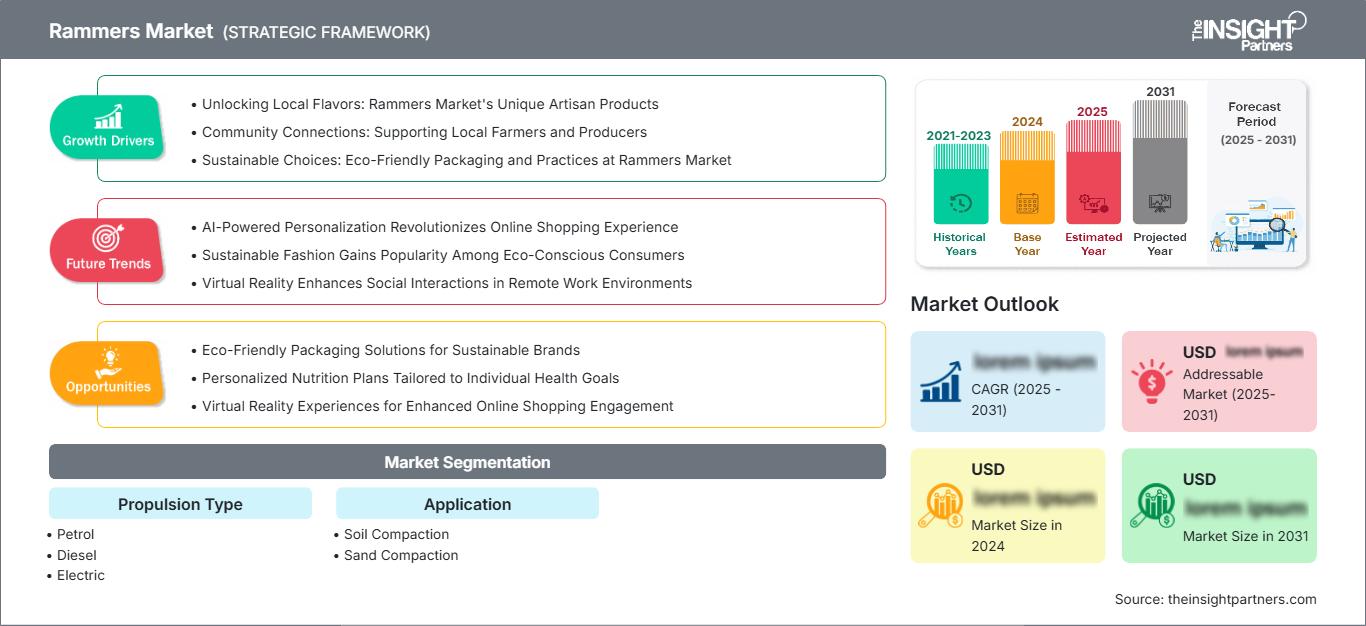
Rammers Market: Strategic Insights
Regional Insights
North America rammers market
North America is estimated to account for 20–24% of the global rammers market demand in 2025 and grow at a 3.8–4.6% CAGR through 2034. The United States remains the biggest market due to the following factors: utility trenching, road reconstruction, housing construction, landscaping, and rental fleet renewal. The demand from Canada comes from the need for infrastructure renewal and municipal construction, whereas the Mexican market needs equipment for the development of industry and cities.
The selection of equipment is determined by the exposure of operators, emissions, portability, and service intervals. In situations where trenches and small working fronts do not allow roller usage, small rammers get their chance. The rental channel will help to accelerate the process of implementation because the contractor will be able to select equipment with the desired weight and drive system without all the expenses of its ownership.
U.S. rammers Market
The U.S. is estimated to represent 70–75% of North American rammers market demand in 2025 and expand at a 3.7–4.5% CAGR through 2034. Demand is supported by road and utility maintenance, residential site preparation, telecommunications trenching, and landscaping. Ammann Group, BOMAG GmbH, Husqvarna AB, J C Bamford Excavators Ltd., and Wacker Neuson SE maintain relevant product or distribution presence.
Application demand favors soil compaction because cohesive and granular soils require targeted impact energy in confined areas. Rental fleets also encourage standardized, easily transported models, while contractors increasingly evaluate electric equipment for indoor work, urban sites, and projects with local emissions constraints. The market remains sensitive to construction activity and financing conditions, but replacement demand provides a recurring base.
Europe rammers Market
Europe is estimated at a 24–28% of the rammers market share in 2025 and is projected to grow at a 4.0–4.8% CAGR through 2034, with Germany serving as a leading market. UK demand is supported by utilities, road repair, housing, and rental fleets. Germany benefits from a strong equipment manufacturing base and an emphasis on efficient, low-emission machinery. France, Italy, and Spain add demand through infrastructure renewal, construction, and municipal projects.
APAC rammers Market
Asia Pacific is estimated at a 34–38% share of the Rammers Market in 2025 and is expected to expand at a 5.8–6.6% CAGR through 2034, with China leading regional volume. Japan and South Korea emphasize compact, reliable equipment, while India and Australia add infrastructure and utility demand. Industrial expansion, urban construction, and equipment localization support procurement, while emissions policies gradually improve the case for electric machines.
Middle East & Africa rammers Market
The Middle East and Africa Rammers Market demand is supported by construction, utilities, industrial sites, and transport infrastructure. Large development projects by Saudi Arabia and the UAE drive activity in the Gulf region, while South Africa serves as a significant equipment buyer. In the remainder of the MEA region, projects will drive the equipment purchases, sometimes linked with contractor availability and the importing of equipment from abroad.
Growth in the region is expected to be at a rate of 4.5–5.5% CAGR until 2034, with Saudi Arabia being a key country. Projects in the energy sector will still prefer conventional equipment due to its durability; however, projects in urban areas will provide chances for quieter electrical equipment.
Segmentation Analysis
Propulsion Type
Propulsion type determines operating cost, emissions profile, refueling requirements, maintenance burden, and suitability for specific job sites. The segment is projected to expand at a 5.0–5.8% CAGR during 2026–2034, according to the Rammers Market Report. Petrol remains the principal configuration because of mature supply chains, while electric models are gaining strategic importance as contractors face tighter site restrictions and seek lower maintenance requirements.
- Petrol: Petrol rammers remain the principal configuration for general construction because compact engines provide high portability, rapid refueling, and established service support. Contractors value their flexibility for dispersed sites and variable operating schedules.
- Diesel: Diesel machines serve applications where durability, fuel efficiency, and longer operating cycles are prioritized. Their relevance is strongest in demanding professional environments where refueling logistics and sustained utilization can outweigh emissions considerations.
- Electric: Electric rammers address urban, indoor, tunnel, and noise-sensitive applications by eliminating direct exhaust emissions. Battery standardization and faster charging are improving their practical value, particularly for fleets operating under environmental procurement requirements.
Application
Application determines required impact characteristics, machine configuration, and productivity expectations. The application segment is expected to grow at a 5.2–6.0% CAGR during 2026–2034, reflecting key Rammers Market Trends. Soil compaction remains the principal use case because rammers can penetrate narrow areas and cohesive materials, while sand compaction creates demand where controlled impact is needed around foundations and confined structures.
- Soil Compaction: Soil compaction represents the core use case across trenches, foundations, road shoulders, and landscaping. Demand centers on machines that combine high impact force with maneuverability, controlled vibration, and reliable performance across cohesive and granular soils.
- Sand Compaction: Sand compaction requires equipment capable of producing repeatable impact without excessive surface disruption. Rammers are selected for confined foundations, utility corridors, and localized preparation where larger compaction equipment cannot operate efficiently.
Opportunity Snapshot
| Application | Revenue Contribution (High/Medium/Low) | Trend Tag | Adoption Stage |
| Soil Compaction | High | Trench Work | Mature |
| Sand Compaction | Medium | Foundation Prep | Scaling |
Rammers Market Growth Drivers and Impact Analysis
Urban and Utility Construction Expands Confined-Space Compaction
Construction in urban areas has constant demands for small equipment since utility trenches, drainage systems, sidewalks, foundations, and narrow points of entry limit the use of large rollers. Rammers can provide impact energy at certain points while still being portable from one work site to another. This feature explains why there is increasing demand for rammers among municipal construction firms, utility providers, landscapers, and civil engineering firms. The impact would be more noticeable in situations when there is limited time for relocation between projects and when there are limitations of equipment access owing to already existing structures. Rental firms would also benefit from the feature of small equipment being able to perform several projects.
Lower-Emission Equipment Requirements Accelerate Powertrain Diversification
Changes to emissions and noise regulations are affecting equipment selection in crowded urban environments, indoors, and on projects subject to environmentally responsible procurement policies. Electric tampers can be used with no emissions from the tailpipe and with reduced noise exposure, thus applicable in indoor construction, tunnels, hospitals, residential districts, and night construction work. The effect on the market goes beyond just equipment sales, as electric-powered systems can provide for reduced engine servicing requirements and for simplified fleets using the same type of batteries for a number of tools. Consequently, manufacturers are likely to maintain multi-powertrain portfolios while improving battery energy density, charging speed, thermal management, and component durability, according to the Rammers Market Forecast.
Operator Safety and Ergonomics Influence Replacement Decisions
Operational operator fatigue has become a growing concern because rammer operation entails exposure to vibration over long periods and demands physical contact. To address this, manufacturers are making efforts to design better handles, vibration dampening, balance, maneuverability of equipment, and control positioning to help minimize fatigue while maintaining compaction output levels. These modifications are important for decision-making because reducing fatigue will allow operators to operate machines for longer hours and also increase employee satisfaction. Another feature that fleet managers might prefer is easy maintainability and fewer parts to change on the equipment during servicing periods. This impact is very important for established markets where machine purchases are mainly driven by factors other than capacity growth.
Rammers Market Future Trends
Battery Platforms Become More Interoperable
Battery interoperability seems bound to become a key competitive feature in the context of contractors' attempts to cut down the number of different types of chargers, additional batteries, and maintenance services needed for small fleets of machines. Instead of regarding an electric rammer as a product on its own, a manufacturer can use common battery systems for various products like plates, rammers, pumps, lighting systems, and other construction machines. The asset utilization will be enhanced since batteries will be interchangeable from one machine to another, depending on the work that needs to be done. It looks like future developments will revolve around battery capacities that can be used in different machines, fast exchange systems, enhanced battery thermal protection, and charging systems tailored for temporary job sites.
Connected Maintenance Supports Predictable Fleet Utilization
Digital service functions are likely to expand from larger construction equipment into compact machines as fleet operators seek better visibility into utilization, maintenance, and location. Rammers can incorporate operating-hour records, service alerts, battery status, fault diagnostics, and asset identification without requiring complex onboard systems. Such information can help rental companies schedule maintenance before failures, identify underutilized equipment, and improve fleet rotation. For contractors, digital records can support preventive servicing and equipment accountability across dispersed projects. The trend is unlikely to eliminate conventional mechanical service, but it can improve planning around consumables, replacement parts, and workshop capacity. Suppliers that integrate simple, low-cost connectivity into durable machines may gain differentiation without materially increasing operator complexity.
Rammers Market Opportunities
Electric Equipment for Urban and Enclosed Projects
The strongest near-term investment opportunity lies in electric rammers designed for environments where exhaust emissions and noise impose operational constraints. Suppliers can target tunnels, basements, hospitals, residential developments, public facilities, and dense urban areas where conventional machines may face restrictions. Product differentiation should center on battery interchangeability, rapid charging, runtime predictability, and robust protection against dust and vibration. Distributors can create additional value through battery rental, charging services, and fleet packages rather than selling machines alone. Contractors may adopt electric units selectively rather than replacing all conventional equipment, creating a mixed-fleet opportunity. Manufacturers that establish reliable service networks and transparent battery lifecycle economics can reduce adoption barriers while building recurring aftermarket relationships around power systems and components.
Regional Rental and Dealer Networks
Expansion through rental companies and specialized dealers offers a scalable route into fragmented construction markets. Compact equipment is frequently purchased according to project requirements, making rental availability influential for contractors that face variable workloads or limited capital budgets. Manufacturers can prioritize high-density construction regions, utility corridors, landscaping markets, and municipal maintenance clusters where equipment turnover is frequent. Local partnerships can improve spare-parts access, operator training, financing, and used-equipment resale, all of which affect total ownership economics. The opportunity is particularly relevant in developing markets where customers may prefer proven petrol equipment but gradually test electric alternatives. A dual-track channel strategy can therefore preserve conventional volume while creating demonstration pathways for newer propulsion technologies.
Frequently Asked Questions

- Comprehensive Market Sizing and Forecast Analysis
- Detailed Segmentation Analysis
- In-Depth Market Dynamics Assessment
- Regional and Country-Level Insights
- Competitive Landscape and Company Benchmarking
- Strategic Business Intelligence
Recent Reports
Testimonials

The Insight Partners provided valuable market intelligence that supported our global go-to-market strategy. Their team was professional, responsive, and attentive to our feedback, providing thoughtful analysis and helpful methodological clarifications throughout the project.
Junmo Kim Chief Financial Officer (CFO), Enertech Co., Ltd.
The Insight Partners' SCADA System Market report is comprehensive, with valuable insights on current trends and future forecasts. The team was highly professional, responsive, and supportive throughout. We are very satisfied and highly recommend their services.
RAN KEDEM Partner, Reali Technologies LTDs
I requested a report on a very specific software market and the team produced the report in a few days. The information was very relevant and well presented. I then requested some changes and additions to the report. The team was again very responsive and I got the final report in less than a week.
JEAN-HERVE JENN Chairman, Future Analytica
We worked with The Insight Partners for an important market study and forecast. They gave us clear insights into opportunities and risks, which helped shape our plans. Their research was easy to use and based on solid data. It helped us make smart, confident decisions. We highly recommend them.
PIYUSH NAGPAL Sr. Vice President, High Beam Global
The Insight Partners delivered insightful, well-structured market research with strong domain expertise. Their team was professional and responsive throughout. The user-friendly website made accessing industry reports seamless. We highly recommend them for reliable, high-quality research services
YUKIHIKO ADACHI CEO, Deep Blue, LLC.
This is the first time I have purchased a market report from The Insight Partners.While I was unsure at first, I visited their web site and felt more comfortable to take the risk and purchase a market report.I am completely satisfied with the quality of the report and customer service. I had several questions and comments with the initial report, but after a couple of dialogs over email with their analyst I believe I have a report that I can use as input to our strategic planning process.Thank you so much for taking the extra time and making this a positive experience.I will definitely recommend your service to others and you will be my first call when we need further market data.
JOHN SUZUKI President and Chief Executive Officer, Board Director, BK Technologies
I wish to appreciate your support and the professionalism you displayed in the course of attending to my request for information regarding to infectious disease IVD market in Nigeria. I appreciate your patience, your guidance, and the fact that you were willing to offer a discount, which eventually made it possible for us to close a deal. I look forward to engaging The Insight Partners in the future, all thanks to the impression you have created in me as a result of this first encounter.
DR CHIJIOKE ONYIA MANAGING DIRECTOR, PineCrest Healthcare Ltd.Reason to Buy
- Informed Decision-Making
- Understanding Market Dynamics
- Competitive Analysis
- Identifying Emerging Markets
- Customer Insights
- Market Forecasts
- Risk Mitigation
- Boosting Operational Efficiency
- Strategic Planning
- Investment Justification
- Tracking Industry Innovations
- Aligning with Regulatory Trends





 Get Free Sample for