
Regenerative Aesthetics Market 2026-2034 | Size, Share & Trends
Coverage: By Products (Biologics & Cell Products, Biomaterials & Fillers, Combination Products/Drug-Device Hybrids, Devices & Equipment); Technology/Modality (Autologous biologics (patient’s own cells), Allogeneic cell-based products (donor cells), Biomaterials & tissue scaffolds, Device-assisted combination procedures); Indication/Application (Facial rejuvenation & volume restoration, Hair restoration, Scar revision & acne scarring, Wound healing & reconstructive adjuncts, Body contouring & soft-tissue defect repair); End-Use/Buyer (Dermatology clinics & aesthetic physicians, Plastic surgery clinics & ambulatory surgical centres, Home-use (topical/adjunctive regenerative products)); Distribution Channel (Direct sales to clinics/hospitals, Medical distributors & dealers, Online professional channels); and Geography
- Status : Data Released
- Report Code : TIPRE00042212
- Category : Life Sciences
- No. of Pages : 150
- Available Report Formats :


- Last update date : January 14, 2026


2025 Market Size
US$ 14.89 Bn
Base year value
2034 Forecast
US$ 38.89 Bn
Projected by 2034
CAGR 2026-2034
11.27 %
Growth rate
Addressable Market
US$ 237.36 Bn
(2026-2034)
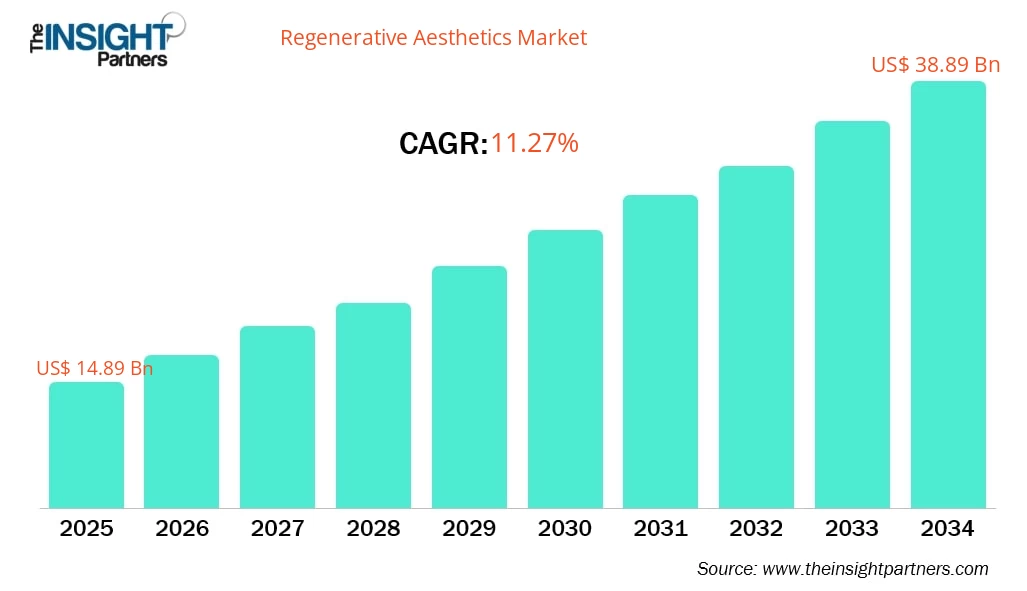
The regenerative aesthetics market size is expected to reach US$ 38.89 billion by 2034 from US$ 14.89 billion in 2025. The market is anticipated to register a CAGR of 11.27% during 2026–2034.
Regenerative Aesthetics Market Analysis
The regenerative aesthetics market forecast indicates growth, owing to the rising demand for minimally invasive and biologically‑driven aesthetic treatments, increasing integration of regenerative medicine into aesthetic procedures, and growing consumer preference for natural‑looking, durable outcomes. The market expansion is facilitated by the compatibility with cell‑based therapies, exosomes, and growth‑factor technologies, and aesthetic clinics upgrading their offerings. Additionally, shifting from purely cosmetic treatments to regenerative protocols (e.g., combining scaffolds, autologous biologics, and advanced injectables) boosts market growth.
Regenerative Aesthetics Market Overview
Regenerative aesthetics refers to aesthetic treatments that go beyond surface cosmetics and aim to regenerate, repair, or rejuvenate tissues using biologics, scaffolds, cell therapies, growth factors, and biomaterials. These solutions help reduce the visible signs of ageing, restore volume and skin texture, enhance hair restoration, minimise scarring, and improve overall tissue health. By enabling clinics and aesthetic physicians to offer higher‑value, longer‑lasting results, regenerative aesthetics is becoming a key pillar in modern aesthetic practice.
Market Research Highlights
- Global market for Regenerative Aesthetics was valued at US$ 14.89 Billion in 2025
- Annual market size is expected to reach US$ 38.89 Billion by 2034
- Total addressable market (TAM) during 2026-2034 is projected to reach approximately US$ 237.36 Billion
- Market is anticipated to register a CAGR of 11.27% during the forecast period
- The United States represents a key market, supported by Demand for Natural-Looking Aesthetic Outcomes, Advances in PRP and Stem Cell Therapies, Shift from Synthetic Fillers, as well as evolving industry dynamics
- Market analysis covers North America, Europe, Asia-Pacific, South and Central America, Middle East and Africa, with growth evaluated across the forecast period
- Market opportunities such as Autologous Aesthetic Treatments, Premium Personalized Procedures, Integration with Cosmetic Surgery are expected to influence market dynamics and addressable market
- Report profiles industry participants, including Cutera, Inc., Venus Concept, Anika Therapeutics, CollPlant Biotechnologies, RegenLab SA, EmCyte Corporation, Lipogems International SpA, Suneva Medical, Inc., Integra LifeSciences Corporation, Arthrex, Inc., while analyzing competitive strategies and innovation developments
-
Source: The Insight Partners' analysis based on proprietary research, government publications, company annual reports, investor presentations, industry databases, and expert interviews.
● REPORT CUSTOMIZATION
Tailor This Report To Align With Your Specific Business Requirements
This report can be customized to align precisely with your business objectives, scope, and target markets. Customization options include tailored segmentation, geography, competitive analysis, and strategic insights to support informed decision-making.
Customize This Report →WHAT YOU CAN ADJUST
- ● Segmentations
- ● Geography
- ● Competitive Analysis
- ● Language Preferences
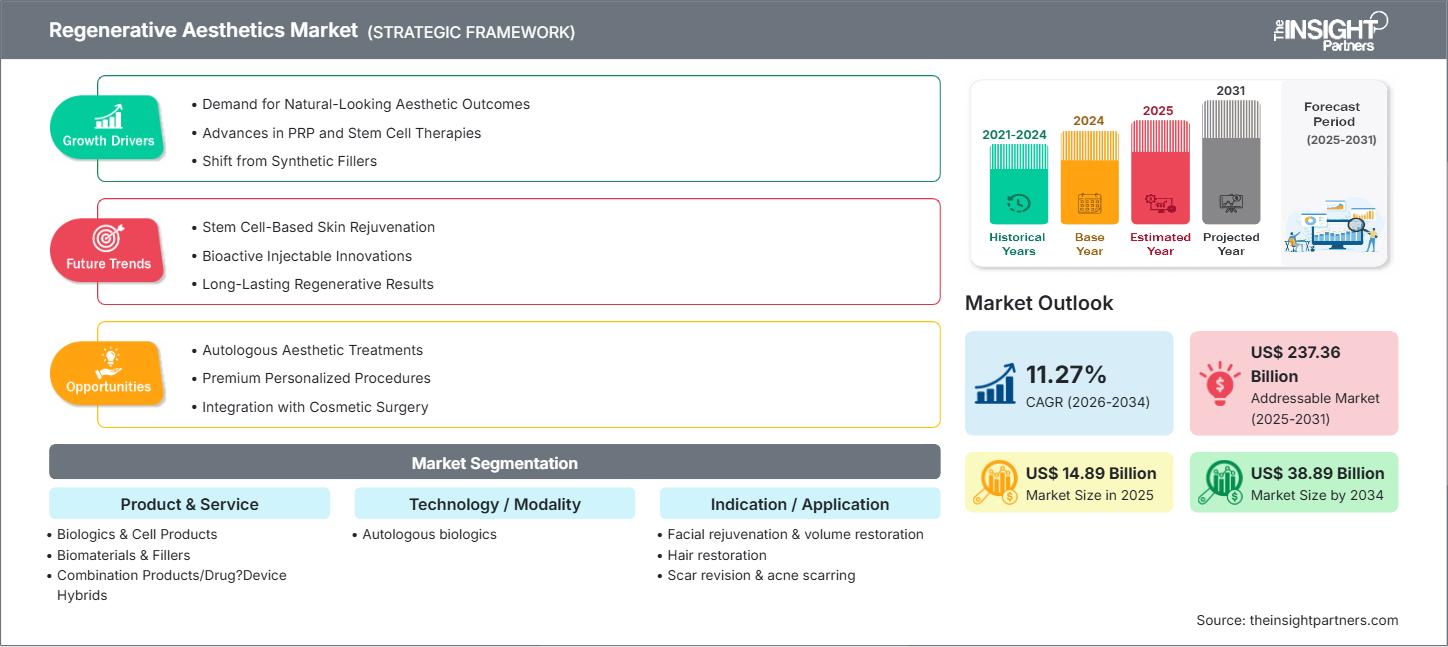
Regenerative Aesthetics Market: Strategic Insights
-
Get Top Key Market Trends of this report.This FREE sample will include data analysis, ranging from market trends to estimates and forecasts.
Regenerative Aesthetics Market Drivers and Opportunities
Market Drivers:
- Rising demand for natural, long‑lasting aesthetic outcomes and shorter downtime procedures
- Growing integration of regenerative medicine techniques (cell‑based, exosome, biomaterials) into aesthetics.
- Increasing disposable income, aging yet active demographics, and growing aesthetic awareness globally.
Market Opportunities:
- Expansion in emerging markets with increasing aesthetic clinic penetration and medical tourism demand.
- Integration of regenerative aesthetics with digital imaging, AI‑based skin/volume assessment, and personalised treatment protocols.
- Development of hybrid therapies combining biologics + devices (e.g., energy‑based + regenerative injectables) to differentiate offerings.
Regenerative Aesthetics Market Report Segmentation Analysis
The regenerative aesthetics market share is analysed across various segments to provide a clearer understanding of its structure, growth potential, and emerging trends. Below is the standard segmentation approach used in most industry reports:
By Product & Service:
- Biologics & Cell Products
- Biomaterials & Fillers
- Combination Products/Drug‑Device Hybrids
- Devices & Equipment
By Technology / Modality:
- Autologous biologics (patient’s own cells)
- Allogeneic cell‑based products (donor cells)
- Biomaterials & tissue scaffolds
- Device‑assisted combination procedures
By Indication / Application:
- Facial rejuvenation & volume restoration
- Hair restoration
- Scar revision & acne scarring
- Wound healing & reconstructive adjuncts
- Body contouring & soft‑tissue defect repair
By End‑Use / Buyer:
- Dermatology clinics & aesthetic physicians
- Plastic surgery clinics & ambulatory surgical centres
- Home‑use (topical/adjunctive regenerative products)
By Distribution Channel:
- Direct sales to clinics/hospitals
- Medical distributors & dealers
- Online professional channels
By Geography:
- North America
- Europe
- Asia Pacific
- South & Central America
- Middle East & Africa
Regenerative Aesthetics Market Report Scope
| Report Attribute | Details |
|---|---|
| Market size in 2025 | US$ 14.89 Billion |
| Market Size by 2034 | US$ 38.89 Billion |
| Global CAGR (2026 - 2034) | 11.27% |
| Historical Data | 2021-2024 |
| Forecast period | 2026-2034 |
| Segments Covered |
By Product
|
| Regions and Countries Covered |
North America
|
| Market leaders and key company profiles |
|
Regenerative Aesthetics Market Players Density: Understanding Its Impact on Business Dynamics
The Regenerative Aesthetics Market is growing rapidly, driven by increasing end-user demand due to factors such as evolving consumer preferences, technological advancements, and greater awareness of the product's benefits. As demand rises, businesses are expanding their offerings, innovating to meet consumer needs, and capitalizing on emerging trends, which further fuels market growth.
Regenerative Aesthetics Market Share Analysis by Geography
North America leads the market owing to advanced aesthetic infrastructure, high consumer demand, and early adoption of regenerative techniques. Europe holds a significant share, driven by regulatory evolution and health‑beauty hybrid models. Asia Pacific is the fastest‑growing region due to increasing clinic density, rising disposable income, and medical tourism growth. Emerging markets in South & Central America, and the Middle East & Africa, represent significant untapped opportunities.
North America
- Market Share: Largest share due to advanced clinics, high aesthetic spend.
- Key Drivers: Rapid adoption of cell‑based treatments, strong regulatory frameworks, and high consumer expenditure on aesthetics.
- Trends: Shift toward clinic networks offering subscription models for regenerative treatments.
Europe
- Market Share: Strong, with a public/private hybrid aesthetic ecosystem.
- Key Drivers: Demand for GDPR‑compliant regenerative aesthetic solutions, multi‑specialty aesthetic clinics, and high R&D.
- Trends: Emerging cross‑border aesthetic tourism, interoperable treatment platforms.
Asia Pacific
- Market Share: Fastest growing.
- Key Drivers: Government investment in healthcare & wellness, large patient base seeking aesthetic care, and rising private clinic investment.
- Trends: Localisation of regenerative treatments, language‑ and culture‑specific protocols, robust medical tourism.
South & Central America
- Market Share: Emerging, driven by the growing private aesthetic sector.
- Key Drivers: Expansion in private boutique aesthetic centres, demand for cost‑effective regenerative options.
- Trends: Cloud‑based clinic management + regenerative service packages.
Middle East & Africa
- Market Share: Developing with high growth potential.
- Key Drivers: National wellness/aesthetics initiatives, affluent urban populations, growth of medical tourism.
- Trends: Integrated aesthetic‑wellness resorts offering regenerative treatments as part of holistic health packages.
Regenerative Aesthetics Market Players Density: Understanding Its Impact on Business Dynamics
High market density and competition: The regenerative aesthetics market is becoming crowded with major aesthetic‑device companies, biotech players, and specialised regenerative aesthetic firms. This competitive environment pushes vendors to differentiate through:
- Seamless integration of biologics with devices and digital imaging,
- Scalable clinic‑ready solutions tailored to both boutique and large clinic practices,
- AI‑enabled diagnostics and treatment planning for regenerative aesthetics,
- Interoperability across third‑party systems, including aesthetic clinic software, imaging platforms, and cell‑processing units.
Opportunities and Strategic Moves:
- Partner with aesthetic clinics, wellness resorts, and plastic‑surgery networks to deploy regenerative aesthetics workflows and train staff.
- Incorporate AI/ML for planning and outcome‑tracking in regenerative aesthetic treatments (patient engagement, forecasting outcomes, automating follow‑ups).
Major Companies operating in the Regenerative Aesthetics Market are:
- Cutera, Inc.
- Venus Concept
- Anika Therapeutics
- CollPlant Biotechnologies
- RegenLab SA
- EmCyte Corporation
- Lipogems International SpA
- Suneva Medical, Inc.
- Integra LifeSciences Corporation
- Arthrex, Inc.
Other companies analysed during the course of research:
- AbbVie Inc.
- Global Stem Cells Group
- Medytox Korea Co., Ltd.
- RepliCel Life Sciences Inc.
- Koru Pharma Co. Ltd.
- BTL Industries Inc.
- ABG Lab LLC
- Daewoong Pharmaceutical Co., Ltd.
- Rohto Pharmaceutical Co., Ltd.
- Geneo
Regenerative Aesthetics Market News and Recent Developments
- Advancements in exosome‑based regenerative aesthetic therapies and dermal scaffolds have been gaining traction, reflecting the shift from purely cosmetic treatments to regenerative outcomes.
- Rapid growth and adoption of hybrid therapies (device + biologic) in clinics aiming to deliver superior aesthetic outcomes with reduced downtime.
Regenerative Aesthetics Market Report Coverage and Deliverables
The “Regenerative Aesthetics Market” report provides a detailed analysis of the market covering the following areas:
- Market size and forecast at global, regional, and country levels for all the key market segments covered under the scope.
- Market trends, as well as market dynamics such as drivers, restraints, and key opportunities.
- Detailed PEST and SWOT analysis.
- Market analysis covering key market trends, global and regional framework, major players, regulations, and recent market developments.
- Industry landscape and competition analysis covering market concentration, heat‑map analysis, prominent players, and recent developments in the regenerative aesthetics market.
- Detailed company profiles.
Frequently Asked Questions
1. North America: Leads the market with the largest share, driven by high aesthetic spend and early adoption of regenerative protocols.
2. Europe: Holds a substantial share, driven by strong regulatory frameworks and advanced clinic models.
3. Asia‑Pacific: The fastest‑growing region, with rapid clinic expansion, rising medical tourism, and increasing adoption of regenerative aesthetic solutions.
1. Rising demand for natural, longer‑lasting aesthetic results and minimal‑downtime procedures.
2. Growing integration of regenerative medicine (cell‑based therapies, biomaterials, exosomes) into aesthetic treatments.
3. Increasing consumer awareness, higher disposable incomes, and broader acceptance of aesthetic treatments globally.
1. Hospitals & clinics: Utilise regenerative aesthetics to supplement reconstructive or aesthetic workflows.
2. Dermatology & plastic‑surgery clinics: Adopt these treatments for volume restoration, scarring, hair restoration, and advanced aesthetic protocols.
3. Home‑use / consumer aesthetics: Emerging products enabling adjunctive regenerative aesthetics treatments.

- Comprehensive Market Sizing and Forecast Analysis
- Detailed Segmentation Analysis
- In-Depth Market Dynamics Assessment
- Regional and Country-Level Insights
- Competitive Landscape and Company Benchmarking
- Strategic Business Intelligence
Recent Reports
Testimonials

The Insight Partners provided valuable market intelligence that supported our global go-to-market strategy. Their team was professional, responsive, and attentive to our feedback, providing thoughtful analysis and helpful methodological clarifications throughout the project.
Junmo Kim Chief Financial Officer (CFO), Enertech Co., Ltd.
The Insight Partners' SCADA System Market report is comprehensive, with valuable insights on current trends and future forecasts. The team was highly professional, responsive, and supportive throughout. We are very satisfied and highly recommend their services.
RAN KEDEM Partner, Reali Technologies LTDs
I requested a report on a very specific software market and the team produced the report in a few days. The information was very relevant and well presented. I then requested some changes and additions to the report. The team was again very responsive and I got the final report in less than a week.
JEAN-HERVE JENN Chairman, Future Analytica
We worked with The Insight Partners for an important market study and forecast. They gave us clear insights into opportunities and risks, which helped shape our plans. Their research was easy to use and based on solid data. It helped us make smart, confident decisions. We highly recommend them.
PIYUSH NAGPAL Sr. Vice President, High Beam Global
The Insight Partners delivered insightful, well-structured market research with strong domain expertise. Their team was professional and responsive throughout. The user-friendly website made accessing industry reports seamless. We highly recommend them for reliable, high-quality research services
YUKIHIKO ADACHI CEO, Deep Blue, LLC.
This is the first time I have purchased a market report from The Insight Partners.While I was unsure at first, I visited their web site and felt more comfortable to take the risk and purchase a market report.I am completely satisfied with the quality of the report and customer service. I had several questions and comments with the initial report, but after a couple of dialogs over email with their analyst I believe I have a report that I can use as input to our strategic planning process.Thank you so much for taking the extra time and making this a positive experience.I will definitely recommend your service to others and you will be my first call when we need further market data.
JOHN SUZUKI President and Chief Executive Officer, Board Director, BK Technologies
I wish to appreciate your support and the professionalism you displayed in the course of attending to my request for information regarding to infectious disease IVD market in Nigeria. I appreciate your patience, your guidance, and the fact that you were willing to offer a discount, which eventually made it possible for us to close a deal. I look forward to engaging The Insight Partners in the future, all thanks to the impression you have created in me as a result of this first encounter.
DR CHIJIOKE ONYIA MANAGING DIRECTOR, PineCrest Healthcare Ltd.Reason to Buy
- Informed Decision-Making
- Understanding Market Dynamics
- Competitive Analysis
- Identifying Emerging Markets
- Customer Insights
- Market Forecasts
- Risk Mitigation
- Boosting Operational Efficiency
- Strategic Planning
- Investment Justification
- Tracking Industry Innovations
- Aligning with Regulatory Trends





 Get Free Sample for