
Regenerative Blowers Market Demand, Trends & Forecast by 2034
Coverage: By Stage (Single-stage, Two-stage, Three-stage); End-user (Water and Wastewater Treatment, Food and Beverage, Chemical, Oil and Gas, Healthcare, Others), and Geography (North America, Europe, Asia Pacific, and South and Central America)
- Status : Data Released
- Report Code : TIPRE00014565
- Category : Manufacturing and Construction
- No. of Pages : 150
- Available Report Formats :


- Last update date : September 01, 2026


2025 Market Size
US$ 1,053.94 Mn
Base year value
2034 Forecast
US$ 1,430.57 Mn
Projected by 2034
CAGR 2026-2034
3.45 %
Growth rate
Addressable Market
US$ 11,281.71 Mn
(2026-2034)
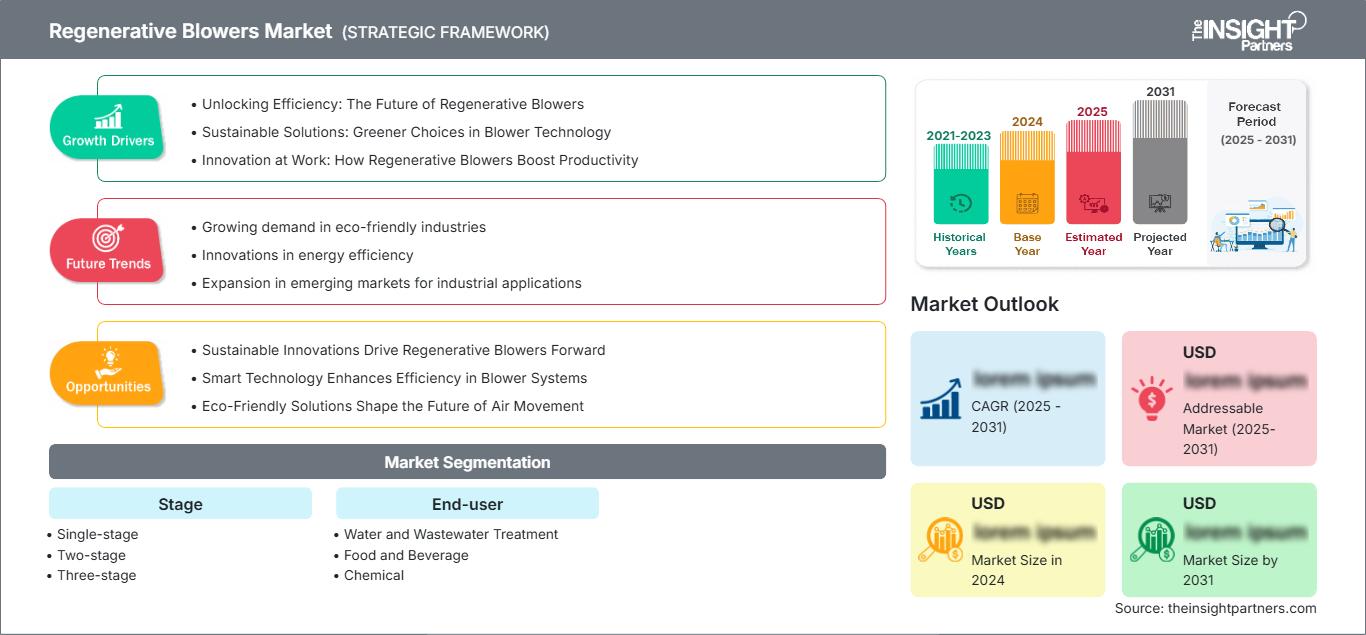
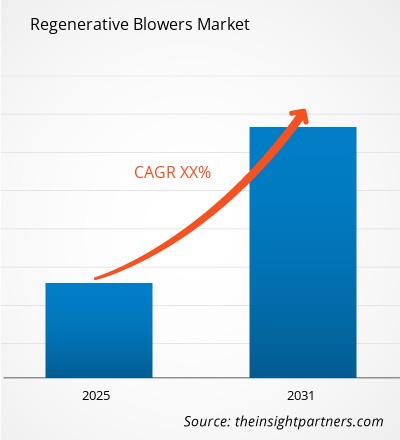
The regenerative blowers market was valued at US$ 1053.94 Million in 2025 and is projected to reach US$ 1430.57 Million by 2034, registering a CAGR of 3.45% during 2026–2034. Demand is supported by continuous low-pressure air requirements across wastewater aeration, pneumatic conveying, food processing, chemical handling, and healthcare equipment. Product development increasingly emphasizes oil-free operation, compact construction, thermal management, variable-speed control, and dependable continuous-duty performance.
North American demand is positioned for steady expansion, with an estimated CAGR of 3.6–4.0% through 2034. The regenerative blowers market size is supported by the modernization of wastewater assets, tighter industrial energy-efficiency requirements, replacement of aging pneumatic equipment, and demand for compact vacuum and pressure systems across manufacturing, healthcare, and food-processing facilities.
Regenerative Blowers Market Assessment and Insights
- North America: North America is expected to represent a 29–33% share in 2025 and grow at a CAGR of 3.6–4.0% between 2026–2034, supported by wastewater infrastructure renewal, industrial automation, and replacement of inefficient legacy air-handling equipment.
- US: The US is estimated to contribute 74–78% of North America's 2025 value and expand at a CAGR of 3.7–4.1% during 2026–2034, supported by municipal treatment upgrades and industrial efficiency programs.
- Europe: Europe is projected to hold a 24–28% share in 2025 and record a 3.2–3.6% CAGR through 2034. Germany, the UK, France, Italy, and Spain provide a diversified demand base through environmental compliance, process modernization, and energy-efficiency investment.
- Asia Pacific: Asia Pacific is estimated at 27–31% share in 2025 and is expected to grow at a CAGR of 4.0–4.5% through 2034. China, Japan, South Korea, India, and Australia are important markets, led by industrial expansion and wastewater investment.
- Largest Segment: Water and Wastewater Treatment is estimated to command a 33–37% market share in 2025, with a 3.8–4.2% CAGR between 2026–2034, reflecting recurring aeration requirements.
- High Growth Segment: Three-stage blowers represent an estimated 10–14% market share in 2025 and are projected to grow at 4.2–4.7% CAGR through 2034, supported by higher differential-pressure applications.
- Key companies analyzed in detail: AMETEK, Inc.; Atlantic Blowers; Becker Pumps Corporation; Busch Group; Chuan Fan Electric Co., Ltd.; Elektror airsystems gmbh; Ingersoll Rand Inc.; Hitachi, Ltd.; KNB Corporation; Spencer Turbine Company.
Source: The Insight Partners' analysis based on proprietary research, government publications, company annual reports, investor presentations, industry databases, and expert interviews.
Regenerative blowers have evolved from relatively standardized air-moving equipment into application-specific systems differentiated by impeller geometry, motor efficiency, acoustic treatment, thermal management, and controllability. Single-stage and multistage architectures now serve distinct pressure requirements, while frequency-converter compatibility enables operating-point adjustment. Oil-free operation remains particularly relevant where contamination cannot be tolerated, including food processing, medical equipment, and selected chemical processes.
Future demand is likely to concentrate on systems that combine compact footprints with measurable lifecycle efficiency. Emerging installations in Asia Pacific and industrializing economies should broaden the customer base, while mature markets prioritize retrofit economics and energy optimization. Wastewater remains strategically important because aeration is energy intensive, encouraging operators to evaluate blower selection, controls, and operating points together rather than treating the blower as an isolated component.
Regenerative Blowers Market Report Scope
| Report Attribute | Details |
|---|---|
| Market size in 2025 | US$ 1,053.94 Million |
| Market Size by 2034 | US$ 1,430.57 Million |
| Global CAGR (2026 - 2034) | 3.45% |
| Historical Data | 2021-2024 |
| Forecast period | 2026-2034 |
Regenerative Blowers Market Analysis
The regenerative blowers market growth is closely connected with low-pressure air demand in wastewater treatment, pneumatic conveying, material handling, food processing, and specialized vacuum systems. Demand moves through an ecosystem comprising motor and electrical-component suppliers, impeller and housing manufacturers, system integrators, engineering contractors, distributors, and end users. Wastewater plants particularly value predictable airflow, low maintenance, and oil-free operation because blower performance directly affects aeration processes.
Supply dynamics increasingly favor manufacturers able to configure motors, controls, coatings, materials, and mounting arrangements around application requirements. Side-channel designs can operate in vacuum or overpressure modes, while two-stage architectures provide higher differential pressure than comparable single-stage arrangements. This supports differentiated product portfolios rather than one-size-fits-all equipment. Availability of local service, replacement components, application engineering, and system commissioning is also becoming important in purchasing decisions.
The regenerative blowers market analysis indicates a fragmented competitive environment in which specialized blower manufacturers compete alongside diversified industrial technology groups. AMETEK, Inc. offers its product line via its ROTRON regenerative blowers, and Busch Group combines its side channel blowers with vacuum and air handling systems. Elektror highlights configurability options for side-channel blowers, including models compatible with frequency converters, making energy management a part of design rather than an option.
Positioning is becoming more dependent on application engineering, global distribution, and product range. Specific industrial applications can be met by such companies as Becker Pumps Corporation, Chuan Fan Electric Co., Ltd., KNB Corporation, and Spencer Turbine Company, while more diversified industrial environments favor Ingersoll Rand Inc. and Hitachi, Ltd. Hence, investments are made into efficient motors and controls, monitoring systems, durable designs, and configurability.
● REPORT CUSTOMIZATION
Tailor This Report To Align With Your Specific Business Requirements
This report can be customized to align precisely with your business objectives, scope, and target markets. Customization options include tailored segmentation, geography, competitive analysis, and strategic insights to support informed decision-making.
Customize This Report →WHAT YOU CAN ADJUST
- ● Segmentations
- ● Geography
- ● Competitive Analysis
- ● Language Preferences
Regenerative Blowers Market: Strategic Insights
Regional Insights
North America regenerative blowers market
North America is estimated to account for 29–33% of the global regenerative blowers market demand in 2025, with a projected CAGR of 3.6–4.0% through 2034. Dominance in regional consumption is due to a large number of installed bases in municipalities, industries, and manufacturers that need reliable low-pressure air. In Canada, there are additional applications of air compressors in water treatment, food processing, mining, and other related resource applications.
Replacement cycles have started being driven by operational costs, not just by machine failure. In updating equipment, efficiency of motors, variable speed, required pressure, noise performance, and ease of maintenance are evaluated. Aeration in the field of wastewater treatment is one of the main applications due to the fact that energy consumed by blowers has a significant effect on the cost of the process.
U.S. regenerative blowers Market
The US is estimated to represent 74–78% of North America's 2025 regenerative blowers market value and is projected to grow at a CAGR of 3.7–4.1%. Demand is distributed across municipal treatment, industrial processing, food and beverage production, healthcare equipment, and pneumatic systems. Manufacturers and integrators, including AMETEK, Ingersoll Rand, Hitachi, and Spencer Turbine support application-specific requirements.
Municipal wastewater modernization creates recurring opportunities for aeration equipment, while industrial facilities increasingly compare lifecycle costs when replacing continuously operated blowers. Food and beverage processors favor oil-free airflow for applications where contamination risk must be minimized. Healthcare equipment uses compact blower configurations for suction, evacuation, and air-handling functions. Purchasing decisions therefore emphasize reliability, serviceability, operating efficiency, noise control, and compatibility with existing electrical and control infrastructure.
Europe regenerative blowers Market
Europe is estimated to hold 24–28% of the global regenerative blowers market value in 2025 and expand at a CAGR of 3.2–3.6%. Germany is the leading country, supported by industrial machinery manufacturing and environmental technology expertise. The UK and France provide substantial wastewater and process-industry demand, while Italy and Spain add applications across manufacturing, food processing, and municipal infrastructure.
The UK market is supported by wastewater network investment and industrial energy-management priorities. Germany benefits from a dense machinery ecosystem and strong demand for engineered air systems. France combines municipal treatment requirements with food and chemical processing. Italy has diverse small and medium industrial applications, while Spain is influenced by water-management needs and process industries. Across the region, energy efficiency, equipment reliability, and emissions-conscious production practices increasingly shape replacement decisions.
APAC regenerative blowers Market
Asia Pacific is estimated at 27–31% share of the APAC regenerative blowers Market in 2025 and is expected to grow at 4.0–4.5% through 2034, making it the fastest-growing major region. China leads regional demand, followed by Japan, South Korea, India, and Australia. Industrial production, wastewater investment, and modernization of process equipment support adoption.
China combines manufacturing scale with extensive environmental infrastructure requirements. Japan and South Korea emphasize reliable, efficient equipment, while India offers expanding municipal and industrial wastewater applications. Australia contributes to demand through water management and resource-processing projects. Regional manufacturers and international suppliers increasingly provide frequency-converter-compatible and application-specific equipment, aligning blower performance with variable operating conditions.
Middle East & Africa regenerative blowers Market
The Middle East and Africa APAC regenerative blowers market represents a smaller but increasingly relevant demand base, supported by water treatment, industrial infrastructure, food processing, and resource-sector applications. The region is projected to grow at a CAGR of 3.0–3.5%, with Saudi Arabia leading regional investment, followed by the UAE and South Africa.
Saudi Arabia and the UAE prioritize water-security infrastructure and industrial diversification, creating applications for low-pressure air systems. South Africa has demand across municipal treatment, mining, and manufacturing. The rest of MEA remains more project-driven, with equipment selection influenced by harsh operating conditions, service availability, and energy costs. Corrosion-resistant materials and reliable thermal management can therefore materially affect purchasing decisions.
Segmentation Analysis
Stage
Stage segmentation is shaped by pressure requirements, airflow continuity, footprint, and energy considerations. Single-stage systems remain broadly suited to moderate-duty applications, while two-stage and three-stage configurations address higher differential-pressure requirements. The segment is projected to expand at a CAGR of 3.2–3.9% during 2026–2034, according to the Regenerative Blowers Market Forecast. Multistage designs gain relevance where users need higher pressure without moving to larger or more complex blower technologies.
- Single-stage: Widely selected for moderate-pressure applications because of straightforward construction, lower component count, and ease of integration into wastewater, conveying, and compact industrial systems.
- Two-stage: Serves applications requiring higher differential pressure while retaining the operating simplicity associated with side-channel and regenerative architectures.
- Three-stage: Addresses specialized higher-pressure requirements where process constraints justify additional compression stages, particularly in demanding vacuum and pneumatic applications.
End-user
End-user demand reflects differences in airflow requirements, contamination tolerance, operating schedules, and process economics. The segment is projected to grow at a CAGR of 3.5–4.1% between 2026 and 2034, reflecting key Regenerative Blowers Market Trends. Water and wastewater treatment represents the largest application base, while food and beverage and healthcare emphasize clean airflow. Chemical and oil and gas users place greater weight on material compatibility, process safety, and application-specific engineering.
- Water and Wastewater Treatment: Requires dependable aeration airflow for biological treatment processes, creating recurring demand from municipal and industrial treatment facilities seeking reliable low-pressure air systems.
- Food and Beverage: Uses oil-free airflow for conveying, drying, packaging, and handling applications where product integrity and hygienic operating conditions influence equipment selection.
- Chemical: Requires controlled airflow and vacuum capabilities across process handling, agitation, drying, and material movement, with corrosion resistance and application compatibility becoming key considerations.
- Oil and Gas: Supports specialized pneumatic and process applications where equipment robustness, operating reliability, and suitability for demanding environments influence procurement decisions.
- Healthcare: Uses compact blower technologies in medical and laboratory equipment, where low contamination risk, acoustic performance, reliability, and continuous operation are important selection criteria.
Opportunity Snapshot
| End-user | Revenue Contribution (High/Medium/Low) | Trend Tag | Adoption Stage |
| Water and Wastewater Treatment | High | Aeration Systems | Mature |
| Food and Beverage | Medium | Hygienic Airflow | Scaling |
| Chemical | Medium | Process Vacuum | Scaling |
| Oil and Gas | Medium | Process Air | Mature |
| Healthcare | Low | Medical Vacuum | Scaling |
Regenerative Blowers Market Growth Drivers and Impact Analysis
Wastewater infrastructure modernization
The need for municipal and industrial wastewater treatment is a sustainable demand generator since biological processes require controlled levels of oxygen feed. Nowadays, blowers are selected based on factors such as energy efficiency, pressure stability, turndown ratio, redundancy, and maintenance needs, as well as equipment price. Scientific papers published in 2025 show that blower energy consumption is still an important aspect that should be taken into account when working with wastewater plants, proving the commercial appeal of such efficiency-related improvements. This leads to replacement needs despite the fact that the equipment may still operate properly. Investment can be justified by lower energy consumption and increased process control and reliability.
Industrial demand for oil-free process air
Aeration without oil is becoming increasingly crucial for operations in food processing and packaging, pharmaceutical manufacturing, electronic assembly and manufacturing operations, as well as specific chemical processes. Regenerative air blowers can operate on dry and oil-free air without requiring traditional lubrication at the compressive end of the device; therefore, these are ideal where contamination is a key consideration. Buyers also require the unit to be compact in size as well as capable of creating either a vacuum or an overpressure with the same mechanism. The capability helps increase the base of applications, thereby enabling the manufacturers of equipment to use similar components in different types of blowers. Automation in industry results in a need for reliable aeration and handling systems.
Energy efficiency and controllability requirements
Customers in industrial applications are now judging air-moving devices based on performance throughout the lifecycle. Continuous duty blowers can build up high electricity bills, due to which sizing and operating point control are vital considerations during purchase. The use of frequency converters offers a good approach to match flow with the requirements of processes instead of running continuously at a constant capacity. For instance, Elektror highlights frequency converter compatibility and IE3 energy efficiency among the various options for side channel blowers. The effect reaches far beyond new installations since even retrofit installations can be made in existing systems having low-efficiency fixed-speed operations.
Regenerative Blowers Market Future Trends
Intelligent variable-speed blower architectures
Future blower systems will probably combine their operation with variable speed drives, sensors, and software for controlling the system directly into the blower system itself. This would allow to no longer choose one fixed operation point at maximum load but rather adjust the air flow rate according to process requirements. This would enable to save energy and stabilize processes in applications like aeration, conveying, and vacuuming. For example, Busch already produces blower systems that highlight controllability and efficiency as important features. In the future, manufacturers who offer, in addition to the mechanical system, monitoring systems, condition indicators, and service tools will be better placed in modernization projects due to their measurable lifecycle benefits.
Application-specific materials and modular configurations
Product development will probably proceed in the direction of modular designs, which would permit the matching of blower material, coating, motor, mountings, and electrical connections to a particular operating environment. Industrial installations such as those for chemicals, oil and gas, food processing, and wastewater treatment may have very different requirements regarding corrosion resistance, hygiene, temperatures, contamination, and dangerous atmospheres. Manufacturers have the chance of providing standardized internal design platforms but configurable external designs. Elektror has already differentiated between special coatings, motor winding protection, compatibility with frequency converters, and certifications within its range of side channel blowers.
Regenerative Blowers Market Opportunities
Localized production and service ecosystems in Asia Pacific
Localization of manufacturing, distribution, commissioning and after-sales services is another advantage for manufacturers in the Asia Pacific region. The markets of China, India, Japan, and Southeast Asia present an expansion of the industry, along with increasing demands in wastewater treatment, making the demand for blowers, standardized and engineered alike, in this region grow. The process of localization could help reduce delivery time, increase the availability of spare parts and minimize the need to maintain after-sales service on imported equipment. The appointment of the company's sales representative in Japan and the Philippines in 2025 by Elektror is an example of the continuous relevance of channel localization in this region.
Integrated retrofit packages for energy optimization
An important potential is that of replacing existing fixed-speed blower applications with a system package. Rather than just replacing the mechanical piece, the supplier can offer appropriately-sized blowers along with motors, variable frequency drives, sensing equipment, control logic, and commissioning services. It will enable the customer to tackle the problems of oversizing, pressure losses, variable demands, and inefficient scheduling all at once. The commercial idea is especially pertinent to wastewater facilities and industries where equipment runs for extended durations. Busch has reported considerable savings in energy by way of optimized vacuum systems, providing a perfect example of the gains that are possible through application-specific analysis. Service-oriented suppliers can create repeated upgrade potential through audit and retrofit analysis.
Frequently Asked Questions

- Comprehensive Market Sizing and Forecast Analysis
- Detailed Segmentation Analysis
- In-Depth Market Dynamics Assessment
- Regional and Country-Level Insights
- Competitive Landscape and Company Benchmarking
- Strategic Business Intelligence
Recent Reports
Testimonials

The Insight Partners' SCADA System Market report is comprehensive, with valuable insights on current trends and future forecasts. The team was highly professional, responsive, and supportive throughout. We are very satisfied and highly recommend their services.
RAN KEDEM Partner, Reali Technologies LTDs
I requested a report on a very specific software market and the team produced the report in a few days. The information was very relevant and well presented. I then requested some changes and additions to the report. The team was again very responsive and I got the final report in less than a week.
JEAN-HERVE JENN Chairman, Future Analytica
We worked with The Insight Partners for an important market study and forecast. They gave us clear insights into opportunities and risks, which helped shape our plans. Their research was easy to use and based on solid data. It helped us make smart, confident decisions. We highly recommend them.
PIYUSH NAGPAL Sr. Vice President, High Beam Global
The Insight Partners delivered insightful, well-structured market research with strong domain expertise. Their team was professional and responsive throughout. The user-friendly website made accessing industry reports seamless. We highly recommend them for reliable, high-quality research services
YUKIHIKO ADACHI CEO, Deep Blue, LLC.
This is the first time I have purchased a market report from The Insight Partners.While I was unsure at first, I visited their web site and felt more comfortable to take the risk and purchase a market report.I am completely satisfied with the quality of the report and customer service. I had several questions and comments with the initial report, but after a couple of dialogs over email with their analyst I believe I have a report that I can use as input to our strategic planning process.Thank you so much for taking the extra time and making this a positive experience.I will definitely recommend your service to others and you will be my first call when we need further market data.
JOHN SUZUKI President and Chief Executive Officer, Board Director, BK Technologies
I wish to appreciate your support and the professionalism you displayed in the course of attending to my request for information regarding to infectious disease IVD market in Nigeria. I appreciate your patience, your guidance, and the fact that you were willing to offer a discount, which eventually made it possible for us to close a deal. I look forward to engaging The Insight Partners in the future, all thanks to the impression you have created in me as a result of this first encounter.
DR CHIJIOKE ONYIA MANAGING DIRECTOR, PineCrest Healthcare Ltd.Reason to Buy
- Informed Decision-Making
- Understanding Market Dynamics
- Competitive Analysis
- Identifying Emerging Markets
- Customer Insights
- Market Forecasts
- Risk Mitigation
- Boosting Operational Efficiency
- Strategic Planning
- Investment Justification
- Tracking Industry Innovations
- Aligning with Regulatory Trends





 Get Free Sample for