
RFID Printer Market Growth, Trends & Forecast by 2034
Coverage: by Type (Desktop RFID Printers, Industrial RFID Printers, Mobile RFID Printers, Others); Technology (Direct Thermal, Thermal Transfer, Others); Application (Manufacturing, Retail, Transportation and Logistics, Healthcare, Government, Entertainment, Others) , and Geography (North America, Europe, Asia Pacific, and South and Central America)
- Status : Data Released
- Report Code : TIPRE00010564
- Category : Electronics and Semiconductor
- No. of Pages : 150
- Available Report Formats :


- Last update date : September 10, 2026


2025 Market Size
US$ 1,047.99 Mn
Base year value
2034 Forecast
US$ 2,420.77 Mn
Projected by 2034
CAGR 2026-2034
9.75 %
Growth rate
Addressable Market
US$ 15,455.36 Mn
(2026-2034)
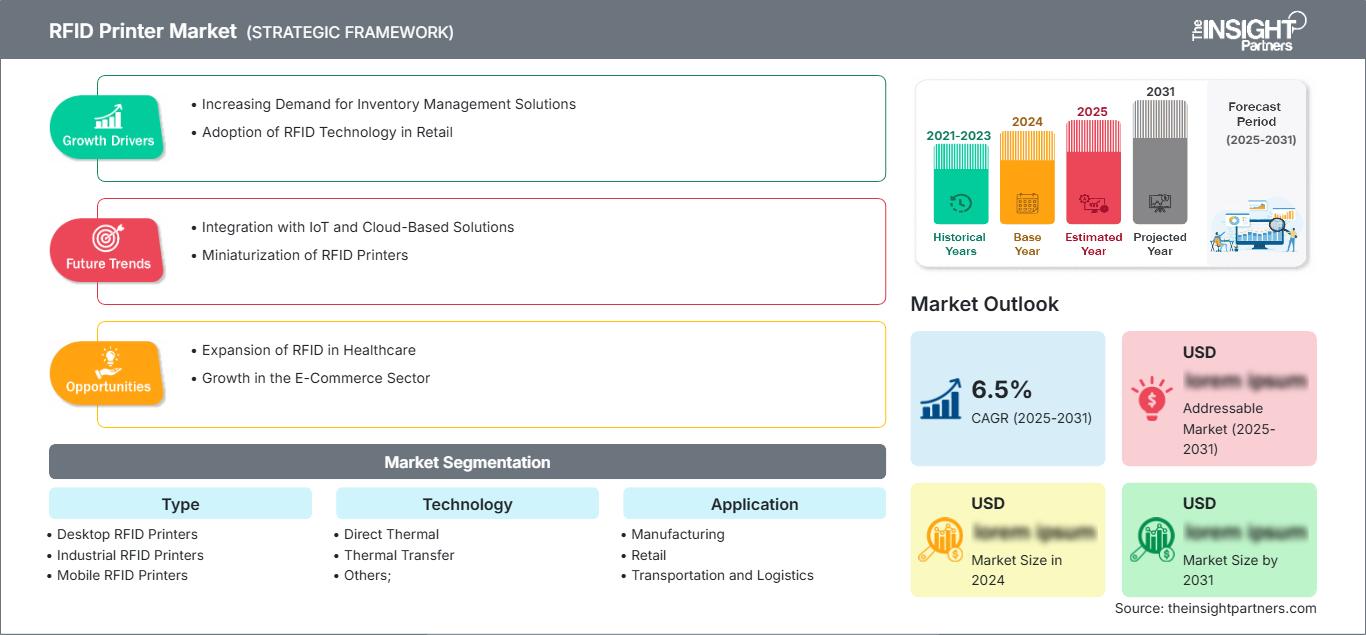
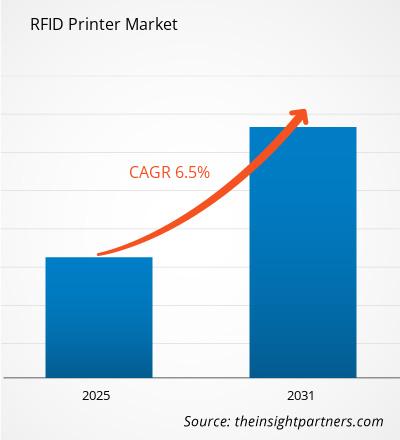
The RFID printer market is projected to expand from US$ 1047.99 Million in 2025 to US$ 2420.77 Million by 2034, registering a CAGR of 9.75% during 2026–2034. Growth is being shaped by increasing use of item-level identification, automated inventory processes, and digitally connected supply chains. Retailers, manufacturers, logistics operators, and healthcare organizations are increasingly deploying printers capable of encoding RFID inlays while simultaneously producing human-readable information.
Across North America, the RFID printer market size is expected to advance at an estimated 8.5–10.0% CAGR between 2026 and 2034. Adoption is supported by mature retail automation infrastructure and continued investments in warehouse digitization. Large retailers are also increasing RFID usage for inventory accuracy, omnichannel fulfillment, loss prevention, and merchandise visibility, strengthening demand for reliable desktop and industrial encoding platforms.
RFID Printer Market Assessment and Insights
- North America: North America is estimated to hold a 31–35% share in 2025 and expand at an 8.5–10.0% CAGR between 2026–2034, supported by retail automation, logistics digitization, and established RFID infrastructure.
- US: The US represents approximately 78–82% of North American demand, with a 9.0–10.2% CAGR between 2026–2034, driven by retail inventory modernization and warehouse automation.
- Europe: Europe accounts for a 24–28% share in 2025 and is expected to grow at 8.0–9.4% CAGR between 2026–2034. Germany, the UK, France, Italy, and Spain are key adoption centers.
- Asia Pacific: Asia Pacific represents a 25–29% share in 2025 and is projected to grow at 10.0–11.5% CAGR between 2026–2034, led by China, Japan, South Korea, and India.
- Largest Segment: Industrial RFID printers hold an estimated 45–49% market share in 2025 and are projected to grow at 9.0–10.0% CAGR between 2026–2034.
- High Growth Segment: Mobile RFID printers represent an estimated 13–17% market share in 2025 and are expected to grow at 11.0–12.5% CAGR between 2026–2034.
- Key companies analyzed in detail: Avery Dennison Corporation, Honeywell International Inc., KYOCERA Corporation, Oki Electric Industry Co., Ltd., Primera Technology, Ricoh Company, Ltd., Seiko Epson Corporation, Sony Corporation, Toshiba International Corporation, Zebra Technologies Corp.
Source: The Insight Partners' analysis based on proprietary research, government publications, company annual reports, investor presentations, industry databases, and expert interviews.
RFID printing has moved from tag encoding specific to integrated identification processes that include printing, encoding, verification, connectivity, and enterprise software. While industrial solutions focus on high-volume production, desktop ones target store-level labeling and small runs. Production trends are also moving towards modular designs, better media management, automation of calibration, and more reliable RFID encoding for different tag formats.
Further growth can be expected to expand into categories beyond apparel into groceries, healthcare, manufacturing, and logistics. The emerging economies in Asia and Latin America are promising markets for deployment as the supply chains are becoming more traceable. More resources will be devoted to interoperable printers, remote fleet management, secure connectivity, and reduced media wastage. Regulations on product traceability and digital supply-chain visibility will be helpful as well.
RFID Printer Market Report Scope
| Report Attribute | Details |
|---|---|
| Market size in 2025 | US$ 1,047.99 Million |
| Market Size by 2034 | US$ 2,420.77 Million |
| Global CAGR (2026 - 2034) | 9.75% |
| Historical Data | 2021-2024 |
| Forecast period | 2026-2034 |
RFID Printer Market Analysis
Demand is increasingly connected to the RFID printer market growth generated by item-level tracking, omnichannel fulfillment, and automated inventory reconciliation. The ecosystem spans RFID inlay suppliers, label converters, printer manufacturers, software providers, systems integrators, enterprise resource planning platforms, retailers, manufacturers, and logistics operators. Printer suppliers compete on encoding reliability, throughput, media compatibility, connectivity, and total ownership cost.
The supply chain is affected by semiconductors, printhead parts, RFID reader parts, mechanics, and unique media. Providers with large service networks are able to eliminate the friction of installing printers because they need calibration, consumables management, firmware maintenance, and integration. The tendency towards the development of connected warehouses contributes to increased demand for central monitoring, allowing operators to find out about printer unavailability, encoding failures, and consumable shortages before they impact the labeling process.
The competition will be characterized by product design and vertical specialization. Zebra Technologies Corporation has a strong market position within industrial and mobile applications, while Honeywell International Inc. has RFID printing together with other identification and warehouse technology solutions. Avery Dennison Corporation has a competitive advantage due to its presence in intelligent labels and materials. Toshiba International Corporation, KYOCERA Corporation, Ricoh Company, Ltd., Seiko Epson Corporation, and Oki Electric Industry Co., Ltd. are involved in printing and enterprise technology solutions.
Primera Technology and Sony Corporation contribute specialized printing and imaging expertise, while competitive positioning increasingly depends on integration rather than hardware alone. The RFID printer market analysis therefore, favors vendors able to connect printers with warehouse management, retail execution, asset tracking, and analytics platforms. Investment priorities include RFID media compatibility, software interoperability, remote diagnostics, and compact systems capable of supporting decentralized labeling operations.
● REPORT CUSTOMIZATION
Tailor This Report To Align With Your Specific Business Requirements
This report can be customized to align precisely with your business objectives, scope, and target markets. Customization options include tailored segmentation, geography, competitive analysis, and strategic insights to support informed decision-making.
Customize This Report →WHAT YOU CAN ADJUST
- ● Segmentations
- ● Geography
- ● Competitive Analysis
- ● Language Preferences
RFID Printer Market: Strategic Insights
Regional Insights
North America RFID printer market
North America is estimated at 31–35% of the RFID printer market share in 2025, with an 8.5–10.0% CAGR through 2034. There is an advanced level of retail automation, warehouse management, and barcode/RFID identification in the region. Automated labeling is gaining momentum due to the increased need for such solutions for large-scale distribution operations, including receiving, picking, packaging, and shipping. The highest demand is expected from industrial platforms that can work 24/7 and provide consistent encoding.
The USA is the key regional market since there are highly advanced identification systems used by retailers, 3PL service providers, manufacturing, and healthcare companies. There is a contribution from Canada due to logistics, food distribution, and industrial applications. Printer fleet replacement and connected device management, as well as increased demand for real-time inventory tracking, add to the regional opportunity.
U.S. RFID printer Market
The US contributes approximately 78–82% of North American RFID printer market demand and is expected to grow at a 9.0–10.2% CAGR through 2034. Application in retail continues to lead the way, especially in apparel and general merchandise, due to the increased visibility made possible by using RFID-enabled labels. Other applications in logistics and manufacturing continue to grow as companies become more automated, making use of case/pallet/component level identification.
Zebra Technologies Corp., Honeywell International Inc., and Avery Dennison Corporation have significant market shares in enterprise ID solutions. There is an increasing demand for industrial-level systems for use in distribution centers and small printers in stores. The need for mobile printing becomes necessary where the labeling process needs to take place at the receiving dock, shelf, workstation or field locations.
Europe RFID printer Market
Europe represents an estimated 24–28% share of the RFID printer market in 2025 and is forecast to expand at an 8.0–9.4% CAGR through 2034. Germany leads regional adoption, followed by the UK, France, Italy, and Spain. Industrial automation, retail traceability, and sustainability-oriented supply-chain initiatives support demand for connected identification equipment.
The UK has strong adoption across apparel, logistics, and omnichannel retail, where RFID supports inventory accuracy and fulfillment. Germany benefits from manufacturing automation and a sophisticated logistics infrastructure. France, Italy, and Spain are expanding applications across retail distribution, consumer products, and healthcare. European buyers increasingly evaluate energy efficiency, serviceability, data integration, and material waste alongside printer throughput. Regional demand, therefore, favors platforms combining reliable encoding with flexible enterprise connectivity.
APAC RFID printer Market
APAC holds an estimated 25–29% share of the RFID printer market in 2025 and is projected to grow at 10.0–11.5% CAGR through 2034. China leads regional demand, supported by manufacturing scale and logistics digitization. Japan and South Korea emphasize automation, while India and Australia present expanding retail and supply-chain opportunities.
Industrial modernization, e-commerce fulfillment, and government-supported digitalization are increasing RFID deployment. Localized manufacturing and expanding technology ecosystems can reduce deployment costs. India is becoming particularly important for supply-chain digitization, while China remains the leading regional production and consumption center. Demand is concentrated in industrial printers, although mobile systems are gaining traction in warehouses and retail environments.
Middle East & Africa RFID printer Market
The Middle East and Africa RFID printer market represents a smaller portion of global demand but is projected to grow at approximately 7.5–9.0% CAGR through 2034. Saudi Arabia and the UAE lead adoption, supported by logistics modernization, smart infrastructure, retail expansion, and industrial diversification. South Africa provides a secondary center for organized retail and logistics.
Investment in distribution infrastructure, airports, ports, manufacturing zones, and large-format retail is creating opportunities for automated identification. The UAE benefits from advanced logistics infrastructure, while Saudi Arabia is supported by industrial and digital transformation programs. South Africa and the rest of MEA remain more price-sensitive, favoring dependable desktop and mid-range industrial platforms with manageable service requirements.
Segmentation Analysis
Type
The Type segment is projected to record differentiated adoption in the RFID Printer Market Trends, with Industrial RFID printers leading at a 9.0–10.0% CAGR between 2026–2034. High-volume warehouses and manufacturing lines prioritize throughput, durability, media flexibility, and continuous encoding. Desktop platforms remain important for stores and offices, while mobile systems benefit from decentralized labeling requirements.
- Desktop RFID printers: Desktop systems serve retail counters, laboratories, small warehouses, and administrative environments where compact footprints and moderate printing volumes are important. Their affordability supports decentralized RFID deployment.
- Industrial RFID printers: Industrial platforms address continuous production, distribution centers, manufacturing lines, and high-volume labeling. Robust construction, high throughput, and encoding reliability make them strategically important for automated operations.
- Mobile RFID printers: Mobile printers support receiving, shelf replenishment, field inventory, and warehouse activities where labels must be generated close to the point of use.
- Others: Other configurations address specialized operating conditions requiring customized form factors, media handling, or integration with specific production environments.
Technology
Technology is expected to progress at a 9.2–10.2% CAGR through 2034 as users balance print durability, speed, consumable economics, and application-specific requirements. Thermal transfer remains valuable for durable labels, while direct thermal supports simpler, short-life identification tasks and lower operational complexity.
- Direct Thermal: Direct thermal printing supports short-duration labels and operational identification, where ribbon-free printing simplifies maintenance. Retail, shipping, and temporary logistics labels remain important use cases.
- Thermal Transfer: Thermal transfer supports durable labels exposed to handling, abrasion, temperature variation, or extended storage. It remains important for industrial and manufacturing identification.
- Others: Alternative approaches address specialized media and printing requirements where conventional thermal methods do not provide the required substrate compatibility or production characteristics.
Application
Application demand is projected to advance at a 9.5–10.5% CAGR through 2034, supported by growing item-level identification across supply chains. Retail remains highly relevant, while manufacturing and transportation increasingly deploy RFID printers to automate identification at multiple workflow stages.
- Manufacturing: Manufacturing users apply RFID labels to components, work-in-progress materials, finished goods, tools, and returnable assets, improving traceability across production and distribution processes.
- Retail: Retailers use encoded labels for merchandise identification, inventory accuracy, replenishment, omnichannel fulfillment, loss prevention, and store-level operational visibility.
- Transportation and Logistics: Logistics operators require dependable RFID printing for cartons, pallets, shipments, and assets. Automated identification reduces manual handling and improves traceability across distribution networks.
- Healthcare: Healthcare organizations use RFID identification for pharmaceuticals, medical equipment, specimens, patient-related materials, and inventory workflows where accuracy and accountability are critical.
- Government: Government applications include asset management, document workflows, equipment tracking, and logistics operations requiring controlled identification and auditable movement.
- Entertainment: Entertainment venues can use RFID labels and credentials for equipment, merchandise, event logistics, and operational tracking where rapid identification improves workflow coordination.
Opportunity Snapshot
| Application | Revenue Contribution | Trend Tag | Adoption Stage |
| Manufacturing | High | Asset Traceability | Scaling |
| Retail | High | Item Visibility | Mature |
| Transportation and Logistics | High | Shipment Tracking | Scaling |
| Healthcare | Medium | Drug Traceability | Scaling |
| Government | Medium | Asset Control | Scaling |
| Entertainment | Low | Event Tracking | Emerging |
RFID Printer Market Growth Drivers and Impact Analysis
Retail inventory accuracy and omnichannel fulfillment
Increasingly, retailers need accurate item-level inventory data as online ordering, store fulfillment, returns, and ship-from-store initiatives depend upon proper stock records. RFID printers facilitate label printing near the production or distribution centers, establishing digital identities of products prior to their entry into stores. The operational effect is not limited to inventory counting since the encoded identifications can link products with warehouse operations, POS transactions, replenishment, and returns processes. With increasing omnichannel capabilities offered by retailers, improper stock data results in order failures and unnecessary transfers. Printer acquisition becomes an element of inventory infrastructure rather than a hardware transaction. Solution providers able to reduce the complexities of encoding validation, media calibration, printer management, and integration can offer a solution for operational challenges.
Warehouse automation and traceability requirements
Automated workflows with requirements for consistent identification have become prevalent in distribution centers across the receiving, sorting, storing, picking, packing, and shipping processes. RFID printers facilitate such a transition through the provision of labels that are readable by machines without any requirement of scanning within the line-of-sight environment. The following effects are achieved due to the described process of automation: identification speed increase, reduction in manual intervention, and synchronization of physical and digital information stored in the warehouse database. The needs of industrial printers grow in response to such requirements because centralizing requires equipment that will function continuously even in challenging working conditions. The integration with the warehouse management system becomes just as necessary in order to initiate printing on the basis of transaction events.
Expansion of item-level identification beyond apparel
RFID printing is gradually making its way into areas such as groceries, healthcare, manufacturing, and logistics, and hence minimizing dependence on one particular retail application. Grocers will find the technology helpful in the processes of identification and movement of products. The healthcare sector can use encoded labels for medications, equipment, and specimens. The manufacturing industry will need to have traceability of components and work-in-progress materials, and logistics firms will be using RFID for shipment and tracking purposes. This helps widen the range of potential customers and reduces risks associated with having too many applications for printers. It also creates a greater demand for more versatile devices that can manage a variety of substrates, sizes, environmental conditions, and encoding capabilities.
RFID Printer Market Future Trends
Connected printer fleets and predictive device management
Connected printer fleets are likely to become a defining feature of large RFID deployments. Instead of managing devices individually, enterprises will increasingly monitor printer status, consumable levels, encoding quality, firmware, utilization, and error conditions through centralized platforms. Predictive analytics can identify declining printhead performance or recurring encoding failures before they affect production. Cloud connectivity may also simplify configuration across geographically distributed stores and warehouses. Security will become more important as printers gain direct access to enterprise networks and operational data. Suppliers that combine hardware with device-management software can therefore create recurring service opportunities while reducing customer maintenance burdens. The trend should particularly benefit organizations operating hundreds or thousands of decentralized printers.
Intelligent labels supporting richer product identities
Future RFID printer deployments will increasingly support labels that carry more than basic identification numbers. Retail and supply-chain operators are exploring combinations of RFID, sensors, digital links, and machine-readable information to connect physical products with digital records. Printers will need to handle increasingly diverse substrates and encoding requirements while maintaining verification accuracy. This development could broaden applications into product authentication, circularity, condition monitoring, and automated recycling workflows. Integration with enterprise data platforms will become important because the commercial value of an intelligent label depends on how effectively its identifier is connected to product, logistics, and customer information. Printer manufacturers able to support flexible encoding architectures will be better positioned as label functionality expands.
RFID Printer Market Opportunities
Localized production and emerging-market deployment
Manufacturers can pursue localized production and distribution strategies in India, Southeast Asia, Latin America, and selected Middle Eastern markets where supply-chain digitization is accelerating. Local service networks can reduce installation delays, simplify maintenance, and improve customer confidence among smaller enterprises. Partnerships with regional systems integrators could further connect printers with warehouse, retail, manufacturing, and enterprise software platforms. Investors should assess opportunities where RFID adoption is moving from pilot programs toward standardized operational deployment because replacement and fleet expansion can create more predictable demand. Product portfolios designed around affordable desktop systems, scalable industrial models, and mobile configurations can address different levels of operational maturity while reducing barriers to initial adoption.
Integrated RFID printing and software ecosystems
The strongest commercial opportunity may come from combining printers with software, device management, analytics, consumables, and integration services rather than selling hardware alone. Customers increasingly expect equipment to operate within existing warehouse, retail, manufacturing, and enterprise platforms. Suppliers can develop differentiated offerings through application programming interfaces, automated print workflows, remote monitoring, encoding verification, and usage analytics. This model can create recurring revenue through software subscriptions and managed services while increasing customer retention. Strategic partnerships with RFID inlay manufacturers, label converters, enterprise software providers, and systems integrators can accelerate adoption. The RFID printer market forecasts indicate that suppliers with broader workflow capabilities could capture greater value as enterprises evaluate total operating efficiency rather than printer acquisition cost alone.
Frequently Asked Questions

- Comprehensive Market Sizing and Forecast Analysis
- Detailed Segmentation Analysis
- In-Depth Market Dynamics Assessment
- Regional and Country-Level Insights
- Competitive Landscape and Company Benchmarking
- Strategic Business Intelligence
Recent Reports
Testimonials

The Insight Partners' SCADA System Market report is comprehensive, with valuable insights on current trends and future forecasts. The team was highly professional, responsive, and supportive throughout. We are very satisfied and highly recommend their services.
RAN KEDEM Partner, Reali Technologies LTDs
I requested a report on a very specific software market and the team produced the report in a few days. The information was very relevant and well presented. I then requested some changes and additions to the report. The team was again very responsive and I got the final report in less than a week.
JEAN-HERVE JENN Chairman, Future Analytica
We worked with The Insight Partners for an important market study and forecast. They gave us clear insights into opportunities and risks, which helped shape our plans. Their research was easy to use and based on solid data. It helped us make smart, confident decisions. We highly recommend them.
PIYUSH NAGPAL Sr. Vice President, High Beam Global
The Insight Partners delivered insightful, well-structured market research with strong domain expertise. Their team was professional and responsive throughout. The user-friendly website made accessing industry reports seamless. We highly recommend them for reliable, high-quality research services
YUKIHIKO ADACHI CEO, Deep Blue, LLC.
This is the first time I have purchased a market report from The Insight Partners.While I was unsure at first, I visited their web site and felt more comfortable to take the risk and purchase a market report.I am completely satisfied with the quality of the report and customer service. I had several questions and comments with the initial report, but after a couple of dialogs over email with their analyst I believe I have a report that I can use as input to our strategic planning process.Thank you so much for taking the extra time and making this a positive experience.I will definitely recommend your service to others and you will be my first call when we need further market data.
JOHN SUZUKI President and Chief Executive Officer, Board Director, BK Technologies
I wish to appreciate your support and the professionalism you displayed in the course of attending to my request for information regarding to infectious disease IVD market in Nigeria. I appreciate your patience, your guidance, and the fact that you were willing to offer a discount, which eventually made it possible for us to close a deal. I look forward to engaging The Insight Partners in the future, all thanks to the impression you have created in me as a result of this first encounter.
DR CHIJIOKE ONYIA MANAGING DIRECTOR, PineCrest Healthcare Ltd.Reason to Buy
- Informed Decision-Making
- Understanding Market Dynamics
- Competitive Analysis
- Identifying Emerging Markets
- Customer Insights
- Market Forecasts
- Risk Mitigation
- Boosting Operational Efficiency
- Strategic Planning
- Investment Justification
- Tracking Industry Innovations
- Aligning with Regulatory Trends





 Get Free Sample for