AI in the K‑12 Education Market Size & Emerging Trends by 2031

AI in the K-12 Education Market Size and Forecast (2021 - 2031), Global and Regional Share, Trend, and Growth Opportunity Analysis Report Report Coverage : by Technology (Machine learning and deep learning, Natural language learning, Others), Component (Solution, Service), Application (Learning platform and facilitators, Intelligent Tutoring Systems, Smart content, Fraud and risk management) End-User (K-12 education, Others) and Geography

  • Report Date : Jan 2026
  • Report Code : TIPRE00042041
  • Category : Technology, Media and Telecommunications
  • Status : Upcoming
  • Available Report Formats : pdf-format excel-format
  • No. of Pages : 150

The AI in K‑12 Education market is estimated at approximately US$ 391.00 million in 2024. It is projected to grow to around US$ 7815.2 million by 2031, representing a compound annual growth rate (CAGR) of approximately 39.6% during 2025–2031.

AI in K‑12 Education Market Analysis

The growth of AI in the K‑12 Education market is driven by a convergence of educational‑technology adoption, advances in artificial intelligence, and changing pedagogical needs. As K‑12 schools face increased pressure to deliver personalized learning, manage remote/hybrid learning environments, and support administrators with data‑driven tools, AI‑enabled solutions (such as intelligent tutoring systems, adaptive learning platforms, smart content, and analytics) are gaining traction. Integration of AI in K‑12 settings enables improved student engagement, tailored instruction to diverse learner needs, automation of routine tasks for educators, and stronger insights into student performance and intervention. In addition, government and institutional initiatives promoting digital education infrastructures further facilitate market growth.

AI in K‑12 Education Market Overview

In this context, a K‑12 AI education solution refers to software (and associated services) that employ artificial intelligence techniques such as machine learning, deep learning, natural language processing, and analytics, to support teaching, learning, assessment, content delivery, and administrative workflows specifically in primary and secondary (K‑12) education settings. These solutions may include adaptive learning systems, virtual facilitators/tutors, smart content (interactive textbooks, simulations), student‑performance analytics, automated grading, attendance and administrative tools, and classroom assistive technologies. By leveraging AI, schools and educators are able to shift more of the routine administrative and instructional burden onto intelligent systems — thereby enabling teachers to allocate more time to direct instruction, student intervention, and differentiated learning — while supporting compliance, data‑driven decision-making, and operational efficiency.

Strategic InsightsAI in K‑12 Education Market Drivers and Opportunities

Market Drivers:

  • Rising demand for personalized learning experiences in K‑12 education: As schools seek to tailor instruction for individual student needs, AI‑based adaptive learning platforms are increasingly adopted.
  • Growth in hybrid and remote/hybrid schooling models: The shift (accelerated by pandemic experience) to more flexible learning environments increases the need for intelligent digital tools that monitor, engage, and support students outside traditional classrooms.
  • Increasing investments from governments and private stakeholders in digital education infrastructure and EdTech: National and regional initiatives to modernize K‑12 schooling drive the adoption of AI‑powered education solutions.

Market Opportunities:

  • Expansion in emerging markets (e.g., India, China, Latin America) with rising K‑12 enrolments, increasing digital penetration in schools, and government initiatives around smart education (providing fertile ground for AI tools).
  • Integration of AI with broader educational ecosystems: Combining AI solutions with learning management systems (LMS), student information systems (SIS), digital content publishers, assessment platforms, and analytics to create unified K‑12 platforms.
  • Growing demand for AI‑driven automation in administrative and back‑office workflows in K‑12 (attendance management, grading, performance analytics), which opens service opportunities beyond pure instructional solutions.
     
AI in K‑12 Education Market Report Segmentation Analysis

The market for AI in K‑12 Education is typically segmented as follows:

By Technology:

  • Machine Learning & Deep Learning
  • Natural Language Processing (NLP)
  • Others

By Component:

  • Solution (software, platforms)
  • Service (implementation, integration, maintenance, training)

By Application:

  • Learning Platforms & Virtual Facilitators
  • Intelligent Tutoring Systems (ITS)
  • Smart Content (interactive textbooks, simulations, adaptive e‑content)
  • Fraud & Risk Management (e.g., cheating detection, attendance analytics)
  • Others

By End‑Use Industry (within education context):

  • K‑12 Education (primary & secondary schools)
  • (Other end‑uses like Higher Education or Corporate Learning may exist, but for this report, the focus is K‑12)

By Geography:

  • North America
  • Europe
  • Asia Pacific
  • South & Central America
  • Middle East & Africa
Market Report ScopeAI in K‑12 Education Market Share Analysis by GeographyNorth America
  • Market share: holds a dominant position due to advanced digital infrastructure in K‑12, high adoption of EdTech, and early deployments of AI‑based learning and analytics tools.
  • Key drivers: Strong K‑12 funding, large-scale digital initiatives in school systems, high teacher/staff readiness for AI tools, and strong vendor presence.
  • Trends: Shift toward cloud‑based AI platforms for remote and hybrid learning, increased adoption of Intelligent Tutoring Systems, and use of analytics for student monitoring.

Europe

  • Market share: substantial, supported by public school digitization strategies, strong regulatory frameworks for data protection (which influence the shape of AI solutions).
  • Key drivers: Government‑backed smart schooling programs, high standards for data privacy (GDPR), prompting vendors to tailor K‑12 AI solutions accordingly.
  • Trends: Growing use of interoperable AI education platforms across multiple countries, language localization, and cross‑border collaborations in EdTech.

Asia Pacific

  • Market share: expected to be the fastest‑growing region in the forecast period, given large K‑12 populations, rising digital education investments, and expanding private schooling sectors.
  • Key drivers: National digital education missions in countries like India and China, large student bases, and increasing use of mobile and cloud‑based learning in schools.
  • Trends: Localisation of AI solutions, affordable cloud‑based models for schools, growth of AI‑driven tutoring/learning apps for K‑12 across large geographies.

South & Central America

  • Market share: Emerging region with significant opportunities as K‑12 school systems adopt digital learning and AI tools.
  • Key drivers: Need to improve learning outcomes, grow private school adoption of digital solutions, and increase partnerships with global EdTech vendors.
  • Trends: Cloud‑first AI education platforms for cost‑efficient deployment, focus on language‑specific content, and adaptive learning for underserved schools.

Middle East & Africa

  • Market share: Developing region but strong growth potential driven by expansion of K‑12 digital infrastructure and national smart school initiatives.
  • Key drivers: Government‑led investments in e‑learning for K‑12, smart classroom roll‑outs, and increasing mobile connectivity.
  • Trends: AI in K‑12 used in integrated smart school models (combining learning, administration, student analytics), often via public–private partnerships.
AI in the K‑12 Education Market

Players Density: Understanding Its Impact on Business Dynamics

The AI in K‑12 Education market is becoming increasingly competitive with a mix of global EdTech firms, AI specialists, school‑system vendors, and localized niche players. High market density is pushing players to differentiate on multiple fronts, including:

  • Seamless integration of AI learning platforms with school information systems (SIS), LM, S, and assessment tools.
  • Scalable, cloud‑based AI solutions tailored for K‑12 schools of different sizes (from single‑school districts to nationwide programmes).
  • AI‑enabled personalized learning, classroom analytics, and teacher‑support automation (reducing teacher workload, enhancing interventions).
  • Localised solutions in terms of language, curriculum, and cultural context for K‑12 markets outside North America/Europe.

Opportunities and Strategic Moves:

  • Partnering with school districts, ministries of education, and EdTech publishers to embed AI within curricula and school workflows.
  • Incorporating advanced AI/ML capabilities (predictive analytics for student outcomes, real‑time intervention systems, intelligent tutoring) to improve learning outcomes and differentiate from standard tools.
  • Expanding into underserved geographies and emerging markets with lower-cost, cloud‑native AI K‑12 solutions.
  • Bundling services (training for teachers, change management, content adaptation) with the AI platform to increase adoption in K‑12 schools, which may have limited internal IT/AI expertise.

Major Companies operating in the AI in K‑12 Education Market are:

  1. Amazon Web Services Inc.
  2. IBM Corporation
  3. Google LLC
  4. Pearson Plc
  5. Cognizant Technology Solutions Corp.
  6. McGraw-Hill Education
  7. Century Tech Limited
  8. Nuance Communications Inc.
  9. Houghton Mifflin Harcourt Company
  10. DreamBox Learning Inc.
Other companies analysed during the course of research:
  1. Knewton Inc.
  2. Osmo 
  3. Carnegie Learning Inc.
  4. Cognii Inc.
  5. Third Space Learning Ltd.
  6. Kidaptive Inc.
  7. BridgeU Ltd.
  8. Elemental Path Inc.
  9. Fishtree Inc.
  10. Jellynote Inc.
AI in the K‑12 Education Market News and Recent Developments
  • The rise of AI‑powered tutoring and classroom analytics in K‑12 has been widely reported — for example, recent data show parent concerns over AI and student data in K‑12 settings, highlighting the importance of data protection and trust frameworks in the rollout of AI solutions.
  • Major education publishers, EdTech platforms, and cloud‑providers are announcing AI‑enhancements in their K‑12 offerings (e.g., adaptive learning modules, intelligent assistants for teachers) — signifying that vendors are accelerating development and commercialization of AI for K‑12.
  • National initiatives in regions such as the Asia Pacific see large budgets committed to smart schooling and digital learning infrastructure, which include AI‑enabled learning platforms at the K‑12 level (see segmentation insights above).
AI in K‑12 Education Market Report Coverage and Deliverables

The “AI in K‑12 Education Market Size & Forecast (2021‑2031)” report provides a detailed analysis covering:

  • Market size and forecast at global, regional, and country levels for all key market segments as per the scope.
  • Key market trends, dynamics, including drivers, restraints, and opportunities specific to K‑12 education.
  • Detailed PEST and SWOT analysis.
  • Market analysis covering key trends, global/regional frameworks, major players, regulations, and recent developments in the K‑12 AI education market.
  • Industry landscape and competition analysis covering market concentration, heat‑map analysis, prominent players, and recent developments in the market.
  • Detailed company profiles of major players.
REGIONAL FRAMEWORK
World Geography

Have a question?

Analyst

Naveen

Naveen will walk you through a 15-minute call to present the report’s content and answer all queries if you have any.

Analyst   Speak to Analyst
  • Sample PDF showcases the content structure and the nature of the information with qualitative and quantitative analysis.
  • Request discounts available for Start-Ups & Universities
MARKET PLAYERS
  • Sample PDF showcases the content structure and the nature of the information with qualitative and quantitative analysis.
  • Request discounts available for Start-Ups & Universities
Report Coverage
Report Coverage

Revenue forecast, Company Analysis, Industry landscape, Growth factors, and Trends

Segment Covered
Segment Covered

This text is related
to segments covered.

Regional Scope
Regional Scope

North America, Europe, Asia Pacific, Middle East & Africa, South & Central America

Country Scope
Country Scope

This text is related
to country scope.

Frequently Asked Questions


Which regions are leading in the adoption of AI in K‑12 Education?

1. North America leads due to advanced infrastructure and strong EdTech adoption.
2. Europe has a significant share due to public schooling budgets and digitization initiatives.
3. Asia Pacific is expected to exhibit the fastest growth due to large K‑12 populations and rising digital‑learning investments.

Which component is gaining traction in the global AI in K‑12 Education market?

The solution (software/platform) segment currently holds a dominant share, given heavy investment into AI‑learning platforms and adaptive tutoring systems. Services (integration, training, ongoing support) are also growing rapidly.

Which industries (end‑users) are the primary users of AI in K‑12 Education?

1. Primary and secondary schools (K‑12) globally, including private and public school systems.
2. Supplementary education providers (tutoring centres) for K‑12.
3. School administration and district‑level IT/education departments managing large K‑12 networks.

Which challenges hinder the AI in the K‑12 Education market growth?

1. Data privacy and security concerns around student data and AI systems.
2. Budget constraints in many K‑12 school systems (especially public schools in lower‑income regions) and variable IT readiness.
3. Need for teacher training, change management, and integration of AI solutions with existing school systems and curriculum.

What are the key drivers of the AI in K‑12 Education market growth?

1. Rising demand for personalized & adaptive learning in K‑12.
2. Growth in remote/hybrid schooling and digital learning infrastructure.
3. Government initiatives and funding for EdTech in K‑12 schools.

Your Key Concerns Addressed - Question & Answer
Can I view a sample of the report before purchasing?

Yes! We provide a free sample of the report, which includes Report Scope (Table of Contents), report structure, and selected insights to help you assess the value of the full report. Please click on the "Download Sample" button or contact us to receive your copy.

Is analyst support included with the purchase?

Absolutely - analyst assistance is part of the package. You can connect with our analyst post-purchase to clarify report insights, methodology or discuss how the findings apply to your business needs.

What are the next steps once I place an order?

Once your order is successfully placed, you will receive a confirmation email along with your invoice.

• For published reports: You'll receive access to the report within 4-6 working hours via a secured email sent to your email.
• For upcoming reports: Your order will be recorded as a pre-booking. Our team will share the estimated release date and keep you informed of any updates. As soon as the report is published, it will be delivered to your registered email.

Can the report be tailored to suit my specific needs?

We offer customization options to align the report with your specific objectives. Whether you need deeper insights into a particular region, industry segment, competitor analysis, or data cut, our research team can tailor the report accordingly. Please share your requirements with us, and we'll be happy to provide a customized proposal or scope.

In what format is the report delivered?

The report is available in either PDF format or as an Excel dataset, depending on the license you choose.

The PDF version provides the full analysis and visuals in a ready-to-read format. The Excel dataset includes all underlying data tables for easy manipulation and further analysis.
Please review the license options at checkout or contact us to confirm which formats are included with your purchase.

How secure is the payment process on your platform?

Our payment process is fully secure and PCI-DSS compliant.

We use trusted and encrypted payment gateways to ensure that all transactions are protected with industry-standard SSL encryption. Your payment details are never stored on our servers and are handled securely by certified third-party processors.
You can make your purchase with confidence, knowing your personal and financial information is safe with us.

Do you provide special pricing for buying multiple reports?

Yes, we do offer special pricing for bulk purchases.
If you're interested in purchasing multiple reports, we're happy to provide a customized bundle offer or volume-based discount tailored to your needs. Please contact our sales team with the list of reports you're considering, and we'll share a personalized quote.

Can I connect with your team to discuss the report before buying?

Yes, absolutely.
Our team is available to help you make an informed decision. Whether you have questions about the report's scope, methodology, customization options, or which license suits you best, we're here to assist. Please reach out to us at sales@theinsightpartners.com, and one of our representatives will get in touch promptly.

Will I get a billing invoice upon purchase?

Yes, a billing invoice will be automatically generated and sent to your registered email upon successful completion of your purchase.
If you need the invoice in a specific format or require additional details (such as company name, GST, or VAT information), feel free to contact us, and we'll be happy to assist.

Is there support available if I can't access my report?

Yes, certainly.
If you encounter any difficulties accessing or receiving your report, our support team is ready to assist you. Simply reach out to us via email or live chat with your order information, and we'll ensure the issue is resolved quickly so you can access your report without interruption.

The Insight Partners performs research in 4 major stages: Data Collection & Secondary Research, Primary Research, Data Analysis and Data Triangulation & Final Review.

  1. Data Collection and Secondary Research:

As a market research and consulting firm operating from a decade, we have published many reports and advised several clients across the globe. First step for any study will start with an assessment of currently available data and insights from existing reports. Further, historical and current market information is collected from Investor Presentations, Annual Reports, SEC Filings, etc., and other information related to company’s performance and market positioning are gathered from Paid Databases (Factiva, Hoovers, and Reuters) and various other publications available in public domain.

Several associations trade associates, technical forums, institutes, societies and organizations are accessed to gain technical as well as market related insights through their publications such as research papers, blogs and press releases related to the studies are referred to get cues about the market. Further, white papers, journals, magazines, and other news articles published in the last 3 years are scrutinized and analyzed to understand the current market trends.

  1. Primary Research:

The primarily interview analysis comprise of data obtained from industry participants interview and answers to survey questions gathered by in-house primary team.

For primary research, interviews are conducted with industry experts/CEOs/Marketing Managers/Sales Managers/VPs/Subject Matter Experts from both demand and supply side to get a 360-degree view of the market. The primary team conducts several interviews based on the complexity of the markets to understand the various market trends and dynamics which makes research more credible and precise.

A typical research interview fulfils the following functions:

  • Provides first-hand information on the market size, market trends, growth trends, competitive landscape, and outlook
  • Validates and strengthens in-house secondary research findings
  • Develops the analysis team’s expertise and market understanding

Primary research involves email interactions and telephone interviews for each market, category, segment, and sub-segment across geographies. The participants who typically take part in such a process include, but are not limited to:

  • Industry participants: VPs, business development managers, market intelligence managers and national sales managers
  • Outside experts: Valuation experts, research analysts and key opinion leaders specializing in the electronics and semiconductor industry.

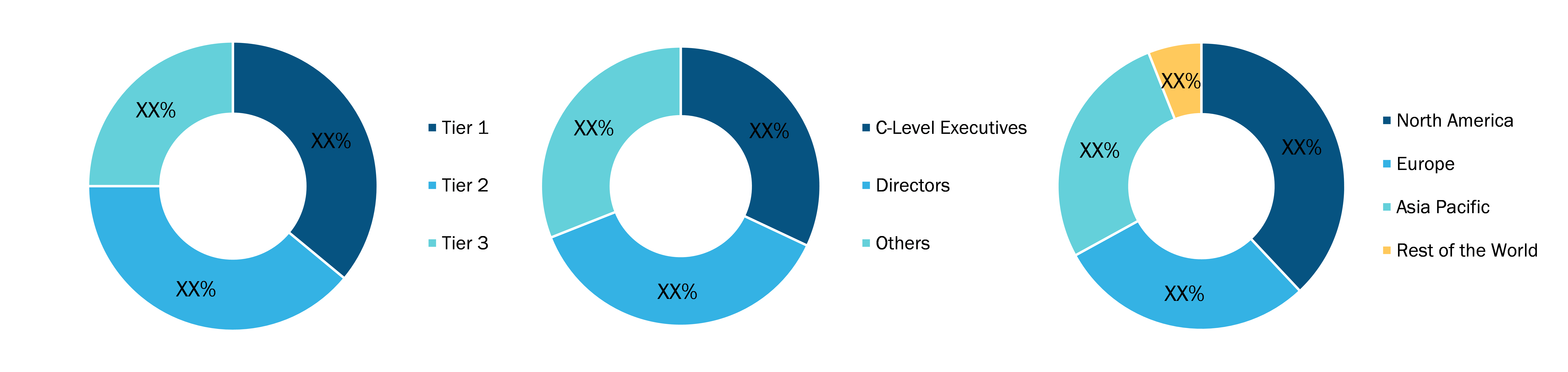
Below is the breakup of our primary respondents by company, designation, and region:
Research Methodology

Once we receive the confirmation from primary research sources or primary respondents, we finalize the base year market estimation and forecast the data as per the macroeconomic and microeconomic factors assessed during data collection.

  1. Data Analysis:

Once data is validated through both secondary as well as primary respondents, we finalize the market estimations by hypothesis formulation and factor analysis at regional and country level.

  • 3.1 Macro-Economic Factor Analysis:

We analyse macroeconomic indicators such the gross domestic product (GDP), increase in the demand for goods and services across industries, technological advancement, regional economic growth, governmental policies, the influence of COVID-19, PEST analysis, and other aspects. This analysis aids in setting benchmarks for various nations/regions and approximating market splits. Additionally, the general trend of the aforementioned components aid in determining the market's development possibilities.

  • 3.2 Country Level Data:

Various factors that are especially aligned to the country are taken into account to determine the market size for a certain area and country, including the presence of vendors, such as headquarters and offices, the country's GDP, demand patterns, and industry growth. To comprehend the market dynamics for the nation, a number of growth variables, inhibitors, application areas, and current market trends are researched. The aforementioned elements aid in determining the country's overall market's growth potential.

  • 3.3 Company Profile:

The “Table of Contents” is formulated by listing and analyzing more than 25 - 30 companies operating in the market ecosystem across geographies. However, we profile only 10 companies as a standard practice in our syndicate reports. These 10 companies comprise leading, emerging, and regional players. Nonetheless, our analysis is not restricted to the 10 listed companies, we also analyze other companies present in the market to develop a holistic view and understand the prevailing trends. The “Company Profiles” section in the report covers key facts, business description, products & services, financial information, SWOT analysis, and key developments. The financial information presented is extracted from the annual reports and official documents of the publicly listed companies. Upon collecting the information for the sections of respective companies, we verify them via various primary sources and then compile the data in respective company profiles. The company level information helps us in deriving the base number as well as in forecasting the market size.

  • 3.4 Developing Base Number:

Aggregation of sales statistics (2020-2022) and macro-economic factor, and other secondary and primary research insights are utilized to arrive at base number and related market shares for 2022. The data gaps are identified in this step and relevant market data is analyzed, collected from paid primary interviews or databases. On finalizing the base year market size, forecasts are developed on the basis of macro-economic, industry and market growth factors and company level analysis.

  1. Data Triangulation and Final Review:

The market findings and base year market size calculations are validated from supply as well as demand side. Demand side validations are based on macro-economic factor analysis and benchmarks for respective regions and countries. In case of supply side validations, revenues of major companies are estimated (in case not available) based on industry benchmark, approximate number of employees, product portfolio, and primary interviews revenues are gathered. Further revenue from target product/service segment is assessed to avoid overshooting of market statistics. In case of heavy deviations between supply and demand side values, all thes steps are repeated to achieve synchronization.

We follow an iterative model, wherein we share our research findings with Subject Matter Experts (SME’s) and Key Opinion Leaders (KOLs) until consensus view of the market is not formulated – this model negates any drastic deviation in the opinions of experts. Only validated and universally acceptable research findings are quoted in our reports.

We have important check points that we use to validate our research findings – which we call – data triangulation, where we validate the information, we generate from secondary sources with primary interviews and then we re-validate with our internal data bases and Subject matter experts. This comprehensive model enables us to deliver high quality, reliable data in shortest possible time.

Your data will never be shared with third parties, however, we may send you information from time to time about our products that may be of interest to you. By submitting your details, you agree to be contacted by us. You may contact us at any time to opt-out.