
AI in the K-12 Education Market Size, Share & Forecast by 2034
AI in the K-12 Education Market Size and Forecast (2021 - 2034), Global and Regional Share, Trend, and Growth Opportunity Analysis Report Report Coverage : by Technology (Machine learning and deep learning, Natural language learning, Others), Component (Solution, Service), Application (Learning platform and facilitators, Intelligent Tutoring Systems, Smart content, Fraud and risk management) End-User (K-12 education, Others) and Geography
- Status : Data Released
- Report Code : TIPRE00042041
- Category : Technology, Media and Telecommunications
- No. of Pages : 150
- Available Report Formats :


- Last update date : August 12, 2026


2025 Market Size
US$ 3.57 Bn
Base year value
2034 Forecast
US$ 18.88 Bn
Projected by 2034
CAGR 2026-2034
20.33 %
Growth rate
Addressable Market
US$ 90.63 Bn
(2026-2034)
The AI in the K-12 education market was valued at US$ 3.57 Billion in 2025 and is projected to reach US$ 18.88 Billion by 2034, expanding at a CAGR of 20.33% during 2026–2034. Demand is increasing as schools implement adaptive learning, intelligent tutoring systems, smart content, analytics, and AI-based work processes to enhance teaching, evaluation, accessibility, and efficiency in administration.
North America still offers the best framework for AI adoption in education, backed by digital transformation at the district level, cloud maturity, policy discussion, and teachers' experimenting with generative AI. The market size of AI in the K-12 education sector will be impacted by personalized curriculums, academic integrity requirements, and demand for scalable tools that decrease teacher burden.
AI in the K-12 Education Market Assessment and Insights
- North America accounted for an estimated 37–40% share in 2025 and is expected to grow at a CAGR of 19–22% during 2026–2034, led by cloud-based platforms, district pilots, and advanced learning analytics.
- US represented 86–90% of North America in 2025 and is forecast to expand at a CAGR of 19–21%, supported by AI training, procurement activity, and policy formation.
- Europe held an estimated 24–27% share in 2025 and is projected to grow at a CAGR of 18–20%, with the UK, Germany, France, Italy, and Spain advancing responsible AI adoption.
- Asia Pacific represented 22–25% share in 2025 and is expected to grow at a CAGR of 22–25%, supported by China, Japan, South Korea, India, and Australia.
- Largest Segment Solution held an estimated 68–72% market share in 2025 and is expected to grow at a CAGR of 19–21% as platforms embed tutoring, analytics, and content automation.
- High Growth Segment Intelligent Tutoring Systems held 18–22% share in 2025 and is expected to grow at a CAGR of 23–26% due to personalized feedback and remediation demand.
- Key companies analyzed in detail: Amazon Web Services, Inc.; International Business Machines Corporation; Google LLC; Pearson plc; Cognizant Technology Solutions Corporation; McGraw Hill LLC; CENTURY Tech Limited; Microsoft Corporation; Houghton Mifflin Harcourt Company; DreamBox Learning, Inc.
Source: The Insight Partners' analysis based on proprietary research, government publications, company annual reports, investor presentations, industry databases, and expert interviews.
The classroom technology has moved away from traditional static digital contents to more adaptive technologies that analyze learner behaviors and offer recommendations, automate routine teaching tasks and offer recommendations. The growth of AI in the K-12 education market will be associated more with the cloud learning platforms, natural language interfaces, learning analytics and smart assessment engines. The vendors have focused on privacy, curriculum alignment, interoperability and usability of their products for teachers because the school districts need to see the value of learning, safe implementation and reasonable implementation costs.
Through the forecast period, the adoption will move beyond initial experiments to structured procurement of the products, especially where education systems will have to integrate digital infrastructure, train teachers and implement proper AI governance. The emerging regions will develop scalable learning platforms to compensate for the shortage of teachers, language diversification and uneven learning outcomes.
AI in the K-12 Education Market Report Scope
| Report Attribute | Details |
|---|---|
| Market size in 2025 | US$ 3.57 Billion |
| Market Size by 2034 | US$ 18.88 Billion |
| Global CAGR (2026 - 2034) | 20.33% |
| Historical Data | 2021-2024 |
| Forecast period | 2026-2034 |
AI in the K-12 Education Market Analysis
The AI technology in the K-12 education industry is primarily fueled by the need for personalized education in classrooms with different capabilities, shortened assessment process cycles, and data-based interventions. The adaptive learning engines will assist in identifying the gaps that exist at the student level, and the natural language learning engines will enable the reading, writing, translation, and conversation processes.
The supply dynamics in the K-12 education industry will be dominated by cloud service providers, education publishers, learning management systems providers, and AI software vendors. The organizations that will be dominating include Amazon Web Services, Inc., Google LLC, Microsoft Corporation, and International Business Machines Corporation. The companies that will dominate as far as the curriculum, tutoring, and learner analytics are concerned include Pearson plc, McGraw Hill LLC, Houghton Mifflin Harcourt Company, CENTURY Tech Limited, and DreamBox Learning, Inc.
Competitive dynamics within the K-12 education market, based on AI in the K-12 education market report, have changed from individual solutions to the whole ecosystem of products. The vendor evaluation by buyers would depend on factors such as data protection, ease of implementation, effectiveness for learning, and compatibility of the system. Requirements for transformation and integration will be provided by Cognizant Technology Solutions Corporation, whereas depth of content, adaptive learning paths, and teacher dashboard will characterize the publishers and platforms.
Investments are going to be more inclined towards scalable solutions. The application of generative AI technology by educators has gone up substantially; however, there is a lack of readiness with regards to training and policies in place. This needs professional service, guardrails, prompt libraries, integrity workflow, and analytics.
● REPORT CUSTOMIZATION
Tailor This Report To Align With Your Specific Business Requirements
This report can be customized to align precisely with your business objectives, scope, and target markets. Customization options include tailored segmentation, geography, competitive analysis, and strategic insights to support informed decision-making.
Customize This Report →WHAT YOU CAN ADJUST
- ● Segmentations
- ● Geography
- ● Competitive Analysis
- ● Language Preferences
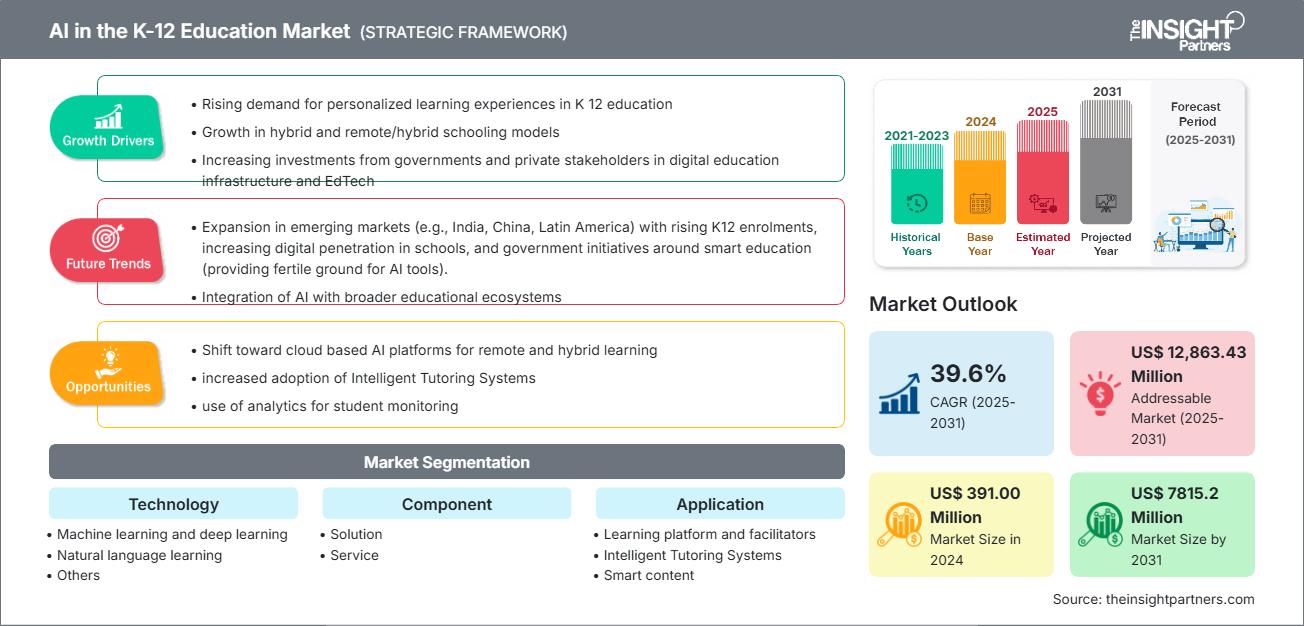
AI in the K-12 Education Market: Strategic Insights
Regional Insights
North America AI in the K-12 education market
North America held an estimated 37–40% AI in the K-12 education market share in 2025 and is expected to grow at a CAGR of 19–22% through 2034. Adoption is supported by strong cloud penetration, public school digitization, and educator use of AI for lesson planning, grading support, and differentiated instruction.
This is also affected by issues of academic integrity, privacy, and governance in the school districts. There has been a shift from the trial-and-error methods to the use of officially adopted AI tools and purchase guidelines in education institutions. In the region, the US leads in funding, while Canada participates through online learning programs.
U.S. AI in the K-12 education Market
The US accounted for an estimated 86–90% of North America in 2025 and is expected to grow at a CAGR of 19–21%. Large districts, charter networks, and state policy initiatives are creating demand for adaptive platforms, student support chatbots, AI writing tools, and administrative automation.
The presence of the company is very high due to the presence of developed education ecosystems from cloud and productivity platform providers, publication and learning platforms. While teachers are using AI to develop instructional content, administrators are concerned with privacy, procurement control, and policies around the responsible use of AI.
Europe AI in the K-12 education Market
The European region accounted for 24-27% share in 2025 and is expected to register a CAGR of 18-20%. The UK has made the earliest inroads via use of digital curriculum resources and procurement of edtech tools, while Germany focuses on data protection, interoperability, and teachers' training before classroom AI implementation.
France, Italy, and Spain are on track when it comes to AI language learning, advanced assessment systems, and online classrooms. The buyers in Europe are selective but structurally positive as the educational institutions require compliance-based solutions. Responsible AI policies would help vendors with explainability and curriculum alignment.
APAC AI in the K-12 education Market
APAC held an estimated 22–25% share in 2025 and is expected to grow at a CAGR of 22–25%, making it the fastest-growing region. China, Japan, South Korea, India, and Australia are investing in smart classrooms, digital learning infrastructure, and AI literacy programs.
China is the frontrunner in regional scale via national digital education policies, whereas India provides solid long-term demand because of sheer number of students and need for multilingual education. Japan, South Korea, and Australia provide support for adoption via high connectivity and demand for customized tutors.
Middle East & Africa AI in the K-12 education Market
The Middle East and Africa region is projected to see a CAGR of 18–21% in the period of 2026–2034. Saudi Arabia and the UAE are the leaders by means of using smart education solutions, cloud computing, and national digital transformation efforts, while South Africa is represented by the private schools' network and e-learning services.
The demand in Rest of MEA region is still inconsistent due to uneven development of infrastructure, accessibility, and teacher training. But AI-based tutoring, language translation, and content localization can help bridge teacher shortages and other gaps in delivering curriculums.
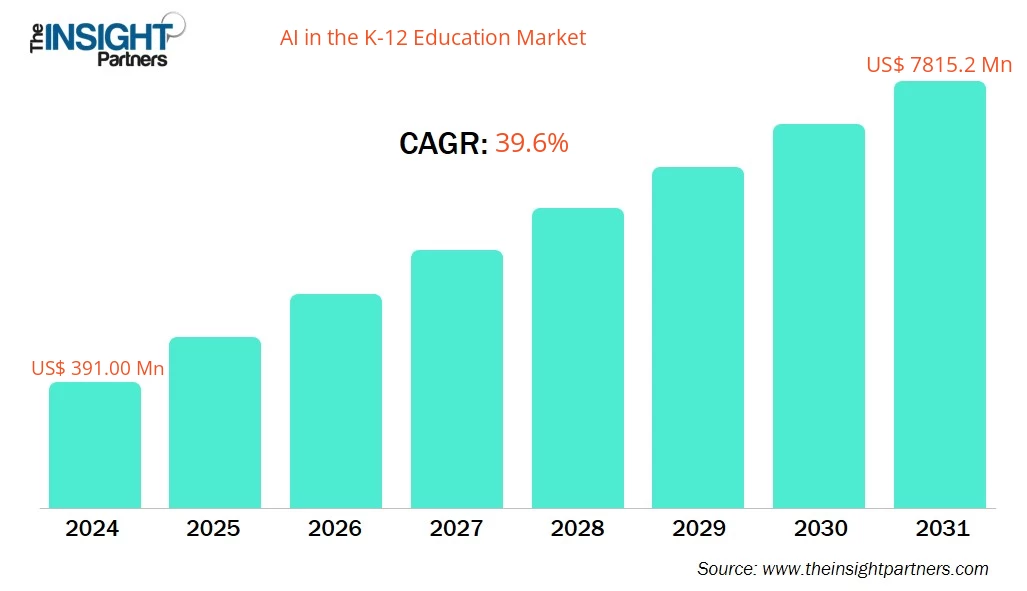
Segmentation Analysis
Technology
Technology is expected to grow at a CAGR of 20–23% during 2026–2034. AI in the K-12 education market scope across technology is expanding as machine learning, deep learning, and natural language learning power adaptive pathways, automated feedback, learning analytics, and classroom assistants. Schools increasingly prioritize models that are explainable, secure, and aligned with curriculum standards.
- Machine learning and deep learning support adaptive recommendations, learner profiling, predictive analytics, and automated assessment, making them central to personalization and early intervention strategies.
- Natural language learning enables reading support, writing feedback, translation, conversational practice, and chatbot-based tutoring, especially in multilingual and inclusive classroom environments.
Component
Component is expected to grow at a CAGR of 19–22%. Solutions dominate because schools need deployable platforms for tutoring, content, assessment, analytics, and classroom support. Services are gaining importance as districts require implementation, teacher training, governance design, data integration, and ongoing optimization.
- Solution contributes high revenue because platforms embed AI into learning workflows, dashboards, assessment engines, content libraries, and classroom productivity tools.
- Service supports adoption through integration, customization, training, support, and responsible AI consulting, especially for districts with limited internal technical capacity.
Application
Application is expected to grow at a CAGR of 21–24%. Learning platforms and intelligent tutoring systems are strategic because they directly influence instruction, remediation, and engagement. Smart content and fraud and risk management are also important as schools seek efficient content creation and academic integrity controls.
- Learning platform and facilitators integrate AI into daily teaching workflows, including lesson support, differentiated resources, student progress tracking, and classroom management.
- Intelligent Tutoring Systems provide personalized explanations, hints, practice sequencing, and feedback, helping students close learning gaps outside one-to-one teacher availability.
- Smart content automates quizzes, summaries, translations, and interactive materials, reducing preparation time while improving accessibility and curriculum responsiveness.
- Fraud and risk management addresses academic integrity, inappropriate use, data privacy, and policy compliance as generative AI becomes more common among students.
End-User
End-User is expected to grow at a CAGR of 20–22%. K-12 education remains the core end-user because schools face rising demand for personalization, tutoring, assessment modernization, and teacher workload reduction. Adoption is strongest where leadership combines digital infrastructure, educator training, procurement governance, and outcome measurement.
- K-12 education includes public schools, private schools, districts, and online academies adopting AI for instruction, assessment, accessibility, administration, and learner support.
Opportunity Snapshot
| Application | Revenue Contribution | Trend Tag | Adoption Stage |
| Learning Platform and Facilitators | High | Teacher Copilots | Scaling |
| Intelligent Tutoring Systems | High | Adaptive Tutoring | Scaling |
| Smart Content | Medium | Content Automation | Scaling |
| Fraud and Risk Management | Medium | Integrity Controls | Emerging |
AI in the K-12 Education Market Growth Drivers and Impact Analysis
Rising demand for personalized learning at classroom scale
Personalized learning remains the strongest driver because K-12 classrooms contain wide differences in reading level, numeracy, language ability, and learning pace. AI systems can recommend practice, adjust difficulty, identify misconceptions, and provide immediate feedback without waiting for manual review. This improves instructional efficiency while supporting intervention for students who need remediation or enrichment. For districts, the impact is practical: fewer one-size-fits-all tools, better progress visibility, and stronger alignment between classroom instruction and student performance data.
Teacher workload pressure and administrative automation
Teacher workload is pushing schools to evaluate AI tools that reduce time spent on lesson preparation, grading support, quiz creation, communication, and resource differentiation. AI does not replace teacher judgment, but it can remove repetitive tasks and free time for instruction, mentoring, and classroom management. Market impact is strongest in platforms that embed AI into familiar workflows, such as learning management systems, productivity suites, and assessment dashboards. Vendors that combine usability, training, and policy guardrails will gain stronger district adoption.
Growing need for responsible AI governance in schools
As student and teacher use of AI expands, schools need tools that support privacy, academic integrity, transparency, and age-appropriate design. This creates demand for approved AI environments, monitoring workflows, auditability, and professional development. The market impact is twofold: generic tools face procurement barriers, while education-specific solutions with compliance features gain advantage. District leaders increasingly want human-in-the-loop systems, data protection controls, and explainable outputs that help teachers use AI safely while maintaining trust with parents and regulators.
AI in the K-12 Education Market Future Trends
Teacher-facing AI copilots becoming embedded in core platforms
AI in the K-12 education market trends point toward copilots embedded directly into learning platforms, productivity suites, assessment tools, and student information systems. Instead of separate applications, teachers will access AI while creating lessons, reviewing work, assigning practice, and communicating with families. This integration will improve adoption because educators prefer tools that fit daily routines. The next wave will emphasize district-approved prompts, curriculum-linked recommendations, and analytics that explain why specific interventions are suggested.
Shift toward evidence-based and privacy-preserving AI deployment
Future procurement will increasingly depend on evidence of learning impact, data minimization, age-appropriate design, and compliance with education privacy rules. Schools will ask vendors to prove that AI improves outcomes without exposing student data or creating biased recommendations. This trend will favor providers with secure architectures, transparent model behavior, interoperability, and teacher oversight. It will also expand demand for third-party validation, implementation services, and district-level governance frameworks.
AI in the K-12 Education Market Opportunities
District-scale intelligent tutoring and intervention programs
AI in the K-12 education market Forecasts show strong opportunity in districtwide tutoring and intervention programs that provide consistent academic support beyond classroom time. Intelligent tutoring systems can help schools address learning gaps, absenteeism-related setbacks, and uneven access to private tutoring. Providers can win by aligning content to standards, integrating with assessment data, and enabling teachers to monitor progress. The opportunity is especially attractive in mathematics, literacy, English language learning, and special education support.
Professional services for AI readiness and change management
Service providers have a growing opportunity to support AI readiness assessments, policy design, teacher training, workflow integration, and data governance. Many schools are interested in AI but lack clear implementation roadmaps or internal expertise. Consulting, managed services, and training packages can help districts move from informal tool use to structured, safe adoption. This opportunity benefits technology integrators and education specialists that combine classroom understanding with cybersecurity, privacy, procurement, and platform deployment expertise.
Frequently Asked Questions

- Comprehensive Market Sizing and Forecast Analysis
- Detailed Segmentation Analysis
- In-Depth Market Dynamics Assessment
- Regional and Country-Level Insights
- Competitive Landscape and Company Benchmarking
- Strategic Business Intelligence
Recent Reports
Testimonials

The Insight Partners' SCADA System Market report is comprehensive, with valuable insights on current trends and future forecasts. The team was highly professional, responsive, and supportive throughout. We are very satisfied and highly recommend their services.
RAN KEDEM Partner, Reali Technologies LTDs
I requested a report on a very specific software market and the team produced the report in a few days. The information was very relevant and well presented. I then requested some changes and additions to the report. The team was again very responsive and I got the final report in less than a week.
JEAN-HERVE JENN Chairman, Future Analytica
We worked with The Insight Partners for an important market study and forecast. They gave us clear insights into opportunities and risks, which helped shape our plans. Their research was easy to use and based on solid data. It helped us make smart, confident decisions. We highly recommend them.
PIYUSH NAGPAL Sr. Vice President, High Beam Global
The Insight Partners delivered insightful, well-structured market research with strong domain expertise. Their team was professional and responsive throughout. The user-friendly website made accessing industry reports seamless. We highly recommend them for reliable, high-quality research services
YUKIHIKO ADACHI CEO, Deep Blue, LLC.
This is the first time I have purchased a market report from The Insight Partners.While I was unsure at first, I visited their web site and felt more comfortable to take the risk and purchase a market report.I am completely satisfied with the quality of the report and customer service. I had several questions and comments with the initial report, but after a couple of dialogs over email with their analyst I believe I have a report that I can use as input to our strategic planning process.Thank you so much for taking the extra time and making this a positive experience.I will definitely recommend your service to others and you will be my first call when we need further market data.
JOHN SUZUKI President and Chief Executive Officer, Board Director, BK Technologies
I wish to appreciate your support and the professionalism you displayed in the course of attending to my request for information regarding to infectious disease IVD market in Nigeria. I appreciate your patience, your guidance, and the fact that you were willing to offer a discount, which eventually made it possible for us to close a deal. I look forward to engaging The Insight Partners in the future, all thanks to the impression you have created in me as a result of this first encounter.
DR CHIJIOKE ONYIA MANAGING DIRECTOR, PineCrest Healthcare Ltd.Reason to Buy
- Informed Decision-Making
- Understanding Market Dynamics
- Competitive Analysis
- Identifying Emerging Markets
- Customer Insights
- Market Forecasts
- Risk Mitigation
- Boosting Operational Efficiency
- Strategic Planning
- Investment Justification
- Tracking Industry Innovations
- Aligning with Regulatory Trends





 Get Free Sample for