The global Cosmetic Bioactive Ingredients market size is projected to reach US$ 3.15 billion by 2034 from US$ 1.91 billion in 2025. The market is anticipated to register a CAGR of 5.7% during the forecast period 2026–2034. Key market dynamics include an intensifying consumer demand for evidence-based skincare, the rapid rise of the clean beauty movement, and significant advancements in biotechnology that allow for more stable and potent active compounds. Additionally, the market is expected to benefit from the growing geriatric population seeking anti-aging solutions, the expansion of premium male grooming sectors, and the increasing integration of bioactive substances in hair care and nutricosmetics.
Cosmetic Bioactive Ingredients Market AnalysisThe cosmetic bioactive ingredients market analysis reveals a decisive shift toward performance-driven formulations where clinical efficacy is the primary competitive differentiator. Strategic opportunities are emerging in the development of microbiome-friendly and blue beauty (marine-derived) ingredients, which cater to the twin consumer desires for skin health and environmental stewardship. For businesses, the focus is increasingly on white biotechnology and green chemistry to replace synthetic molecules with sustainable, bio-identical alternatives. The analysis also suggests that market entry and expansion strategies should prioritize the stabilization of sensitive actives, such as polyphenols and probiotics, through advanced encapsulation technologies. By providing transparent clinical data and ethical sourcing narratives, ingredient suppliers can command premium pricing in an increasingly scrutinized global supply chain.
Cosmetic Bioactive Ingredients Market OverviewCosmetic bioactive ingredients are evolving from simple emollients to sophisticated molecules that interact directly with skin cells. Traditionally dominated by vitamins and botanical extracts, cosmetic bioactive ingredients are now being revolutionized by peptides, amino acids, and microbial-derived ferments that offer targeted physiological benefits. Global urbanization and rising pollution levels have spurred a surge in anti-pollution and skin-barrier products, making antioxidants a staple of modern formulations. While Europe and North America remain mature hubs for research and development, the market is witnessing high-volume growth in the Asia-Pacific region. As consumers become more educated via digital platforms, the transparency of the INCI list has become a critical factor for brand loyalty across both mass and luxury segments. For instance, the market in the US is characterized by a mature consumer base that prioritizes scientific innovation and high-performance skincare. There is a strong movement toward personalized beauty solutions and clean-label products. Local manufacturers focus on leveraging advanced biotechnology to develop sustainable, multifunctional ingredients that align with rigorous regulatory standards.
Customize Research To Suit Your Requirement
We can optimize and tailor the analysis and scope which is unmet through our standard offerings. This flexibility will help you gain the exact information needed for your business planning and decision making.
Cosmetic Bioactive Ingredients Market: Strategic Insights
Market Size Value in US$ 1,529.91 million in 2021 Market Size Value by US$ 2,215.96 million by 2028 Growth rate CAGR of 5.4% from 2021-2028 Forecast Period 2021-2028 Base Year 2021
Shejal
Have a question?
Shejal will walk you through a 15-minute call to present the report’s content and answer all queries if you have any.
Speak to Analyst
Cosmetic Bioactive Ingredients Market Drivers and OpportunitiesCustomize Research To Suit Your Requirement
We can optimize and tailor the analysis and scope which is unmet through our standard offerings. This flexibility will help you gain the exact information needed for your business planning and decision making.
Cosmetic Bioactive Ingredients Market: Strategic Insights
| Market Size Value in | US$ 1,529.91 million in 2021 |
| Market Size Value by | US$ 2,215.96 million by 2028 |
| Growth rate | CAGR of 5.4% from 2021-2028 |
| Forecast Period | 2021-2028 |
| Base Year | 2021 |
Shejal
Have a question?
Shejal will walk you through a 15-minute call to present the report’s content and answer all queries if you have any.
Speak to Analyst
Market Drivers:
- The Rise of Bio-Hacking and Evidence-Backed Performance: The modern consumer, often termed a Skintellectual or Bio-hacker, has moved beyond superficial brand promises. There is an intensifying demand for clinical-grade efficacy and transparency in the INCI (International Nomenclature Cosmetic Ingredient) list. Ingredients like engineered peptides and polyglutamic acid are replacing generic fillers because they offer measurable physiological changes, such as cellular repair and targeted collagen synthesis.
- Biotechnology as the New Standard for Sustainability: Clean beauty has evolved into Biotech Beauty. Precision fermentation and lab-grown actives (like microalgae-derived antioxidants) allow manufacturers to produce rare botanical compounds without the environmental footprint of traditional farming. This shift ensures ingredient purity, stability, and consistency, which are often compromised in wild-harvested natural extracts.
- The Barrier-First and Longevity Mindset: There is a global transition from aggressive, exfoliation-heavy routines to barrier-supportive regimens. Driven by rising skin sensitivity and environmental pollution, consumers are seeking bioactives that mimic the skin's natural ecosystem, such as ceramides, postbiotics, and lipids. This is coupled with a skin longevity trend, where the goal is to enhance deep biological resilience rather than just achieving a temporary glow.
Market Opportunities
- Hyper-Personalization via AI and Smart Diagnostics: A significant opportunity exists in integrating AI-driven skin analysis with modular formulation systems. By 2026, the market is shifting toward micro-dosing, where algorithms determine the exact concentration of an active based on a user's visual diagnostic or at-home hormone test. Suppliers who can provide customizable active concentrations at scale will lead the premium segment.
- Neurocosmetics and the Brain-Skin Axis: Psychodermatology is rapidly emerging as a high‑growth category, presenting significant opportunities for innovation in ingredients that address the interplay between psychological stress and skin health. Bioactive compounds such as neuropeptides and adaptogenic ingredients, including Ashwagandha and CBD, are being strategically positioned beyond traditional topical benefits. They now form part of a new class of “sensory skincare,” designed to help mitigate cortisol-driven skin aging and inflammation, while enhancing overall consumer well‑being.
- Nutricosmetics and Beauty from Within: The convergence of the food and beauty sectors is opening a significant market opportunity for dual‑purpose bioactive ingredients. Compounds that can be incorporated into both topical formulations and ingestible supplements—such as marine collagen or ferulic acid—enable brands to deliver comprehensive, 360‑degree beauty solutions. This integrated approach positions companies to capitalize on the accelerating demand within the wellness and longevity markets, where consumers increasingly seek holistic routines that support beauty from both the inside and the outside.
The Cosmetic Bioactive Ingredients Market share is analyzed across various segments to provide a clearer understanding of its structure, growth potential, and emerging trends. Below is the standard segmentation approach used in most industry reports:
By Ingredient Type:
- Probiotics and Prebiotics: A burgeoning segment focused on balancing the skin's microbiome and enhancing natural defense mechanisms against environmental stressors.
- Omega-3 Fatty Acids: Essential for maintaining skin lipid barriers and providing anti-inflammatory benefits in products for sensitive or dry skin.
- Vitamins: A foundational segment including Vitamin C, E, and A (Retinoids), widely utilized for their proven antioxidant and anti-aging properties.
- Carotenoids and Antioxidants: Critical for UV protection and neutralizing free radicals, increasingly popular in urban-focused anti-pollution formulations.
- Plant Extracts: The largest segment by volume, covering a vast array of botanicals valued for their natural appeal and diverse functional benefits.
- Minerals: Key components in sun protection (zinc/titanium) and skin-soothing products, often sourced from thermal waters or clays.
- Amino Acids: Utilized as building blocks for skin repair and moisture retention, frequently found in high-end moisturizing serums.
- Proteins and Peptides: The fastest-growing high-value segment, essential for stimulating collagen production and addressing deep-tissue aging concerns.
- Others: Includes enzymes and specialty organic acids that provide exfoliation and brightening benefits.
By Sources:
- Plant: The primary source for the market, favored for its alignment with organic and clean beauty trends.
- Animal: Includes traditional ingredients like collagen, honey, and elastin, though facing competition from synthetic and plant-based alternatives.
- Microbial: An innovative and sustainable source utilizing fermentation and biotechnology to produce high-purity actives like hyaluronic acid and certain peptides.
By Geography:
- North America
- Europe
- Asia Pacific
- South & Central America
- Middle East & Africa
Market Report Scope
Cosmetic Bioactive Ingredients Market Share Analysis by GeographyAsia-Pacific is expected to grow fastest in the coming years. Emerging markets in South & Central America, the Middle East, and Africa also have many untapped opportunities for high-performance ingredient suppliers and premium personal care brands to expand.
The cosmetic bioactive ingredients market is undergoing a significant transformation, moving from traditional botanical use to a global science-driven industry. Growth is driven by the rising prevalence of pollution-related skin concerns, a surge in anti-aging and skin-longevity demand, and the expansion of the luxury cosmeceutical sector. Below is a summary of market share and trends by region:
North America
- Market Share: A dominant and highly innovative segment driven by a robust R&D ecosystem and the presence of major specialty chemical players.
- Key Drivers:
- High consumer spending on performance-driven skincare and professional-grade medical beauty products.
- Rapid adoption of biotechnology-derived actives, such as bio-identical peptides and synthetic growth factors.
- Strong regulatory focus on safety and transparency, pushing brands toward high-purity, clean-label ingredients.
- Trends: Scaling of the nutricosmetics sector and the successful integration of AI-driven skin analysis to recommend targeted bioactive formulations for personalized regimes.
Europe
- Market Share: Holds a leading global position, anchored by the headquarters of major industry giants like BASF and Evonik and a deep heritage in luxury formulation.
- Key Drivers:
- Strict REACH regulations and the European Green Deal are driving a massive shift toward biodegradable and upcycled ingredients.
- High domestic demand for advanced anti-aging serums containing established actives like Retinoids and Vitamin C.
- Strong government and institutional support for White Biotechnology and green extraction methods.
- Trends: A strategic pivot toward Circular Beauty, where bioactive molecules are extracted from food industry by-products (e.g., grape pomace or olive leaves) to meet eco-conscious consumer demands.
Asia-Pacific
- Market Share: The fastest-growing region, with South Korea, Japan, and China acting as the global engines for innovative ingredient trends and high-volume consumption.
- Key Drivers:
- Massive consumer base seeking high-performance brightening and UV-protection bioactives.
- Rapid urbanization and rising disposable incomes are leading to a preference for premium, sophisticated multi-step skincare routines.
- Strong regional expertise in fermentation technology, leading the world in probiotic and prebiotic cosmetic applications.
- Trends: Heavy reliance on J-Beauty and K-Beauty influence, focusing on Glass Skin aesthetics and the use of exotic microbial ferments and marine-derived bioactives.
South and Central America
- Market Share: An emerging market with a unique focus on biodiversity-sourced actives, particularly from the Amazonian biomes.
- Key Drivers:
- Increasing awareness of the benefits of natural bioactives for hair health and sun-damaged skin repair.
- Modernization of local manufacturing hubs in Brazil and Chile to produce export-quality botanical extracts.
- Rising middle-class interest in Clean Beauty that combines indigenous wisdom with modern dermatological science.
- Trends: Growth of Farm-to-Face boutique brands and the introduction of regional superfood-based actives, such as Acai and Buriti oils, into global luxury formulations.
Middle East and Africa
- Market Share: A developing market with significant cultural roots in essential oils, transitioning toward high-tech commercial bioactive production.
- Key Drivers:
- The traditional presence of high-value resins and oils (e.g., Argan, Prickly Pear) is now being refined into standardized bioactive ingredients.
- High demand for Barrier-Repair and ultra-hydrating actives due to the harsh, arid regional climates.
- Strategic investments in Smart Agriculture and local processing facilities to reduce reliance on imported luxury actives.
- Trends: Implementation of advanced encapsulation technologies to preserve the stability of heat-sensitive actives, coupled with a growing focus on Halal-certified bioactive certifications.
Competition is intensifying due to the presence of established leaders such as Koninklijke DSM N.V., Ajinomoto Co., Inc., Roquette Frères, ADM, BASF SE, FMC Corporation, Vytrus Biotech, Cargill, Inc., and Sensient Technologies Corporation, which also contribute to a diverse and rapidly expanding market landscape.
This competitive environment pushes vendors to differentiate through:
- Premiumization and Clinical Validation: Positioning bioactive ingredients as high-performance cosmeceuticals by emphasizing clinical trial data, bioavailability, and targeted physiological benefits such as collagen synthesis and microbiome regulation for health-conscious consumers.
- Biotech-Driven Portfolio Diversification: Moving beyond basic plant extracts to include lab-engineered peptides, plant exosomes, and fermented actives. Companies now offer specialized solutions for anti-aging, neurocosmetics (mind-skin axis), and blue-light protection.
- Vertical Integration and Ethical Sourcing: Managing the entire value chain—from the lab-bench engineering of bio-identical molecules to the upcycling of food industry by-products. This approach ensures maximum transparency, sustainability, and adherence to clean-label standards.
- Advanced Delivery Technologies: Utilizing innovative processing such as nano-encapsulation, liquid microneedling formulations, and membrane filtration to ensure the stability and deep dermal penetration of sensitive active compounds.
- Partner with Luxury and Indie Brand Channels: Collaborate with high-end clinical skincare brands and rapidly growing indie beauty labels to tap into the surging demand for science-backed and personalized beauty solutions in the North American and Asia-Pacific markets.
- Incorporate White Biotechnology and Regenerative Sourcing: Adopt precision fermentation and circular economy certifications to appeal to environmentally conscious Gen Z and Millennial consumers seeking ethical, carbon-neutral, and vegan-certified dairy or botanical alternatives.
- Koninklijke DSM N.V.
- Ajinomoto Co., Inc.
- Roquette Frères
- ADM
- BASF SE
- FMC Corporation
- Vytrus Biotech
- Cargill, Inc.
- Sensient Technologies Corporation
Disclaimer: The companies listed above are not ranked in any particular order.
Cosmetic Bioactive Ingredients Market News and Recent Developments- In June 2025, L'Oréal Groupe announced that it had signed a definitive agreement to acquire a majority stake in the British skincare brand Medik8. This strategic acquisition allowed the beauty giant to integrate Medik8's specialized range of Cosmetic Bioactive Ingredients, particularly its proprietary vitamin A and stable retinaldehyde technologies, into its Luxe Division. As part of the transaction, the European private equity firm Inflexion remained a minority shareholder. At the same time, the founder continued to serve on the board alongside the existing management committee to ensure operational continuity.
- In September 2024, Evonik launched two new products to meet the increasing demand for sustainable, natural actives within the beauty and personal care sectors. These newly released Cosmetic Bioactive Ingredients included CapilAcid, an active derived from the Maqui fruit designed as a comprehensive hair protector and antioxidant, and Oleobiota, an ingredient sustainably sourced from the Misiones rainforest for sebum-normalizing skincare. Both products originated from Novachem, which Evonik acquired one year prior as part of a strategic move to integrate high-performance biotechnologies into its Care Solutions business.
The Cosmetic Bioactive Ingredients Market Size and Forecast (2021–2034) report provides a detailed analysis of the market covering below areas:
- Cosmetic Bioactive Ingredients Market size and forecast at global, regional, and country levels for all the key market segments covered under the scope
- Cosmetic Bioactive Ingredients Market trends, as well as market dynamics such as drivers, restraints, and key opportunities
- Detailed PEST and SWOT analysis
- Cosmetic Bioactive Ingredients Market analysis covering key market trends, global and regional framework, major players, regulations, and recent market developments
- Industry landscape and competition analysis covering market concentration, heat map analysis, prominent players, and recent developments in the Cosmetic Bioactive Ingredients Market.
- Detailed company profiles
Report Coverage
Revenue forecast, Company Analysis, Industry landscape, Growth factors, and Trends

Segment Covered
Ingredient Type, Sources and Geography

Regional Scope
North America, Europe, Asia Pacific, Middle East & Africa, South & Central America

Country Scope
France, Germany, Italy, Spain, United Kingdom
Frequently Asked Questions
Key trends include the adoption of upcycled ingredients in Europe, the rise of K-Beauty influenced botanical innovation in the Asia-Pacific, and a focus on clinical-grade cosmeceuticals in North America.
The market is expected to reach approximately US$ 3.15 billion by 2034 from US$ 1.91 billion in 2025. The market is anticipated to register a CAGR of 5.7%.
Asia-Pacific is the fastest-growing region, fueled by rising disposable incomes and a high consumer appetite for advanced skincare routines in China and South Korea.
Major challenges include the high cost of R&D for novel actives, the complexity of stabilizing bioactive molecules in formulations, and navigating diverse global regulatory requirements for safety and claims.
Key players include Koninklijke DSM N.V., Ajinomoto Co., Inc., Roquette Frères, ADM, BASF SE, FMC Corporation, Vytrus Biotech, Cargill, Inc., and Sensient Technologies Corporation.
Yes! We provide a free sample of the report, which includes Report Scope (Table of Contents), report structure, and selected insights to help you assess the value of the full report. Please click on the "Download Sample" button or contact us to receive your copy.
Absolutely - analyst assistance is part of the package. You can connect with our analyst post-purchase to clarify report insights, methodology or discuss how the findings apply to your business needs.
Once your order is successfully placed, you will receive a confirmation email along with your invoice.
• For published reports: You'll receive access to the report within 4-6 working hours via a secured email sent to your email.
• For upcoming reports: Your order will be recorded as a pre-booking. Our team will share the estimated release date and keep you informed of any updates. As soon as the report is published, it will be delivered to your registered email.
We offer customization options to align the report with your specific objectives. Whether you need deeper insights into a particular region, industry segment, competitor analysis, or data cut, our research team can tailor the report accordingly. Please share your requirements with us, and we'll be happy to provide a customized proposal or scope.
The report is available in either PDF format or as an Excel dataset, depending on the license you choose.
The PDF version provides the full analysis and visuals in a ready-to-read format. The Excel dataset includes all underlying data tables for easy manipulation and further analysis.
Please review the license options at checkout or contact us to confirm which formats are included with your purchase.
Our payment process is fully secure and PCI-DSS compliant.
We use trusted and encrypted payment gateways to ensure that all transactions are protected with industry-standard SSL encryption. Your payment details are never stored on our servers and are handled securely by certified third-party processors.
You can make your purchase with confidence, knowing your personal and financial information is safe with us.
Yes, we do offer special pricing for bulk purchases.
If you're interested in purchasing multiple reports, we're happy to provide a customized bundle offer or volume-based discount tailored to your needs. Please contact our sales team with the list of reports you're considering, and we'll share a personalized quote.
Yes, absolutely.
Our team is available to help you make an informed decision. Whether you have questions about the report's scope, methodology, customization options, or which license suits you best, we're here to assist. Please reach out to us at sales@theinsightpartners.com, and one of our representatives will get in touch promptly.
Yes, a billing invoice will be automatically generated and sent to your registered email upon successful completion of your purchase.
If you need the invoice in a specific format or require additional details (such as company name, GST, or VAT information), feel free to contact us, and we'll be happy to assist.
Yes, certainly.
If you encounter any difficulties accessing or receiving your report, our support team is ready to assist you. Simply reach out to us via email or live chat with your order information, and we'll ensure the issue is resolved quickly so you can access your report without interruption.
The Insight Partners performs research in 4 major stages: Data Collection & Secondary Research, Primary Research, Data Analysis and Data Triangulation & Final Review.
- Data Collection and Secondary Research:
As a market research and consulting firm operating from a decade, we have published many reports and advised several clients across the globe. First step for any study will start with an assessment of currently available data and insights from existing reports. Further, historical and current market information is collected from Investor Presentations, Annual Reports, SEC Filings, etc., and other information related to company’s performance and market positioning are gathered from Paid Databases (Factiva, Hoovers, and Reuters) and various other publications available in public domain.
Several associations trade associates, technical forums, institutes, societies and organizations are accessed to gain technical as well as market related insights through their publications such as research papers, blogs and press releases related to the studies are referred to get cues about the market. Further, white papers, journals, magazines, and other news articles published in the last 3 years are scrutinized and analyzed to understand the current market trends.
- Primary Research:
The primarily interview analysis comprise of data obtained from industry participants interview and answers to survey questions gathered by in-house primary team.
For primary research, interviews are conducted with industry experts/CEOs/Marketing Managers/Sales Managers/VPs/Subject Matter Experts from both demand and supply side to get a 360-degree view of the market. The primary team conducts several interviews based on the complexity of the markets to understand the various market trends and dynamics which makes research more credible and precise.
A typical research interview fulfils the following functions:
- Provides first-hand information on the market size, market trends, growth trends, competitive landscape, and outlook
- Validates and strengthens in-house secondary research findings
- Develops the analysis team’s expertise and market understanding
Primary research involves email interactions and telephone interviews for each market, category, segment, and sub-segment across geographies. The participants who typically take part in such a process include, but are not limited to:
- Industry participants: VPs, business development managers, market intelligence managers and national sales managers
- Outside experts: Valuation experts, research analysts and key opinion leaders specializing in the electronics and semiconductor industry.
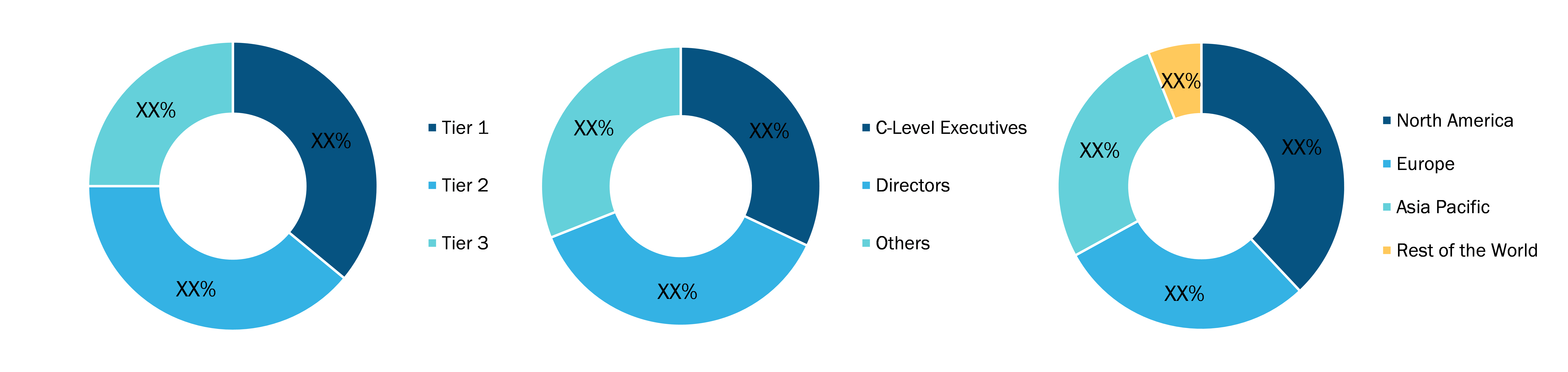
Below is the breakup of our primary respondents by company, designation, and region:
Once we receive the confirmation from primary research sources or primary respondents, we finalize the base year market estimation and forecast the data as per the macroeconomic and microeconomic factors assessed during data collection.
- Data Analysis:
Once data is validated through both secondary as well as primary respondents, we finalize the market estimations by hypothesis formulation and factor analysis at regional and country level.
- 3.1 Macro-Economic Factor Analysis:
We analyse macroeconomic indicators such the gross domestic product (GDP), increase in the demand for goods and services across industries, technological advancement, regional economic growth, governmental policies, the influence of COVID-19, PEST analysis, and other aspects. This analysis aids in setting benchmarks for various nations/regions and approximating market splits. Additionally, the general trend of the aforementioned components aid in determining the market's development possibilities.
- 3.2 Country Level Data:
Various factors that are especially aligned to the country are taken into account to determine the market size for a certain area and country, including the presence of vendors, such as headquarters and offices, the country's GDP, demand patterns, and industry growth. To comprehend the market dynamics for the nation, a number of growth variables, inhibitors, application areas, and current market trends are researched. The aforementioned elements aid in determining the country's overall market's growth potential.
- 3.3 Company Profile:
The “Table of Contents” is formulated by listing and analyzing more than 25 - 30 companies operating in the market ecosystem across geographies. However, we profile only 10 companies as a standard practice in our syndicate reports. These 10 companies comprise leading, emerging, and regional players. Nonetheless, our analysis is not restricted to the 10 listed companies, we also analyze other companies present in the market to develop a holistic view and understand the prevailing trends. The “Company Profiles” section in the report covers key facts, business description, products & services, financial information, SWOT analysis, and key developments. The financial information presented is extracted from the annual reports and official documents of the publicly listed companies. Upon collecting the information for the sections of respective companies, we verify them via various primary sources and then compile the data in respective company profiles. The company level information helps us in deriving the base number as well as in forecasting the market size.
- 3.4 Developing Base Number:
Aggregation of sales statistics (2020-2022) and macro-economic factor, and other secondary and primary research insights are utilized to arrive at base number and related market shares for 2022. The data gaps are identified in this step and relevant market data is analyzed, collected from paid primary interviews or databases. On finalizing the base year market size, forecasts are developed on the basis of macro-economic, industry and market growth factors and company level analysis.
- Data Triangulation and Final Review:
The market findings and base year market size calculations are validated from supply as well as demand side. Demand side validations are based on macro-economic factor analysis and benchmarks for respective regions and countries. In case of supply side validations, revenues of major companies are estimated (in case not available) based on industry benchmark, approximate number of employees, product portfolio, and primary interviews revenues are gathered. Further revenue from target product/service segment is assessed to avoid overshooting of market statistics. In case of heavy deviations between supply and demand side values, all thes steps are repeated to achieve synchronization.
We follow an iterative model, wherein we share our research findings with Subject Matter Experts (SME’s) and Key Opinion Leaders (KOLs) until consensus view of the market is not formulated – this model negates any drastic deviation in the opinions of experts. Only validated and universally acceptable research findings are quoted in our reports.
We have important check points that we use to validate our research findings – which we call – data triangulation, where we validate the information, we generate from secondary sources with primary interviews and then we re-validate with our internal data bases and Subject matter experts. This comprehensive model enables us to deliver high quality, reliable data in shortest possible time.

Get Free Sample For