Key market dynamics include a heightening global focus on decentralized healthcare, rising demand for rapid and accurate infectious disease testing, and significant advancements in microfluidics and biosensor technologies. Additionally, the market is expected to benefit from the growing prevalence of chronic conditions requiring frequent monitoring, the expansion of CLIA-waived testing in retail clinics, and the increasing integration of artificial intelligence for real-time result interpretation in non-laboratory settings.
Point-of-Care Molecular Diagnostics Market AnalysisThe point-of-care molecular diagnostics market analysis shows near-patient testing as healthcare providers prioritize reducing turnaround times and improving patient outcomes. The market is moving into high-volume clinical settings and the rapidly growing home-based/OTC segment, where ease of use is the primary driver. Strategic opportunities are emerging in syndromic testing, where multiplex panels can simultaneously detect several pathogens from a single sample, offering a clear competitive advantage in emergency and outpatient care. The analysis also notes that market expansion depends on the simplification of sample preparation and the stability of reagents at room temperature. Competitive differentiation now stands out depending on the portability of devices and the ability to seamlessly integrate diagnostic data with Electronic Health Records (EHR), helping manufacturers capture market share in an increasingly digital healthcare ecosystem.
Point-of-Care Molecular Diagnostics Market OverviewMolecular diagnostics at the point of care have evolved from specialized laboratory procedures to mainstream clinical tools. The market includes portable PCR devices, isothermal amplification kits, and handheld genetic sequencing platforms. Both global diagnostic giants and agile med-tech startups compete in this market, utilizing technologies such as RT-PCR, CRISPR, and Loop-mediated Isothermal Amplification (LAMP). Growing demand for hospital-at-home models among aging populations in North America and Europe has increased the popularity of molecular POC as a vital component of personalized medicine. North America leads in revenue due to its established reimbursement frameworks and high adoption of innovative technologies, while Asia-Pacific is advancing in manufacturing cost-efficiencies and large-scale public health screening initiatives. The US market is a mature landscape characterized by rapid adoption of CLIA-waived assays and robust investment in decentralized testing. Growth is driven by a shift toward value-based care and outpatient clinics. Increasing demand for at-home molecular kits and hospital-at-home models further solidifies its position as a global innovation hub.
Customize Research To Suit Your Requirement
We can optimize and tailor the analysis and scope which is unmet through our standard offerings. This flexibility will help you gain the exact information needed for your business planning and decision making.
Point-of-Care Molecular Diagnostics Market: Strategic Insights
| Market Size Value in | US$ 2,230.94 million in 2021 |
| Market Size Value by | US$ 5,381.18 million by 2028 |
| Growth rate | CAGR of 13.4% from 2021 to 2028 |
| Forecast Period | 2021-2028 |
| Base Year | 2021 |
Mrinal
Have a question?
Mrinal will walk you through a 15-minute call to present the report’s content and answer all queries if you have any.
Speak to Analyst
Market Drivers:
- Surge in Infectious Disease Outbreaks: Recurrent waves of respiratory infections and the emergence of drug-resistant pathogens are driving the need for immediate, on-site molecular confirmation to guide treatment and containment.
- Technological Shift to Isothermal Amplification: The development of techniques like LAMP and RPA allows for molecular testing without complex thermal cyclers, enabling the creation of lower-cost, portable devices suitable for remote areas.
- Expansion of Retail and Community Clinics: The proliferation of urgent care centers and pharmacy-based clinics has created a massive new distribution network for POC molecular platforms that provide lab-quality results in under 30 minutes.
Market Opportunities:
- Integration of AI and Cloud Connectivity: There is a significant opportunity to embed AI algorithms into POC devices for automated quality control and predictive analytics, which is particularly valuable in resource-limited settings.
- Growth in Oncology and Pharmacogenomics: Beyond infectious diseases, extending molecular POC to bedside cancer biomarker testing and companion diagnostics offers high-margin growth potential.
- Development of Multi-Pathogen Multiplex Panels: Forming strategic partnerships to develop single-cartridge tests for quademic scenarios (Flu, COVID, RSV, and Norovirus) can facilitate dominant positioning in the primary care market.
The Point-of-Care Molecular Diagnostics Market share is analyzed across various segments to provide a clearer understanding of its structure, growth potential, and emerging trends. Below is the standard segmentation approach used in most industry reports:
By Product & Services:
- Assays and Kits: Holds the largest market share due to the continuous and repetitive demand for consumables and specialized test cartridges required for each diagnostic run.
- Instruments: Includes portable analyzers and handheld devices that serve as the foundational hardware for decentralized molecular testing.
- Services and Software: A rapidly expanding segment focused on digital integration, cloud-based data management, and technical maintenance support for connected POC networks.
By Technology:
- PCR: The gold standard technology, specifically Real-Time PCR (qPCR), which accounts for a significant portion of the market due to its high sensitivity and established clinical trust.
- Isothermal Nucleic Acid Amplification Technology: Includes techniques like LAMP that operate at constant temperatures, facilitating the development of low-cost, truly portable devices for field use.
- Other Technologies: Encompasses emerging methods such as CRISPR-based detection and microfluidics-based hybridization.
By Application:
- Infectious Diseases: The primary revenue contributor, driven by testing for respiratory infections, STDs, and tropical diseases.
- Oncology: Growing focus on rapid liquid biopsies and tumor marker detection at the point of care.
- Hematology: Application in rapid blood analysis and screening for blood-borne disorders.
- Prenatal Testing: Increasing adoption for non-invasive, rapid screening of genetic conditions in maternal-fetal medicine.
- Endocrinology: Utilization in metabolic monitoring and hormone-related diagnostic testing.
- Other Applications: Includes neurology, cardiovascular screening, and pharmacogenomics.
By Geography:
- North America
- Europe
- Asia Pacific
- South & Central America
- Middle East & Africa
Asia-Pacific is expected to grow fastest in the coming years. Emerging markets in South & Central America, the Middle East, and Africa also have many untapped opportunities for diagnostic manufacturers to expand.
The point-of-care molecular diagnostics market is undergoing a significant transformation, moving from a specialized laboratory function to a global essential for decentralized healthcare. Growth is driven by the rising prevalence of respiratory infections, a surge in demand for rapid STI screening, and the expansion of the hospital-at-home diagnostic services. Below is a summary of market share and trends by region:
1. North America
- Market Share: Holds the largest share globally, anchored by a sophisticated healthcare ecosystem and high adoption of innovative technologies in the US and Canada.
- Key Drivers:
- Favorable reimbursement policies, including recent CMS increases for waived molecular panels.
- Widespread availability of CLIA-waived products in retail clinics and physician offices.
- Strong presence of industry giants focusing on EHR-integrated and cloud-connected platforms.
- Trends: Scaling of home-based OTC molecular kits and the successful adoption of rapid oncology panels in outpatient infusion centers to support same-visit therapy decisions.
2. Europe
- Market Share: Significant global contributor, driven by strict regulatory frameworks like CE-IVDR and established public health surveillance in the UK, Germany, and France.
- Key Drivers:
- Government-led decentralized testing initiatives to reduce the burden on central hospital laboratories.
- High demand for rapid antimicrobial resistance (AMR) screening in acute care settings.
- Robust investment in universal healthcare access and integrated diagnostic networks.
- Trends: A strategic shift toward lab-on-a-chip microfluidics and a focus on multiplexing for seasonal respiratory quademic scenarios (Flu/COVID/RSV/Norovirus).
3. Asia-Pacific
- Market Share: The fastest-growing region, with major modernization programs in China and India driving large-scale adoption.
- Key Drivers:
- Massive consumer base seeking affordable, high-accuracy diagnostics in rural and semi-urban areas.
- Government-supported agricultural and public health initiatives focused on infectious disease containment.
- Rapid urbanization and rising disposable incomes are leading to a preference for premium, Western-style healthcare convenience models.
- Trends: Heavy reliance on mobile-connected diagnostic platforms and B2B contracts for portable PCR systems used in national tuberculosis and hepatitis surveillance programs.
4. South and Central America
- Market Share: Emerging market with a growing private diagnostic industry in countries like Brazil and Chile.
- Key Drivers:
- Increasing awareness of the clinical superiority of molecular testing over traditional rapid antigen tests.
- Modernization of community clinics into commercial-grade diagnostic centers to supply urban centers.
- Rising interest in maternal-fetal medicine and rapid prenatal screening among middle-to-high income segments.
- Trends: Growth of decentralized lab models and the introduction of portable molecular assays for tropical diseases like Zika and Dengue to differentiate from central lab services.
5. Middle East and Africa
- Market Share: Developing market with deep public health needs, transitioning toward formalized commercial diagnostic infrastructure.
- Key Drivers:
- Strategic focus on containing localized infectious disease outbreaks (e.g., Ebola, Mpox, and Malaria).
- High demand for shelf-stable, robust molecular reagents suitable for arid or resource-limited climates.
- Investment in Smart Agriculture and digital health frameworks to improve local health resilience.
- Trends: Implementation of AI-powered infectious disease diagnostic solutions in Saudi Arabia, coupled with a focus on high-throughput, portable systems for rural health workers.
High Market Density and Competition
Competition is intensifying due to the presence of established leaders such as Abbott, Danaher Corporation (Cepheid), and F. Hoffmann-La Roche Ltd. Regional innovators and niche players like Molbio Diagnostics and Biocartis also contribute to a diverse and rapidly expanding market landscape.
This competitive environment pushes vendors to differentiate through:
- Connectivity and Data Integration: Positioning platforms as superior by emphasizing seamless integration with Electronic Health Records (EHR) and cloud-based reporting for real-time surveillance.
- Multiplexing Capabilities: Companies offer single-cartridge tests that can detect multiple pathogens simultaneously, such as respiratory or STI panels, reducing the need for separate tests.
- Vertical Supply Chain Integration: Producers manage the entire manufacturing process, from proprietary enzyme development to cartridge assembly, ensuring quality and meeting ethical medical standards.
- Next-Gen Miniaturization: New processing technologies, like silicon-based microfluidics and CRISPR-based detection, help create handheld, truly portable devices used in emergency response and home care.
Opportunities and Strategic Moves
- Expand into Home-Based and OTC Segments: Partner with retail pharmacy chains and e-commerce giants to tap into the surging demand for consumer-led, CLIA-waived molecular kits.
- Incorporate AI and Machine Learning: Integrate AI-driven analytics for automated result interpretation to appeal to non-specialist healthcare workers and improve diagnostic reliability in remote settings.
- bioMérieux SA
- F. Hoffmann-La Roche Ltd.
- Danaher Corporation
- Enzo Biochem, Inc.
- Abbott
- binx health, Inc.
- Meridian BioScience, Inc.
- Biocartis
- Quidel Corporation
- Bio-Rad Laboratories, Inc.
Disclaimer: The companies listed above are not ranked in any particular order.
Point-of-Care Molecular Diagnostics Market News and Recent Developments- In March 2025, QuidelOrtho Corporation, a global provider of innovative in vitro diagnostic technologies designed for point-of-care settings, clinical labs, and transfusion medicine, announced a refocusing of its molecular diagnostics strategy. This strategy includes the intent to acquire full ownership of LEX Diagnostics after 510(k) clearance by the U.S. Food and Drug Administration ("FDA") for consideration at closing of approximately $100 million and plans to discontinue the Company's Savanna platform development.
- In January 2025, bioMérieux, a world leader in the field of in vitro diagnostics, announced that it had entered into an agreement to acquire SpinChip Diagnostics ASA (“SpinChip”), a privately held Norwegian diagnostics company that has developed a game-changing immunoassay diagnostics platform. The small benchtop analyzer is well adapted to near-patient testing as it can deliver a result from a whole blood sample within 10 minutes with the same high-sensitivity performance as the laboratory instruments.
The Point-of-Care Molecular Diagnostics Market Size and Forecast (2021–2034) report provides a detailed analysis of the market covering below areas:
- Point-of-Care Molecular Diagnostics Market size and forecast at global, regional, and country levels for all the key market segments covered under the scope
- Point-of-Care Molecular Diagnostics Market trends, as well as market dynamics such as drivers, restraints, and key opportunities
- Detailed PEST and SWOT analysis
- Point-of-Care Molecular Diagnostics Market analysis covering key market trends, global and regional framework, major players, regulations, and recent market developments
- Industry landscape and competition analysis covering market concentration, heat map analysis, prominent players, and recent developments in the Point-of-Care Molecular Diagnostics Market.
- Detailed company profiles
Report Coverage
Revenue forecast, Company Analysis, Industry landscape, Growth factors, and Trends

Segment Covered
Product & Services, Technology, Application, End User, Geography

Regional Scope
North America, Europe, Asia Pacific, Middle East & Africa, South & Central America

Country Scope
Argentina, Australia, Brazil, Canada, China, France, Germany, India, Italy, Japan, Mexico, Saudi Arabia, South Africa, South Korea, Spain, United Arab Emirates, United Kingdom, United States
Frequently Asked Questions
Key players include bioMérieux SA, F. Hoffmann-La Roche Ltd., Danaher Corporation, Enzo Biochem, Inc., Abbott Binx Health, Inc., and Meridian BioScience, Inc.
Some main challenges are that instrument and cartridge costs remain higher than traditional rapid tests, complex and fragmented reimbursement landscapes, and the requirement for simplified sample prep for non-laboratory users.
Asia-Pacific is the fastest-growing region, with a strong focus on government-supported decentralized testing and the adoption of portable PCR technologies in India and China.
The market is expected to reach approximately US$ 7.96 billion, growing from a valuation of US$ 3.07 billion in 2025.
Trends include the shift toward AI-powered diagnostics in the Middle East, the rise of home-care molecular testing in North America, and the expansion of national infectious disease surveillance programs in Asia-Pacific.
Yes! We provide a free sample of the report, which includes Report Scope (Table of Contents), report structure, and selected insights to help you assess the value of the full report. Please click on the "Download Sample" button or contact us to receive your copy.
Absolutely - analyst assistance is part of the package. You can connect with our analyst post-purchase to clarify report insights, methodology or discuss how the findings apply to your business needs.
Once your order is successfully placed, you will receive a confirmation email along with your invoice.
• For published reports: You'll receive access to the report within 4-6 working hours via a secured email sent to your email.
• For upcoming reports: Your order will be recorded as a pre-booking. Our team will share the estimated release date and keep you informed of any updates. As soon as the report is published, it will be delivered to your registered email.
We offer customization options to align the report with your specific objectives. Whether you need deeper insights into a particular region, industry segment, competitor analysis, or data cut, our research team can tailor the report accordingly. Please share your requirements with us, and we'll be happy to provide a customized proposal or scope.
The report is available in either PDF format or as an Excel dataset, depending on the license you choose.
The PDF version provides the full analysis and visuals in a ready-to-read format. The Excel dataset includes all underlying data tables for easy manipulation and further analysis.
Please review the license options at checkout or contact us to confirm which formats are included with your purchase.
Our payment process is fully secure and PCI-DSS compliant.
We use trusted and encrypted payment gateways to ensure that all transactions are protected with industry-standard SSL encryption. Your payment details are never stored on our servers and are handled securely by certified third-party processors.
You can make your purchase with confidence, knowing your personal and financial information is safe with us.
Yes, we do offer special pricing for bulk purchases.
If you're interested in purchasing multiple reports, we're happy to provide a customized bundle offer or volume-based discount tailored to your needs. Please contact our sales team with the list of reports you're considering, and we'll share a personalized quote.
Yes, absolutely.
Our team is available to help you make an informed decision. Whether you have questions about the report's scope, methodology, customization options, or which license suits you best, we're here to assist. Please reach out to us at [email protected], and one of our representatives will get in touch promptly.
Yes, a billing invoice will be automatically generated and sent to your registered email upon successful completion of your purchase.
If you need the invoice in a specific format or require additional details (such as company name, GST, or VAT information), feel free to contact us, and we'll be happy to assist.
Yes, certainly.
If you encounter any difficulties accessing or receiving your report, our support team is ready to assist you. Simply reach out to us via email or live chat with your order information, and we'll ensure the issue is resolved quickly so you can access your report without interruption.
The Insight Partners performs research in 4 major stages: Data Collection & Secondary Research, Primary Research, Data Analysis and Data Triangulation & Final Review.
- Data Collection and Secondary Research:
As a market research and consulting firm operating from a decade, we have published many reports and advised several clients across the globe. First step for any study will start with an assessment of currently available data and insights from existing reports. Further, historical and current market information is collected from Investor Presentations, Annual Reports, SEC Filings, etc., and other information related to company’s performance and market positioning are gathered from Paid Databases (Factiva, Hoovers, and Reuters) and various other publications available in public domain.
Several associations trade associates, technical forums, institutes, societies and organizations are accessed to gain technical as well as market related insights through their publications such as research papers, blogs and press releases related to the studies are referred to get cues about the market. Further, white papers, journals, magazines, and other news articles published in the last 3 years are scrutinized and analyzed to understand the current market trends.
- Primary Research:
The primarily interview analysis comprise of data obtained from industry participants interview and answers to survey questions gathered by in-house primary team.
For primary research, interviews are conducted with industry experts/CEOs/Marketing Managers/Sales Managers/VPs/Subject Matter Experts from both demand and supply side to get a 360-degree view of the market. The primary team conducts several interviews based on the complexity of the markets to understand the various market trends and dynamics which makes research more credible and precise.
A typical research interview fulfils the following functions:
- Provides first-hand information on the market size, market trends, growth trends, competitive landscape, and outlook
- Validates and strengthens in-house secondary research findings
- Develops the analysis team’s expertise and market understanding
Primary research involves email interactions and telephone interviews for each market, category, segment, and sub-segment across geographies. The participants who typically take part in such a process include, but are not limited to:
- Industry participants: VPs, business development managers, market intelligence managers and national sales managers
- Outside experts: Valuation experts, research analysts and key opinion leaders specializing in the electronics and semiconductor industry.
Below is the breakup of our primary respondents by company, designation, and region:
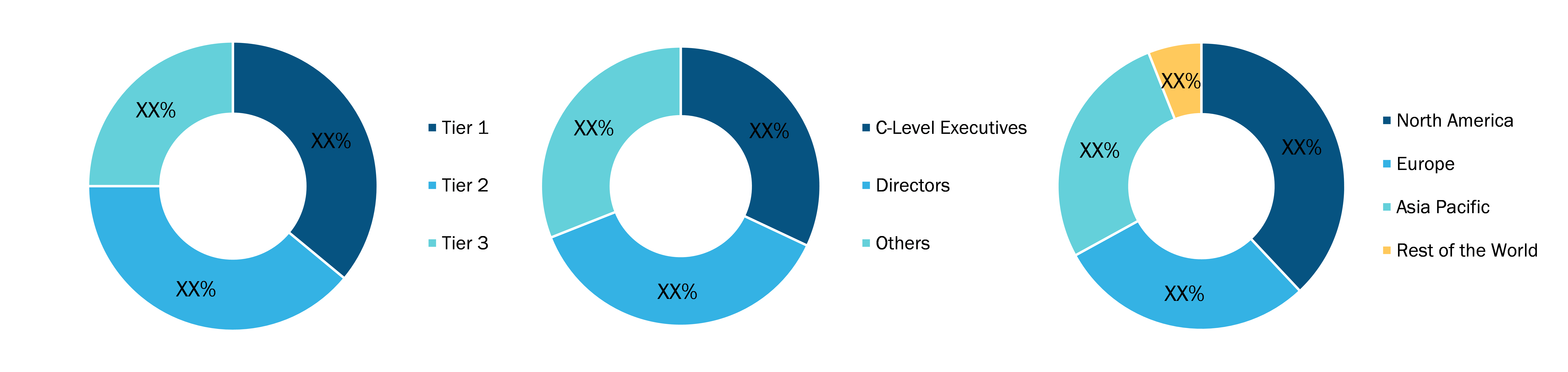
Once we receive the confirmation from primary research sources or primary respondents, we finalize the base year market estimation and forecast the data as per the macroeconomic and microeconomic factors assessed during data collection.
- Data Analysis:
Once data is validated through both secondary as well as primary respondents, we finalize the market estimations by hypothesis formulation and factor analysis at regional and country level.
- 3.1 Macro-Economic Factor Analysis:
We analyse macroeconomic indicators such the gross domestic product (GDP), increase in the demand for goods and services across industries, technological advancement, regional economic growth, governmental policies, the influence of COVID-19, PEST analysis, and other aspects. This analysis aids in setting benchmarks for various nations/regions and approximating market splits. Additionally, the general trend of the aforementioned components aid in determining the market's development possibilities.
- 3.2 Country Level Data:
Various factors that are especially aligned to the country are taken into account to determine the market size for a certain area and country, including the presence of vendors, such as headquarters and offices, the country's GDP, demand patterns, and industry growth. To comprehend the market dynamics for the nation, a number of growth variables, inhibitors, application areas, and current market trends are researched. The aforementioned elements aid in determining the country's overall market's growth potential.
- 3.3 Company Profile:
The “Table of Contents” is formulated by listing and analyzing more than 25 - 30 companies operating in the market ecosystem across geographies. However, we profile only 10 companies as a standard practice in our syndicate reports. These 10 companies comprise leading, emerging, and regional players. Nonetheless, our analysis is not restricted to the 10 listed companies, we also analyze other companies present in the market to develop a holistic view and understand the prevailing trends. The “Company Profiles” section in the report covers key facts, business description, products & services, financial information, SWOT analysis, and key developments. The financial information presented is extracted from the annual reports and official documents of the publicly listed companies. Upon collecting the information for the sections of respective companies, we verify them via various primary sources and then compile the data in respective company profiles. The company level information helps us in deriving the base number as well as in forecasting the market size.
- 3.4 Developing Base Number:
Aggregation of sales statistics (2020-2022) and macro-economic factor, and other secondary and primary research insights are utilized to arrive at base number and related market shares for 2022. The data gaps are identified in this step and relevant market data is analyzed, collected from paid primary interviews or databases. On finalizing the base year market size, forecasts are developed on the basis of macro-economic, industry and market growth factors and company level analysis.
- Data Triangulation and Final Review:
The market findings and base year market size calculations are validated from supply as well as demand side. Demand side validations are based on macro-economic factor analysis and benchmarks for respective regions and countries. In case of supply side validations, revenues of major companies are estimated (in case not available) based on industry benchmark, approximate number of employees, product portfolio, and primary interviews revenues are gathered. Further revenue from target product/service segment is assessed to avoid overshooting of market statistics. In case of heavy deviations between supply and demand side values, all thes steps are repeated to achieve synchronization.
We follow an iterative model, wherein we share our research findings with Subject Matter Experts (SME’s) and Key Opinion Leaders (KOLs) until consensus view of the market is not formulated – this model negates any drastic deviation in the opinions of experts. Only validated and universally acceptable research findings are quoted in our reports.
We have important check points that we use to validate our research findings – which we call – data triangulation, where we validate the information, we generate from secondary sources with primary interviews and then we re-validate with our internal data bases and Subject matter experts. This comprehensive model enables us to deliver high quality, reliable data in shortest possible time.

Get Free Sample For