Key market dynamics include an accelerating global adoption of minimally invasive surgeries (MIS), rapid advancements in high-definition 3D visualization and haptic feedback technologies, and the increasing integration of artificial intelligence for intraoperative decision support. Additionally, the market is expected to benefit from the rising geriatric population prone to chronic conditions, the expansion of robotic-assisted platforms in emerging economies, and a growing emphasis on reducing costs.
Surgical Robots Market AnalysisThe surgical robots market analysis reveals a decisive shift toward specialized, multi-specialty platforms that move beyond traditional urological dominance. Strategic opportunities are emerging in the diversification of robotic applications, particularly in soft-tissue and orthopedic procedures where precision-driven outcomes significantly reduce human error. Procurement trends indicate that while the initial capital investment remains high, hospitals are increasingly adopting per-procedure or leasing models to mitigate financial barriers. The analysis also suggests that market leaders are pivoting toward data-centric ecosystems, using machine learning to analyze thousands of surgical hours to provide real-time guidance. Competitive differentiation is now centered on modularity and portability, allowing robotic arms to be moved between operating rooms, thereby increasing system utilization and return on investment for healthcare facilities.
Surgical Robots Market OverviewThe surgical robots market is transitioning from a niche technological luxury to a standard of care in modern operating rooms. Driven by the quest for greater surgical dexterity and patient safety, these systems allow surgeons to perform complex maneuvers through tiny incisions that would be impossible with traditional open surgery. The landscape is currently dominated by robotic-assisted minimally invasive surgery (RAMIS), with a growing footprint in general surgery and oncology. While established systems like the da Vinci platform have paved the way, a new wave of competitors is introducing compact, open-console designs that improve surgeon ergonomics. This evolution is supported by a robust supply chain of specialized instruments and accessories that provide recurring revenue streams for manufacturers and ensure consistent clinical performance. For instance, the market in the US represents the most mature and high-volume segment of the surgical robotics landscape. Characterized by a sophisticated healthcare infrastructure and high patient demand for advanced treatments, the US market leads in the early adoption of next-generation robotic platforms. Favorable reimbursement policies and a concentration of major industry players further solidify its position as the global innovation hub for robotic-assisted medical procedures.
Customize Research To Suit Your Requirement
We can optimize and tailor the analysis and scope which is unmet through our standard offerings. This flexibility will help you gain the exact information needed for your business planning and decision making.
Surgical Robots Market: Strategic Insights
| Market Size Value in | US$ 6,839.07 million in 2021 |
| Market Size Value by | US$ 17,647.82 million by 2028 |
| Growth rate | CAGR of 14.8% from 2022 to 2028 |
| Forecast Period | 2022-2028 |
| Base Year | 2021 |
Mrinal
Have a question?
Mrinal will walk you through a 15-minute call to present the report’s content and answer all queries if you have any.
Speak to Analyst
Market Drivers:
- Rising Demand for Minimally Invasive Procedures: Patients and providers increasingly prioritize surgeries that offer smaller incisions, reduced blood loss, and faster recovery times. Surgical robots are the primary enablers of these outcomes, driving steady adoption across diverse surgical specialties.
- Technological Integration of AI and Machine Learning: The infusion of AI into robotic platforms allows for enhanced preoperative planning and real-time intraoperative analytics. This technology helps surgeons identify critical structures and automate repetitive tasks, improving overall procedural safety and efficiency.
- Global Shortage of Specialized Surgical Talent: As the demand for complex surgeries outpaces the supply of highly trained surgeons, robotic systems serve as force multipliers. These platforms reduce physical strain on clinicians and enable less-experienced surgeons to achieve high-precision results more consistently.
Market Opportunities:
- Expansion into Ambulatory Surgical Centers (ASCs): There is a significant opportunity for manufacturers to develop smaller, cost-effective robotic systems tailored for the outpatient setting. As more procedures shift from inpatient hospitals to ASCs, portable robotics will be a key growth driver.
- Advancements in Telesurgery and Remote Mentoring: Improving 5G connectivity and low-latency data transmission open the door for remote robotic surgery. This presents an opportunity to provide specialized surgical care to underserved or rural regions where on-site expertise is unavailable.
- Development of Bio-Compatible and Smart Instruments: The next frontier of opportunity lies in the creation of smart surgical tools that can sense tissue tension or biochemical markers during surgery, providing a level of feedback that traditional instruments cannot offer.
The Surgical Robots Market share is analyzed across various segments to provide a clearer understanding of its structure, growth potential, and emerging trends. Below is the standard segmentation approach used in most industry reports:
By Component:
- Robotic Systems: These represent the core capital equipment, including surgeon consoles and patient-side carts, serving as the central platform for all robotic interventions.
- Instruments & Accessories: The most significant segment by volume, consisting of specialized, often disposable tools that must be replaced regularly, ensuring a steady stream of recurring revenue.
- Services: Includes maintenance, software updates, and professional training programs required to keep robotic programs operational and compliant with safety standards.
By Application:
- Urological Surgery: Historically, the leading application, widely utilized for prostatectomies and kidney procedures.
- Orthopedic Surgery: A rapidly growing segment focused on joint replacements, where robotic precision ensures optimal implant alignment.
- General Surgery: Encompassing a broad range of procedures like hernia repairs and colorectal surgeries, this segment is seeing the highest growth rate.
- Gynecological Surgery: Used extensively for hysterectomies and fibroid removals, offering superior visualization in the pelvic cavity.
- Cardiothoracic Surgery: Facilitates delicate heart and lung procedures through minimally invasive access points.
- Neurosurgery: Employs robotic guidance for high-precision brain and spine interventions.
- Others: Includes emerging fields such as dental surgery and otolaryngology.
By End User:
- Hospitals: The primary adopters, equipped with the capital and infrastructure to support comprehensive robotic surgical programs.
- Ambulatory Surgical Centers: A burgeoning segment seeking compact and specialized robots for high-volume, outpatient procedures.
- Others: Comprises academic research institutions and specialty clinics focused on specific robotic applications.
By Geography:
- North America
- Europe
- Asia Pacific
- South & Central America
- Middle East & Africa
North America currently holds the largest share of the surgical robots market, driven by high healthcare spending and a robust pipeline of technological innovation. Asia-Pacific is projected to be the fastest-growing region during the forecast period as healthcare modernization accelerates across China, India, and Japan.
The surgical robots market is undergoing a significant transformation, moving from a specialized tool to a widely integrated surgical standard. Growth is driven by the global push for value-based care, where improved patient outcomes and shorter hospital stays directly influence hospital profitability. Below is a summary of market share and trends by region:
North America
- Market Share: Dominant position with the highest concentration of installed robotic units globally.
- Key Drivers:
- High Prevalence of Chronic Conditions: Rising cases of cancer and cardiovascular diseases drive the demand for high-precision, repeatable robotic interventions.
- Mature Reimbursement Landscape: Comprehensive coverage from CMS and private insurers for robotic-assisted procedures incentivizes hospital adoption.
- Concentration of Key Players: Proximity to the headquarters of giants like Intuitive Surgical and Stryker ensures rapid access to the latest system upgrades and support.
- Trends: A significant shift toward Ambulatory Surgical Centers (ASCs), where compact and cost-effective robots are being deployed for outpatient orthopedic and general surgeries. There is also an increasing focus on data-driven surgery, utilizing cloud-based platforms to benchmark surgeon performance.
Europe
- Market Share: Significant share anchored by advanced healthcare systems in Germany, France, and the UK.
- Key Drivers:
- Aging Demographic: A growing geriatric population in Western Europe fuels demand for robotic-assisted hip and knee replacements.
- Government Support for Digital Health: National health initiatives focused on Operating Room 4.0 encourage the integration of AI and robotics.
- Strong Orthopedic Foundation: Established expertise in robotic-assisted bone surgery, particularly in Germany and Switzerland.
- Trends: The market is seeing a rise in modular robotic architectures, allowing hospitals to share robotic arms across different surgical suites to maximize utilization. There is also a growing emphasis on sustainability, with manufacturers developing re-processable instruments to meet strict EU environmental regulations.
Asia-Pacific
- Market Share: Fastest-growing region, fueled by massive investments in healthcare infrastructure and smart manufacturing.
- Key Drivers:
- Healthcare Modernization: Rapid expansion of Tier-1 hospital networks in China and India seeking state-of-the-art technology to attract patients.
- Medical Tourism: Emerging hubs in Southeast Asia are adopting robotics to position themselves as global leaders in high-end surgical care.
- Pro-Robotics Government Policies: Subsidies and favorable Smart Medicine frameworks in Japan and South Korea accelerate the adoption of domestic and global systems.
- Trends: A surge in locally developed robotic platforms that offer more competitive pricing than Western models. Additionally, the region is a pioneer in 5G-enabled telesurgery, with multiple successful long-distance remote procedures performed in China, bridging the gap between urban specialists and rural patients.
South and Central America
- Market Share: Emerging market with a growing private healthcare sector in Brazil, Argentina, and Chile.
- Key Drivers:
- Private Hospital Competition: Leading private clinics are investing in robotics to differentiate their services and offer superior patient outcomes.
- Increased Surgeon Training: A Growing number of specialized training centers in Brazil is reducing the learning curve barrier for new adopters.
- Rising Awareness of MIS: Increasing patient preference for minimally invasive options to reduce recovery time and work absenteeism.
- Trends: Adoption is primarily concentrated in oncology and urology, but there is a burgeoning trend of using robotics for complex bariatric surgeries to address rising regional obesity rates.
Middle East and Africa
- Market Share: Developing market with strategic investments in high-tech healthcare cities and hubs.
- Key Drivers:
- Vision-Driven Investments: Major projects like Saudi Arabia’s Vision 2030 prioritize the digitization and automation of the national healthcare system.
- Medical Hub Strategy: The UAE and Qatar are establishing themselves as regional centers of excellence for robotic surgery to reduce the need for outbound medical travel.
- Smart Infrastructure: Integration of robotics into newly built Smart Hospitals that utilize AI for end-to-end patient management.
- Trends: Growing demand for robotic-assisted pediatric surgery and a strong focus on UHT-stable and portable systems that can operate effectively in varied climates and infrastructure conditions.
High Market Density and Competition
The surgical robots market is characterized by a high degree of concentration among a few dominant medical technology giants, though the landscape is rapidly diversifying. While Intuitive Surgical remains the undisputed leader with over 8,000 da Vinci units installed globally as of 2026, the density of the market is increasing as challengers like Medtronic and Johnson & Johnson scale their multi-specialty platforms. This competitive environment is moving away from a one-size-fits-all approach toward specialized, procedure-centric innovation.
This competitive environment pushes vendors to differentiate through:
- Modularity and Portability: New entrants like CMR Surgical with the Versius system and Medtronic with Hugo RAS emphasize modular robotic arms on mobile carts. This allows hospitals to reconfigure systems based on the specific surgical theater layout and move units between rooms, significantly increasing system utilization rates.
- Procedure-Specific Optimization: Companies such as Stryker (Mako) and Zimmer Biomet (ROSA) have successfully carved out high-density niches in orthopedics. By focusing on bone-cutting precision and implant alignment, they differentiate themselves from general soft-tissue platforms, creating a best-of-breed competitive dynamic.
- Digital Ecosystems and Performance-Guided Surgery: Competitive differentiation now relies heavily on software. Systems like Asensus Surgical’s Senhance (now under Karl Storz) leverage haptic feedback and eye-tracking, while Medtronic’s Touch Surgery provides AI-driven video analytics. These features transition the robot from a mechanical tool to an intelligent co-surgeon.
Opportunities and Strategic Moves
- Capitalizing on the ASC Pivot: Manufacturers are strategically downsizing their robotic footprints to target the surging Ambulatory Surgical Center (ASC) market in North America. By offering compact, lower-cost systems tailored for high-volume outpatient procedures like hernia repairs and gallbladder removals, firms can unlock a secondary tier of high-growth demand.
- Telesurgery and Remote Mentoring Platforms: As 5G infrastructure matures globally, a major strategic move involves developing robust remote surgical capabilities. This allows top-tier specialists to mentor or operate on patients in rural or emerging market locations, effectively expanding a company’s reach without the need for on-site expert surgeons.
- Intuitive Surgical
- Smith + Nephew
- Johnson & Johnson Services, Inc
- Stryker
- Medtronic
- Siemens Healthineers AG
- Asensus Surgical, Inc
- THINK Surgical
- Renishaw plc.
- Zimmer Biomet
Disclaimer: The companies listed above are not ranked in any particular order.
Surgical Robots Market News and Recent Developments- In May 2025, Intuitive announced that the U.S. Food and Drug Administration (FDA) cleared the da Vinci Single Port (SP) surgical system for transanal local excision and resection. This specific form of minimally invasive surgery was performed through a natural orifice to avoid abdominal incisions for select procedures. This clearance extended the capabilities of these Surgical Robots in the field of colorectal surgery, building upon a suite of procedures previously cleared by the FDA in November 2024. Those earlier clearances included several transabdominal procedures, such as low anterior resection, total mesorectal excision, colectomy, abdominoperineal resection, and sigmoidectomy.
- In August 2024, Asensus Surgical, Inc., a global leader in digital solutions for the operating room, announced the closing of its merger with the KARL STORZ Group in August 2024. The transaction was completed following the formal approval of the merger by Asensus Surgical stockholders. This strategic union allowed the companies to combine their expertise and accelerate the development of next-generation Surgical Robots, specifically designed to enhance precision and predictability in the operating room.
The Surgical Robots Market Size and Forecast (2021–2034) report provides a detailed analysis of the market covering below areas:
- Surgical Robots Market size and forecast at global, regional, and country levels for all the key market segments covered under the scope
- Surgical Robots Market trends, as well as market dynamics such as drivers, restraints, and key opportunities
- Detailed PEST and SWOT analysis
- Surgical Robots Market analysis covering key market trends, global and regional framework, major players, regulations, and recent market developments
- Industry landscape and competition analysis covering market concentration, heat map analysis, prominent players, and recent developments in the Surgical Robots Market.
- Detailed company profiles
Report Coverage
Revenue forecast, Company Analysis, Industry landscape, Growth factors, and Trends

Segment Covered
Component, Application, End User, and Geography

Regional Scope
North America, Europe, Asia Pacific, Middle East & Africa, South & Central America

Country Scope
This text is related
to country scope.
Frequently Asked Questions
The market is expected to reach approximately US$ 27.77 billion, growing from a valuation of US$ 8.05 billion in 2025.
Trends include the shift toward outpatient robotic surgery in North America, the rise of locally manufactured, cost-effective platforms in Asia-Pacific to increase accessibility, and a strong focus on modular, resource-sharing models in Europe to maximize hospital return on investment.
Asia-Pacific is the fastest-growing region, driven by massive healthcare infrastructure investments in China and India, alongside a burgeoning medical tourism sector in Southeast Asia that prioritizes state-of-the-art medical technology.
Key players include Intuitive Surgical, Smith + Nephew, Johnson & Johnson Services, Inc., Stryker, Medtronic, Siemens Healthineers AG, Asensus Surgical, Inc., THINK Surgical, Renishaw plc., and Zimmer Biomet.
Primary challenges include the prohibitive initial capital investment required for systems, a steep learning curve for surgical staff, and the need for standardized global reimbursement policies to make these advanced procedures affordable for a broader patient base.
Yes! We provide a free sample of the report, which includes Report Scope (Table of Contents), report structure, and selected insights to help you assess the value of the full report. Please click on the "Download Sample" button or contact us to receive your copy.
Absolutely - analyst assistance is part of the package. You can connect with our analyst post-purchase to clarify report insights, methodology or discuss how the findings apply to your business needs.
Once your order is successfully placed, you will receive a confirmation email along with your invoice.
• For published reports: You'll receive access to the report within 4-6 working hours via a secured email sent to your email.
• For upcoming reports: Your order will be recorded as a pre-booking. Our team will share the estimated release date and keep you informed of any updates. As soon as the report is published, it will be delivered to your registered email.
We offer customization options to align the report with your specific objectives. Whether you need deeper insights into a particular region, industry segment, competitor analysis, or data cut, our research team can tailor the report accordingly. Please share your requirements with us, and we'll be happy to provide a customized proposal or scope.
The report is available in either PDF format or as an Excel dataset, depending on the license you choose.
The PDF version provides the full analysis and visuals in a ready-to-read format. The Excel dataset includes all underlying data tables for easy manipulation and further analysis.
Please review the license options at checkout or contact us to confirm which formats are included with your purchase.
Our payment process is fully secure and PCI-DSS compliant.
We use trusted and encrypted payment gateways to ensure that all transactions are protected with industry-standard SSL encryption. Your payment details are never stored on our servers and are handled securely by certified third-party processors.
You can make your purchase with confidence, knowing your personal and financial information is safe with us.
Yes, we do offer special pricing for bulk purchases.
If you're interested in purchasing multiple reports, we're happy to provide a customized bundle offer or volume-based discount tailored to your needs. Please contact our sales team with the list of reports you're considering, and we'll share a personalized quote.
Yes, absolutely.
Our team is available to help you make an informed decision. Whether you have questions about the report's scope, methodology, customization options, or which license suits you best, we're here to assist. Please reach out to us at sales@theinsightpartners.com, and one of our representatives will get in touch promptly.
Yes, a billing invoice will be automatically generated and sent to your registered email upon successful completion of your purchase.
If you need the invoice in a specific format or require additional details (such as company name, GST, or VAT information), feel free to contact us, and we'll be happy to assist.
Yes, certainly.
If you encounter any difficulties accessing or receiving your report, our support team is ready to assist you. Simply reach out to us via email or live chat with your order information, and we'll ensure the issue is resolved quickly so you can access your report without interruption.
The Insight Partners performs research in 4 major stages: Data Collection & Secondary Research, Primary Research, Data Analysis and Data Triangulation & Final Review.
- Data Collection and Secondary Research:
As a market research and consulting firm operating from a decade, we have published many reports and advised several clients across the globe. First step for any study will start with an assessment of currently available data and insights from existing reports. Further, historical and current market information is collected from Investor Presentations, Annual Reports, SEC Filings, etc., and other information related to company’s performance and market positioning are gathered from Paid Databases (Factiva, Hoovers, and Reuters) and various other publications available in public domain.
Several associations trade associates, technical forums, institutes, societies and organizations are accessed to gain technical as well as market related insights through their publications such as research papers, blogs and press releases related to the studies are referred to get cues about the market. Further, white papers, journals, magazines, and other news articles published in the last 3 years are scrutinized and analyzed to understand the current market trends.
- Primary Research:
The primarily interview analysis comprise of data obtained from industry participants interview and answers to survey questions gathered by in-house primary team.
For primary research, interviews are conducted with industry experts/CEOs/Marketing Managers/Sales Managers/VPs/Subject Matter Experts from both demand and supply side to get a 360-degree view of the market. The primary team conducts several interviews based on the complexity of the markets to understand the various market trends and dynamics which makes research more credible and precise.
A typical research interview fulfils the following functions:
- Provides first-hand information on the market size, market trends, growth trends, competitive landscape, and outlook
- Validates and strengthens in-house secondary research findings
- Develops the analysis team’s expertise and market understanding
Primary research involves email interactions and telephone interviews for each market, category, segment, and sub-segment across geographies. The participants who typically take part in such a process include, but are not limited to:
- Industry participants: VPs, business development managers, market intelligence managers and national sales managers
- Outside experts: Valuation experts, research analysts and key opinion leaders specializing in the electronics and semiconductor industry.
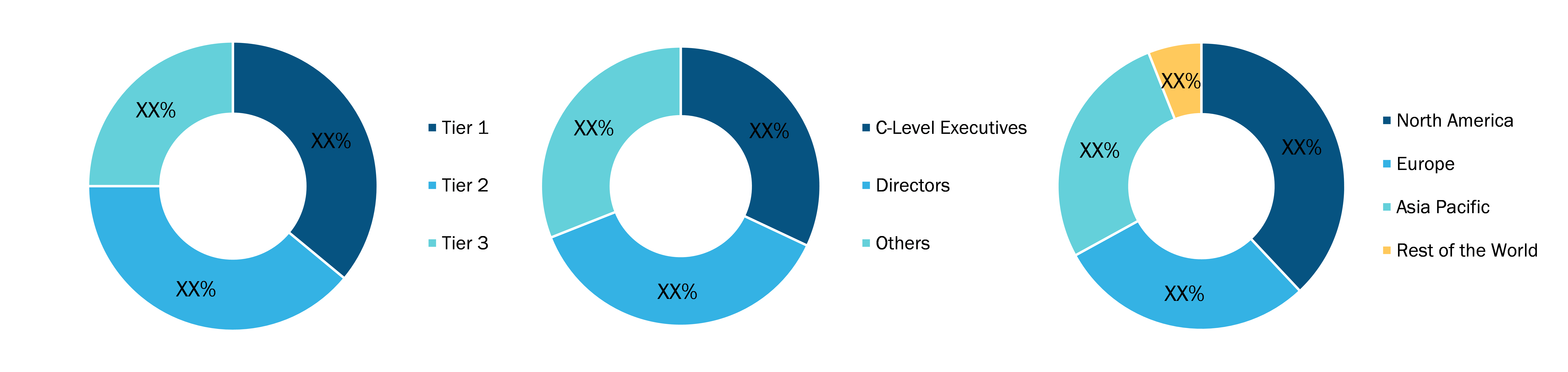
Below is the breakup of our primary respondents by company, designation, and region:
Once we receive the confirmation from primary research sources or primary respondents, we finalize the base year market estimation and forecast the data as per the macroeconomic and microeconomic factors assessed during data collection.
- Data Analysis:
Once data is validated through both secondary as well as primary respondents, we finalize the market estimations by hypothesis formulation and factor analysis at regional and country level.
- 3.1 Macro-Economic Factor Analysis:
We analyse macroeconomic indicators such the gross domestic product (GDP), increase in the demand for goods and services across industries, technological advancement, regional economic growth, governmental policies, the influence of COVID-19, PEST analysis, and other aspects. This analysis aids in setting benchmarks for various nations/regions and approximating market splits. Additionally, the general trend of the aforementioned components aid in determining the market's development possibilities.
- 3.2 Country Level Data:
Various factors that are especially aligned to the country are taken into account to determine the market size for a certain area and country, including the presence of vendors, such as headquarters and offices, the country's GDP, demand patterns, and industry growth. To comprehend the market dynamics for the nation, a number of growth variables, inhibitors, application areas, and current market trends are researched. The aforementioned elements aid in determining the country's overall market's growth potential.
- 3.3 Company Profile:
The “Table of Contents” is formulated by listing and analyzing more than 25 - 30 companies operating in the market ecosystem across geographies. However, we profile only 10 companies as a standard practice in our syndicate reports. These 10 companies comprise leading, emerging, and regional players. Nonetheless, our analysis is not restricted to the 10 listed companies, we also analyze other companies present in the market to develop a holistic view and understand the prevailing trends. The “Company Profiles” section in the report covers key facts, business description, products & services, financial information, SWOT analysis, and key developments. The financial information presented is extracted from the annual reports and official documents of the publicly listed companies. Upon collecting the information for the sections of respective companies, we verify them via various primary sources and then compile the data in respective company profiles. The company level information helps us in deriving the base number as well as in forecasting the market size.
- 3.4 Developing Base Number:
Aggregation of sales statistics (2020-2022) and macro-economic factor, and other secondary and primary research insights are utilized to arrive at base number and related market shares for 2022. The data gaps are identified in this step and relevant market data is analyzed, collected from paid primary interviews or databases. On finalizing the base year market size, forecasts are developed on the basis of macro-economic, industry and market growth factors and company level analysis.
- Data Triangulation and Final Review:
The market findings and base year market size calculations are validated from supply as well as demand side. Demand side validations are based on macro-economic factor analysis and benchmarks for respective regions and countries. In case of supply side validations, revenues of major companies are estimated (in case not available) based on industry benchmark, approximate number of employees, product portfolio, and primary interviews revenues are gathered. Further revenue from target product/service segment is assessed to avoid overshooting of market statistics. In case of heavy deviations between supply and demand side values, all thes steps are repeated to achieve synchronization.
We follow an iterative model, wherein we share our research findings with Subject Matter Experts (SME’s) and Key Opinion Leaders (KOLs) until consensus view of the market is not formulated – this model negates any drastic deviation in the opinions of experts. Only validated and universally acceptable research findings are quoted in our reports.
We have important check points that we use to validate our research findings – which we call – data triangulation, where we validate the information, we generate from secondary sources with primary interviews and then we re-validate with our internal data bases and Subject matter experts. This comprehensive model enables us to deliver high quality, reliable data in shortest possible time.

Get Free Sample For