The Virtual Shopping Assistant Market size is projected to reach US$ 33.11 billion by 2031 from US$ 5.46 billion in 2024. The market is expected to register a CAGR of 29.4% during 2025–2031The virtual shopping assistant market is being propelled by the global shift toward mobile-first consumer behavior.
Virtual Shopping Assistant Market AnalysisThe rising demand for personalized shopping experiences is driving the growth of the virtual shopping assistant market. Consumers are expecting retailers to understand them, anticipate their needs, and provide personalized product recommendations. A virtual shopping assistant leverages artificial intelligence, natural language processing, and machine learning techniques to observe user patterns, purchase behaviors, and contextual insights to create curated recommendations and associated promotions. This extreme level of personalization not only enhances the user experience but also converts better, making these tools beneficial assets to retailers that want to enhance engagement and revenue.
Virtual Shopping Assistant Market OverviewThe Virtual Shopping Assistant market is expanding very quickly, and this is all due to the growth of e-commerce and demand for real-time, personalized customer support. Omnichannel retail strategies are also driving demand for virtual shopping assistants. As companies aim to deliver a seamless customer experience across online and offline channels, virtual shopping assistants are the bridge that links the two. Voice recognition and conversational AI advancements are also extending the reach of virtual shopping assistants further. In addition, increasing use of mobile payment systems and digital wallets propels virtual shopping assistant market growth. The growing position of predictive intelligence and data analytics in retail is also speeding up virtual shopping assistants' adoption.
Strategic Insights
Virtual Shopping Assistant Market Drivers and OpportunitiesMarket Driver:
- Rapid Growth of E-Commerce: The increase in online shopping has prompted retailers to embrace technologies simulating in-store experiences. Virtual Shopping Assistants facilitate real-time assistance while customers search for, compare, and purchase products, increasing user satisfaction and sales, especially in competitive e-commerce markets.
- Demand for Personalization: Today's consumers expect shopping experiences to be tailored to their preferences. Virtual Shopping Assistants can personalize the experience by monitoring user activity, past purchases and user browsing behavior to make targeted recommendations. Personalized shopping influences customer engagement, causes conversion rates to rise and increases loyalty by making shopping experiences more relevant and enjoyable.
- Rise in Mobile and Voice Commerce: The increase in mobile shopping and voice-enabled devices like Alexa and Google Assistant has expanded the need for hands-free, voice-activated shopping assistants. These tools offer convenience and accessibility, especially for multitasking users, making shopping faster and more intuitive through spoken commands and real-time interaction.
Market Opportunities:
- Omnichannel & In‑Store Augmentation: Virtual assistants can improve a physical retail environment by providing functions integrated with mobile applications or augmented reality tools. Virtual assistants can help patrons look up products, scan inventory, and explore personalized offers while providing an entirely seamless experience between online and offline shopping—all while helping connect modern consumer to a physical store location. This omnichannel support attracts modern consumers and helps retailers boost in-store engagement while maintaining digital convenience.
- Voice, Multilingual & Mobile Integration: With voice commerce and global e-commerce growth, there’s a huge opportunity in building VSAs that support multiple languages and mobile platforms. Voice-enabled assistants offer hands-free convenience, while multilingual support helps retailers reach diverse markets, increasing adoption among mobile-first consumers in both developed and emerging regions.
- Data‑Driven Retail Optimization: Virtual assistants can also gather useful shopper data on buying behavior, preferences, and purchase-intent. Retailers can use this data to enhance inventory planning, create personalized marketing, and improve customer loyalty programs. These insights can both increase sales and pave the way for smarter business decisions and long-term competitive advantages.
The virtual shopping assistant market share is analyzed across various segments to provide a clearer understanding of its structure, growth potential, and emerging trends. Below is the standard segmentation approach used in most industry reports:
By Interaction Mode:
- Chatbots: Chatbots in online retail benefit consumers by offering personalized product recommendations, answering questions, facilitating purchases, and enhancing the overall shopping experience is more efficient.
- Voice Assistants: It allows users to engage in hands-free and convenient interactions by helping them to search for products, place orders, and receive personalized product recommendations by speaking naturally.
- Messengers: Engage customers instantly with real-time support and personalized product suggestions.
- Websites: Offer customers assistance in-store, answer frequently asked questions, and help customers navigate the shopping experience.
- Mobile Apps: Provide engaging, personalized shopping experiences, and push notifications for deals.
- Avatars: Create interactive, human-like assistants to enhance engagement and provide a personalized touch.
By Platform:
- Mobile: Allow for personalized and flexible shopping via voice/text chatbots, push notifications, seamless browsing, and easy and straightforward mobile payments, anytime, anywhere.
- Desktop: Provide detailed product suggestions, live chat features, simple exploration, and easy checkouts for entertaining and easy-to-navigate shopping experiences.
- Smart Speakers: Enable hands-free shopping using voice control–searching for products, placing orders, and personalized recommendations with natural audio interaction.
- Smart TVs: Provide immersive shopping experiences through the inclusion of virtual assistants for product exploation, voice search, and in-entertainment purchases.
- Wearables: Provide speedy, glanceable alerts, voice-based shopping commands, and seamless access to shopping assistants for speedy, convenient purchases in transit.
- Other: Improve virtual shopping with rich, interactive settings where assistants lead users through simulated product tests and tailored suggestions.
By Technology:
- NLP: Understanding customer language to have natural conversations, answer questions and provide on-demand personalized contextual shopping assistance.
- ML: Learning from user data to enhance recommendations, personalize experiences, and create marketing strategies for better consumer engagement and sales.
- Computer Vision: Enables visual search, product recognition, and augmented reality try-ons, enhancing interactive and immersive virtual shopping experiences.
- Predictive Analytics: Predicting customer preferences, inventory needs, and purchase behavior in order to make recommendations and help optimize inventory management in a virtual shopping space.
- Biometrics: Enabled safe, personalized, and payment alternatives through the recognition of individual features such as fingerprints or facial characteristics.
- Others: Facilitates real-time, interactive assistance and engaging experiences in an immersive virtual experience that makes it fun, quick, and easy to shop.
By Industry Vertical:
- Retail & E-commerce
- Healthcare
- BFSI
- Travel & Hospitality
- Automotive
- Media & Entertainment
- Others
By Application:
- Customer Support
- Personal Assistant
- Data Privacy
- Workflow Automation
- Content Curation
- Campaign Management
By Geography:
- North America
- Europe
- Asia-Pacific
- South & Central America
- Middle East & Africa
The virtual shopping assistant market in the Asia Pacific is expected to see the largest growth in the next few years. The rapidly expanding e-commerce industry in countries like China, India, and Southeast Asia.
Market Report Scope
Virtual Shopping Assistant Market Share Analysis by GeographyAsia Pacific is expected to grow fastest in the coming years. Emerging markets in South & Central America, the Middle East, and Africa also have many untapped opportunities for virtual shopping assistant providers to expand.
The virtual shopping assistant market shows a different growth trajectory in each region due to increasing penetration of e-commerce platforms and the rising adoption of AI-based technologies. Below is a summary of market share and trends by region:
1. North America
- Market Share: Holds the largest market share, driven by early technology adoption and a mature e-commerce ecosystem.
- Key Drivers: The high adoption rate of advanced technologies such as artificial intelligence (AI) and machine learning (ML), particularly in the United States.
- Trends: Voice-enabled shopping: integration of virtual assistants with devices (e.g., smart speakers) to enable speech-based purchase flows.
2. Europe
- Market Share: The virtual shopping assistant industry in Europe is anticipated to register considerable growth.
- Key Drivers: Stringent data‑privacy regulations (such as GDPR) encourage the adoption of compliant AI shopping assistant solutions.
- Trends: Growing omnichannel retail strategies—physical and digital retail blending, with assistants bridging the gap.
3. Asia Pacific
- Market Share: The fastest increasing region because rise of e-commerce and m-commerce across the region.
- Key Drivers: Heavy investments in retail digitalization, AI, and cloud infrastructure in regions like China, India, and Southeast Asia.
- Trends: Use of AR/VR, image-based product discovery, voice/multilingual assistants adapting to regional languages.
4. South and Central America
- Market Share: The South and Central America hold a smaller share of the virtual shopping assistant market.
- Key Drivers: Countries like Brazil and Mexico are witnessing a growing demand for virtual shopping assistants as consumers shift towards online shopping.
- Trends: Adoption of chat-based shopping assistants in messaging apps (e.g., WhatsApp commerce) to reach mobile-only users.
5. Middle East and Africa
- Market Share: The Middle East and Africa hold a smaller share of the virtual shopping assistant market.
- Key Drivers: Technological advancements and the expansion of digital retail infrastructure are expected to drive future growth in the market.
- Trends: Integration of virtual assistants in mobile-first retail apps, boutique luxury experiences, and high-end e-commerce.
The virtual shopping assistant market is witnessing intensified competition due to the presence of major global technology providers alongside emerging niche players and specialized startups. Companies are actively innovating to strengthen their market position and meet the growing demand for intelligent decision-making platforms across industries.
The competitive landscape is driving vendors to differentiate through:
- Utilizing Generative AI for human-like, multi-turn conversations and highly predictive product recommendations.
- Offering seamless, unified customer experiences across websites, apps, voice assistants, and physical retail channels.
- Employing Computer Vision for visual search and AR/VR for immersive virtual try-ons and 3D product visualization tools.
Opportunities and Strategic Moves
- Form strategic alliances with large retailers for co-branded deployments, increasing visibility, shared insights, and ecosystem growth.
- Adopt cloud-native infrastructure to ensure fast deployment, high availability, and scalability for global clients of all sizes.
- Capitalize on voice assistant adoption to deliver hands-free, accessible shopping experiences across smart devices and connected home ecosystems.
- Amazon- United States
- Microsoft– United States
- Google LLC– United States
- Apple Inc– United States
- Mobisoft Infotech- United States
- Oracle Corporation– United States
- Nuance Communications, Inc.– United States
- Luka- United States
- Pypestream Inc- United States
- EdgeVerve Systems- India
Disclaimer: The companies listed above are not ranked in any particular order.
Virtual Shopping Assistant Market News and Recent Developments- Amazon: Amazon has unveiled Rufus, a generative AI-powered conversational shopping assistant, in India. Rufus is an expert shopping assistant that has been trained on Amazon’s product information and other information available online, to respond to customer questions on shopping requirements, products and comparisons, make recommendations based on its context, and help customers discover products fully within the same Amazon shopping experience customers are familiar with.
- Apple: Apple today introduced Shop with a Specialist over Video in India, offering customers a new way to shop for Apple products on the Apple Store online. The service connects customers with an Apple Store team member via a secure, one-way video call to browse the latest Apple products, including the iPhone 16 lineup; discover new features; and learn about Apple’s trade-in program, financing options, and more, all from the comfort of their homes. As more Indians shop online, the service brings a secure and personal way to shop for Apple products.
The "Virtual Shopping Assistant Market Size and Forecast (2021–2031)" report provides a detailed analysis of the market covering below areas:
- Virtual Shopping Assistant Market size and forecast at global, regional, and country levels for all the key market segments covered under the scope
- Virtual Shopping Assistant Market trends, as well as market dynamics such as drivers, restraints, and key opportunities
- Detailed PEST and SWOT analysis
- Virtual Shopping Assistant Market analysis covering key market trends, global and regional framework, major players, regulations, and recent market developments
- Industry landscape and competition analysis covering market concentration, heat map analysis, prominent players, and recent developments in the Virtual Shopping Assistant Market. Detailed company profiles
Have a question?
Naveen
Naveen will walk you through a 15-minute call to present the report’s content and answer all queries if you have any.
Speak to Analyst
- Sample PDF showcases the content structure and the nature of the information with qualitative and quantitative analysis.
- Request discounts available for Start-Ups & Universities
- Sample PDF showcases the content structure and the nature of the information with qualitative and quantitative analysis.
- Request discounts available for Start-Ups & Universities
Report Coverage
Revenue forecast, Company Analysis, Industry landscape, Growth factors, and Trends

Segment Covered
This text is related
to segments covered.

Regional Scope
North America, Europe, Asia Pacific, Middle East & Africa, South & Central America

Country Scope
This text is related
to country scope.
Frequently Asked Questions
Key companies include Amazon, Microsoft, google llc, apple. Inc., oracle corporation, luka, pypestream, and others.
Challenges include high implementation costs for retailers and concerns over data privacy and security as virtual assistants rely on consumer data.
North America leads the market, while the Asia-Pacific region is expected to experience the highest growth rate.
Key drivers include the rise of e-commerce, demand for personalized shopping experiences, and advancements in AI-powered solutions.
Yes! We provide a free sample of the report, which includes Report Scope (Table of Contents), report structure, and selected insights to help you assess the value of the full report. Please click on the "Download Sample" button or contact us to receive your copy.
Absolutely - analyst assistance is part of the package. You can connect with our analyst post-purchase to clarify report insights, methodology or discuss how the findings apply to your business needs.
Once your order is successfully placed, you will receive a confirmation email along with your invoice.
• For published reports: You'll receive access to the report within 4-6 working hours via a secured email sent to your email.
• For upcoming reports: Your order will be recorded as a pre-booking. Our team will share the estimated release date and keep you informed of any updates. As soon as the report is published, it will be delivered to your registered email.
We offer customization options to align the report with your specific objectives. Whether you need deeper insights into a particular region, industry segment, competitor analysis, or data cut, our research team can tailor the report accordingly. Please share your requirements with us, and we'll be happy to provide a customized proposal or scope.
The report is available in either PDF format or as an Excel dataset, depending on the license you choose.
The PDF version provides the full analysis and visuals in a ready-to-read format. The Excel dataset includes all underlying data tables for easy manipulation and further analysis.
Please review the license options at checkout or contact us to confirm which formats are included with your purchase.
Our payment process is fully secure and PCI-DSS compliant.
We use trusted and encrypted payment gateways to ensure that all transactions are protected with industry-standard SSL encryption. Your payment details are never stored on our servers and are handled securely by certified third-party processors.
You can make your purchase with confidence, knowing your personal and financial information is safe with us.
Yes, we do offer special pricing for bulk purchases.
If you're interested in purchasing multiple reports, we're happy to provide a customized bundle offer or volume-based discount tailored to your needs. Please contact our sales team with the list of reports you're considering, and we'll share a personalized quote.
Yes, absolutely.
Our team is available to help you make an informed decision. Whether you have questions about the report's scope, methodology, customization options, or which license suits you best, we're here to assist. Please reach out to us at sales@theinsightpartners.com, and one of our representatives will get in touch promptly.
Yes, a billing invoice will be automatically generated and sent to your registered email upon successful completion of your purchase.
If you need the invoice in a specific format or require additional details (such as company name, GST, or VAT information), feel free to contact us, and we'll be happy to assist.
Yes, certainly.
If you encounter any difficulties accessing or receiving your report, our support team is ready to assist you. Simply reach out to us via email or live chat with your order information, and we'll ensure the issue is resolved quickly so you can access your report without interruption.
The Insight Partners performs research in 4 major stages: Data Collection & Secondary Research, Primary Research, Data Analysis and Data Triangulation & Final Review.
- Data Collection and Secondary Research:
As a market research and consulting firm operating from a decade, we have published many reports and advised several clients across the globe. First step for any study will start with an assessment of currently available data and insights from existing reports. Further, historical and current market information is collected from Investor Presentations, Annual Reports, SEC Filings, etc., and other information related to company’s performance and market positioning are gathered from Paid Databases (Factiva, Hoovers, and Reuters) and various other publications available in public domain.
Several associations trade associates, technical forums, institutes, societies and organizations are accessed to gain technical as well as market related insights through their publications such as research papers, blogs and press releases related to the studies are referred to get cues about the market. Further, white papers, journals, magazines, and other news articles published in the last 3 years are scrutinized and analyzed to understand the current market trends.
- Primary Research:
The primarily interview analysis comprise of data obtained from industry participants interview and answers to survey questions gathered by in-house primary team.
For primary research, interviews are conducted with industry experts/CEOs/Marketing Managers/Sales Managers/VPs/Subject Matter Experts from both demand and supply side to get a 360-degree view of the market. The primary team conducts several interviews based on the complexity of the markets to understand the various market trends and dynamics which makes research more credible and precise.
A typical research interview fulfils the following functions:
- Provides first-hand information on the market size, market trends, growth trends, competitive landscape, and outlook
- Validates and strengthens in-house secondary research findings
- Develops the analysis team’s expertise and market understanding
Primary research involves email interactions and telephone interviews for each market, category, segment, and sub-segment across geographies. The participants who typically take part in such a process include, but are not limited to:
- Industry participants: VPs, business development managers, market intelligence managers and national sales managers
- Outside experts: Valuation experts, research analysts and key opinion leaders specializing in the electronics and semiconductor industry.
Below is the breakup of our primary respondents by company, designation, and region:
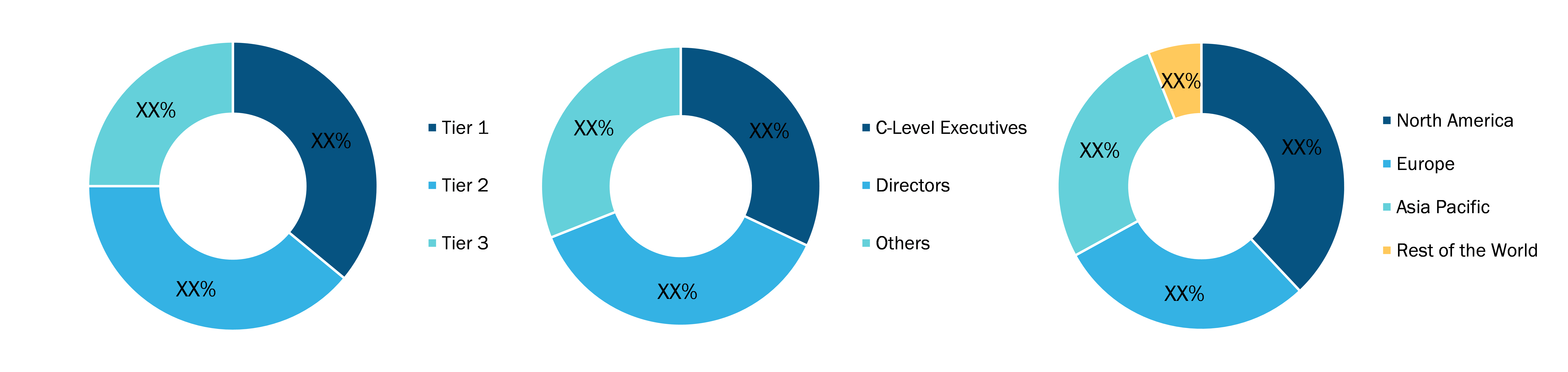
Once we receive the confirmation from primary research sources or primary respondents, we finalize the base year market estimation and forecast the data as per the macroeconomic and microeconomic factors assessed during data collection.
- Data Analysis:
Once data is validated through both secondary as well as primary respondents, we finalize the market estimations by hypothesis formulation and factor analysis at regional and country level.
- 3.1 Macro-Economic Factor Analysis:
We analyse macroeconomic indicators such the gross domestic product (GDP), increase in the demand for goods and services across industries, technological advancement, regional economic growth, governmental policies, the influence of COVID-19, PEST analysis, and other aspects. This analysis aids in setting benchmarks for various nations/regions and approximating market splits. Additionally, the general trend of the aforementioned components aid in determining the market's development possibilities.
- 3.2 Country Level Data:
Various factors that are especially aligned to the country are taken into account to determine the market size for a certain area and country, including the presence of vendors, such as headquarters and offices, the country's GDP, demand patterns, and industry growth. To comprehend the market dynamics for the nation, a number of growth variables, inhibitors, application areas, and current market trends are researched. The aforementioned elements aid in determining the country's overall market's growth potential.
- 3.3 Company Profile:
The “Table of Contents” is formulated by listing and analyzing more than 25 - 30 companies operating in the market ecosystem across geographies. However, we profile only 10 companies as a standard practice in our syndicate reports. These 10 companies comprise leading, emerging, and regional players. Nonetheless, our analysis is not restricted to the 10 listed companies, we also analyze other companies present in the market to develop a holistic view and understand the prevailing trends. The “Company Profiles” section in the report covers key facts, business description, products & services, financial information, SWOT analysis, and key developments. The financial information presented is extracted from the annual reports and official documents of the publicly listed companies. Upon collecting the information for the sections of respective companies, we verify them via various primary sources and then compile the data in respective company profiles. The company level information helps us in deriving the base number as well as in forecasting the market size.
- 3.4 Developing Base Number:
Aggregation of sales statistics (2020-2022) and macro-economic factor, and other secondary and primary research insights are utilized to arrive at base number and related market shares for 2022. The data gaps are identified in this step and relevant market data is analyzed, collected from paid primary interviews or databases. On finalizing the base year market size, forecasts are developed on the basis of macro-economic, industry and market growth factors and company level analysis.
- Data Triangulation and Final Review:
The market findings and base year market size calculations are validated from supply as well as demand side. Demand side validations are based on macro-economic factor analysis and benchmarks for respective regions and countries. In case of supply side validations, revenues of major companies are estimated (in case not available) based on industry benchmark, approximate number of employees, product portfolio, and primary interviews revenues are gathered. Further revenue from target product/service segment is assessed to avoid overshooting of market statistics. In case of heavy deviations between supply and demand side values, all thes steps are repeated to achieve synchronization.
We follow an iterative model, wherein we share our research findings with Subject Matter Experts (SME’s) and Key Opinion Leaders (KOLs) until consensus view of the market is not formulated – this model negates any drastic deviation in the opinions of experts. Only validated and universally acceptable research findings are quoted in our reports.
We have important check points that we use to validate our research findings – which we call – data triangulation, where we validate the information, we generate from secondary sources with primary interviews and then we re-validate with our internal data bases and Subject matter experts. This comprehensive model enables us to deliver high quality, reliable data in shortest possible time.

Get Free Sample For