
Virtual Shopping Assistant Market Insights & Growth Scope by 2031
Virtual Shopping Assistant Market Size and Forecast (2021 - 2031), Global and Regional Share, Trend, and Growth Opportunity Analysis Report Report Coverage : by Interaction Mode (Chatbots, Messengers, Websites, Mobile Apps, Voice Assistants, Others), Platform (Mobile, Desktop, Smart Speakers, Smart TVs, Wearable’s, Others), Technology (NLP, ML, Computer Vision, Predictive Analytics, Biometrics, Others), Industry Vertical (Retail & eCommerce, Healthcare, BFSI, Travel & Hospitality, Automotive, Media & Entertainment, Others), Application (Customer Support, Personal Assistant, Data Privacy, Workflow Automation, Content Curation, Campaign Management, Others)and Geography
- Status : Data Released
- Report Code : TIPRE00042076
- Category : Technology, Media and Telecommunications
- No. of Pages : 150
- Available Report Formats :


- Last update date : December 05, 2025


2024 Market Size
US$ 5.46 Bn
Base year value
2031 Forecast
US$ 33.11 Bn
Projected by 2031
CAGR 2025-2031
29.4 %
Growth rate
Addressable Market
US$ 121.96 Bn
(2025-2031)
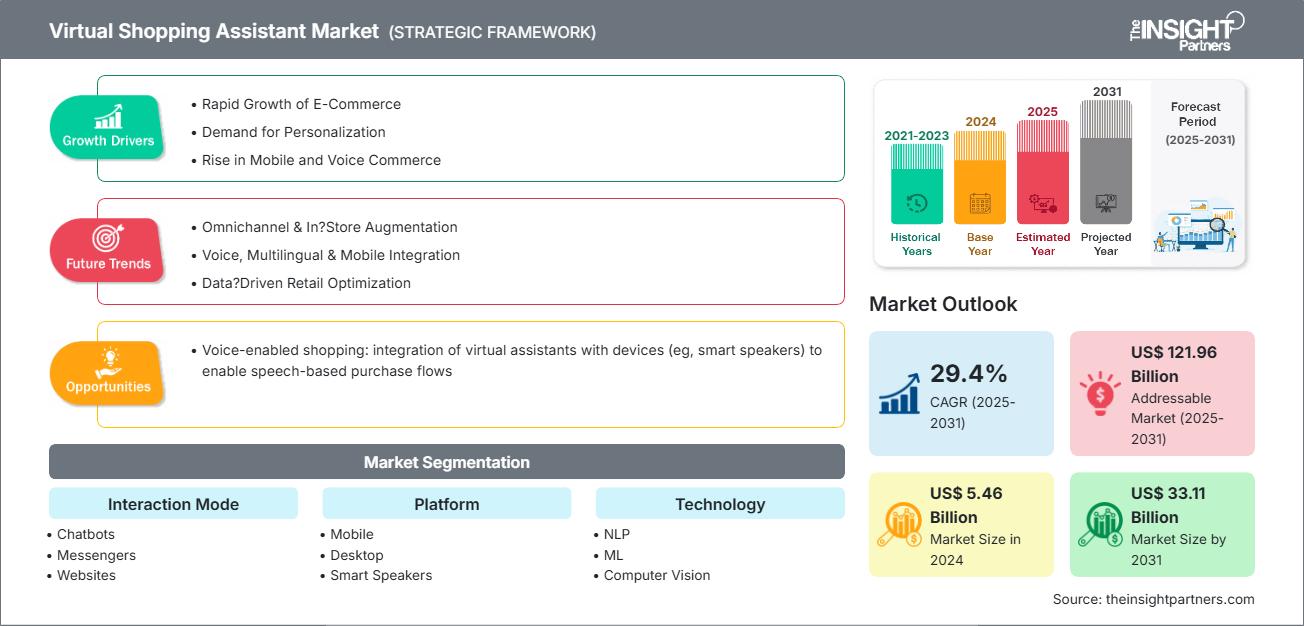
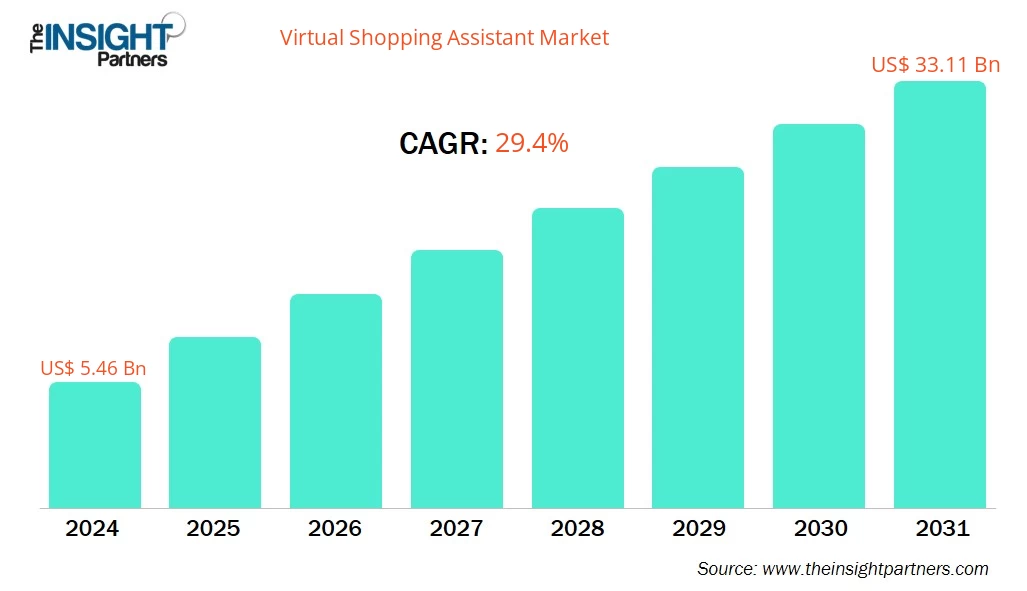
The Virtual Shopping Assistant Market size is projected to reach US$ 33.11 billion by 2031 from US$ 5.46 billion in 2024. The market is expected to register a CAGR of 29.4% during 2025–2031. The virtual shopping assistant market is being propelled by the global shift toward mobile-first consumer behaviour.
Virtual Shopping Assistant Market Analysis
The rising demand for personalized shopping experiences is driving the growth of the virtual shopping assistant market. Consumers are expecting retailers to understand them, anticipate their needs, and provide personalized product recommendations. A virtual shopping assistant leverages artificial intelligence, natural language processing, and machine learning techniques to observe user patterns, purchase behaviors, and contextual insights to create curated recommendations and associated promotions. This extreme level of personalization not only enhances the user experience but also converts better, making these tools beneficial assets to retailers that want to enhance engagement and revenue.
Virtual Shopping Assistant Market Overview
The Virtual Shopping Assistant market is expanding very quickly, and this is all due to the growth of e-commerce and demand for real-time, personalized customer support. Omnichannel retail strategies are also driving demand for virtual shopping assistants. As companies aim to deliver a seamless customer experience across online and offline channels, virtual shopping assistants are the bridge that links the two. Voice recognition and conversational AI advancements are also extending the reach of virtual shopping assistants further. In addition, increasing use of mobile payment systems and digital wallets propels virtual shopping assistant market growth. The growing position of predictive intelligence and data analytics in retail is also speeding up virtual shopping assistants' adoption.
Market Research Highlights
- Global market for Virtual Shopping Assistant was valued at US$ 5.46 Billion in 2024
- Annual market size is expected to reach US$ 33.11 Billion by 2031
- Total addressable market (TAM) during 2025-2031 is projected to reach approximately US$ 121.96 Billion
- Market is anticipated to register a CAGR of 29.4% during the forecast period
- The United States represents a key market, supported by Rapid Growth of E-Commerce, Demand for Personalization, Rise in Mobile and Voice Commerce, as well as evolving industry dynamics
- Market analysis covers North America, Europe, Asia-Pacific, South and Central America, Middle East and Africa, with growth evaluated across the forecast period
- Market opportunities such as Voice-enabled shopping: integration of virtual assistants with devices (eg, smart speakers) to enable speech-based purchase flows are expected to influence market dynamics and addressable market
- Report profiles industry participants, including Amazon- United States, Microsoft- United States, Google LLC- United States, Apple Inc- United States, Mobisoft Infotech- United States, Oracle Corporation- United States, Nuance Communications, Inc.- United States, Luka- United States, Pypestream Inc- United States, EdgeVerve Systems- India, while analyzing competitive strategies and innovation developments
-
Source: The Insight Partners' analysis based on proprietary research, government publications, company annual reports, investor presentations, industry databases, and expert interviews.
● REPORT CUSTOMIZATION
Tailor This Report To Align With Your Specific Business Requirements
This report can be customized to align precisely with your business objectives, scope, and target markets. Customization options include tailored segmentation, geography, competitive analysis, and strategic insights to support informed decision-making.
Customize This Report →WHAT YOU CAN ADJUST
- ● Segmentations
- ● Geography
- ● Competitive Analysis
- ● Language Preferences
Virtual Shopping Assistant Market: Strategic Insights
-
Get Top Key Market Trends of this report.This FREE sample will include data analysis, ranging from market trends to estimates and forecasts.
Virtual Shopping Assistant Market Drivers and Opportunities
Market Driver:
- Rapid Growth of E-Commerce: The increase in online shopping has prompted retailers to embrace technologies simulating in-store experiences. Virtual Shopping Assistants facilitate real-time assistance while customers search for, compare, and purchase products, increasing user satisfaction and sales, especially in competitive e-commerce markets.
- Demand for Personalization: Today's consumers expect shopping experiences to be tailored to their preferences. Virtual Shopping Assistants can personalize the experience by monitoring user activity, past purchases and user browsing behavior to make targeted recommendations. Personalized shopping influences customer engagement, causes conversion rates to rise and increases loyalty by making shopping experiences more relevant and enjoyable.
- Rise in Mobile and Voice Commerce: The increase in mobile shopping and voice-enabled devices like Alexa and Google Assistant has expanded the need for hands-free, voice-activated shopping assistants. These tools offer convenience and accessibility, especially for multitasking users, making shopping faster and more intuitive through spoken commands and real-time interaction.
Market Opportunities:
- Omnichannel & In‑Store Augmentation: Virtual assistants can improve a physical retail environment by providing functions integrated with mobile applications or augmented reality tools. Virtual assistants can help patrons look up products, scan inventory, and explore personalized offers while providing an entirely seamless experience between online and offline shopping—all while helping connect modern consumer to a physical store location. This omnichannel support attracts modern consumers and helps retailers boost in-store engagement while maintaining digital convenience.
- Voice, Multilingual & Mobile Integration: With voice commerce and global e-commerce growth, there’s a huge opportunity in building VSAs that support multiple languages and mobile platforms. Voice-enabled assistants offer hands-free convenience, while multilingual support helps retailers reach diverse markets, increasing adoption among mobile-first consumers in both developed and emerging regions.
- Data‑Driven Retail Optimization: Virtual assistants can also gather useful shopper data on buying behavior, preferences, and purchase-intent. Retailers can use this data to enhance inventory planning, create personalized marketing, and improve customer loyalty programs. These insights can both increase sales and pave the way for smarter business decisions and long-term competitive advantages.
Virtual Shopping Assistant Market Report Segmentation Analysis
The virtual shopping assistant market share is analyzed across various segments to provide a clearer understanding of its structure, growth potential, and emerging trends. Below is the standard segmentation approach used in most industry reports:
By Interaction Mode:
- Chatbots: Chatbots in online retail benefit consumers by offering personalized product recommendations, answering questions, facilitating purchases, and enhancing the overall shopping experience is more efficient.
- Voice Assistants: It allows users to engage in hands-free and convenient interactions by helping them to search for products, place orders, and receive personalized product recommendations by speaking naturally.
- Messengers: Engage customers instantly with real-time support and personalized product suggestions.
- Websites: Offer customers assistance in-store, answer frequently asked questions, and help customers navigate the shopping experience.
- Mobile Apps: Provide engaging, personalized shopping experiences, and push notifications for deals.
- Avatars: Create interactive, human-like assistants to enhance engagement and provide a personalized touch.
By Platform:
- Mobile: Allow for personalized and flexible shopping via voice/text chatbots, push notifications, seamless browsing, and easy and straightforward mobile payments, anytime, anywhere.
- Desktop: Provide detailed product suggestions, live chat features, simple exploration, and easy checkouts for entertaining and easy-to-navigate shopping experiences.
- Smart Speakers: Enable hands-free shopping using voice control–searching for products, placing orders, and personalized recommendations with natural audio interaction.
- Smart TVs: Provide immersive shopping experiences through the inclusion of virtual assistants for product exploation, voice search, and in-entertainment purchases.
- Wearables: Provide speedy, glanceable alerts, voice-based shopping commands, and seamless access to shopping assistants for speedy, convenient purchases in transit.
- Other: Improve virtual shopping with rich, interactive settings where assistants lead users through simulated product tests and tailored suggestions.
By Technology:
- NLP: Understanding customer language to have natural conversations, answer questions and provide on-demand personalized contextual shopping assistance.
- ML: Learning from user data to enhance recommendations, personalize experiences, and create marketing strategies for better consumer engagement and sales.
- Computer Vision: Enables visual search, product recognition, and augmented reality try-ons, enhancing interactive and immersive virtual shopping experiences.
- Predictive Analytics: Predicting customer preferences, inventory needs, and purchase behavior in order to make recommendations and help optimize inventory management in a virtual shopping space.
- Biometrics: Enabled safe, personalized, and payment alternatives through the recognition of individual features such as fingerprints or facial characteristics.
- Others: Facilitates real-time, interactive assistance and engaging experiences in an immersive virtual experience that makes it fun, quick, and easy to shop.
By Industry Vertical:
- Retail & E-commerce
- Healthcare
- BFSI
- Travel & Hospitality
- Automotive
- Media & Entertainment
- Others
By Application:
- Customer Support
- Personal Assistant
- Data Privacy
- Workflow Automation
- Content Curation
- Campaign Management
By Geography:
- North America
- Europe
- Asia-Pacific
- South & Central America
- Middle East & Africa
The virtual shopping assistant market in the Asia Pacific is expected to see the largest growth in the next few years. The rapidly expanding e-commerce industry in countries like China, India, and Southeast Asia.
Virtual Shopping Assistant Market Report Scope
| Report Attribute | Details |
|---|---|
| Market size in 2024 | US$ 5.46 Billion |
| Market Size by 2031 | US$ 33.11 Billion |
| Global CAGR (2025 - 2031) | 29.4% |
| Historical Data | 2021-2023 |
| Forecast period | 2025-2031 |
| Segments Covered |
By Interaction Mode
|
| Regions and Countries Covered |
North America
|
| Market leaders and key company profiles |
|
Virtual Shopping Assistant Market Players Density: Understanding Its Impact on Business Dynamics
The Virtual Shopping Assistant Market is growing rapidly, driven by increasing end-user demand due to factors such as evolving consumer preferences, technological advancements, and greater awareness of the product's benefits. As demand rises, businesses are expanding their offerings, innovating to meet consumer needs, and capitalizing on emerging trends, which further fuels market growth.
Virtual Shopping Assistant Market Share Analysis by Geography
Asia Pacific is expected to grow fastest in the coming years. Emerging markets in South & Central America, the Middle East, and Africa also have many untapped opportunities for virtual shopping assistant providers to expand.
The virtual shopping assistant market shows a different growth trajectory in each region due to increasing penetration of e-commerce platforms and the rising adoption of AI-based technologies. Below is a summary of market share and trends by region:
1. North America
- Market Share: Holds the largest market share, driven by early technology adoption and a mature e-commerce ecosystem.
- Key Drivers: The high adoption rate of advanced technologies such as artificial intelligence (AI) and machine learning (ML), particularly in the United States.
- Trends: Voice-enabled shopping: integration of virtual assistants with devices (e.g., smart speakers) to enable speech-based purchase flows.
2. Europe
- Market Share: The virtual shopping assistant industry in Europe is anticipated to register considerable growth.
- Key Drivers: Stringent data‑privacy regulations (such as GDPR) encourage the adoption of compliant AI shopping assistant solutions.
- Trends: Growing omnichannel retail strategies—physical and digital retail blending, with assistants bridging the gap.
3. Asia Pacific
- Market Share: The fastest increasing region because rise of e-commerce and m-commerce across the region.
- Key Drivers: Heavy investments in retail digitalization, AI, and cloud infrastructure in regions like China, India, and Southeast Asia.
- Trends: Use of AR/VR, image-based product discovery, voice/multilingual assistants adapting to regional languages.
4. South and Central America
- Market Share: The South and Central America hold a smaller share of the virtual shopping assistant market.
- Key Drivers: Countries like Brazil and Mexico are witnessing a growing demand for virtual shopping assistants as consumers shift towards online shopping.
- Trends: Adoption of chat-based shopping assistants in messaging apps (e.g., WhatsApp commerce) to reach mobile-only users.
5. Middle East and Africa
- Market Share: The Middle East and Africa hold a smaller share of the virtual shopping assistant market.
- Key Drivers: Technological advancements and the expansion of digital retail infrastructure are expected to drive future growth in the market.
- Trends: Integration of virtual assistants in mobile-first retail apps, boutique luxury experiences, and high-end e-commerce.
Virtual Shopping Assistant Market Players Density: Understanding Its Impact on Business Dynamics
The virtual shopping assistant market is witnessing intensified competition due to the presence of major global technology providers alongside emerging niche players and specialized startups. Companies are actively innovating to strengthen their market position and meet the growing demand for intelligent decision-making platforms across industries.
The competitive landscape is driving vendors to differentiate through:
- Utilizing Generative AI for human-like, multi-turn conversations and highly predictive product recommendations.
- Offering seamless, unified customer experiences across websites, apps, voice assistants, and physical retail channels.
- Employing Computer Vision for visual search and AR/VR for immersive virtual try-ons and 3D product visualization tools.
Opportunities and Strategic Moves
- Form strategic alliances with large retailers for co-branded deployments, increasing visibility, shared insights, and ecosystem growth.
- Adopt cloud-native infrastructure to ensure fast deployment, high availability, and scalability for global clients of all sizes.
- Capitalize on voice assistant adoption to deliver hands-free, accessible shopping experiences across smart devices and connected home ecosystems.
Major Companies Operating in the Virtual Shopping Assistant Market Are:
- Amazon- United States
- Microsoft– United States
- Google LLC– United States
- Apple Inc– United States
- Mobisoft Infotech- United States
- Oracle Corporation– United States
- Nuance Communications, Inc.– United States
- Luka- United States
- Pypestream Inc- United States
- EdgeVerve Systems- India
Disclaimer: The companies listed above are not ranked in any particular order.
Virtual Shopping Assistant Market News and Recent Developments
- Amazon: Amazon has unveiled Rufus, a generative AI-powered conversational shopping assistant, in India. Rufus is an expert shopping assistant that has been trained on Amazon’s product information and other information available online, to respond to customer questions on shopping requirements, products and comparisons, make recommendations based on its context, and help customers discover products fully within the same Amazon shopping experience customers are familiar with.
- Apple: Apple today introduced Shop with a Specialist over Video in India, offering customers a new way to shop for Apple products on the Apple Store online. The service connects customers with an Apple Store team member via a secure, one-way video call to browse the latest Apple products, including the iPhone 16 lineup; discover new features; and learn about Apple’s trade-in program, financing options, and more, all from the comfort of their homes. As more Indians shop online, the service brings a secure and personal way to shop for Apple products.
Virtual Shopping Assistant Market Report Coverage and Deliverables
The "Virtual Shopping Assistant Market Size and Forecast (2021–2031)" report provides a detailed analysis of the market covering below areas:
- Virtual Shopping Assistant Market size and forecast at global, regional, and country levels for all the key market segments covered under the scope
- Virtual Shopping Assistant Market trends, as well as market dynamics such as drivers, restraints, and key opportunities
- Detailed PEST and SWOT analysis
- Virtual Shopping Assistant Market analysis covering key market trends, global and regional framework, major players, regulations, and recent market developments
- Industry landscape and competition analysis covering market concentration, heat map analysis, prominent players, and recent developments in the Virtual Shopping Assistant Market. Detailed company profiles
Frequently Asked Questions

- Comprehensive Market Sizing and Forecast Analysis
- Detailed Segmentation Analysis
- In-Depth Market Dynamics Assessment
- Regional and Country-Level Insights
- Competitive Landscape and Company Benchmarking
- Strategic Business Intelligence
Recent Reports
Testimonials

The Insight Partners provided valuable market intelligence that supported our global go-to-market strategy. Their team was professional, responsive, and attentive to our feedback, providing thoughtful analysis and helpful methodological clarifications throughout the project.
Junmo Kim Chief Financial Officer (CFO), Enertech Co., Ltd.
The Insight Partners' SCADA System Market report is comprehensive, with valuable insights on current trends and future forecasts. The team was highly professional, responsive, and supportive throughout. We are very satisfied and highly recommend their services.
RAN KEDEM Partner, Reali Technologies LTDs
I requested a report on a very specific software market and the team produced the report in a few days. The information was very relevant and well presented. I then requested some changes and additions to the report. The team was again very responsive and I got the final report in less than a week.
JEAN-HERVE JENN Chairman, Future Analytica
We worked with The Insight Partners for an important market study and forecast. They gave us clear insights into opportunities and risks, which helped shape our plans. Their research was easy to use and based on solid data. It helped us make smart, confident decisions. We highly recommend them.
PIYUSH NAGPAL Sr. Vice President, High Beam Global
The Insight Partners delivered insightful, well-structured market research with strong domain expertise. Their team was professional and responsive throughout. The user-friendly website made accessing industry reports seamless. We highly recommend them for reliable, high-quality research services
YUKIHIKO ADACHI CEO, Deep Blue, LLC.
This is the first time I have purchased a market report from The Insight Partners.While I was unsure at first, I visited their web site and felt more comfortable to take the risk and purchase a market report.I am completely satisfied with the quality of the report and customer service. I had several questions and comments with the initial report, but after a couple of dialogs over email with their analyst I believe I have a report that I can use as input to our strategic planning process.Thank you so much for taking the extra time and making this a positive experience.I will definitely recommend your service to others and you will be my first call when we need further market data.
JOHN SUZUKI President and Chief Executive Officer, Board Director, BK Technologies
I wish to appreciate your support and the professionalism you displayed in the course of attending to my request for information regarding to infectious disease IVD market in Nigeria. I appreciate your patience, your guidance, and the fact that you were willing to offer a discount, which eventually made it possible for us to close a deal. I look forward to engaging The Insight Partners in the future, all thanks to the impression you have created in me as a result of this first encounter.
DR CHIJIOKE ONYIA MANAGING DIRECTOR, PineCrest Healthcare Ltd.Reason to Buy
- Informed Decision-Making
- Understanding Market Dynamics
- Competitive Analysis
- Identifying Emerging Markets
- Customer Insights
- Market Forecasts
- Risk Mitigation
- Boosting Operational Efficiency
- Strategic Planning
- Investment Justification
- Tracking Industry Innovations
- Aligning with Regulatory Trends





 Get Free Sample for