
Roofing Systems Market Size, Growth & Demand by 2034
Coverage: By Material (Asphalt, Clay, Concrete, Metal, Wood, Others); Product (Shingles and Plates, Tiles, Others); End-user (Residential, Commercial, Industrial) , and Geography (North America, Europe, Asia Pacific, and South and Central America)
- Status : Data Released
- Report Code : TIPRE00012418
- Category : Manufacturing and Construction
- No. of Pages : 150
- Available Report Formats :


- Last update date : September 07, 2026


2025 Market Size
US$ 125.99 Bn
Base year value
2034 Forecast
US$ 179.1 Bn
Projected by 2034
CAGR 2026-2034
3.99 %
Growth rate
Addressable Market
US$ 1,385.96 Bn
(2026-2034)
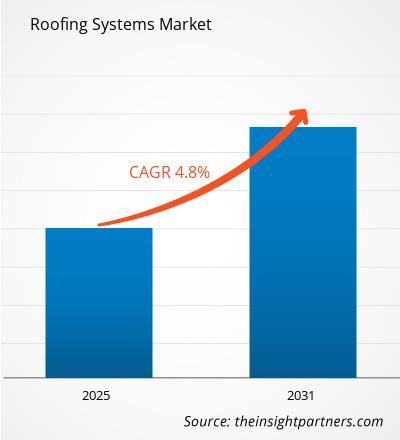
The global Roofing Systems market was valued at US$ 125.99 billion in 2025 and is expected to reach US$ 179.1 billion by 2034; it is estimated to record a CAGR of 3.99% during 2026-2034.
Roofing Systems Market Assessment and Insights
- North America: North America is expected to represent 38–40% share in 2025 and grow at a 3.9–4.4% CAGR between 2026–2034, supported by reroofing demand, commercial construction, building-code requirements, and weather-resilient product adoption.
- US: The U.S. is estimated at 66–68% of North American share in 2025, with a 3.8–4.3% CAGR between 2026–2034, reflecting residential replacement and commercial construction activity.
- Europe: Europe is projected to hold 19–21% share in 2025 and grow at a 3.5–4.1% CAGR between 2026–2034, with Germany, the UK, France, Italy, and Spain supported by renovation, energy-efficiency requirements, and aging building stock.
- Asia Pacific: Asia Pacific is estimated at 29–31% share in 2025 and is expected to expand at a 5.0–5.8% CAGR between 2026–2034, led by China, India, Japan, South Korea, and Southeast Asian construction investment.
- Largest Segment: Residential is estimated at a 45–48% market share in 2025, with a 4.0–4.6% CAGR between 2026–2034, reflecting housing construction and recurring replacement demand.
- High Growth Segment: Metal is estimated at a 21–24% market share in 2025, with a 4.1–4.6% CAGR between 2026–2034, supported by durability, recyclability, lightweight construction, and weather resistance.
- Key companies analyzed in detail: Atlas Roofing Corporation, Johns Manville, Boral Limited, Braas Monier Building Group SA, Carlisle Companies Incorporated, CSR Limited, Etex Group NV, Owens Corning, Saint-Gobain, and Siam Cement Group.
Source: The Insight Partners' analysis based on proprietary research, government publications, company annual reports, investor presentations, industry databases, and expert interviews.
The roofing sector has shifted from commodity-oriented material selection toward integrated systems combining structural protection, insulation, drainage, ventilation, and energy performance. Asphalt remains important in North America, while metal, concrete, clay, and engineered products retain stronger positions across other climates. Manufacturing strategies increasingly emphasize regional capacity, recycled inputs, automated production, logistics efficiency, and product systems designed around local building codes and contractor practices.
The Roofing Systems Market Forecast suggests that over the forecast period, investment should increasingly favor resilient materials, cool-roof technologies, recyclable products, and systems compatible with photovoltaic integration. Emerging Asian economies provide volume opportunities through urban development, while North America and Europe offer replacement-driven value pools. Regulatory emphasis on building efficiency and climate adaptation should encourage manufacturers to differentiate through thermal performance, durability, installation productivity, and documented environmental attributes rather than material price alone.
Roofing Systems Market Report Scope
| Report Attribute | Details |
|---|---|
| Market size in 2025 | US$ 125.99 Billion |
| Market Size by 2034 | US$ 179.1 Billion |
| Global CAGR (2026 - 2034) | 3.99% |
| Historical Data | 2021-2024 |
| Forecast period | 2026-2034 |
Roofing Systems Market Analysis
Demand for roofing systems is strongly tied to the construction value chain, starting from the supply of basic raw materials like asphalt, steel, cement, clay, polymers, and wood and ending with production, distribution, contracting, installation, and finally end users. The cycle of replacement adds a layer of demand that helps counterbalance any variations in new construction. The supply of materials, freight rates, contractor relationships, and regional requirements affect buying decisions, and weather events might cause an immediate need for replacements.
The trend of the supply chain towards localizing production operations will continue since suppliers strive to shorten their transportation routes and gain control over key inputs. Manufacturing companies that have a wide variety of raw materials can effectively substitute one kind of material with another – asphalt, metal, concrete, clay, and engineered products, depending on the economic situation in the region. Major distributors still play a significant role in the market due to the labor-intensive nature of installation and scheduling issues.
Competitive positioning in the roofing systems market analysis increasingly depends on portfolio breadth, manufacturing footprint, distribution reach, and innovation capacity. Owens Corning has strengthened roofing manufacturing investments, while Carlisle Companies Incorporated maintains a strong commercial-building orientation. Saint-Gobain combines roofing with broader construction solutions, and Johns Manville contributes insulation and roofing capabilities. Atlas Roofing Corporation, Boral Limited, Braas Monier Building Group SA, CSR Limited, Etex Group NV, and Siam Cement Group provide additional regional and product specialization.
Roofing Systems Market Trends indicate that investment is also shifting toward capacity modernization, acquisitions, recycling infrastructure, and higher-value building products. Owens Corning brought roofing investments online during 2025 and announced further manufacturing modernization, while Saint-Gobain continued portfolio expansion and supply-chain investments in North America and Asia. These moves indicate that scale is being pursued alongside geographic localization, operational efficiency, and sustainability-oriented product development.
● REPORT CUSTOMIZATION
Tailor This Report To Align With Your Specific Business Requirements
This report can be customized to align precisely with your business objectives, scope, and target markets. Customization options include tailored segmentation, geography, competitive analysis, and strategic insights to support informed decision-making.
Customize This Report →WHAT YOU CAN ADJUST
- ● Segmentations
- ● Geography
- ● Competitive Analysis
- ● Language Preferences
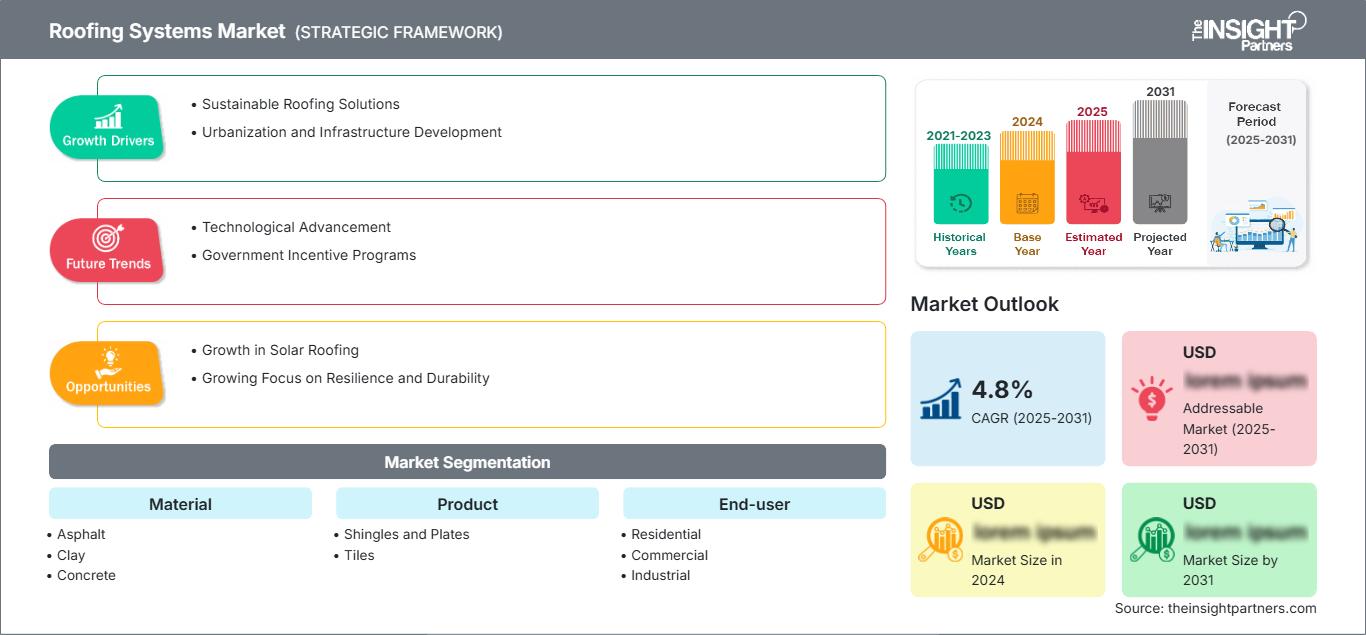
Roofing Systems Market: Strategic Insights
Regional Insights
North America roofing systems market
North America is estimated to hold 38–40% of the roofing systems market share in 2025 and expand at a 3.9–4.4% CAGR through 2034. The region is well-endowed with a substantial stock of built housing, repeat reroofing business, commercial renovations, weathering, and tough material standards. The United States is the primary market, whereas Canada is contributing through its renovation and cold environment requirements. Mexico is adding further demand via urban construction and industrialization.
The supply infrastructure in the region consists of established companies that manufacture, distribute, contract, and source materials. Growing demand includes impact resistance, reflective surface, insulative properties, and durability. Commercial buildings, logistics centers, health care buildings, and data centers are adding more demands for superior assemblies. Investments by leading companies are boosting local manufacturing and reducing supply chains.
U.S. roofing systems Market
The U.S. represents approximately 66–68% of North American roofing systems market share in 2025 and is projected to grow at a 3.8–4.3% CAGR. Residential reroofing is still very important, whereas commercial building drives the need for durable low-slope and metal roofs. Owens Corning, Johns Manville, Carlisle Companies Incorporated, Atlas Roofing Corporation, and Saint-Gobain all stay relevant in their respective markets.
The applicability of the roof depends largely on the climatic conditions, the type of building, and regulatory requirements. Products resistant to storms and with reflection are in demand in southern states, whereas durability, insulation, and moisture control are in high demand in colder states. There is an increasing need for roofing systems due to data centers, warehouses, hospitals, and manufacturing sites.
Europe roofing systems Market
Europe is estimated at 19–21% share of the roofing systems market in 2025, with a 3.5–4.1% CAGR through 2034. Germany leads in this market segment, followed by the United Kingdom, France, Italy, and Spain. The demand for renovation, efficient building design, and aged buildings fuels the replacement market, and material choices are becoming more and more focused on thermal efficiency and sustainability.
In the UK, the market drivers are housing shortages, renovation needs, and energy-efficient designs. In Germany, building refurbishments and durable roof assemblies drive the market. In France, it is a combination of renovations and new constructions along with energy-efficient designs. In Italy and Spain, tiles continue to be popular due to their architectural preferences and climate conditions, whereas metal roofs are growing in popularity for commercial buildings.
APAC roofing systems Market
APAC is estimated at 29–31% share of the roofing systems market in 2025 and is expected to expand at a 5.0–5.8% CAGR, making it the fastest-growing major region. China remains the leading market, while India, Japan, South Korea, and Australia provide distinct construction and replacement opportunities.
Industrialization, urban housing, infrastructure development, and public construction support regional demand. India is particularly attractive for incremental volume growth, with its roofing materials market projected at a 5.6% CAGR through 2033. China provides scale, Japan emphasizes renovation and resilience, South Korea supports advanced construction, and Australia favors durable systems suited to demanding climatic conditions.
Middle East & Africa roofing systems Market
Middle East and Africa roofing systems market demand is smaller but structurally supported by infrastructure development, housing construction, tourism projects, and industrial facilities. Saudi Arabia and the UAE lead regional activity, while South Africa provides an established construction base. The broader MEA market is projected to grow at approximately 3.8–4.5% CAGR through 2034.
Saudi Arabia benefits from large-scale urban and infrastructure programs, while the UAE supports commercial, hospitality, and mixed-use construction. South Africa generates replacement and industrial demand, and the rest of MEA remains project-driven. High temperatures increase the importance of reflective, durable, and moisture-resistant products, creating opportunities for systems that combine thermal performance with long service life.
Segmentation Analysis
Material
According to the Roofing Systems Market, material selection determines cost, durability, climate suitability, installation requirements, and lifecycle performance. The segment is expected to expand at a 3.9–4.6% CAGR from 2026–2034, with asphalt retaining broad residential relevance while metal gains strategic importance because of durability, recyclability, and compatibility with energy-efficient building designs.
- Asphalt: Asphalt remains a major residential roofing material because of installation familiarity, broad distribution, competitive pricing, and compatibility with established contractor practices, particularly across North America.
- Clay: Clay supports premium and traditional construction where architectural appearance, fire resistance, longevity, and climatic suitability justify higher material and installation costs.
- Concrete: Concrete products serve residential and commercial applications where durability, thermal mass, and design flexibility are prioritized, particularly in markets with established tile manufacturing capabilities.
- Metal: Metal roofing is strategically important for long service life, weather resistance, recyclability, and lightweight construction, supporting adoption across residential, commercial, and industrial buildings.
- Wood: Wood remains concentrated in architectural and premium applications where natural appearance is valued, although maintenance requirements and regional fire considerations constrain broader adoption.
- Others: Alternative materials address specialized climatic, architectural, and industrial requirements, allowing manufacturers to serve applications where conventional materials face performance or design limitations.
Product
According to the Roofing Systems Market, product demand reflects roof geometry, installation practices, aesthetic preferences, and structural requirements. The segment is forecast to expand at a 4.0–4.7% CAGR from 2026–2034, with shingles and plates retaining scale while tiles remain important across established regional construction traditions.
- Shingles and Plates: Shingles and plates provide standardized installation, broad design choice, and efficient replacement, making them particularly important for residential construction and reroofing markets with mature contractor networks.
- Tiles: Tiles remain significant in regions favoring concrete and clay products, offering durability, thermal properties, architectural variety, and established compatibility with pitched-roof construction.
End-user
End-user demand is expected to grow at a 4.0–4.7% CAGR from 2026–2034. Residential applications remain the largest demand pool, while commercial and industrial facilities increasingly require high-performance roofing assemblies, energy efficiency, weather resistance, and longer replacement cycles.
- Residential: Residential demand is supported by new housing, renovation, reroofing, storm replacement, and homeowner preference for durable products with predictable maintenance requirements.
- Commercial: Commercial projects increasingly specify systems supporting energy efficiency, drainage performance, fire protection, durability, and rapid installation across offices, warehouses, healthcare facilities, and retail buildings.
- Industrial: Industrial facilities prioritize mechanical durability, weather resistance, low maintenance, and compatibility with large roof areas, making performance consistency important for manufacturing and logistics properties.
Opportunity Snapshot
| End-User | Revenue Contribution (High/Medium/Low) | Trend Tag | Adoption Stage |
| Residential | High | Reroofing | Mature |
| Commercial | Medium | Cool Roofs | Scaling |
| Industrial | Medium | Durable Systems | Scaling |
Roofing Systems Market Growth Drivers and Impact Analysis
Reroofing and Aging Building Stock
Residential and commercial buildings that age necessitate the creation of repeat replacement needs that are not contingent on any new construction projects. In mature markets, roofing systems become due for replacement as a result of degradation of materials, storm damage, water penetration and changing expectations for energy performance. This repeat need ensures that production is consistent even when the number of housing units being built drops. Premiumization is further encouraged since consumers are beginning to judge roofing systems based on their expected lifespan, warranty protection, ease of maintenance and speed of installations, among other factors, besides their purchase prices. Repeat roofings provide the distributors and installers with repeat business opportunities and market insight into local needs. This makes it easier for manufacturers to utilize installed base information in planning for capacity, stock and installer programs in regions. This effect is especially important in North America and Europe.
Climate Resilience and Energy-Efficient Construction
Risks related to extremely hot weather, heavy rains, storm activity, exposure to wildfires, and others, which are associated with climate change, create an increased focus on the durability of the roof and overall building envelope performance. It results in the shift toward impact-resistant, reflective, insulated, corrosion-resistant, and water-management systems. Cool roofs help to decrease the heat gain, whereas reflective coatings and appropriate insulation assemblies contribute to building performance. In particular, the commercial industry is sensitive to this matter due to the significant roof surfaces, which can impact cooling needs and operating expenses. Insurance aspects are another factor motivating resilient building constructions in risky areas. Therefore, manufacturers work on solutions that provide weather resistance along with sustainability and an extended life cycle. The effects of this trend go beyond just materials sales since the manufacturers can benefit from underlayments, insulation, ventilation, coatings, accessories, and technical services.
Urbanization and Commercial Construction Investment
Expansion of urban areas is giving rise to a need for houses, logistics buildings, manufacturing plants, healthcare buildings, retail properties, schools, and infrastructures. In large projects, roofs should be available in consistent supplies, fast installations, and long operational lives. The region of Asia Pacific plays a significant role since urbanization and investments in industries are increasing the potential construction market, whereas North America and Europe are producing renovation and refurbishing demand. Data centers and logistics buildings give an additional reason since the owners focus on reliability, waterproofing, insulation, and timely installation. For the manufacturers, these projects provide preference to standard solutions, regional production capacities, technical specifications, and solid networks of distributors. Such an opportunity will not be only related to larger amounts of materials. Companies that can take part in the specification process at the early stage will have the ability to specify materials, get approval status for products, and receive repeat orders for multi-site development programs.
Roofing Systems Market Future Trends
Digitalized Roof Design and Predictive Maintenance
The use of digital technology will become even more prevalent when considering roof assessment, specifying materials for roofing projects, installation planning, and maintenance. The use of drone photography, satellite imagery, digital twin technology, thermal imaging, and inspection using artificial intelligence may help improve the detection of areas that require repair and replacement. The connection between inspection reports and manufacturers' and contractors' product databases and warranty and maintenance plans may become more prevalent. It may result in the appearance of novel business models involving condition monitoring and not manual inspection of roofs. Digital estimating may also reduce material waste through improved measurements and planning of projects. Centralized roof management software may help manage capital expenditures for commercial buildings more efficiently. Suppliers that are capable of integrating physical products with digital solutions and data analysis can help retain customers and gain insights into product development and regional demand.
Low-Carbon and Circular Roofing Systems
It is anticipated that environmental considerations will affect material formulation, energy use in manufacturing, percentage of recycled materials, transport, and recovery at the end of its life cycle. Recycling of asphalt shingles, recyclable metals, low-carbon concrete, and designing longer-lasting products will help minimize the impact of materials on the environment. It is likely that building owners will ask for an environmental product declaration and traceability of materials during the purchasing process. The circular economy will also help minimize reliance on landfills since recovered materials from reroofing can be brought back into the manufacturing stream whenever possible. It means that manufacturers will have the motivation to change products, but not affect their weather-resistance, fire-retardant qualities, warranties, or ease of installation. Collaboration among manufacturers, distributors, contractors, recyclers, and municipalities will probably play an important role, since recovery is economically viable based on collection intensity and segregation of materials.
Roofing Systems Market Opportunities
Expansion of Premium Resilient Roofing Solutions
Premium resilience systems offer the chance to maximize value through replacement and renovation. Suppliers can create package solutions that incorporate impact resistance, reflectivity, corrosion resistance, compatibility with insulation, drainage, ventilation, and long-term warranties. These systems would be applicable in regions susceptible to hurricanes, hailstorms, wildfires, heavy rainfall, or high temperatures. This is even more the case where property owners consider the total cost of ownership instead of the initial cost of the materials. Manufacturers can create regional versions of these products that meet specific requirements, while sharing common manufacturing processes. The commercialization process can also be enhanced through distributor training and installer certification, thus minimizing installation issues. Accordingly, strategic investments should focus on product testing, regional technical support, and specifications from architects, engineers, insurance companies, developers, and large property owners.
Integrated Roofing and Solar-Ready Building Envelopes
Roof surfaces increasingly represent an underused space for distributed energy generation and building-performance improvements. Manufacturers can capture opportunity by designing roofing assemblies that accommodate photovoltaic installations, reflective surfaces, insulation, drainage, and maintenance access without compromising waterproofing or structural performance. Solar-ready roofing can be particularly relevant for commercial warehouses, industrial facilities, retail buildings, and institutional properties with substantial roof area. Suppliers can collaborate with solar developers and building-envelope specialists to establish compatible mounting, flashing, warranty, and maintenance standards. The opportunity extends beyond new construction because existing commercial roofs can be assessed for structural and remaining-life suitability before solar installation. Product development should therefore focus on integrated system compatibility, installation sequencing, and lifecycle documentation. This approach can expand the addressable value per project while aligning roofing procurement with broader energy-management strategies.
Frequently Asked Questions

- Comprehensive Market Sizing and Forecast Analysis
- Detailed Segmentation Analysis
- In-Depth Market Dynamics Assessment
- Regional and Country-Level Insights
- Competitive Landscape and Company Benchmarking
- Strategic Business Intelligence
Recent Reports
Testimonials

The Insight Partners provided valuable market intelligence that supported our global go-to-market strategy. Their team was professional, responsive, and attentive to our feedback, providing thoughtful analysis and helpful methodological clarifications throughout the project.
Junmo Kim Chief Financial Officer (CFO), Enertech Co., Ltd.
The Insight Partners' SCADA System Market report is comprehensive, with valuable insights on current trends and future forecasts. The team was highly professional, responsive, and supportive throughout. We are very satisfied and highly recommend their services.
RAN KEDEM Partner, Reali Technologies LTDs
I requested a report on a very specific software market and the team produced the report in a few days. The information was very relevant and well presented. I then requested some changes and additions to the report. The team was again very responsive and I got the final report in less than a week.
JEAN-HERVE JENN Chairman, Future Analytica
We worked with The Insight Partners for an important market study and forecast. They gave us clear insights into opportunities and risks, which helped shape our plans. Their research was easy to use and based on solid data. It helped us make smart, confident decisions. We highly recommend them.
PIYUSH NAGPAL Sr. Vice President, High Beam Global
The Insight Partners delivered insightful, well-structured market research with strong domain expertise. Their team was professional and responsive throughout. The user-friendly website made accessing industry reports seamless. We highly recommend them for reliable, high-quality research services
YUKIHIKO ADACHI CEO, Deep Blue, LLC.
This is the first time I have purchased a market report from The Insight Partners.While I was unsure at first, I visited their web site and felt more comfortable to take the risk and purchase a market report.I am completely satisfied with the quality of the report and customer service. I had several questions and comments with the initial report, but after a couple of dialogs over email with their analyst I believe I have a report that I can use as input to our strategic planning process.Thank you so much for taking the extra time and making this a positive experience.I will definitely recommend your service to others and you will be my first call when we need further market data.
JOHN SUZUKI President and Chief Executive Officer, Board Director, BK Technologies
I wish to appreciate your support and the professionalism you displayed in the course of attending to my request for information regarding to infectious disease IVD market in Nigeria. I appreciate your patience, your guidance, and the fact that you were willing to offer a discount, which eventually made it possible for us to close a deal. I look forward to engaging The Insight Partners in the future, all thanks to the impression you have created in me as a result of this first encounter.
DR CHIJIOKE ONYIA MANAGING DIRECTOR, PineCrest Healthcare Ltd.Reason to Buy
- Informed Decision-Making
- Understanding Market Dynamics
- Competitive Analysis
- Identifying Emerging Markets
- Customer Insights
- Market Forecasts
- Risk Mitigation
- Boosting Operational Efficiency
- Strategic Planning
- Investment Justification
- Tracking Industry Innovations
- Aligning with Regulatory Trends





 Get Free Sample for