
Rotary Tiller Market Research Report by Size Share Analysis 2034
Coverage: By Shape (L-shape, C-shape, J-shape, Straight Knife Blade); End-Use (Agriculture, Gardening, Commercial, Others) , and Geography (North America, Europe, Asia Pacific, and South and Central America)
- Status : Data Released
- Report Code : TIPRE00021345
- Category : Manufacturing and Construction
- No. of Pages : 150
- Available Report Formats :


- Last update date : October 26, 2026


2025 Market Size
US$ 2.68 Bn
Base year value
2034 Forecast
US$ 3.97 Bn
Projected by 2034
CAGR 2026-2034
4.10 %
Growth rate
Addressable Market
US$ 29.65 Bn
(2026-2034)
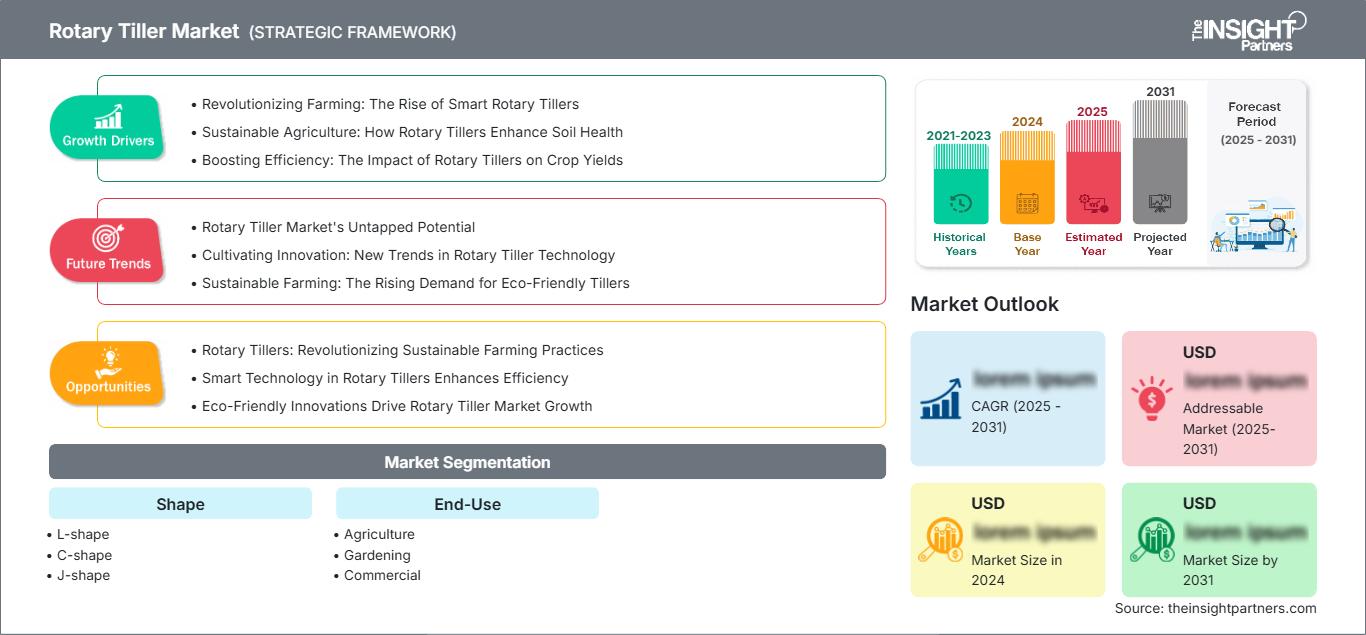
The rotary tiller market was valued at US$ 2.68 Billion in 2025 and is projected to reach US$ 3.97 Billion by 2034, expanding at a CAGR of 4.10% during 2026–2034. Demand is supported by mechanized soil preparation, replacement of manual cultivation practices, and wider use of tractor-mounted implements across agriculture, gardening, and commercial land maintenance. Product development increasingly emphasizes operating efficiency, adaptable working widths, durable blades, and compatibility with compact and utility tractors.
North America represents a mature but steadily expanding opportunity, supported by mechanized farming, commercial landscaping, specialty crop production, and replacement demand for tractor implements. Increasing adoption of compact tractors among small farms, municipalities, landscapers, and property owners is broadening the addressable customer base. Equipment standardization, dealer availability, and demand for implements that can perform multiple soil-preparation tasks are also supporting replacement and upgrade cycles. These factors continue to reinforce market expansion across the region, contributing to the overall Rotary Tiller Market size.
Rotary Tiller Market Assessment and Insights
- North America: The region is expected to hold a 20–24% share in 2025 and expand at a 3.2–4.0% CAGR between 2026–2034, supported by commercial landscaping, compact tractors, specialty farming, and established equipment distribution networks.
- US: The US is estimated to represent 76–81% of North American demand in 2025, growing at a 3.1–3.9% CAGR between 2026–2034, with agriculture and landscaping providing the principal demand base.
- Europe: Europe is estimated at a 18–22% share in 2025 and is projected to grow at a 3.5–4.3% CAGR between 2026–2034, led by Germany, Italy, France, the UK, and Spain.
- Asia Pacific: Asia Pacific is estimated to account for a 42–47% share in 2025, expanding at a 4.6–5.5% CAGR between 2026–2034, with China, India, Japan, South Korea, and Australia forming important demand centers.
- Largest Segment: Agriculture is expected to command a 58–63% market share in 2025 and grow at a 3.8–4.5% CAGR between 2026–2034, reflecting recurring soil-preparation requirements.
- High Growth Segment: Commercial applications are estimated at a 13–18% share in 2025 and are projected to register a 4.8–5.7% CAGR between 2026–2034, supported by landscaping and land-management applications.
- Key companies analyzed in detail: Bobcat Company, Caroni S.p.A., Deere & Company, Del Morino S.r.l., HOWSE Implement, Kubota Agricultural Machinery India Pvt. Ltd., Land Pride, Tarter Farm and Ranch Equipment, Wessex International, and Woods Equipment Company.
Source: The Insight Partners' analysis based on proprietary research, government publications, company annual reports, investor presentations, industry databases, and expert interviews.
The technology base has progressed from basic mechanical-driven soil preparation tools towards more advanced tools that provide improved depth regulation, quick hitch adaptability, interchangeable blades, and custom designs. Increasingly, product differentiation is based on tractor adaptability and blade design. The reverse rotation designs are expected to benefit from deeper soil penetration and residue burial capabilities, while forward rotation products benefit from versatility and efficient seedbed preparation.
Future growth in the forecast period is expected due to increasing adoption in developing countries, where the mechanization of agriculture is a major priority. Dealer financing, government farm mechanization initiatives, tractor miniaturization, and horticultural modernization will all aid equipment sales. Manufacturers are also likely to prioritize modular designs, easier attachment systems, longer component life, and compatibility with increasingly connected tractors as customers seek greater productivity from existing equipment fleets, according to the Rotary Tiller Market report.
Rotary Tiller Market Report Scope
| Report Attribute | Details |
|---|---|
| Market size in 2025 | US$ 2.68 Billion |
| Market Size by 2034 | US$ 3.97 Billion |
| Global CAGR (2026 - 2034) | 4.10% |
| Historical Data | 2021-2024 |
| Forecast period | 2026-2034 |
Rotary Tiller Market Analysis
Demand is closely connected to tractor ownership, farm size, crop intensity, soil conditions, and the frequency of land preparation. The value chain includes steel and component suppliers, gearbox and driveline manufacturers, implement producers, tractor OEMs, distributors, dealers, rental operators, and end users. Supply remains relatively fragmented because regional customers require different working widths, hitch categories, blade configurations, and power requirements.
The rotary tiller market growth is therefore influenced by both agricultural mechanization and non-agricultural applications. Manufacturers with broad dealer networks can serve replacement demand efficiently, while specialized producers compete through blade design, durability, compact dimensions, and application-specific configurations. The supply chain resilience for this product category depends upon the availability of steel, production capability, gearboxes, bearings, and spare parts. Standardizing the products within tractor classifications would make procurement easier and more efficient for dealers. Competition for this product category relies not upon a particular technological factor but rather a range of factors, including implement durability, compatibility with the tractor, depth of operation, width of operation, maintenance needs, and dealership support. Deere & Company, Kubota Agricultural Machinery India Pvt. Ltd., Land Pride, Bobcat Company, Woods Equipment Company, and Tarter Farm and Ranch Equipment leverage existing agricultural or equipment ecosystems, whereas Caroni S.p.A., Del Morino S.r.l., HOWSE Implement, and Wessex International increase competition through specialized implements. Continued emphasis on product reliability, service networks, and implement versatility is expected to shape market competition, according to the Rotary Tiller Market forecast.
Investment priorities are increasingly moving toward manufacturing automation, component reliability, attachment systems, digital compatibility, and aftermarket support. Deere & Company is also extending autonomy into tillage applications, illustrating how implement manufacturers may increasingly need compatibility with precision and autonomous tractor platforms. The rotary tiller market analysis consequently points toward gradual convergence between conventional mechanical implements and digitally enabled agricultural equipment ecosystems.
● REPORT CUSTOMIZATION
Tailor This Report To Align With Your Specific Business Requirements
This report can be customized to align precisely with your business objectives, scope, and target markets. Customization options include tailored segmentation, geography, competitive analysis, and strategic insights to support informed decision-making.
Customize This Report →WHAT YOU CAN ADJUST
- ● Segmentations
- ● Geography
- ● Competitive Analysis
- ● Language Preferences
Rotary Tiller Market: Strategic Insights
Regional Insights
North America Rotary Tiller Market
North America is estimated to represent a 20–24% share in 2025, with the regional market projected to expand at a 3.2–4.0% CAGR through 2034. The US will continue to be the primary market, backed by commercial agriculture, horticulture, landscaping, and gardening. Small and utility tractors widen the pool of buyers away from larger farms, and existing dealer networks help in replacements and parts supply.
The demand is also affected by farm economics and machinery replacement cycles. During times when farm economics become difficult, customers may delay purchases of new machinery and run existing equipment for longer time periods, making reparability and spare parts a key concern. Commercial landscaping is a good diversification opportunity for demand, especially for small attachments that can prepare planting beds and handle small plots of land.
U.S. Rotary Tiller Market
The U.S. is estimated to account for 76–81% of North American demand in 2025, with growth of approximately 3.1–3.9% through 2034. The demand covers row crop requirements, special agriculture, nurseries, landscaping, food plots, and grounds keeping. The manufacturers have the advantages of a seasoned tractor fleet and dealer network.
There is an ongoing trend of the preference for implements that can be used with compact tractors and loaders. The commercial users appreciate easy installation, consistent depth, interchangeable tines, and reliability, whereas the agricultural community prefers good soil preparation and efficiency of the fields. There is a range of products supplied by Deere & Company, Bobcat Company, Land Pride, Woods Equipment Company and others.
Europe Rotary Tiller Market
Europe is estimated to hold an 18–22% share of the Rotary Tiller Market in 2025 and is expected to grow at a 3.5–4.3% CAGR through 2034. Germany and Italy remain important equipment markets and manufacturing centers, while the UK, France, and Spain contribute substantial demand through agriculture, horticulture, vineyards, landscaping, and specialty cultivation.
The UK’s market demands include demand from commercial agriculture, grounds maintenance, horticulture, and rural estates. The buyers’ priorities include implementing reliability, tractor compatibility, maneuverability, and servicing. Wessex International competes together with other European producers with the help of their special attachments and local distribution network. The demand comes from professional land management and replacement needs for existing tractors.
In Germany, the high demand for agricultural machinery is provided by the big agricultural machinery ecosystem and demand from commercial agriculture, horticulture, and landscaping companies. The buyers’ priorities include high engineering qualities of the product, operational efficiency, safety standards compliance, and service support. Both producers and distributors profit from established mechanization traditions, whereas replacements depend on the age of machines and usage intensity.
France, Italy, and Spain provide additional demand through specialty crops, vineyards, orchards, vegetable cultivation, and commercial landscaping. Italy is particularly relevant because companies such as Caroni S.p.A. and Del Morino S.r.l. operate within a strong agricultural implement manufacturing environment. Southern European demand also reflects the need for compact machinery capable of operating efficiently in fragmented or specialized agricultural plots.
APAC Rotary Tiller Market
Asia Pacific is estimated to command a 42–47% of the Rotary Tiller Market share in 2025 and is projected to expand at a 4.6–5.5% CAGR through 2034. China and India form major demand centers, supported by farm mechanization, horticulture, and diverse smallholder operating conditions. Japan and South Korea favor compact, efficient equipment, while Australia supports agricultural and land-maintenance applications. Policy support for mechanization and rising labor costs reinforce adoption.
Middle East & Africa Rotary Tiller Market
The Middle East and Africa Rotary Tiller Market demand is projected to expand at a 3.8–4.7% CAGR through 2034, with Saudi Arabia, the UAE, and South Africa representing important markets. Mechanized farming, irrigation-linked cultivation, landscaping, and infrastructure development influence equipment requirements. Saudi Arabia and the UAE emphasize productive land management and landscaping, while South Africa provides a broader agricultural equipment base.
Segmentation Analysis
Shape
The rotary tiller market scope by shape is influenced by soil hardness, operating depth, horsepower availability, residue handling, and desired soil pulverization. Blade geometry determines cutting action, power consumption, and field finish. C-shaped and L-shaped configurations are widely suited to different soil-preparation requirements, while straight and J-shaped designs serve specific operating preferences.
- L-shape: L-shaped blades provide a balanced cutting profile and are suited to routine soil preparation across agriculture, gardening, and landscaping. Their straightforward geometry supports maintenance and replacement.
- C-shape: C-shaped blades are valued for reduced power requirements and smoother soil engagement. They are particularly relevant to compact tractors and applications where efficient power utilization is important.
- J-shape: J-shaped blades provide a distinct cutting geometry for specialized soil conditions and operating requirements. Their adoption is supported when users prioritize particular tillage characteristics and machine compatibility.
- Straight Knife Blade: Straight knife blades support direct soil cutting and are used where simple, robust blade construction is preferred. Replacement convenience and predictable operation influence purchasing decisions.
End-Use
End-use diversification remains central to the rotary tiller market because the same mechanical platform can serve agricultural soil preparation, gardening, and commercial land-management applications. Agriculture remains the dominant use case, while commercial and gardening applications provide incremental demand and reduce dependence on crop-sector investment cycles.
- Agriculture: Agriculture represents the principal demand base because tillers prepare seedbeds, incorporate organic matter, and break compacted soil. Recurring cultivation cycles and mechanization support sustained implement utilization.
- Gardening: Gardening applications favor compact tillers that can operate around beds, small plots, landscaping areas, and nurseries. Ease of attachment, maneuverability, and operating depth are important purchasing considerations.
- Commercial: Commercial users include landscapers, grounds-maintenance operators, nurseries, and property managers. They prioritize uptime, productivity, attachment flexibility, and equipment durability across repeated professional workloads.
Opportunity Snapshot
| End-Use | Revenue Contribution | Trend Tag | Adoption Stage |
| Agriculture | High | Seedbed Preparation | Mature |
| Gardening | Medium | Compact Tillage | Scaling |
| Commercial | Medium | Landscape Tillage | Scaling |
Rotary Tiller Market Growth Drivers and Impact Analysis
Rising Agricultural Mechanization and Labor Constraints
Agricultural mechanization remains a fundamental demand driver because tillage is repetitive, time-sensitive, and physically intensive. Labor shortages increase the economic value of implements capable of completing soil preparation within narrow cultivation windows. Compact tractors paired with rotary tillers allow smaller farms, horticultural operators, and specialty growers to reduce dependence on manual preparation while improving consistency. Mechanization programs in developing agricultural economies can further accelerate adoption by improving access to tractors and compatible implements. In mature markets, replacement demand is reinforced by requirements for higher utilization and lower downtime. Manufacturers, therefore, have an opportunity to design implements around easier attachment, longer-wearing blades, simplified servicing, and compatibility with multiple tractor categories. These attributes can improve total operating economics and support purchasing decisions even when agricultural capital expenditure remains constrained. These developments are among the key Rotary Tiller Market trends shaping industry growth and product innovation during the forecast period.
Expansion of Horticulture, Landscaping, and Specialty Cultivation
Growth in horticulture, nursery operations, landscaping, and commercial grounds management is expanding the addressable customer base beyond conventional farms. These users frequently operate on smaller plots where maneuverability, working width, soil finish, and attachment flexibility are more important than maximum field throughput. Rotary tillers can prepare planting beds, incorporate compost, break compacted soil, and support recurring landscaping activities. The commercial segment therefore, creates a useful diversification opportunity for manufacturers facing cyclicality in agricultural equipment demand. Compact tractors and skid-steer platforms further increase applicability because operators can deploy the same power unit across multiple attachments. Manufacturers that provide different working widths, hitch configurations, blade options, and replacement components can serve multiple customer profiles without fundamentally changing the core product architecture.
Increasing Compatibility with Precision and Autonomous Tractors
Agricultural equipment is increasingly becoming part of connected machinery ecosystems, creating a longer-term driver for implement compatibility with precision guidance, machine control, and autonomous operation. Tillage is particularly relevant because it involves repetitive passes that can be standardized and monitored. Autonomous tractor developments demonstrate that equipment manufacturers are moving toward systems where tractor, implement, positioning technology, cameras, and farm-management software operate as an integrated workflow. For tiller suppliers, this creates requirements around consistent operating behavior, predictable implement response, and compatibility with digitally controlled tractor systems. Although autonomous tillage remains more relevant to advanced equipment segments than the broader market, its influence can progressively affect product design standards. Manufacturers able to anticipate digital integration requirements may strengthen their positioning as tractor platforms become more connected.
Rotary Tiller Market Future Trends
Shift Toward Modular and Multi-Application Implements
Future development of products is expected to favor the concept of modularity, whereby a single implement platform could be used on tractors of various categories, different types of soils and end use. The ability to have interchangeable blade settings, variable working widths, quick hitch systems and attachment capability could help in simplifying the ownership of implements for individuals who are handling multiple operations. Modularity would be useful for owners of compact tractors, landscapers, nurseries, and small farms whose need to justify the cost of implements needs to be met. In the future, manufacturers might develop families of products using similar gearboxes and driveshaft configurations while making changes in the cutter and frame assembly.
Greater Integration of Data-Enabled Tillage Operations
"Connected agriculture is going to impact the tillage equipment through monitoring of machines, diagnostic of implements, data gathering and automated field documentation." The modern tractors equipped with the necessary data tools are capable of gathering information about the machinery and fields, which allows the potential implementation of visibility of implements within the digital farm management processes. Future tillers will be equipped with some sensors or electronic interfaces that will provide information about the operation status of the machine, maintenance needs, operational conditions, attachments, etc. Initially, adoption is likely to be limited to technology-oriented commercial farms due to the high costs of hardware and integration but increasing standardization of tractor connectivity is expected to mitigate those concerns.
Rotary Tiller Market Opportunities
Localized Manufacturing and Dealer Expansion in Emerging Markets
There is an emerging market for agricultural products where manufacturers have the option of combining suitable product specifications with localized distribution and services. There is diversity in farm structure in India, China, Southeast Asia, and some African countries, where small-sized machines and implements could be used in order to overcome issues related to labor shortage and small landholdings. Localized assembly or sourcing of parts would help to lower logistics costs and meet the needs of the region better. The dealer network is just as important, as the customer needs demoing, installation, spare parts, and servicing. The manufacturer may tailor product families based on different categories of tractor horsepower, soil type, and major crops grown in the area.
Premium Attachments for Commercial Land Management
Professional landscapes, nurseries, sports field preparations, and institutional land maintenance provide a market for high-end rotary tiller machines focused on uptime and productive operations by operators. Professional buyers are more likely to prioritize factors like easy attachment, tough drivetrain parts, depth of work achieved, and less maintenance rather than cost considerations as compared to small users. Equipment manufacturers can react to this by providing reinforced frames, well-designed blades, quick hitch fittings, and maintenance plans. Combining tillers with compact tractors or other equipment can help increase equipment usage and cross-selling. Rental operations constitute another possible route since sturdy attachments can be used in various settings and by several clients. As commercial buyers look for equipment that is versatile enough to handle various tasks, implement manufacturers with a large range of attachments can benefit from their customer loyalty.
Frequently Asked Questions

- Comprehensive Market Sizing and Forecast Analysis
- Detailed Segmentation Analysis
- In-Depth Market Dynamics Assessment
- Regional and Country-Level Insights
- Competitive Landscape and Company Benchmarking
- Strategic Business Intelligence
Recent Reports
Testimonials

The Insight Partners provided valuable market intelligence that supported our global go-to-market strategy. Their team was professional, responsive, and attentive to our feedback, providing thoughtful analysis and helpful methodological clarifications throughout the project.
Junmo Kim Chief Financial Officer (CFO), Enertech Co., Ltd.
The Insight Partners' SCADA System Market report is comprehensive, with valuable insights on current trends and future forecasts. The team was highly professional, responsive, and supportive throughout. We are very satisfied and highly recommend their services.
RAN KEDEM Partner, Reali Technologies LTDs
I requested a report on a very specific software market and the team produced the report in a few days. The information was very relevant and well presented. I then requested some changes and additions to the report. The team was again very responsive and I got the final report in less than a week.
JEAN-HERVE JENN Chairman, Future Analytica
We worked with The Insight Partners for an important market study and forecast. They gave us clear insights into opportunities and risks, which helped shape our plans. Their research was easy to use and based on solid data. It helped us make smart, confident decisions. We highly recommend them.
PIYUSH NAGPAL Sr. Vice President, High Beam Global
The Insight Partners delivered insightful, well-structured market research with strong domain expertise. Their team was professional and responsive throughout. The user-friendly website made accessing industry reports seamless. We highly recommend them for reliable, high-quality research services
YUKIHIKO ADACHI CEO, Deep Blue, LLC.
This is the first time I have purchased a market report from The Insight Partners.While I was unsure at first, I visited their web site and felt more comfortable to take the risk and purchase a market report.I am completely satisfied with the quality of the report and customer service. I had several questions and comments with the initial report, but after a couple of dialogs over email with their analyst I believe I have a report that I can use as input to our strategic planning process.Thank you so much for taking the extra time and making this a positive experience.I will definitely recommend your service to others and you will be my first call when we need further market data.
JOHN SUZUKI President and Chief Executive Officer, Board Director, BK Technologies
I wish to appreciate your support and the professionalism you displayed in the course of attending to my request for information regarding to infectious disease IVD market in Nigeria. I appreciate your patience, your guidance, and the fact that you were willing to offer a discount, which eventually made it possible for us to close a deal. I look forward to engaging The Insight Partners in the future, all thanks to the impression you have created in me as a result of this first encounter.
DR CHIJIOKE ONYIA MANAGING DIRECTOR, PineCrest Healthcare Ltd.Reason to Buy
- Informed Decision-Making
- Understanding Market Dynamics
- Competitive Analysis
- Identifying Emerging Markets
- Customer Insights
- Market Forecasts
- Risk Mitigation
- Boosting Operational Efficiency
- Strategic Planning
- Investment Justification
- Tracking Industry Innovations
- Aligning with Regulatory Trends





 Get Free Sample for