
Rubber Testing Equipment Market Growth, Size & Forecast by 2034
Coverage: By Type of Testing (Tensile and Compression Testing, Hardness Testing, Density Testing, Viscosity Testing, Flex Testing, Others); Application (Tires and Automotive Parts, General Rubber Goods, Industrial Rubber Products, Others) , and Geography (North America, Europe, Asia Pacific, and South and Central America)
- Status : Data Released
- Report Code : TIPRE00018434
- Category : Manufacturing and Construction
- No. of Pages : 150
- Available Report Formats :


- Last update date : September 21, 2026


2025 Market Size
US$ 15.99 Bn
Base year value
2034 Forecast
US$ 23.24 Bn
Projected by 2034
CAGR 2026-2034
4.24 %
Growth rate
Addressable Market
US$ 178.14 Bn
(2026-2034)
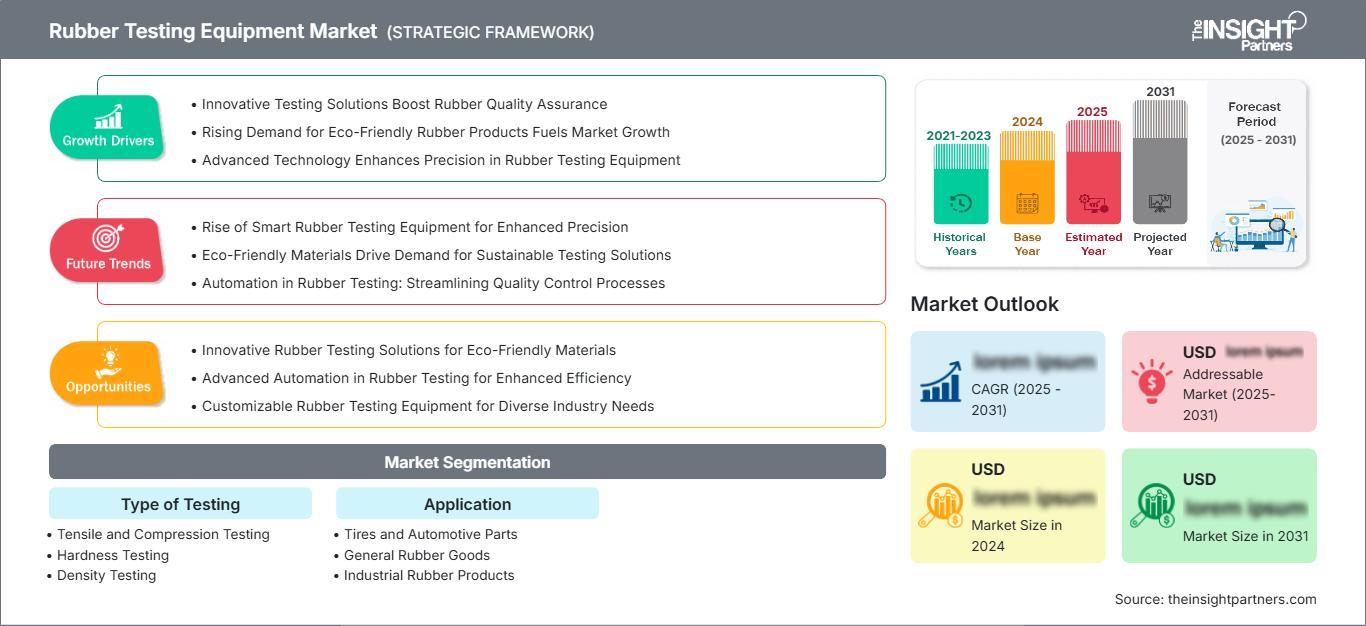
The rubber testing equipment market is projected to expand from US$ 15.99 Billion in 2025 to US$ 23.24 Billion by 2034, registering a CAGR of 4.24% during 2026–2034. The market encompasses equipment used to evaluate mechanical, physical, rheological, and durability characteristics of rubber compounds and finished products. Demand is closely linked with quality assurance, formulation development, tire manufacturing, industrial components, and increasingly stringent requirements for repeatable material performance.
North America is expected to maintain steady expansion, with the rubber testing equipment market size supported by replacement demand, laboratory modernization, and continued testing requirements across automotive, aerospace, medical, and industrial rubber applications. The region is estimated to register a CAGR of 3.5–4.3% during 2026–2034. Automation, traceable measurement, and increasing emphasis on material qualification are expected to sustain equipment investment across established testing laboratories and manufacturing facilities.
Rubber Testing Equipment Market Assessment and Insights
- North America: North America is projected to account for a 22–26% share in 2025 and expand at a CAGR of 3.5–4.3% between 2026–2034, supported by established testing laboratories, automotive applications, equipment replacement, and quality-control requirements.
- US: The US is expected to represent 72–76% of North America's 2025 demand, with growth of 3.6–4.4% during 2026–2034, supported by automotive, aerospace, and advanced materials testing.
- Europe: Europe is estimated to hold a 23–27% share in 2025 and grow at 3.2–4.0% through 2034, with Germany, France, Italy, and the UK providing substantial demand through automotive and industrial manufacturing.
- Asia Pacific: Asia Pacific is estimated at a 34–39% share in 2025 and is expected to grow at 4.8–5.7%, led by China, Japan, South Korea, and India as tire and rubber production capacity expands.
- Largest Segment: Tires and Automotive Parts is estimated at a 29–34% market share in 2025, growing at 4.5–5.3% through 2034 as performance validation becomes increasingly important.
- High Growth Segment: Flex Testing is estimated at a 13–17% share in 2025 and is projected to grow at 5.0–5.8%, reflecting greater durability and fatigue characterization requirements.
- Key companies analyzed in detail: Alpha Technologies, Ektron Tek Co., Ltd., Gibitre Instruments S.r.l., Gotech Testing Machines Inc., GÖTTFERT Werkstoff-Prüfmaschinen GmbH, TTFERT Material Testing Machines GmbH, J.T.M Technology Co., Ltd., MonTech Werkstoffprüfmaschinen GmbH, Prescott Instruments Ltd, TA Instruments, U-CAN DYNATEX INC.
Source: The Insight Partners' analysis based on proprietary research, government publications, company annual reports, investor presentations, industry databases, and expert interviews.
The rubber testing equipment market has evolved from predominantly standalone mechanical measurement toward integrated systems combining automated sample handling, digital acquisition, software-based analysis, and standardized test protocols. Laboratories in today’s environment need repeatable results in hardness, tensile, compression, viscosity, and dynamic testing. In response to this challenge, equipment manufacturers are paying more attention to quick processes, calibration traceability, automated reporting, and connectivity, all while keeping compatibility with ISO, ASTM, DIN, and JIS standards.
In the forecast period, investment is expected to shift from likely to go beyond just equipment, with more emphasis being made on connected laboratories and high-throughput testing systems. New manufacturing hubs in South and Southeast Asia will create further demand for laboratory equipment, as the quality systems of local manufacturers improve. Testing will be affected by sustainability demands, as recycled and biogenic materials can have different properties from their traditional counterparts.
Rubber Testing Equipment Market Report Scope
| Report Attribute | Details |
|---|---|
| Market size in 2025 | US$ 15.99 Billion |
| Market Size by 2034 | US$ 23.24 Billion |
| Global CAGR (2026 - 2034) | 4.24% |
| Historical Data | 2021-2024 |
| Forecast period | 2026-2034 |
Rubber Testing Equipment Market Analysis
The rubber testing equipment market growth is closely connected with the value chain extending from polymer suppliers and compounders to tire manufacturers, molded-product producers, laboratories, and certification functions. Demand exists due to the need to measure incoming materials, to optimize formulations, to control processing conditions, and to characterize product properties. The equipment suppliers compete in terms of measurement precision, software capabilities, calibration services, expertise in applications, and conformity with accepted standards.
Automobile and tire manufacturers are important customers since rubber compounds need to perform reliably in cycles of mechanical, thermal, and environmental stress. Similarly, industrial rubber manufacturers need tests for seals, hoses, anti-vibration parts, belts, and moldings. From the supply side, there are differentiated offerings from instrument manufacturers specializing in mechanical testers, rheometers, hardness testers, viscometers, density testers, and fatigue equipment.
The rubber testing equipment market analysis indicates a fragmented competitive structure with specialist instrument manufacturers competing alongside diversified materials-testing companies. Alpha Technologies and TA Instruments have strong positions in rheology and compound characterization, while MonTech, Gibitre Instruments, GÖTTFERT Werkstoff-Prüfmaschinen GmbH, and U-CAN DYNATEX INC. offer specialized rubber-testing portfolios. Ektron Tek, Gotech Testing Machines, J.T.M Technology, Prescott Instruments, and TTFERT Material Testing Machines GmbH strengthen competition across mechanical and laboratory testing applications.
Strategic positioning increasingly depends on application knowledge rather than hardware alone. Manufacturers are investing in automated test sequences, software integration, remote service, calibration capabilities, and instruments designed for evolving formulations. Partnerships with laboratories, universities, and compound developers can strengthen application credibility. The Rubber Testing Equipment Market report highlights growing emphasis on faster rheological measurements, fatigue characterization, digital workflows, and testing methods capable of connecting laboratory measurements with production decisions.
● REPORT CUSTOMIZATION
Tailor This Report To Align With Your Specific Business Requirements
This report can be customized to align precisely with your business objectives, scope, and target markets. Customization options include tailored segmentation, geography, competitive analysis, and strategic insights to support informed decision-making.
Customize This Report →WHAT YOU CAN ADJUST
- ● Segmentations
- ● Geography
- ● Competitive Analysis
- ● Language Preferences
Rubber Testing Equipment Market: Strategic Insights
Regional Insights
North America rubber testing equipment market
North America is expected to hold a 22–26% of the rubber testing equipment market share in 2025 and expand at a CAGR of 3.5–4.3% through 2034. The US remains the principal demand center, supported by tire manufacturing, aerospace components, medical products, industrial seals, and advanced polymer research. Canada contributes through automotive, industrial, and materials-testing activities, while Mexico benefits from manufacturing integration with the broader North American automotive supply chain.
Regional purchasing is influenced by laboratory modernization and requirements for repeatable measurement across multiple rubber characteristics. Manufacturers increasingly prioritize automated workflows, software-enabled reporting, calibration traceability, and compatibility with ASTM and ISO procedures. Replacement demand provides stability in mature laboratories, while new installations are linked to electric-vehicle components, advanced elastomers, and higher-performance industrial products. The regional CAGR is expected to remain within the 3.5–4.3% range.
U.S. rubber testing equipment Market
The U.S. is estimated to represent 72–76% of North America's 2025 rubber testing equipment market demand and is projected to grow at a CAGR of 3.6–4.4% through 2034. Its demand base spans tire producers, aerospace suppliers, medical-device manufacturers, industrial rubber processors, research institutions, and independent testing laboratories. Equipment suppliers, including Alpha Technologies, TA Instruments, and Prescott Instruments, maintain relevant capabilities across specialized testing categories.
Application demand is shifting toward automated characterization and higher test reproducibility. Tire and automotive laboratories require mechanical, rheological, fatigue, and durability measurements, while aerospace and medical applications emphasize controlled procedures and documented results. The US market also benefits from a mature installed base that generates recurring calibration, maintenance, software, and replacement requirements. These factors should support consistent capital expenditure despite the relatively mature industrial environment.
Europe rubber testing equipment Market
Europe is estimated to command a 23–27% share of the rubber testing equipment market in 2025 and grow at a CAGR of 3.2–4.0%, with Germany leading regional demand. The market is supported by automotive engineering, industrial rubber production, sustainability initiatives, and strong laboratory infrastructure. Germany remains particularly important because of its concentration of automotive manufacturers, suppliers, materials laboratories, and testing-technology specialists.
The UK maintains demand through aerospace, automotive, advanced materials, and independent laboratory testing, with emphasis on precise characterization and compliance. Germany combines large automotive and industrial manufacturing bases with specialized testing equipment suppliers and research institutions. France, Italy, and Spain contribute through automotive components, tire-related applications, industrial goods, and engineered rubber products. Across these markets, replacement cycles and digital laboratory upgrades remain important purchasing considerations.
APAC rubber testing equipment Market
APAC is projected to represent 34–39% of 2025 rubber testing equipment market demand and grow at 4.8–5.7% through 2034, making it the leading regional market. China remains the largest contributor, followed by Japan, South Korea, India, and Australia. Expanding tire capacity, industrialization, export-oriented manufacturing, and local quality-control investments support equipment demand.
China's large rubber-processing base provides the strongest regional demand, while Japan and South Korea emphasize advanced automotive and materials applications. India is strengthening its domestic tire and industrial manufacturing capacity, whereas Australia supports specialized laboratory requirements. Industrial modernization, product-quality initiatives, and greater adoption of international testing practices are expected to reinforce the region's leading position.
Middle East & Africa rubber testing equipment Market
The Middle East and Africa rubber testing equipment market demand is expected to expand at approximately 3.0–3.8% through 2034. Saudi Arabia and the UAE are important Middle Eastern markets because industrial diversification and infrastructure investment are expanding demand for engineered materials and quality-control capabilities. South Africa remains the principal African testing center, supported by automotive and industrial manufacturing.
The Rest of MEA presents smaller but emerging opportunities in construction materials, transportation components, oil and gas applications, and industrial products. Energy-sector diversification and infrastructure programs can increase demand for durable seals, hoses, gaskets, and elastomeric components. Procurement is generally influenced by equipment reliability, service availability, calibration support, and compatibility with internationally recognized testing procedures.
Segmentation Analysis
Type of Testing
The type of testing segment covers multiple analytical requirements, ranging from fundamental mechanical properties to processing behavior and durability. The segment is expected to grow at a CAGR of 4.0–4.8% during 2026–2034. Demand is shaped by laboratories seeking broader characterization from fewer instruments, higher automation, standardized procedures, and reliable data for formulation and production decisions.
- Tensile and Compression Testing: Widely used for determining strength, elongation, modulus, and compression behavior, these systems remain fundamental for the qualification of rubber components, finished goods, and compound formulations.
- Hardness Testing: Hardness systems provide rapid production and laboratory checks for elastomer consistency, making them important for incoming-material inspection, process control, and finished-product verification.
- Density Testing: Density measurement supports compound formulation and material consistency by identifying variation in filler, polymer, and additive content across production batches.
- Viscosity Testing: Viscosity testing helps characterize processing behavior and compound consistency, supporting formulation optimization and reducing variation before molding, extrusion, or vulcanization.
- Flex Testing: Flex testing evaluates resistance to repeated deformation and fatigue, supporting durability assessment for products exposed to cyclic bending, vibration, and service stresses.
Application
The application segment is expected to expand at a CAGR of 4.2–5.0% during 2026–2034. Tires and automotive parts remain the dominant demand center because safety, durability, rolling performance, and component reliability require extensive characterization. General rubber goods and industrial products provide additional demand through seals, hoses, belts, vibration-control parts, and molded components.
- Tires and Automotive Parts: This application represents the largest equipment demand pool because tire compounds and automotive elastomers require extensive mechanical, rheological, fatigue, aging, and durability characterization.
- General Rubber Goods: Seals, gaskets, consumer products, medical components, and molded goods require repeatable testing to maintain dimensional stability, elasticity, hardness, and service performance.
- Industrial Rubber Products: Hoses, belts, vibration isolators, engineered seals, and other industrial components depend on testing that validates performance under mechanical, thermal, chemical, and cyclic operating conditions.
Opportunity Snapshot
| Application | Revenue Contribution (High/Medium/Low) | Trend Tag | Adoption Stage |
| Tires and Automotive Parts | High | EV Validation | Mature |
| General Rubber Goods | Medium | Material Compliance | Scaling |
| Industrial Rubber Products | Medium | Fatigue Testing | Scaling |
Rubber Testing Equipment Market Growth Drivers and Impact Analysis
Rising Quality Requirements for Rubber Components
The rise in product quality demands has spurred an increase in laboratory and manufacturing testing for manufacturers. In order for rubber components used in tires, cars, industrial machines, medical supplies, and construction sites to function well in tough environments, certain characteristics should be maintained. Through testing apparatus, manufacturers will be able to find any changes in hardness, tensile strength, compression, viscosity, density, and fatigue without problems being experienced by the consumers. In business, the effects of testing are especially important when material failure could bring about warranty costs, production downtime, recalls, and negative publicity. Standardized tests also make communications between compounders and rubber component manufacturers easier through acceptance standards that have been established.
Expansion of Automotive and Tire Testing Requirements
The growth of automotive applications is making rubber compound qualification increasingly complex as these components are supposed to meet new demands in terms of durability, efficiency, heat resistance, vibration management, and electric vehicle operations. Tire makers are also required to assess the compounds in various mechanical and environmental conditions prior to the commercialization of these tires. This situation creates a need for equipment that can combine repeatability with faster throughput. The effect goes beyond major tire makers since there is a need for supplier component providers to prove their compliance with customer standards and quality practices. Therefore, test equipment makers will have an opportunity to meet the demand from new labs as well as existing ones that are undergoing upgrades.
Growth of Automated and Digitally Connected Laboratories
There is a trend towards automation of laboratories, where the manual manipulation of machines is being replaced by automated processes to increase the uniformity of tests and data. The automated handling of samples, programming of tests, electronic documentation, software for calculations, and centralized storage of data can decrease test time and ensure better tracking of tests. For producers who deal with many substances or production lots, such features can help to decrease the burden of routine tasks and enable technical staff to concentrate on analysis and optimization of the process. As a result of these developments, there will be a shift in commercial criteria from specifications of hardware to the overall productivity of the process.
Rubber Testing Equipment Market Future Trends
Integrated Multi-Property Characterization
The rubber testing equipment market trends are expected to move toward integrated characterization platforms that connect several measurements within a common laboratory workflow. Rather than considering such properties separately, in the form of disparate datasets, there will likely be more efforts to analyze these properties together so that the effects of formulation on processing and performance can be assessed. Software will become even more important as a tool for method organization, instrument control, comparison of historical results, and the production of standardized reports. In particular, this trend will be especially pertinent to tire and auto labs where the cycles of formulations require quick analysis of various candidate compounds. Instrument companies might start competing with each other not only on their separate measurement capabilities but also on their interoperability and data architecture.
Testing for Recycled and Advanced Rubber Formulations
Characterization difficulties related to the use of recycled, biologically-derived and performance-optimized elastomer formulations will become increasingly relevant in future demand as well. These formulations tend to exhibit higher variability in terms of fillers' dispersion, molecular structure, contaminations and processability than the formulations traditionally used. Therefore, testing methods should be made more sensitive and repeatable to differentiate between acceptable variability and material defects. Some manufacturers might develop application-specific testing protocols using a combination of rheological, mechanical, aging and fatigue data to create a fuller picture of the material's performance. Testing laboratories will have to ensure higher traceability since the sustainability claims will increasingly depend on the consistent performance of materials. This trend may lead to a higher demand for more advanced analytical equipment despite low growth in general rubber production.
Rubber Testing Equipment Market Opportunities
Expansion of Local Testing Capacity in Emerging Manufacturing Hubs
The rubber testing equipment market forecasts point toward opportunities for suppliers that establish stronger service and application support in emerging manufacturing centers. Industrial and automotive needs are increasing in India, Southeast Asia, and some Latin American countries, which means the need for calibration, maintenance, training, and support closer to the region. A local infrastructure could help decrease machine downtime, as well as solve an important issue during purchase decisions related to specialized laboratory instrumentation. At the same time, suppliers may create applications specifically designed for regional tire, automotive parts, industrial rubber, and other goods production industries. All of that could be achieved by establishing strategic distribution, technical collaboration, and regional laboratories, which would not require considerable fixed costs on behalf of the supplier. It means that this opportunity is broader than just the sale of equipment.
Specialized Solutions for High-Performance Elastomers
Another avenue worth exploring is the equipment intended to analyze advanced elastomers, which have found usage in such sectors as mobility, energy, aerospace, medicine, and industry. The analysis of these advanced materials should be much more sophisticated due to the fact that their performance depends heavily on parameters such as temperature, frequency, deformation, fatigue, and processing. The suppliers can concentrate on labs working on the development of such compounds, which will demonstrate higher durability, lower energy losses, higher thermal stability, or unique chemical resistance. Such equipment can be distinguished by special fixtures, a higher range of measurements, automated conditioning and software correlating different parameters. It can also rely on collaboration with compound developers and laboratories.
Frequently Asked Questions

- Comprehensive Market Sizing and Forecast Analysis
- Detailed Segmentation Analysis
- In-Depth Market Dynamics Assessment
- Regional and Country-Level Insights
- Competitive Landscape and Company Benchmarking
- Strategic Business Intelligence
Recent Reports
Testimonials

The Insight Partners' SCADA System Market report is comprehensive, with valuable insights on current trends and future forecasts. The team was highly professional, responsive, and supportive throughout. We are very satisfied and highly recommend their services.
RAN KEDEM Partner, Reali Technologies LTDs
I requested a report on a very specific software market and the team produced the report in a few days. The information was very relevant and well presented. I then requested some changes and additions to the report. The team was again very responsive and I got the final report in less than a week.
JEAN-HERVE JENN Chairman, Future Analytica
We worked with The Insight Partners for an important market study and forecast. They gave us clear insights into opportunities and risks, which helped shape our plans. Their research was easy to use and based on solid data. It helped us make smart, confident decisions. We highly recommend them.
PIYUSH NAGPAL Sr. Vice President, High Beam Global
The Insight Partners delivered insightful, well-structured market research with strong domain expertise. Their team was professional and responsive throughout. The user-friendly website made accessing industry reports seamless. We highly recommend them for reliable, high-quality research services
YUKIHIKO ADACHI CEO, Deep Blue, LLC.
This is the first time I have purchased a market report from The Insight Partners.While I was unsure at first, I visited their web site and felt more comfortable to take the risk and purchase a market report.I am completely satisfied with the quality of the report and customer service. I had several questions and comments with the initial report, but after a couple of dialogs over email with their analyst I believe I have a report that I can use as input to our strategic planning process.Thank you so much for taking the extra time and making this a positive experience.I will definitely recommend your service to others and you will be my first call when we need further market data.
JOHN SUZUKI President and Chief Executive Officer, Board Director, BK Technologies
I wish to appreciate your support and the professionalism you displayed in the course of attending to my request for information regarding to infectious disease IVD market in Nigeria. I appreciate your patience, your guidance, and the fact that you were willing to offer a discount, which eventually made it possible for us to close a deal. I look forward to engaging The Insight Partners in the future, all thanks to the impression you have created in me as a result of this first encounter.
DR CHIJIOKE ONYIA MANAGING DIRECTOR, PineCrest Healthcare Ltd.Reason to Buy
- Informed Decision-Making
- Understanding Market Dynamics
- Competitive Analysis
- Identifying Emerging Markets
- Customer Insights
- Market Forecasts
- Risk Mitigation
- Boosting Operational Efficiency
- Strategic Planning
- Investment Justification
- Tracking Industry Innovations
- Aligning with Regulatory Trends





 Get Free Sample for